Best Starting Island for Base Building in Windrose (2026 Strategy Guide)
If there’s one mistake almost every new captain makes in Windrose, it’s rushing to build a permanent base on the first “pretty” island they find. I did exactly that during my first week in the 2026 version of the game. The beach looked perfect, the water was calm, and I thought I had discovered paradise. Ten hours later I realized my Brigantine couldn’t even dock there properly, half my storage was constantly getting smashed by boars, and every iron run turned into a 20-minute sailing simulator.
After hundreds of in-game days, several wipes, and way too much time experimenting with the current meta, I can confidently say this: your starting island decides how smooth the rest of your progression feels.
A good island saves time.
A bad island wastes dozens of hours.
This guide isn’t about “official rankings” or fake theorycrafting. It’s the kind of advice you hear from experienced players sitting around a harbor campfire after surviving the late game. If you want a base that actually feels efficient, safe, and enjoyable to live in, these are the island types worth hunting for.
Why Base Location Matters More in Windrose 2026
The 2026 updates changed the entire rhythm of progression in Windrose. Before Patch 1.2, players could get away with building almost anywhere and simply brute-forcing logistics later. That no longer works.
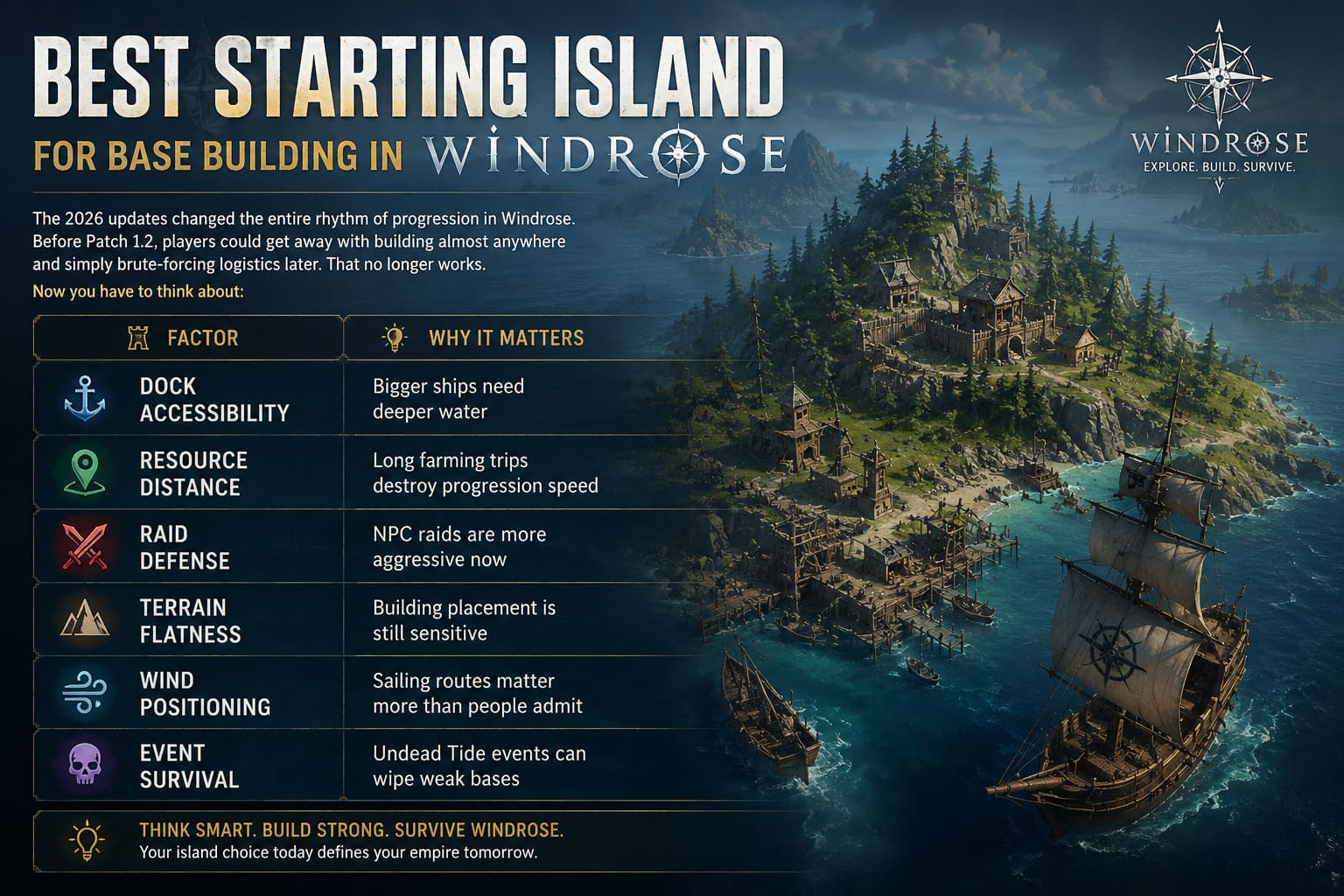
Now you have to think about:
| Factor | Why It Matters |
|---|---|
| Dock Accessibility | Bigger ships need deeper water |
| Resource Distance | Long farming trips destroy progression speed |
| Raid Defense | NPC raids are more aggressive now |
| Terrain Flatness | Building placement is still sensitive |
| Wind Positioning | Sailing routes matter more than people admit |
| Event Survival | Undead Tide events can wipe weak bases |
The strongest players aren’t necessarily the best fighters anymore. Usually, they’re the people who chose smart locations early.
1. Crescent Islands — Still the Best Overall Choice
If I had to recommend only one island type to a new player, it would easily be the classic Crescent-shaped island.
You know the one immediately when you see it: two rocky arms forming a curved bay with a narrow entrance toward the sea. In practice, it’s basically a natural fortress.
What makes these islands so good is how much work the terrain does for you.
Instead of defending an entire coastline, you defend one opening.
That changes everything.
During late-game raid events, especially when rogue pirate NPCs arrive with artillery rafts, funneling enemies into a single entry point becomes ridiculously valuable. A few upgraded cannons and defensive spikes can stop attacks that would otherwise flatten an open shoreline base.
Another underrated advantage is ship safety. The new Rogue Wave mechanic punishes players who leave vessels exposed near open coasts. Crescent bays naturally protect docked ships from wave damage, which saves a ton of repair materials over time.
Why players love Crescent islands
- Natural harbor protection
- Easy cannon placement
- Great for medium and large ships
- Usually rich in early-game resources
- Excellent expansion potential
Personally, this is the only island type where my base consistently survived without needing constant repairs.
Windrose Brigantine vs Sloop: Which Is Best for Solo Players in 2026?
2. Biome Border Islands Are Insanely Efficient
This is probably the most “meta” strategy in Windrose right now.
Biome-border islands sit where two environmental regions collide. Usually it’s something like tropical coastline merging into jungle foothills or rocky forest terrain.
At first glance, these islands don’t look special.
But the efficiency is absurd.
Instead of sailing between islands for different resources, you can gather nearly everything within walking distance. Fiber near the beach, hardwood inland, copper close to cliffs, iron further uphill — all in one compact area.
The difference becomes massive around the mid-game.
Most players hit a progression wall around Levels 15–25 because crafting requirements suddenly explode. Ships need better materials, crafting stations demand refined metals, and advanced ammo becomes resource-hungry.
On a normal island, that means endless transport trips.
On a biome-border island, you just walk a few hundred meters.
The downside nobody mentions
These islands are dangerous early.
Predators from higher-tier biomes often patrol close to beginner zones, which means new players can accidentally settle beside creatures they aren’t ready to fight.
I learned that the hard way after building next to what looked like a harmless jungle slope. Turned out a Level 18 Razorcat spawn was hidden nearby. Every night became a horror movie.
Still, once you’re geared properly, biome-border islands become some of the best long-term locations in the game.
3. Plateau and “Twin Peaks” Islands Are Almost Impossible to Raid
Some players care more about safety than convenience.
If that’s your style, elevated islands are absolutely worth considering.
The community usually calls them “Twin Peaks” islands because of the two large elevated cliffs or mountain ridges dominating the center.
Honestly, these places feel unfair sometimes.
Enemy AI in Windrose still struggles with steep vertical pathing. If your base sits on a plateau with only one or two climbable routes, defending becomes dramatically easier.
I’ve seen players survive full Undead Tide assaults with little more than spike traps and basic muskets simply because enemies bottlenecked themselves on narrow slopes.
Major advantages of elevated bases
| Advantage | Result |
|---|---|
| High visibility | Spot ships from far away |
| Natural choke points | Easier defense |
| Reduced raid damage | Fewer exposed walls |
| Strong sniper positions | Excellent ranged combat |
| Safer storage areas | Harder for NPCs to reach loot |
The only real annoyance is logistics.
Hauling heavy ore uphill gets old very quickly unless you invest early into pulley systems or staircase networks. Some players underestimate how much time vertical travel adds.
Still, if your goal is survival above all else, plateau islands are elite-tier choices.
4. Lagoon Atolls Are Surprisingly Good for Builders
I used to think atoll islands were mostly cosmetic.
Turns out I was wrong.
These circular islands with central lagoons are some of the smoothest building experiences in Windrose. The terrain generation there is dramatically cleaner than on rocky islands, meaning fewer placement bugs and fewer moments where the game screams “Obstruction Detected” because of invisible pebbles.
That alone makes them appealing.
But there’s more.
The shallow inner lagoon creates a naturally protected water zone that’s perfect for:
- Fishing setups
- Water farms
- Small raft storage
- Decorative docks
- Safe beginner transport routes
Large warships usually can’t enter the lagoon itself, but honestly that becomes less important once you establish outer docks.
For players who enjoy creative base design, atolls are probably the most satisfying islands in the game right now.
And yes — they genuinely look incredible during sunset storms.
Windrose Ship Hull Reinforcement Guide: Best Materials and Upgrades 2026
Things I ALWAYS Check Before Claiming an Island
After rebuilding multiple bases, I started using a personal checklist before placing my Bonfire.
These five things matter more than people realize.
1. Fresh Water
No freshwater source = constant annoyance later.
Rain collectors help early, but late-game cooking and alchemy consume ridiculous amounts of water.
A pond or stream nearby saves massive time.
2. Deep Water Access
This one ruins so many bases.
Always test whether larger ships can approach your shoreline before fully committing.
I’ve seen beautiful bases become abandoned because Galleons kept getting stuck offshore.
3. Wind Routes
People ignore wind positioning constantly.
Bad wind alignment turns every trade run into frustration. If your island is permanently upwind from important hubs, traveling becomes miserable.
It sounds minor until you’ve done the same route 50 times.
4. Wildlife Spawn Zones
Never build directly beside aggressive animal spawns.
Even weak creatures become annoying when they repeatedly damage walls, kill livestock, or interrupt crafting.
Scout the island properly first.
5. Shrine Distance
Being close to a Wayfinder Shrine saves more resources than most players realize.
Fast travel costs add up fast during the late game.
A naturally convenient island often outperforms a “perfect” island in the middle of nowhere.
My Personal Favorite Base Type
After experimenting with almost every island generation type currently available, I still think the best overall balance comes from a medium-sized Crescent island with partial biome overlap.
That setup gives you:
- Strong natural defense
- Decent ship access
- Nearby resource diversity
- Efficient expansion space
- Easier long-term survival
It may not be the flashiest option, but it consistently performs well in every stage of the game.
And honestly, that’s what matters most in Windrose.
Because eventually every player learns the same lesson:
The best base isn’t the prettiest one.
It’s the one that makes the rest of the game easier.