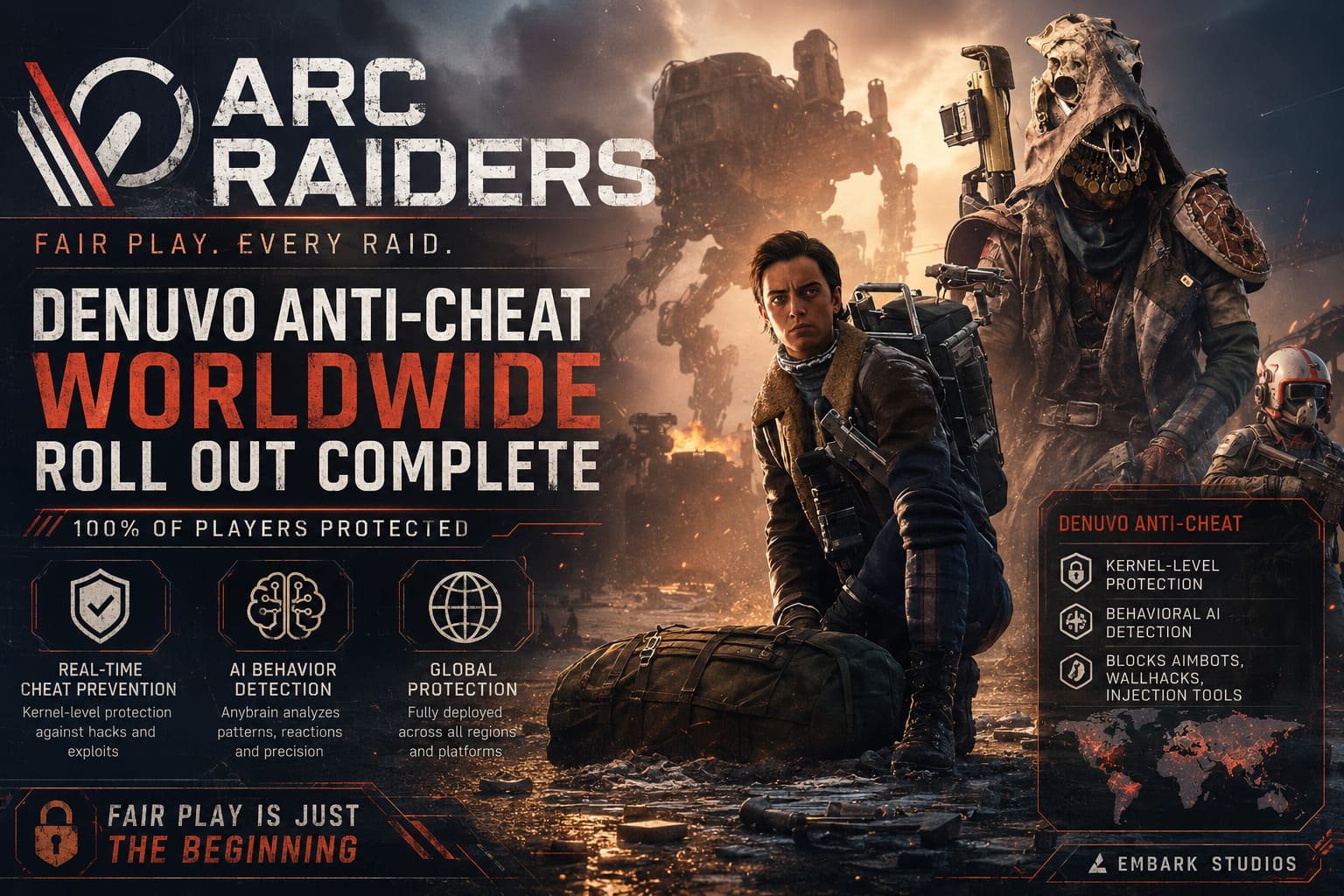
Arc Raiders Deploys Denuvo Anti-Cheat Worldwide: Why Embark Studios Says This Is Just the Beginning for Fair Play
The multiplayer gaming space has always felt like an ongoing warzone, not just inside the matches but behind the scenes as well. With the global rollout of Denuvo Anti-Cheat now fully completed for Arc Raiders, Embark Studios is clearly signaling that they are not interested in letting cheating define their game’s future. As someone who’s spent years bouncing between competitive shooters and extraction-style survival games, this move feels less like a surprise and more like an inevitable step in today’s gaming landscape.
What stands out most isn’t just the technical implementation itself, but the philosophy behind it. Embark isn’t treating anti-cheat as a checkbox feature. Instead, they’re building an entire ecosystem around fairness, even if that means dealing with controversy, privacy concerns, and community skepticism along the way.
Xbox Cancels Project Fantasy: Inside Microsoft’s Strategic Reset and IO Interactive Layoffs
A Full Global Rollout, Not a One-Time Fix
The rollout of Denuvo Anti-Cheat didn’t happen overnight. It started as a controlled experiment back in mid-May, slowly expanding through a phased deployment system introduced in Patch 1.29.0. At first, only a small slice of the player base had access to it, which allowed the developers to monitor system stability, performance impact, and compatibility issues.
By the end of June, that cautious approach ended. The system was pushed live globally, covering 100% of active players. According to Embark Studios, this wasn’t just a technical milestone—it was a stress test for their entire infrastructure.
What’s important here is that they didn’t just flip a switch and walk away. The studio is actively monitoring how the anti-cheat behaves in real-world conditions, which suggests that this is more of an evolving system than a finished product.
Why Anti-Cheat Matters So Much in Extraction Shooters
If you’ve played extraction shooters before, you already know how brutal cheating can be in this genre. Losing gear after a 30-minute tense raid is frustrating enough, but losing it to someone using a wallhack or aim assist script can completely kill motivation.
In games like Arc Raiders, the stakes are inherently high, and the gameplay loop makes fairness absolutely essential. One cheater can ruin an entire session for multiple players, especially when progression is tied directly to survival and loot extraction.
- High-risk, high-reward gameplay structure
- Persistent loss of gear after death
- Heavy reliance on fair PvP encounters
This is why Embark Studios is taking such a hard stance. Early community feedback from Reddit threads and forums already showed concerns about competitive integrity during testing phases. If left unchecked, cheating could easily damage the game before it even fully launches.
Denuvo Anti-Cheat vs DRM Confusion Problem
One of the biggest sources of backlash isn’t even the anti-cheat itself—it’s the name “Denuvo.” For years, gamers have associated Denuvo with DRM protection systems that were criticized for performance issues in single-player titles.
However, this is where things are often misunderstood. Denuvo Anti-Cheat is not the same system as Denuvo DRM. They operate independently and serve completely different purposes.
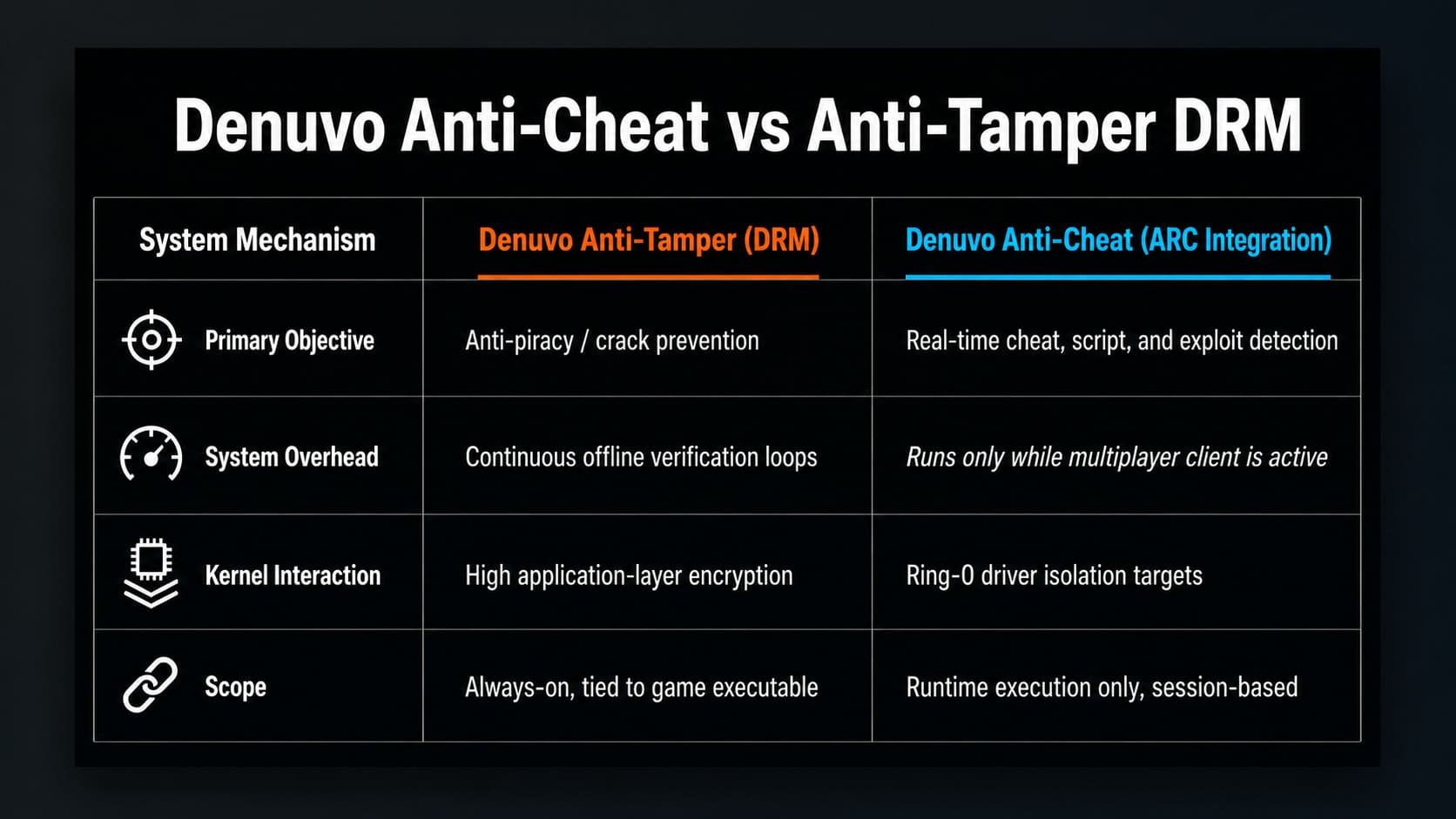
Key Differences Between Systems
| Feature | Denuvo DRM | Denuvo Anti-Cheat |
|---|---|---|
| Main Purpose | Game license protection | Cheat detection and prevention |
| Target | Game files | Player behavior and memory |
| Impact Focus | Single-player performance | Multiplayer fairness |
| Method | Encryption and verification | Kernel-level monitoring |
Embark Studios has repeatedly clarified that Arc Raiders does not include DRM-based performance throttling. Instead, the anti-cheat system focuses on real-time exploit prevention such as injection tools, aimbots, and wallhacks.
Privacy Concerns and Kernel-Level Access
Now let’s talk about the part that makes even experienced PC players uneasy: kernel-level access. During rollout, many users noticed administrative prompts requesting elevated permissions to run the game client properly.
This is expected behavior for systems operating at kernel level, but it still raises understandable concerns. Kernel-level software sits deep within the operating system, meaning that if it were ever compromised, it could theoretically expose significant parts of a user’s system.
It’s a classic trade-off between security and control. Stronger anti-cheat protection requires deeper system access, but that also increases responsibility on the developer’s side to maintain trust and security.
Linux, Steam Deck, and Compatibility Improvements
Interestingly, one of the more positive outcomes of this rollout is improved compatibility with Linux-based systems and Steam Deck devices. Many players initially feared that anti-cheat integration would completely break Proton compatibility.
However, early testing suggests that Embark Studios has handled this more carefully than expected. Similar to their previous experience with The Finals, they appear to have implemented compatibility layers that allow Linux users to continue accessing the game.
While not perfect, this is still a significant step toward maintaining accessibility across platforms.
Beyond Denuvo: AI-Based Behavioral Detection
What makes Embark’s approach more interesting is that Denuvo Anti-Cheat is only one layer of a broader system. The studio is also integrating an AI-driven tool called Anybrain, which focuses on behavioral analysis rather than file scanning.
This system evaluates how players interact with the game in real time, tracking inputs and patterns such as reaction speed, aiming consistency, and movement precision.
- Reaction time analysis
- Input precision tracking
- Behavioral pattern recognition
The idea is simple: even if a cheat bypasses traditional detection, it still has to produce human-like behavior. If it doesn’t, the system can flag it as suspicious.

The Rise of Hardware-Based Cheats
The motivation behind these systems becomes clearer when you look at modern cheating tools. Today’s cheats are no longer simple scripts or modified files. Instead, they include advanced hardware solutions that operate outside the game entirely.
These include DMA devices, external AI systems, and capture-based manipulation tools that interact with gameplay through secondary hardware. Because they don’t modify game files directly, traditional anti-cheat methods struggle to detect them.
This is why layered defense systems are becoming essential in modern competitive gaming environments.
What Comes Next for Arc Raiders
Embark Studios has confirmed that this rollout is only the beginning. A detailed transparency blog is expected soon, outlining their long-term strategy for maintaining fair play across the entire ecosystem.
Future improvements are likely to include enhanced server authority systems, machine learning refinements, and deeper integration between reporting tools and automated detection systems.
Final Thoughts
From a player perspective, anti-cheat systems like this always come with tension. Nobody wants cheaters ruining matches, but at the same time, kernel-level access and deep system monitoring raise valid concerns about privacy and control.
Still, in today’s multiplayer landscape, especially in extraction shooters, strong anti-cheat systems are no longer optional. Without them, games often collapse under their own competitive imbalance.
Embark Studios is clearly betting on a future where fairness is enforced through layered security systems and continuous monitoring. Whether this approach succeeds will depend not only on the technology itself, but also on how transparently it evolves over time.
One thing is clear: Arc Raiders is not just launching as a game, but as a tightly controlled competitive ecosystem built around the idea of fair play.