Gothic 1 Remake Smithing Guide: How to Craft Swords for Free and Get Infinite Ore Early
There are very few RPGs that make you feel completely powerless during the first few hours quite like Gothic. You arrive in the Valley of Mines with nothing, everyone treats you like garbage, and even a random scavenger can send you back to the loading screen if you are careless. That brutal beginning is exactly why so many players fell in love with the original game, and thankfully, the Gothic 1 Remake keeps that same atmosphere alive.
What surprised me the most, however, was not the combat or the visual overhaul. It was the new smithing system. Instead of being a simple menu where you click a button and receive a sword, blacksmithing actually feels like a real profession. You work with the forge, shape hot metal, assemble weapon parts, and finish the blade by sharpening it. It is one of those mechanics that can easily become a side activity you spend hours on without realizing it.
And here’s the funny part: if you understand how the system works, you can almost completely remove the cost of crafting. With a bit of exploration, some well-timed “borrowing” of materials, and a few community-discovered tricks, you can build an impressive collection of swords without wasting your precious ore.
Why Smithing Is Worth Learning Early
A lot of players make the mistake of saving every Learning Point for combat skills or Strength. I understand the logic, but after experimenting with several playthroughs, I honestly think investing in smithing early is one of the smartest decisions you can make.
Here’s why:
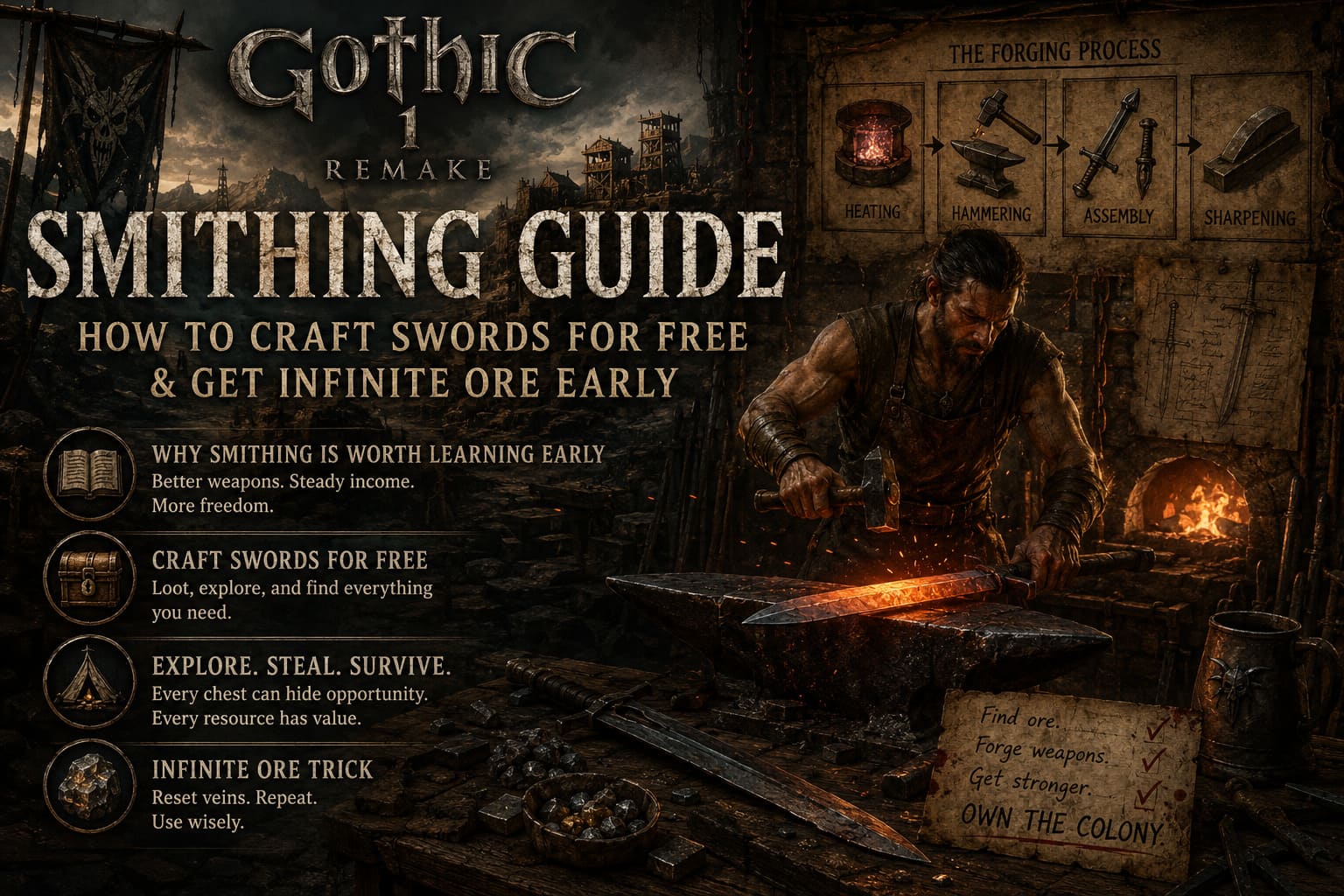
- You gain access to reliable weapon upgrades.
- Crafted swords can be sold for a decent amount of ore.
- You become less dependent on random loot drops.
- The system naturally pays for itself after a few successful crafts.
In a game where every ore nugget matters, having a way to create both weapons and income at the same time feels incredibly rewarding.
The New Crafting Process Feels Surprisingly Immersive
One thing I genuinely appreciate about the Remake is that the developers didn’t reduce blacksmithing to a boring mini-game. Instead, forging a weapon is split into several logical stages that make you feel like an actual craftsman.
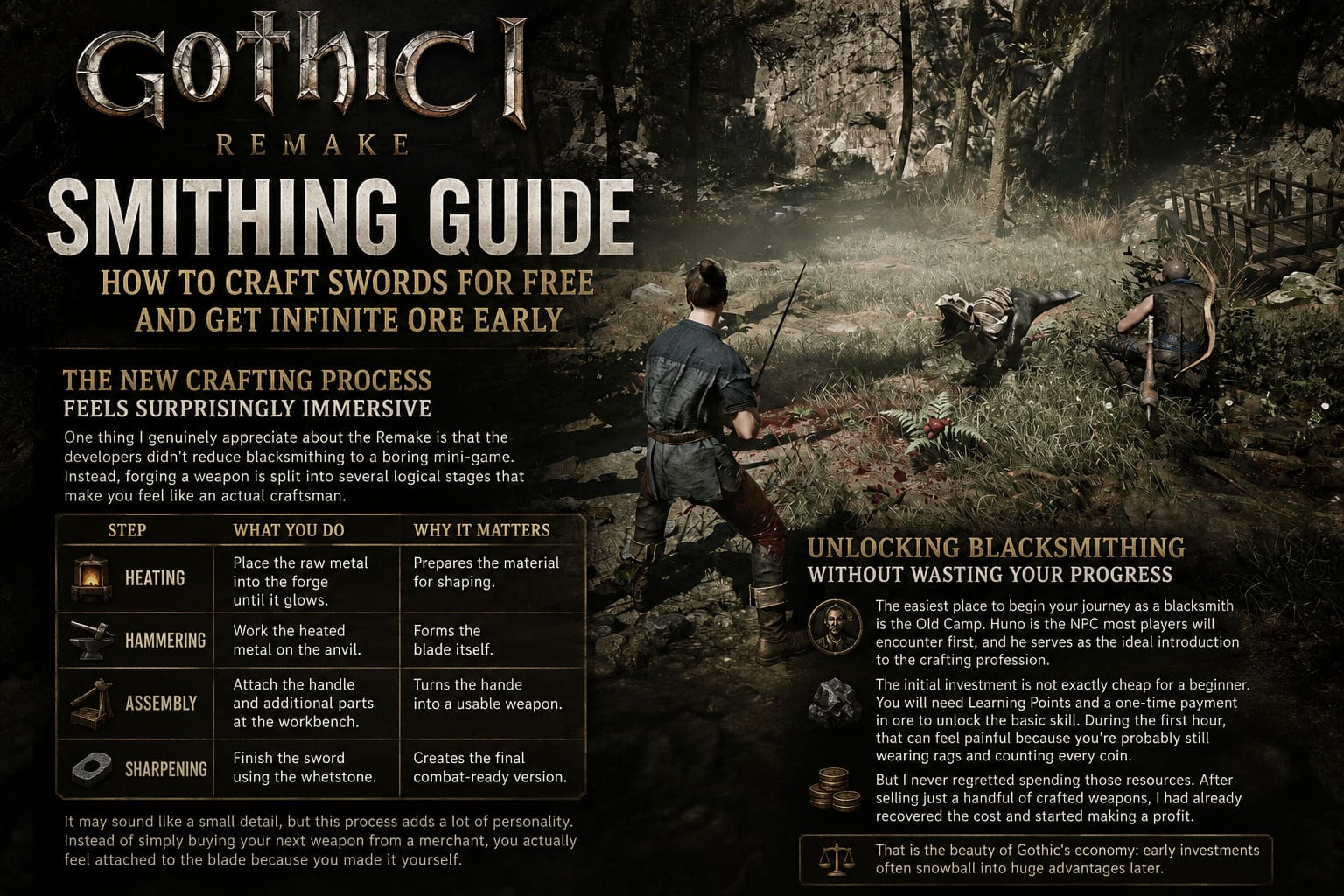
| Step | What You Do | Why It Matters |
|---|---|---|
| Heating | Place the raw metal into the forge until it glows. | Prepares the material for shaping. |
| Hammering | Work the heated metal on the anvil. | Forms the blade itself. |
| Assembly | Attach the handle and additional parts at the workbench. | Turns the blade into a usable weapon. |
| Sharpening | Finish the sword using the whetstone. | Creates the final combat-ready version. |
It may sound like a small detail, but this process adds a lot of personality. Instead of simply buying your next weapon from a merchant, you actually feel attached to the blade because you made it yourself.
Unlocking Blacksmithing Without Wasting Your Progress
The easiest place to begin your journey as a blacksmith is the Old Camp. Huno is the NPC most players will encounter first, and he serves as the ideal introduction to the crafting profession.
The initial investment is not exactly cheap for a beginner. You will need Learning Points and a one-time payment in ore to unlock the basic skill. During the first hour, that can feel painful because you’re probably still wearing rags and counting every coin.
But I never regretted spending those resources. After selling just a handful of crafted weapons, I had already recovered the cost and started making a profit.
That is the beauty of Gothic’s economy: early investments often snowball into huge advantages later.
The Best Way to Craft Swords for Free
Let’s be honest for a second. Nobody survives in the Colony by playing fair.
The world of Gothic practically encourages you to search every chest, inspect every abandoned hut, and “relocate” anything that isn’t nailed down. If you want to reduce crafting costs to almost zero, exploration is far more important than grinding monsters.
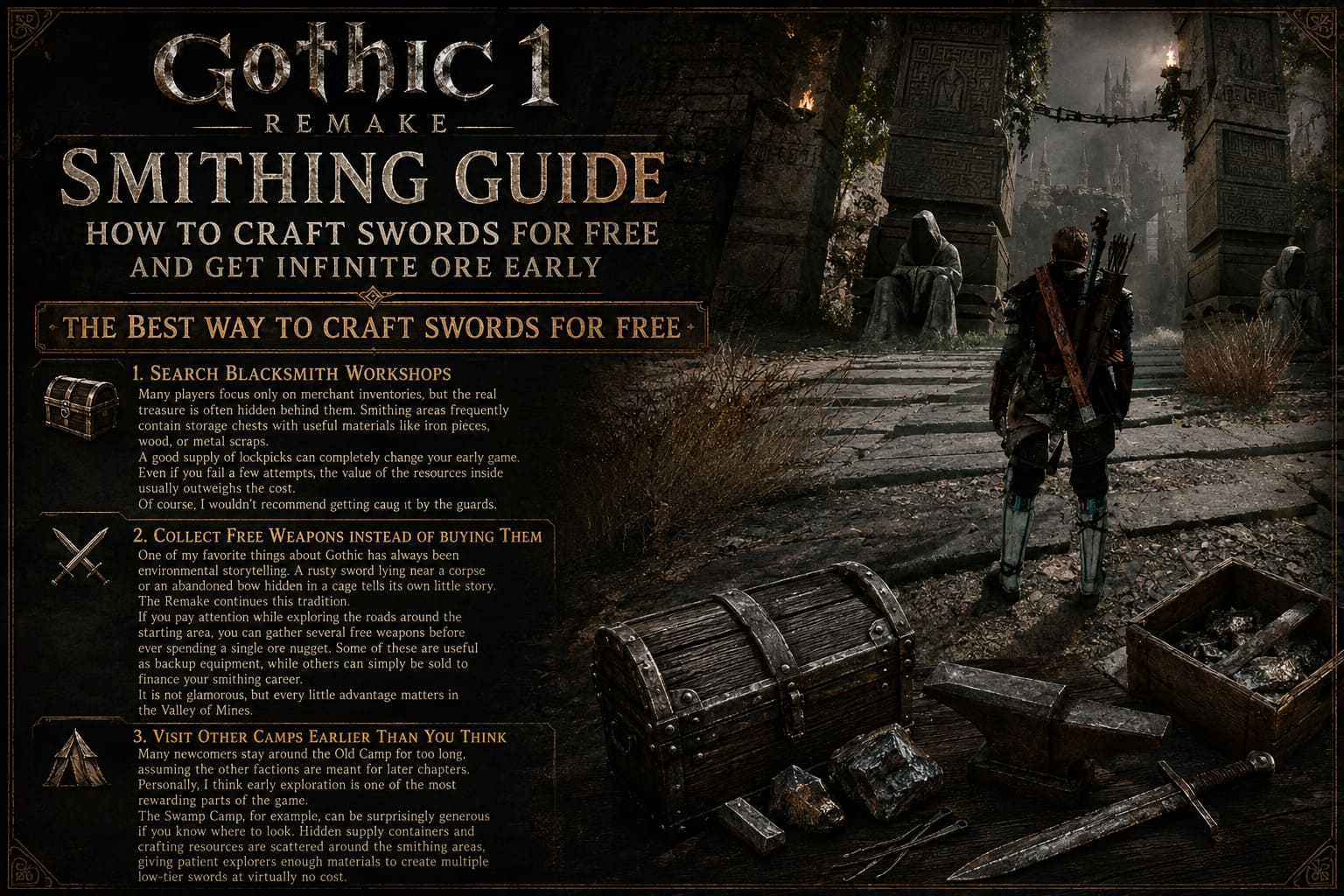
1. Search Blacksmith Workshops
Many players focus only on merchant inventories, but the real treasure is often hidden behind them. Smithing areas frequently contain storage chests with useful materials like iron pieces, wood, or metal scraps.
A good supply of lockpicks can completely change your early game. Even if you fail a few attempts, the value of the resources inside usually outweighs the cost.
Of course, I wouldn’t recommend getting caught by the guards.
2. Collect Free Weapons Instead of Buying Them
One of my favorite things about Gothic has always been environmental storytelling. A rusty sword lying near a corpse or an abandoned bow hidden in a cage tells its own little story.
The Remake continues this tradition. If you pay attention while exploring the roads around the starting area, you can gather several free weapons before ever spending a single ore nugget. Some of these are useful as backup equipment, while others can simply be sold to finance your smithing career.
It is not glamorous, but every little advantage matters in the Valley of Mines.
3. Visit Other Camps Earlier Than You Think
Many newcomers stay around the Old Camp for too long, assuming the other factions are meant for later chapters. Personally, I think early exploration is one of the most rewarding parts of the game.
The Swamp Camp, for example, can be surprisingly generous if you know where to look. Hidden supply containers and crafting resources are scattered around the smithing areas, giving patient explorers enough materials to create multiple low-tier swords at virtually no cost.
The Community’s Favorite Infinite Ore Trick
No discussion about Gothic 1 Remake crafting would be complete without mentioning the infamous ore vein reset exploit that players have been talking about since release.
The idea is very simple. Normally, mining nodes provide only a limited amount of ore before becoming depleted. However, many players discovered that saving the game after exhausting a vein and then immediately reloading can cause the resource node to refresh.
If the trick works on your version of the game, you can repeat the process over and over again, effectively generating an endless supply of ore.
I have mixed feelings about this.
On one hand, exploits like this can completely destroy the intended balance. Part of Gothic’s charm comes from struggling through poverty and slowly becoming stronger. If you suddenly have thousands of ore nuggets before Chapter 2, a lot of that progression disappears.
On the other hand, Gothic has always been a playground for experimentation. The original game had its own share of strange mechanics and unintended shortcuts, and many veterans actually enjoy discovering these little loopholes.
Personally, I would recommend trying a normal playthrough first. Then, on a second run, feel free to break the economy and roleplay as the richest blacksmith in the Colony.
STARSEEKER: Astroneer Expeditions Item IDs List & Console Spawn Codes (Complete Guide 2026)
Turning the Forge Into Your Personal Money Machine
The real power of smithing is not simply creating weapons for yourself. It is creating products that can be exchanged for everything else you need.
A stack of crafted one-handed swords can quickly be converted into:
- Better armor.
- Healing potions.
- Magic scrolls.
- Lockpicks and utility items.
- Materials for even more advanced crafting.
This creates a satisfying gameplay loop. You gather or steal raw materials, forge swords, sell them, buy better supplies, and repeat. Before long, you stop worrying about money entirely.
And unlike many RPG crafting systems that feel disconnected from the world, Gothic’s economy actually supports this style of play. Becoming a respected blacksmith feels like a believable path for your nameless hero.
Gothic 1 Remake Digital Deluxe Edition: Is the Bonus Content Worth It?
My Final Thoughts
After spending time with the Remake, I honestly think the overhauled blacksmithing system is one of its biggest strengths. It adds immersion without becoming tedious and gives players another meaningful way to progress besides simply killing stronger enemies.
If you enjoy exploration, resource management, and discovering clever ways to outsmart the game’s harsh economy, learning to forge swords early is absolutely worth it. Even without using exploits, you can gather enough free materials to keep your workshop running and your inventory full of quality weapons.
And if you decide to use the famous ore reset trick? Well… the Colony was never exactly a place known for fair play. Sometimes surviving in Gothic means bending the rules a little.
At the end of the day, there is something incredibly satisfying about walking into a dangerous fight carrying a sword that you forged with your own hands—and knowing it didn’t cost you a single piece of ore.