Mina the Hollower Difficulty Settings Guide
There are games you simply play, and then there are games you end up living inside for a while. Mina the Hollower falls into the second category for me.
It feels like a carefully crafted blend of Game Boy Color-era adventure design and modern precision gameplay, but what really makes it stand out is how much control it gives you over the experience itself.
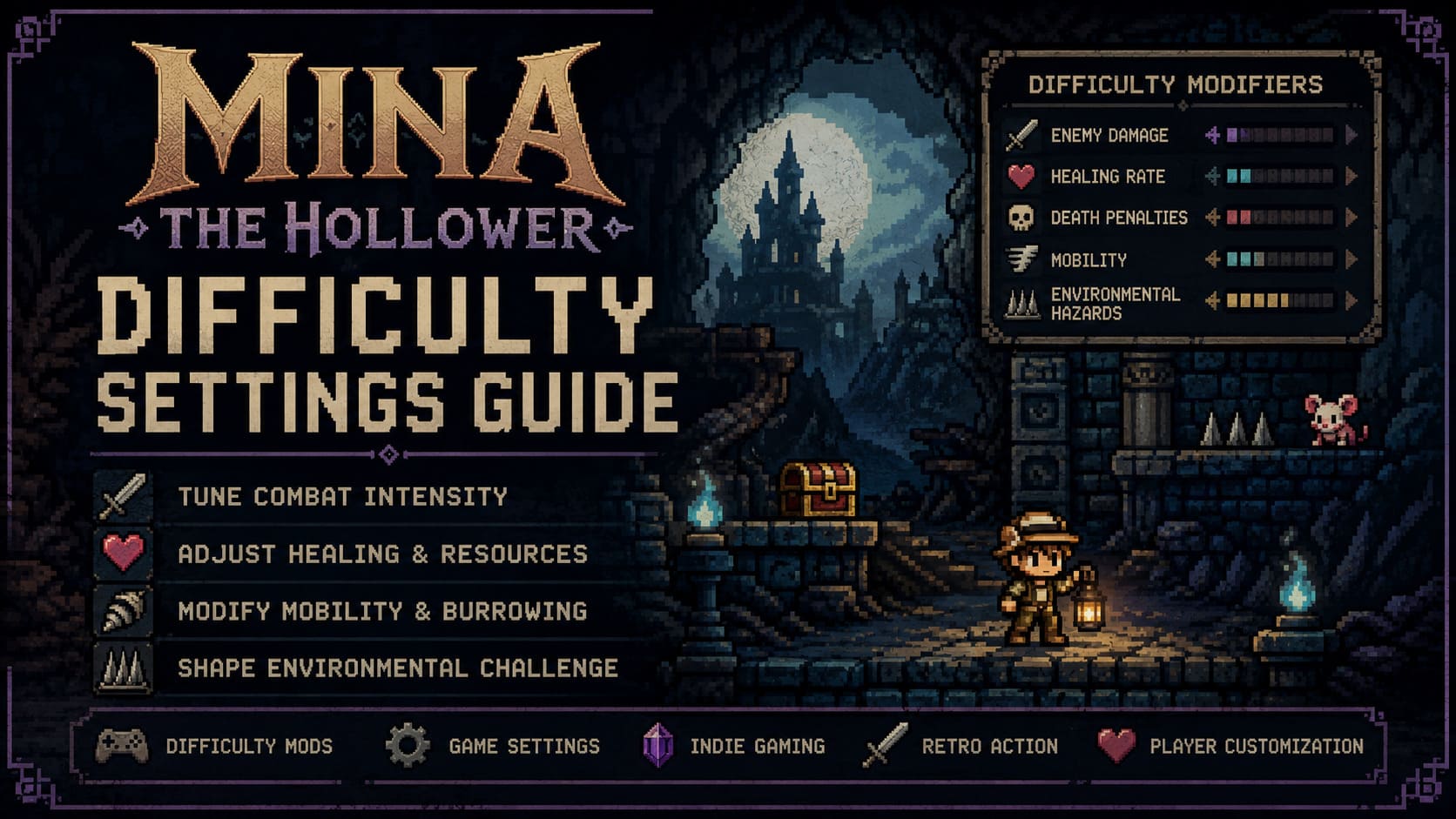
The difficulty modifier system is not just a menu feature—it’s a design philosophy. It lets you reshape how the entire game behaves without breaking its core identity, and that’s something I don’t see done well very often in modern indie games.
Why the Difficulty System Matters
Most retro-inspired games stick to a rigid difficulty curve. You get Easy, Normal, or Hard, and that’s it. Mina the Hollower refuses to be boxed in like that. Instead, it gives players granular control over combat pressure, healing economy, movement responsiveness, and environmental hazards.
This means two players can experience the same dungeon in completely different ways. One might be carefully surviving every encounter, while another is aggressively rushing through enemies with boosted mobility. The game supports both without judgment.
Ossex City Side Quests Guide – Mina the Hollower Walkthrough & Gamer Review
Core Design Philosophy: Challenge Without Gatekeeping
What stood out to me immediately is that the default experience is already well-balanced. Enemies are dangerous but readable, movement is responsive, and exploration feels fair. You’re not being punished for playing, which already puts it ahead of many modern action-adventure titles.
The modifiers exist not to fix the game, but to let you tune it like an instrument. That distinction matters. You’re not lowering or raising difficulty in a traditional sense—you’re shaping the tone of the entire experience.
Breakdown of Difficulty Modifier Categories
Combat Intensity Controls
This is where the most noticeable changes happen. Enemy damage scaling and player survivability adjustments directly affect how stressful every encounter feels. At higher values, even basic enemies become lethal threats, while lower values shift the game toward exploration and experimentation.
Mina the Hollower Sidearms Guide: Joules, Builds, and Player Strategy
From my experience, the sweet spot sits slightly above default difficulty. Too high and it becomes a challenge run; too low and tension disappears completely.
Healing and Resource Economy
Healing systems in Mina the Hollower are tightly tied to exploration pacing. Adjusting healing drop rates or potency completely changes how you approach combat encounters. If healing is scarce, every fight becomes a calculated decision. If it’s abundant, you’re encouraged to take risks and experiment.
Disabling death penalties also has a huge psychological impact. It turns exploration from risk management into curiosity-driven progression.
Mobility and Burrowing Mechanics
The burrowing system is one of Mina’s defining mechanics, and it becomes even more interesting when modified. Adjusting invincibility frames or movement responsiveness can drastically change boss encounters and traversal flow.
This is easily the most sensitive part of the system. Even small changes here ripple across the entire gameplay loop, especially in combat-heavy sections.
Environmental Challenge Settings
Environmental hazards like traps and spikes can be tuned to feel either punishing or forgiving. Keeping them strict preserves classic retro tension, while softening them allows for smoother exploration and less frustration during platforming-heavy sections.
How the Game Feels When You Tweak It
What impressed me most is how cohesive the game remains even when heavily modified. The structure doesn’t fall apart—it adapts.
| Setup | Combat Feel | Exploration | Stress Level | Best For |
|---|---|---|---|---|
| Default | Balanced and fair | Steady progression | Medium | First playthrough |
| Casual Mode | Forgiving encounters | Relaxed exploration | Low | Story focus |
| Hardcore Mode | High punishment combat | Slow and careful | High | Challenge runs |
| Speed Build | Fast aggressive fights | Rapid traversal | High intensity | Streamers and veterans |
What I appreciate most is that none of these configurations feel like “wrong” ways to play. The game simply adapts to your preference instead of forcing a single vision of difficulty.
Community Perspective and Player Behavior
Across discussions and gameplay breakdowns, players seem to fall into distinct groups. Exploration-focused players tend to disable harsh penalties and increase healing availability, while challenge runners push enemy damage and resource scarcity to extremes. Meanwhile, more mechanical-focused players experiment heavily with movement and burrow timing to reshape combat flow entirely.
The interesting part is that all of these approaches coexist without conflict. The system is flexible enough to support multiple interpretations of the same game world.
Recommended Difficulty Builds
Balanced First Playthrough
Enemy damage at default, standard healing, standard death penalties, and untouched mobility settings. This is the intended baseline experience and the best place to start.
Relaxed Exploration Build
Lower enemy damage, increased healing availability, reduced or removed death penalties, and softened environmental hazards. This build is ideal for players who want to focus on atmosphere, story, and exploration rather than pressure.
High-Intensity Challenge Build
Increased enemy damage, reduced healing, strict death penalties, and tighter mobility windows. This turns the game into a reflex-heavy experience where precision matters in every encounter.
Final Thoughts
Mina the Hollower’s difficulty modifier system is one of the more thoughtful implementations I’ve seen in a modern action-adventure game. Instead of forcing players into predefined difficulty boxes, it allows them to shape their own experience in a meaningful way.
It doesn’t simplify the game—it reconfigures it. And once you start experimenting with the settings, it becomes clear that the real strength of the system is freedom. You’re not just playing the game; you’re tuning how the game responds to you.
That level of control is what makes Mina the Hollower stand out in a crowded genre, and it’s something more developers should take seriously moving forward.