GTA 6 Jason & Lucia: A Streamer’s Take on Rockstar’s New Duo
When Rockstar finally revealed Grand Theft Auto 6, it didn’t feel like just another game announcement. It felt like the entire open-world genre got a reminder of who still sets the rules.
As someone who streams and analyzes games regularly, I’ve seen hype cycles come and go, but this one feels unusually grounded in character-driven storytelling rather than pure chaos and spectacle.
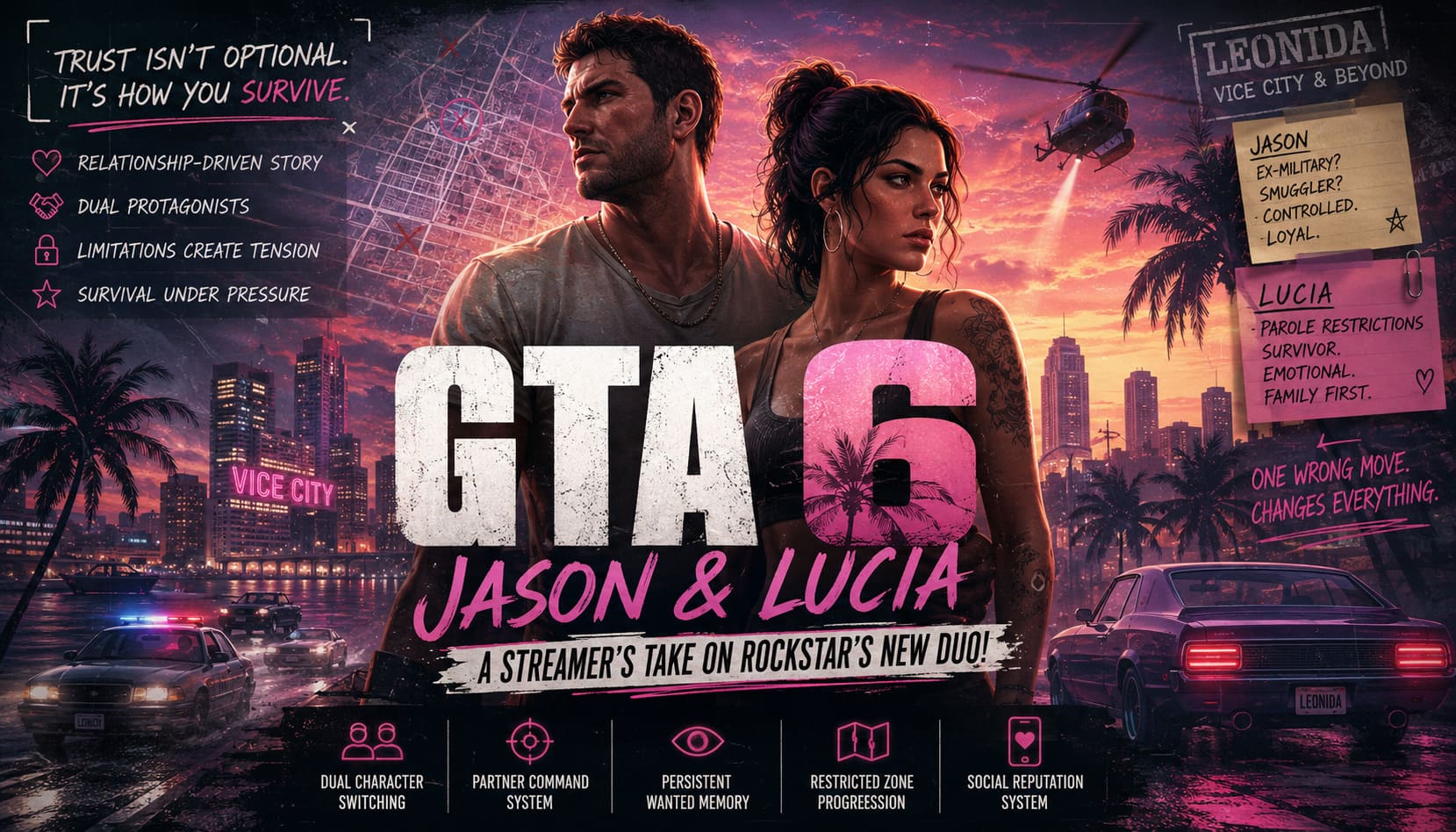
Jason and Lucia immediately stand out not because they are louder or more exaggerated than past GTA protagonists, but because they feel more human. That alone changes the tone of everything we expect from this entry.
GTA 6 PS5 Bundle Hype: Leaks, Pricing, and Next-Gen Console Wars
The Shift in Rockstar’s Design Philosophy
Previous GTA titles leaned heavily into satire, chaos, and power fantasies. GTA 6, based on everything shown so far, seems to be shifting toward emotional pressure, survival systems, and character dependency.
Instead of building an empire, Jason and Lucia appear to be trying to stay ahead of collapse. That’s a very different emotional foundation for a sandbox game, and honestly, it’s what makes this duo so interesting to follow as a streamer.
What feels different this time
- Smaller-scale criminal storytelling instead of empire building
- Stronger focus on emotional relationship dynamics
- More grounded environments and consequences
- Gameplay tied to narrative limitations rather than pure freedom
Lucia: The Emotional Core of GTA 6
Lucia is arguably the most important narrative shift Rockstar has made in years. She is not introduced as a dominant criminal mastermind, but as someone shaped by a system that already has control over her life.
From prison imagery to parole restrictions, everything about her framing suggests limitation first, freedom second.
Key traits of Lucia
- High emotional intensity and personal motivation
- Combat experience rooted in survival, not dominance
- Strong narrative connection to family and past consequences
- Restricted mobility suggesting structured progression systems
From my perspective as a streamer, Lucia feels like a character designed to make players feel pressure even in downtime. That’s rare in GTA, where downtime usually means freedom and experimentation.

Jason: Controlled Violence and Stability
Jason is positioned almost as the counterweight to Lucia. Where she feels reactive and emotionally driven, he feels measured and controlled. His background theories — military involvement, smuggling experience, and structured violence — all point toward a character who understands chaos but doesn’t lose himself inside it.
Jason’s gameplay identity (theoretical)
- More stable combat performance under pressure
- Improved driving and tactical movement
- Lower emotional volatility in narrative moments
- Strong loyalty-driven decision-making patterns
What makes Jason interesting isn’t aggression — it’s restraint. That contrast is what builds tension between him and Lucia.
The Core Dynamic: Trust as a Gameplay Mechanic
The most important aspect of Jason and Lucia’s design isn’t individual ability — it’s their dependency on each other. Everything shown so far suggests that trust is not just narrative flavor, but a functional system that affects gameplay outcomes.
Relationship-driven mechanics
- Shared decision consequences
- Coordinated mission actions
- Dynamic dialogue based on trust levels
- Behavioral changes under stress conditions
This is where GTA 6 potentially becomes very different from GTA 5. Instead of switching characters for variety, switching might feel like managing perspective and emotional alignment.
Gameplay Systems We Might See
Based on trailer analysis and community interpretation, several systems are heavily speculated. Even if only part of them exist, they would represent a significant evolution in Rockstar’s design approach.
| System | Description | Impact |
|---|---|---|
| Dual Character Switching | Real-time switching between Jason and Lucia | More dynamic mission flow |
| Partner Command System | Issue tactical instructions to AI partner | Semi-cooperative gameplay structure |
| Persistent Wanted Memory | NPCs remember actions and appearances | Increased realism and stealth depth |
| Restricted Zone Progression | Map access tied to narrative conditions | Story-driven exploration pacing |
| Social Reputation System | In-game viral media reacting to crimes | Dynamic world perception |
Bonnie and Clyde Influence, Reinterpreted
Yes, the Bonnie and Clyde comparison is obvious, but Rockstar rarely copies archetypes directly. Instead, they reshape them into something more grounded and uncomfortable.
What we seem to be getting here is not romanticized criminal glamour, but survival under pressure, emotional instability, and constant risk management.
That’s a major tonal shift for a franchise that historically thrives on exaggeration.
Community Theories That Actually Matter
There’s no shortage of theories around GTA 6, but a few stand out as structurally interesting rather than purely speculative noise.
1. Undercover Connection Theory
Jason may be tied to law enforcement or federal surveillance operations. This would create a dual-layer narrative where trust becomes dangerously fragile.
2. Non-linear Timeline Theory
Some believe the trailer is not chronological, suggesting the story begins with failure and works backward or forward depending on mission structure.
3. Dual Moral Collapse Theory
This theory suggests Jason and Lucia gradually shift morally in opposite directions, eventually forcing a final decision where survival is not guaranteed for both.
Why This Matters for Open-World Games
If GTA 6 successfully delivers on even part of these systems, it will influence the genre far beyond Rockstar itself. The shift is not just mechanical — it’s structural.
We are potentially looking at open-world design that prioritizes:
- Emotional character interdependence
- Reactive storytelling systems
- Dynamic reputation evolution
- AI companions with meaningful agency
That is a very different direction compared to traditional sandbox progression loops.
Final Thoughts: A Streamer’s Perspective
From a streaming standpoint, GTA 6 has something most open-world games lack — natural tension that exists even outside combat. Jason and Lucia are not just characters you control; they feel like a relationship you manage under pressure.
If Rockstar delivers on this vision, this won’t just be another entry in the franchise. It will be a shift in how narrative and gameplay interact in open-world design.
And honestly, that’s what makes this so exciting to watch unfold — not because of chaos, but because of connection under stress.