Gothic Remake Faction Choice Guide: Old Camp vs. New Camp
I’ve played more RPGs than I care to admit—everything from the old-school Morrowind era grindfests to modern narrative-heavy titles where every dialogue choice is tracked like a criminal record.
So when I look at the upcoming Gothic Remake, I don’t just see nostalgia. I see two very different gameplay philosophies clashing inside the same brutal prison world.
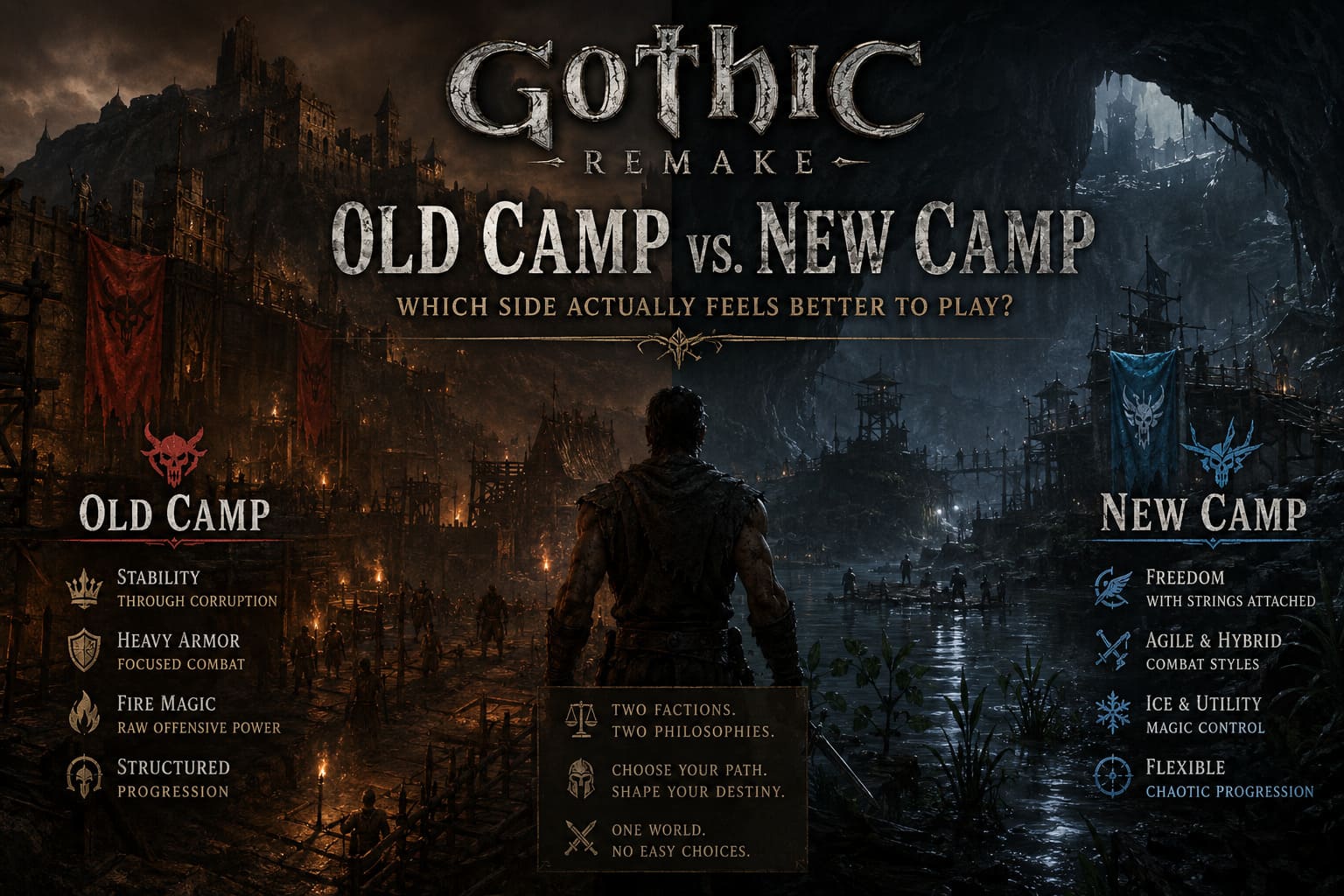
This isn’t just about lore anymore. In the remake era—with Unreal Engine visuals, expanded systems, and modern pacing tweaks—it becomes a question of playstyle identity. Which version of the Nameless Hero do you actually want to be?
How to Beat Hands in Windrose: Foothills Boss Guide (Needle in a Haystack)
First Impressions Still Matter: Atmosphere Hits Hard
Old Camp feels like controlled decay
The Old Camp is basically what happens when criminals build their own corrupt feudal state and decide it works well enough to keep going indefinitely. Every time I’ve started there in the original game, it always felt like stepping into a structured mafia economy.
In the remake, it’s even more oppressive: tight inner castle hierarchy, crowded outer ring full of desperate laborers, guards acting like tax collectors with swords, and a constant sense that you’re being watched. It’s “safe” in the way a prison is safe—you follow rules, or you disappear.
New Camp feels like organized chaos
The New Camp, on the other hand, has always felt like someone took the concept of freedom and immediately added layers of exploitation on top of it.
It’s wet, cold, cavern-based survival living, rice fields stretching into muddy labor zones, mercenaries enforcing “freedom” through intimidation, and a constant tension between rebellion and internal control. Where Old Camp is rigid oppression, New Camp is unstable freedom. Neither is clean. That’s the point.
Ideology vs Reality: Neither Faction Is “Good”
Old Camp: Stability through corruption
Old Camp is essentially a functioning crime economy where ore is currency, protection is sold, violence is regulated rather than eliminated, and power flows from hierarchy instead of merit. From a gameplay perspective, this translates into predictability. You always know what comes next. You always know who to talk to. Progression feels structured.
But the cost is obvious—you’re reinforcing a system built on exploitation.
New Camp: Freedom with strings attached
New Camp sells you a dream: break the system, escape the barrier, take control of your fate. But in practice, weak characters get exploited in rice fields, internal hierarchy still exists, bandit raids replace formal taxation, and power struggles are constant.
It’s freedom—but only if you’re strong enough to survive it.
Gameplay Differences That Actually Matter
Old Camp – structured progression
From a pure gameplay standpoint, Old Camp is the classic RPG path: faster access to heavy armor, reliable one-handed combat progression, early crossbow specialization, and fire magic focused on straightforward offensive power.
It’s the “safe build” route. If you’ve ever played a warrior in an RPG and just wanted consistency, this is it.
New Camp – flexible, chaotic progression
New Camp rewards experimentation. You get faster access to two-handed weapons, better synergy for dexterity builds, more open-ended quest paths, and water magic focused on control and utility.
You’re not guided—you’re pushed into systems and expected to figure them out.
Questing Experience: Structure vs Improvisation
Old Camp quests feel like administration
You’re doing deliveries with strict approval chains, reputation-building with multiple gatekeepers, and structured “prove yourself” tasks. It feels almost bureaucratic. Even combat feels like paperwork with swords.
New Camp quests feel like sabotage
New Camp pushes you into disrupting Old Camp logistics, manipulating supply chains, exploiting social tension, and making morally questionable choices early. You don’t climb a ladder—you kick it over and build your own path upward.
The Real Difference: Player Identity
Faction choice isn’t about lore—it’s about how you tolerate structure.
Old Camp players usually prefer:
- Clear progression systems
- Predictable power scaling
- Heavy armor fantasy
- Traditional RPG structure
New Camp players usually prefer:
- Freedom of approach
- Hybrid builds
- Risk/reward gameplay
- Emergent storytelling
Quick Comparison Table
| Old Camp Summary | New Camp Summary |
|---|---|
| Stable hierarchy, controlled progression, heavy armor focus, fire-based offense | Chaotic freedom, flexible builds, agile combat, ice/utility magic |
| Authority, stability, progression, control | Freedom, chaos, adaptation, survival |
What the Gothic Remake Might Change
Based on previews and developer commentary, the remake is more than a visual upgrade. It expands dialogue branches, environmental interactions, quest depth, NPC behavior, and introduces a more dynamic economy system. This could slightly blur faction identity, making both paths more flexible than in the original.
Still, the core contrast between structured control and chaotic freedom is likely to remain intact—and it should.
My Personal Take After Years of RPGs
If I had to recommend one faction blindly to a new player: choose Old Camp if you want structure, story rhythm, and a classic RPG climb. Choose New Camp if you want freedom, experimentation, and unpredictable but memorable gameplay moments.
But the truth is simple: the best way to experience Gothic has always been to play both at least once.
Final Thoughts
The Old Camp vs New Camp debate works because it isn’t just nostalgia—it’s design philosophy. Two systems of power, both flawed, both functional, both deeply tied to how you experience the world.
If the Gothic Remake delivers on its promise, it won’t just modernize a classic—it will remind players why these kinds of faction choices still matter in RPG design today.