Aion 2 Abyss Points Guide: How to Farm AP Fast in 2026
If you’re playing Aion 2 seriously, you’ll eventually run into the same problem: everything you actually want costs Abyss Points.
Better PvP gear? AP. Stronger weapons? AP. Wings and other faction rewards? More AP. And once you start looking at the higher-end PvP progression, it becomes pretty obvious that Abyss Points aren’t some optional side currency. They’re one of the main things driving your character forward.
The good news is that Aion 2 gives you several ways to build your AP balance. The bad news? Not all of them are equally efficient.
I’ve always liked games that reward players for understanding their systems instead of simply throwing hundreds of hours at the same monster. Aion 2 is very much that kind of game. You can grind mobs for hours, but if you’re ignoring Daily Duties, Supply Requests, sieges, and contribution-based PvP, you’re leaving a lot of progression on the table.
So, if your goal is to farm Abyss Points quickly in Aion 2, here’s how I’d structure the entire process.
Spendable AP and Rank Points Are Not the Same Thing
Before farming anything, there’s one distinction you absolutely need to understand.

Aion 2 separates Spendable Abyss Points from Competitive Rank Points. They are connected to the same overall PvP progression system, but they serve different purposes.
| Currency | Main Purpose | Can You Spend It? | Affected by Death? |
|---|---|---|---|
| Spendable Abyss Points | PvP gear, weapons, wings and consumables | Yes | No |
| Competitive Rank Points | Server ranking and higher PvP ranks | No | Yes |
Your Spendable AP is the currency you’ll actually take to Abyss vendors and faction merchants. This is what matters when you’re saving for equipment upgrades.
Rank Points are different. They determine your position on the competitive ladder and contribute toward access to powerful ranks and transformations such as Commander, Marshal, and Supreme Commander.
One change I particularly like in the current system is that dying in open-world PvP doesn’t simply wipe away the AP you’ve spent hours earning. You can actually take risks without feeling like one bad encounter just deleted an evening of progress.
That doesn’t mean death is irrelevant, though. Rank Points can still be affected, so competitive PvP has its own consequences.
There’s also a weekly limit on AP gained from killing monsters in Abyss PvE areas. Once you’ve reached that limit, continuing to slaughter mobs won’t keep producing AP. At that point, it’s time to move on to another activity.
And honestly, that’s a good thing.
It encourages players to play the whole game instead of turning Aion 2 into a single-room farming simulator.
1. Start With Daily Duty Missions
For players who don’t want to spend their entire evening fighting in the Abyss, Daily Duty Missions are probably the easiest place to start.
They’re available through your Journal and give you objectives that naturally overlap with other things you’re already doing. You might be asked to complete dungeons, gather resources, or perform other routine activities.
The important part is not blindly accepting every mission.
Check the rewards first.
Some objectives are simply better than others when your main goal is AP farming. If you’ve got a weak reward sitting in your list, the reroll system gives you a chance to replace it for a relatively small Kinah cost.
I wouldn’t recommend burning through your money trying to create some imaginary perfect set of missions. That’s the kind of optimization that looks clever on paper and ends up costing more than it saves.
Instead, reroll obvious low-value tasks and keep the good AP rewards.
There’s another reason I like this approach: Daily Duties can also provide Odella Energy, which is useful for gaining additional entries into profitable content. So you’re not only earning AP directly. You’re potentially opening up more opportunities to make AP later.
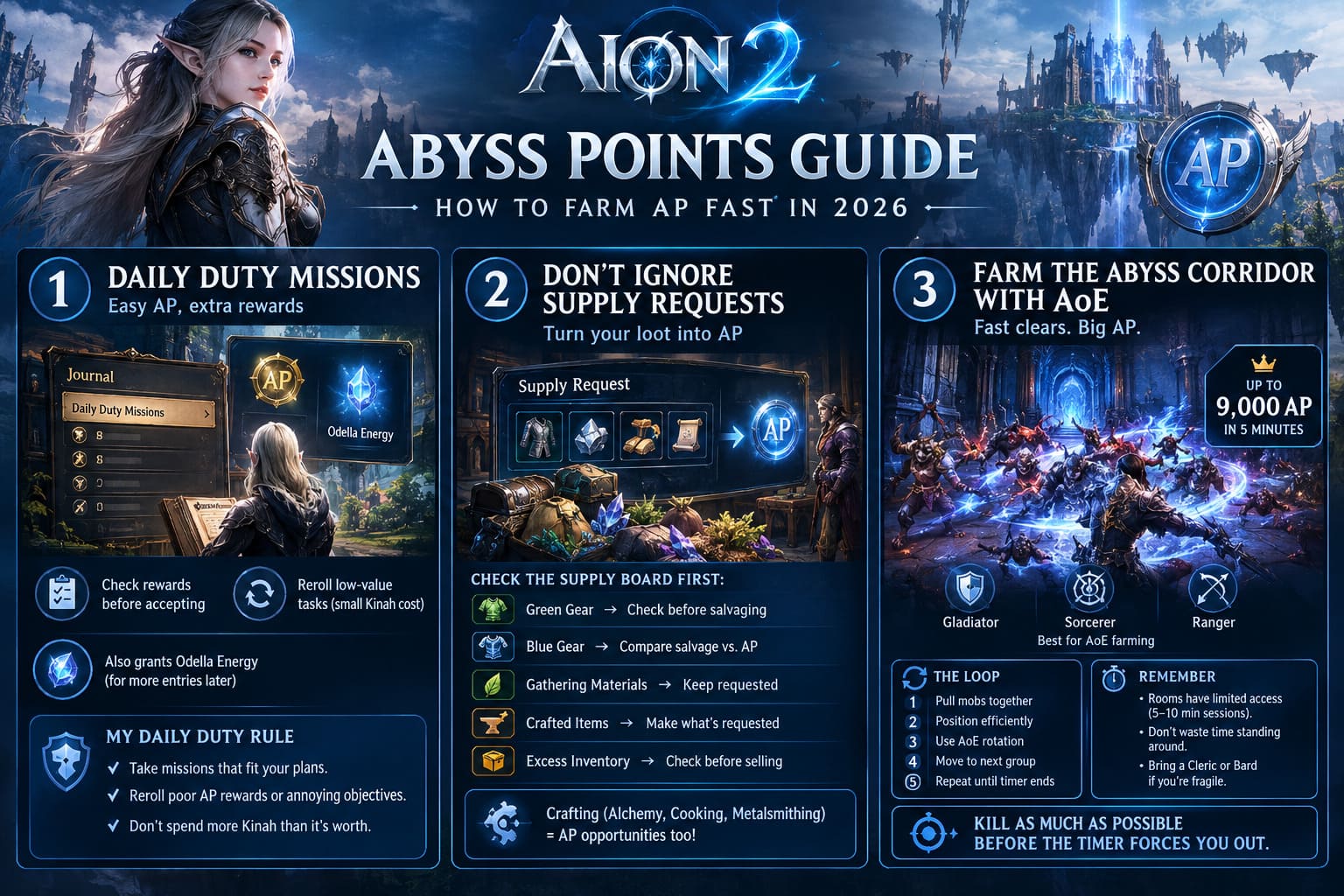
My Daily Duty Rule
If a mission fits naturally into something you’re already planning to do, take it.
If the AP reward is poor and the objective is annoying, reroll it.
Don’t spend more Kinah rerolling than the mission is realistically worth.
Simple, but effective.
2. Don’t Ignore Supply Requests
This is probably one of the easiest AP sources to overlook because it doesn’t feel like traditional PvP progression.
The Supply Request system essentially turns unwanted items and crafting materials into AP.
And if you’ve been playing for a while, you’ve probably got a warehouse full of random gear and materials anyway.
Instead of instantly salvaging every green or blue item you find, check the Supply interface first. Items requested by your faction can be delivered for an immediate AP reward.
| Item Source | What to Do |
|---|---|
| Green Gear | Check Supply Requests before salvaging |
| Blue Gear | Compare its salvage value against AP rewards |
| Gathering Materials | Keep requested resources for turn-ins |
| Crafted Items | Produce items currently requested |
| Excess Inventory | Check the Supply board before selling |
This becomes especially interesting if you have a crafting profession.
Alchemy, cooking, and metalsmithing can all become part of your AP routine when the right items appear on the board. Instead of crafting something nobody wants, you can focus production around current requests.
That’s the kind of small optimization that adds up over an entire week.
Your inventory is basically another AP resource. Start treating it that way.
3. Farm the Abyss Corridor With AoE
Now we get into the part that feels much more like classic Aion grinding.
If you enjoy watching your character pull an entire room and erase everything with one rotation, the Abyss Corridor and its specialized grind rooms are where things get interesting.
These areas are designed around fast PvE clearing, and classes with strong AoE capabilities can turn them into serious AP generators.
Gladiators, Sorcerers, and Rangers are particularly well suited to this style of farming because they can handle groups of enemies efficiently.
A properly geared Gladiator can reportedly push extremely high AP numbers during short farming windows, with around 9,000 AP in five minutes possible under favorable conditions.
But here’s the catch: this isn’t a relaxed farming activity.
The rooms have limited access windows, and some sessions last only around five to ten minutes. That means standing around between pulls is basically throwing AP away.
The ideal loop is simple:
- Pull several enemies together.
- Position them efficiently.
- Use your AoE rotation.
- Move immediately to the next group.
- Repeat until the room timer expires.
The goal isn’t to survive for twenty minutes.
The goal is to kill as much as possible before the timer forces you out.
If your class is fragile, bringing a Cleric or Bard can make the difference between an efficient farming session and constantly stopping to recover.
Personally, this is the AP method I’d recommend to players who actually enjoy grinding. There’s something satisfying about improving your pull size and clear speed until the same five-minute window produces noticeably more AP.
4. 300v300 Abyss Battlefields Are Built Around Contribution
Large-scale PvP is where Aion 2 gets considerably more interesting.
The 300v300 Abyss Battlefield isn’t simply about getting the highest kill count. Contribution matters, which means support classes aren’t automatically stuck at the bottom of the AP economy.
This is especially important for Clerics, Bards, and Templars.
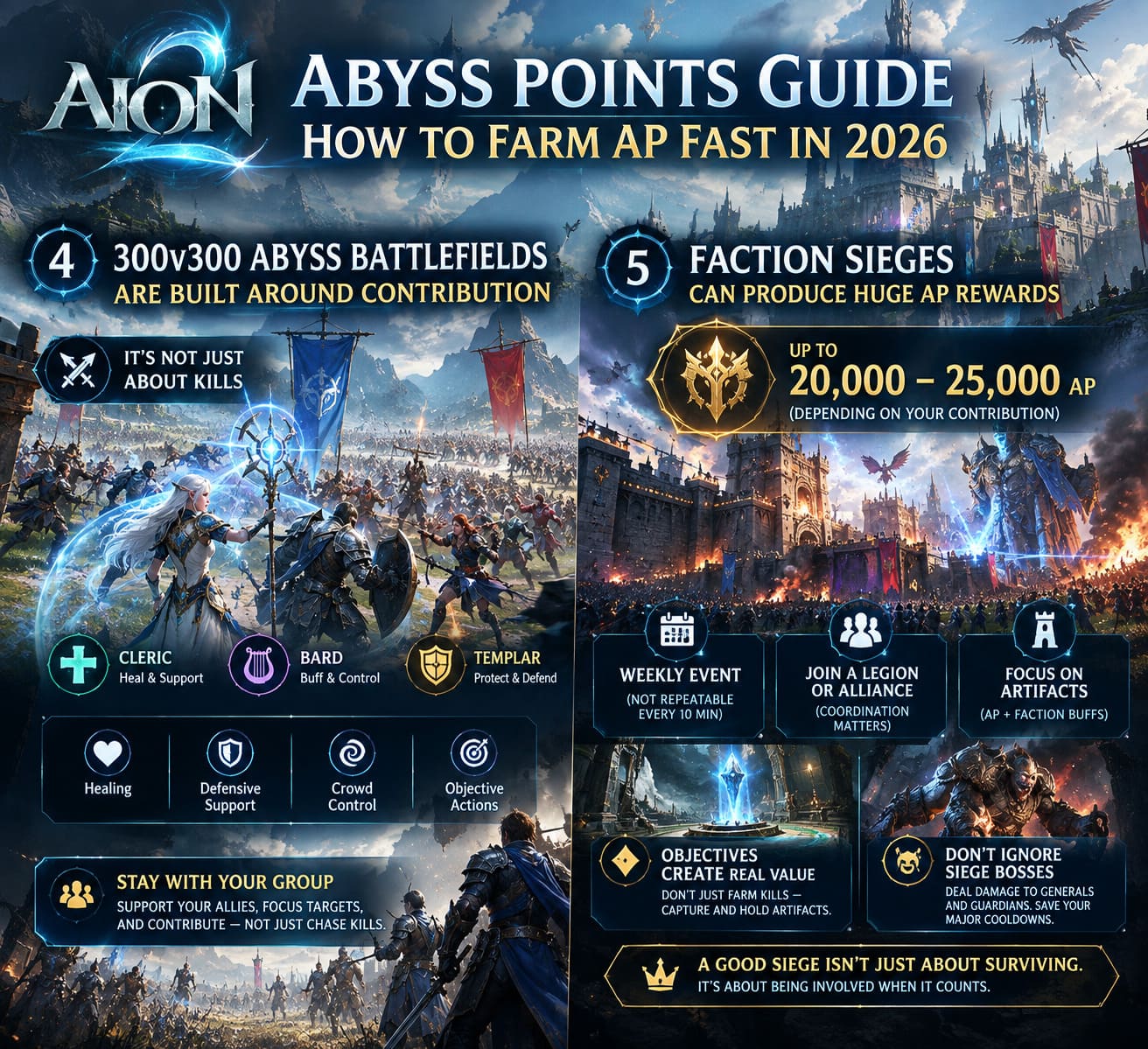
If you’re playing support, your job isn’t to chase kills across the map. Stay close to your frontline, keep your allies alive, apply shields, control dangerous targets, and contribute around important objectives.
Healing, defensive support, crowd control, and other battlefield actions can all contribute toward your overall score.
Damage dealers should take a similar approach from the opposite side.
Instead of wandering around looking for isolated targets, stay with your group and assist focus targets. Helping take down important enemies can be more productive than chasing random kills on the edge of the battlefield.
That’s one of the things I appreciate about contribution-based PvP. It gives different classes a reason to participate instead of making the scoreboard entirely about who can land the final hit.
5. Faction Sieges Can Produce Huge AP Rewards
If you’re serious about AP farming, don’t skip scheduled Faction Sieges.
These large-scale events can produce some of the biggest single-event AP rewards in the game, with successful participation potentially reaching around 20,000–25,000 AP depending on your contribution and the outcome.
Obviously, that’s not something you can repeat every ten minutes.
That’s why sieges should be treated as major weekly events rather than a normal farming route.
Joining an organized legion or alliance can make a huge difference here. Coordination matters when hundreds of players are fighting over the same objectives.
Focus on Artifacts
Artifacts are especially important.
Capturing and holding these structures can provide AP rewards while also giving your faction useful buffs during the larger battle.
If your group is pushing an objective, don’t assume that standing nearby and farming kills is the best use of your time.
Objectives are where the real value is.
Don’t Ignore Siege Bosses
The final contribution calculation also places significant importance on damage dealt to major targets, including opposing generals and fortress guardians.
Save your major cooldowns when appropriate and make sure you’re contributing during these crucial phases rather than wasting everything earlier in the fight.
A good siege isn’t just about surviving.
It’s about being involved when the game is actually calculating the important contribution rewards.
The Best Aion 2 AP Farming Routine
There’s no single activity that you should spam all day.
The more efficient approach is to combine several sources and work around their limits.
| Activity | AP Potential | Risk | Best For |
|---|---|---|---|
| Daily Duties | Moderate | Low | Consistent daily AP |
| Supply Requests | Moderate to High | None | Extra materials and gear |
| Abyss Corridor | High | Moderate | Fast PvE farming |
| 300v300 Battlefield | High | High | Large-scale PvP |
| Faction Sieges | Very High | High | Major AP bursts |
| Arena PvP | Moderate | Moderate | Extra PvP progression |
This is where I think a lot of players make the wrong decision.
They find one good farming method and then refuse to leave it.
But Aion 2’s systems are built around variety. PvE AP has limits, certain activities have timers, and PvP rewards depend on contribution and participation.
So instead of asking, “What’s the one best AP farm?”, I’d ask:
“What should I be doing next?”
That mindset is much more useful.
Aion 2 Fast Leveling Guide: Level 1 to 45 Speed Leveling and Max XP Methods (2026 Global Launch)
A Simple Daily AP Checklist
If you want a routine that doesn’t require constantly thinking about optimization, use this as your baseline:
- Check Daily Duty Missions and reroll obviously poor AP rewards.
- Open Supply Requests before salvaging or selling excess items.
- Use your Abyss Corridor farming window with an AoE-focused build.
- Join scheduled PvP battles and sieges whenever possible.
- Use Arena matches as additional PvP progression rather than relying on them as your only AP source.
- Watch your weekly PvE AP limit so you don’t waste time farming mobs after you’ve reached the cap.
The important thing is consistency.
You don’t need to turn every session into a spreadsheet. Just build a routine where you’re rarely doing an activity that has stopped giving meaningful rewards.
Aion 2 Altgard Guide: All Empyrean Trace & Hidden Cube Locations
Final Thoughts
Abyss Points are one of the biggest progression currencies in Aion 2, but farming them efficiently isn’t really about finding one magical location and grinding it forever.
It’s about understanding how the different systems fit together.
Daily Duties provide reliable progress. Supply Requests turn the junk sitting in your inventory into something useful. Abyss Corridor farming rewards players who can clear quickly. Large-scale battlefields give different classes opportunities to earn through contribution, while Faction Sieges can deliver enormous AP rewards when you’re involved in the right objectives.
And then there’s the weekly PvE cap.
That’s the mechanic I would keep in the back of my mind the entire time. Once you’ve reached it, don’t stubbornly keep farming Abyss monsters expecting the same return. Move into PvP, complete your other activities, or work toward the next scheduled siege.
That’s ultimately what makes the AP system more interesting than simple mob grinding.
You are constantly switching between different parts of Aion 2.
If your goal is to build a strong PvP character in 2026, start thinking of AP farming as a complete gameplay loop rather than a single grind spot. Keep the easy daily rewards flowing, squeeze value out of your inventory, maximize timed Abyss sessions, and show up for the big faction battles.
Do that consistently, and your AP balance will start moving in the right direction without making the game feel like a second job.