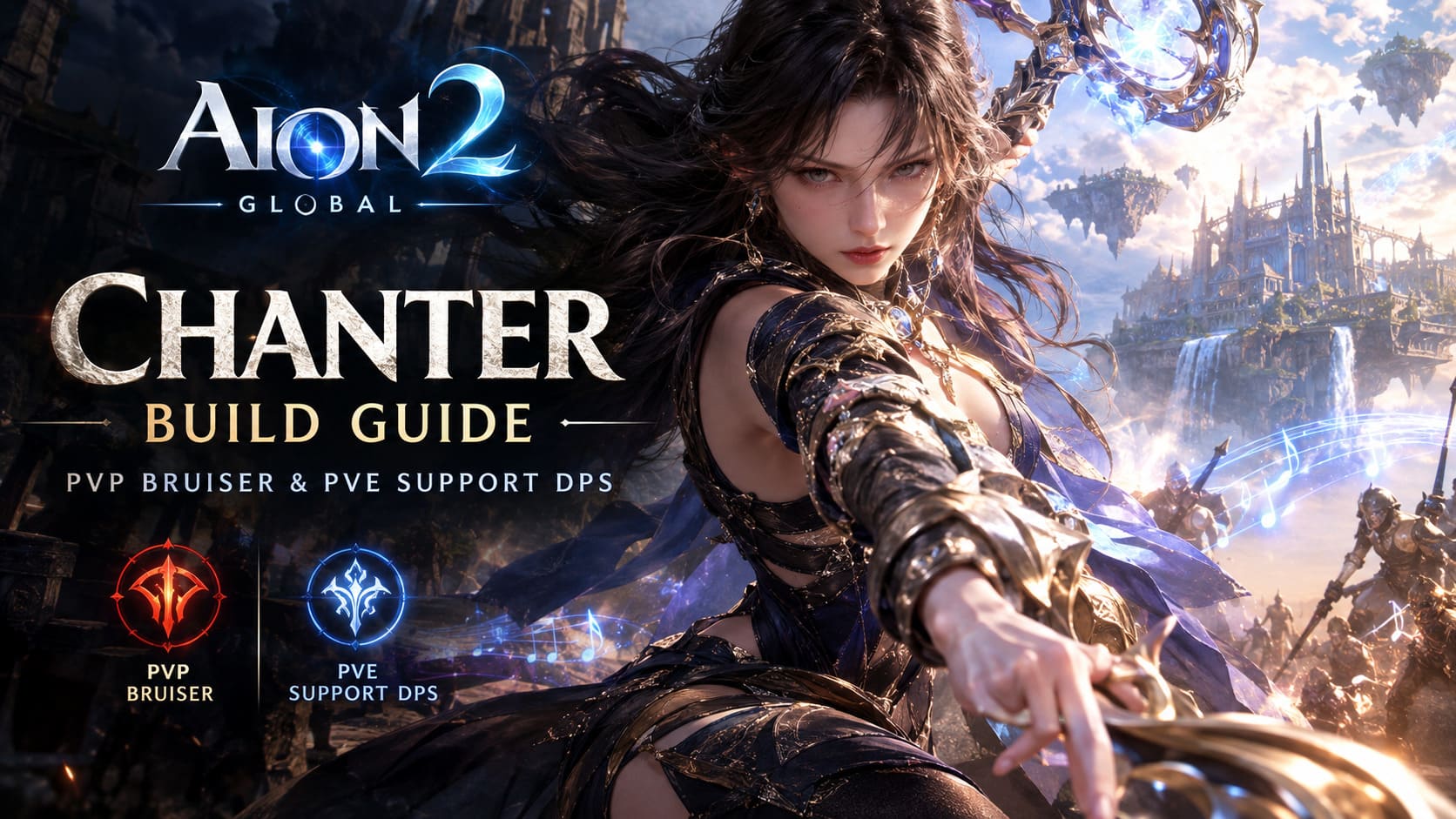
AION 2 Global Chanter Build Guide: Best PvP Bruiser & PvE Support DPS Skills and Rotations (2026)
The Chanter in Aion 2 Global is not the sleepy old-school support class some players might remember. If you expect to stand behind the party, throw out a few buffs, and occasionally poke an enemy with a stick, you are going to be in for a surprise.
The modern Chanter is a melee hybrid that wants to be in the fight. You are constantly managing positioning, cooldowns, defensive tools, burst windows, and passive bonuses. In PvP, that means getting into the enemy formation and making someone’s life miserable. In PvE, it means contributing serious physical damage while still bringing the utility that makes the class valuable to a group.
After looking closely at the current skill architecture, two setups stand out as the most practical foundations: the PvP Bruiser build and the PvE Support DPS build. They play very differently, even though they share a large portion of the Chanter’s core toolkit.
With 4,060 skill points available at the high-end level, sloppy allocation can leave you with a character that does everything reasonably well but nothing particularly well. The goal here is to avoid that trap.
This guide covers the essential Chanter skills, recommended passive combinations, PvP and PvE builds, and practical combat rotations for Aion 2 Global.
Aion 2 Chanter Core Skill Breakdown
Before choosing a specialization, you need to understand what your buttons actually do. The Chanter’s combat system is built around chaining relatively efficient attacks together while saving its expensive abilities for the moments when they matter most.
| Skill | Efficiency | Primary Role |
|---|---|---|
| Onslaught | -5~-6 | Gap closer / opener |
| Incandescent Blow | -4~-5 | Core damage |
| Rushing Smash | -5~-6 | Tracking / mobility |
| Impactful Crush | -4~-5 | Combo bridge |
| Dark Crush | -1~-2 | Fast reaction burst |
| Gust Rampage | -2~-3 | Multi-hit AoE pressure |
| Heat Wave Blow | -14~-15 | Heavy burst |
| Recuperation | -7~-8 | Self-sustain |
| Tremor Crush | -5~-6 | Crowd control |
| Wave Blow | -13~-14 | Sustained heavy damage |
| Spinning Strike | -2~-3 | Fast filler |
| Defiance | -2~-3 | Anti-disruption defense |
Onslaught
Onslaught is one of the most important tools in your kit because it solves the classic melee problem: actually getting into range.
Its -5~-6 efficiency profile makes it more than a random engage button. It establishes your initial position and lets you immediately start building pressure. In PvP, wasting Onslaught can mean spending the next several seconds chasing someone who has already escaped your effective range.
Incandescent Blow
Incandescent Blow fills the middle of your offensive sequence. With an efficiency value of -4~-5, it provides reliable pressure without demanding the enormous commitment of your heaviest attacks.
It is especially useful in PvE when you are transitioning between major cooldowns.
Rushing Smash
If the opponent starts running, Rushing Smash is the answer.
This -5~-6 mobility attack is designed around tracking moving targets and keeping your melee pressure alive. In PvP, this is particularly important against players who understand that simply stepping away from a Chanter can disrupt an entire combo.
Impactful Crush
Impactful Crush is a precision attack that fits neatly between larger abilities. Its -4~-5 efficiency profile makes it a dependable bridge when your main skills are unavailable.
It is not necessarily the flashy button, but these kinds of skills often make the difference between a clean rotation and standing around waiting for something to come off cooldown.
Dark Crush
This is the skill I would pay the closest attention to.
Dark Crush has an extremely efficient -1~-2 profile and operates around a short reaction window. Once its condition is triggered, you want to fire it immediately rather than sitting on it.
That small delay might not look important on paper, but over a long encounter, repeatedly missing these windows can seriously hurt your overall damage.
Gust Rampage
Gust Rampage is your sweeping multi-hit physical attack. With a -2~-3 efficiency profile, it is excellent when several targets are packed around you.
It gives the Chanter a useful way to maintain pressure while dealing with groups rather than a single isolated target.
Heat Wave Blow
Now we get to the expensive stuff.
Heat Wave Blow carries a massive -14~-15 efficiency footprint and comes with two specialty slots. This is not something you casually throw into every rotation.
Save it for a genuine damage window. If the target is vulnerable and your group has created an opening, this is when Heat Wave Blow should come crashing down.
Recuperation
Recuperation is the Chanter’s personal safety net.
With a -7~-8 footprint and one specialty slot, it provides on-demand sustain when incoming pressure becomes uncomfortable. It is particularly valuable in PvP, where surviving another few seconds can completely change the outcome of an engagement.
Tremor Crush
Tremor Crush is the centerpiece of the PvP control package.
Its -5~-6 efficiency rating comes with a very important benefit: crowd control. Used against a clustered enemy formation, it can disrupt multiple priority targets and create the opening needed for your damage chain.
Wave Blow
Wave Blow is another high-investment ability, operating at -13~-14 with two specialty slots.
Its strength is sustained pressure rather than a single instant hit. In PvE, it belongs inside your major damage windows rather than being treated as a disposable filler.
Spinning Strike
Every melee build needs a reliable filler, and Spinning Strike fills that job beautifully.
At -2~-3 efficiency, it is fast, cheap enough to cycle frequently, and useful for keeping your damage moving while stronger abilities recharge.
Defiance
Finally, Defiance gives the Chanter an answer to enemy pressure.
With a -2~-3 efficiency profile, it allows you to push through disruption and regain control of an engagement instead of simply accepting whatever the opponent throws at you.
Aion 2 Chanter PvP Bruiser Build
The PvP Bruiser Chanter is built around one simple idea: get in, stay in, and make the enemy team deal with you.
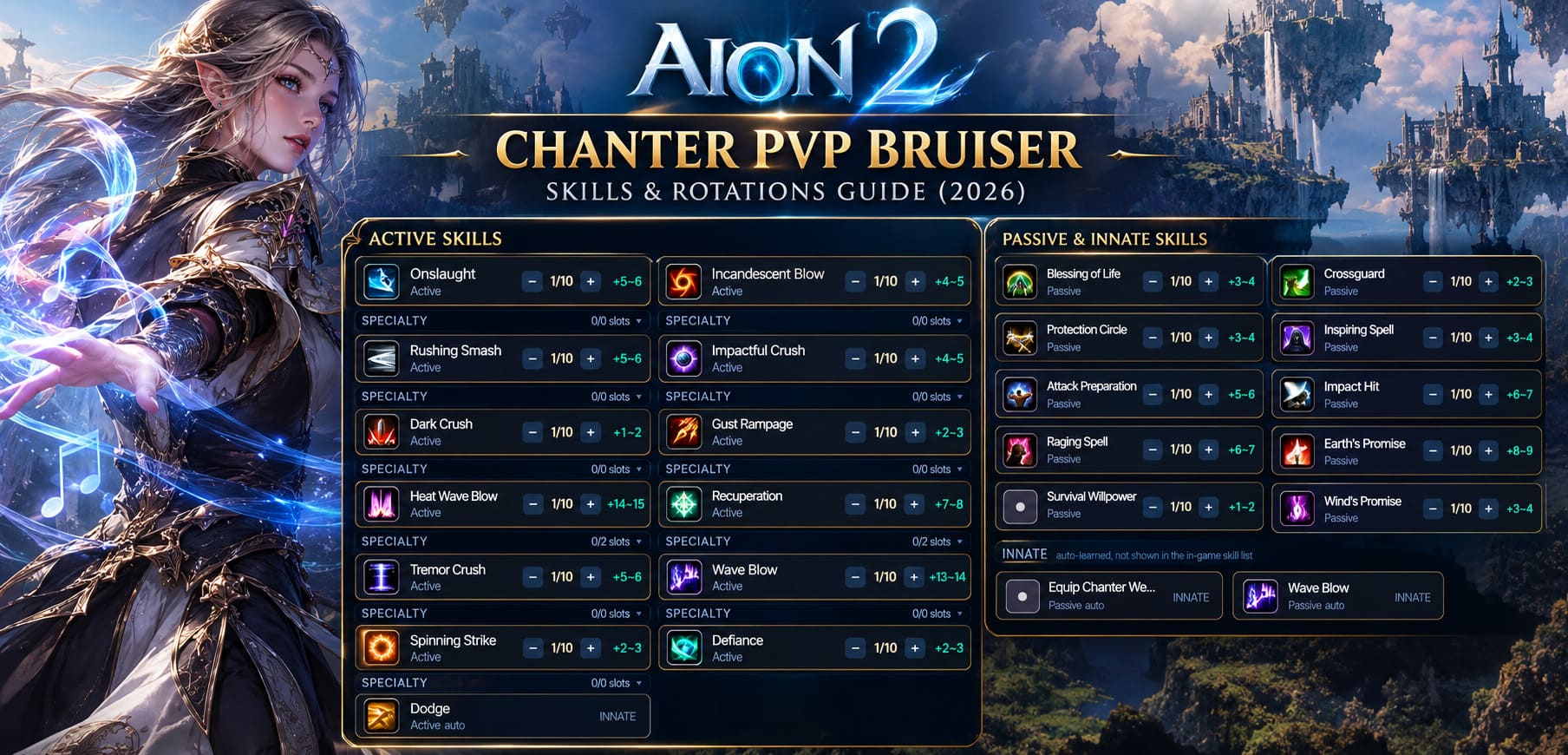
This is not a backline support build. You are a frontline nuisance with enough defensive tools to survive extended pressure while constantly interfering with enemy positioning.
Your mobility skills are critical here. Onslaught gets you into the fight, while Rushing Smash keeps you attached to targets that try to disengage.
Once you are in position, Tremor Crush becomes one of your most important tools. The goal is to disrupt the opposing formation and create an opening for Gust Rampage and Spinning Strike.
Against vulnerable targets, the Chanter can maintain surprisingly persistent pressure. The trick is not blowing every cooldown immediately.
Recommended PvP Chanter Passives
Your passive allocation should reinforce survivability and the ability to remain active under pressure.
| Passive | Efficiency | Purpose |
|---|---|---|
| Blessing of Life | -3~-4 | Health and healing reception |
| Crossguard | -2~-3 | Physical mitigation |
| Protection Circle | -3~-4 | Defensive resistance |
| Survival Willpower | -1~-2 | Critical-health survival |
Blessing of Life
Blessing of Life increases your baseline health and improves incoming healing reception. For a melee Chanter, that combination is extremely useful because you are naturally going to attract attention.
Crossguard
Crossguard is particularly valuable when facing physical attackers. Against classes such as Assassins and Gladiators, additional mitigation can make extended trades much more manageable.
Protection Circle
Protection Circle adds another layer of defensive resistance. In large PvP fights, where several sources of damage can hit you simultaneously, this passive helps reinforce the Bruiser identity.
Survival Willpower
The name says pretty much everything.
Survival Willpower becomes increasingly important when your health drops into dangerous territory. The additional defensive boost can give you the breathing room needed to recover rather than getting deleted during the final stage of an enemy burst.
PvP Chanter Rotation
Your PvP rotation should prioritize engagement, immediate reaction damage, crowd control, and target retention.
Recommended PvP Bruiser Sequence
- Onslaught — Close the gap.
- Dark Crush — Trigger your fast reaction damage immediately.
- Tremor Crush — Disrupt the target or surrounding enemies.
- Spinning Strike — Maintain pressure through the control window.
- Rushing Smash — Follow targets attempting to escape.
The biggest mistake here is treating the rotation like a rigid five-button macro.
Real PvP is messy.
Players move. Cooldowns get interrupted. Targets use defensive abilities. Someone else on your team suddenly lands crowd control. Your job is to understand the purpose of each step, not blindly follow the sequence regardless of what is happening.
Aion 2 Chanter PvE Support DPS Build
The PvE Support DPS Chanter changes the class’s priorities considerably.
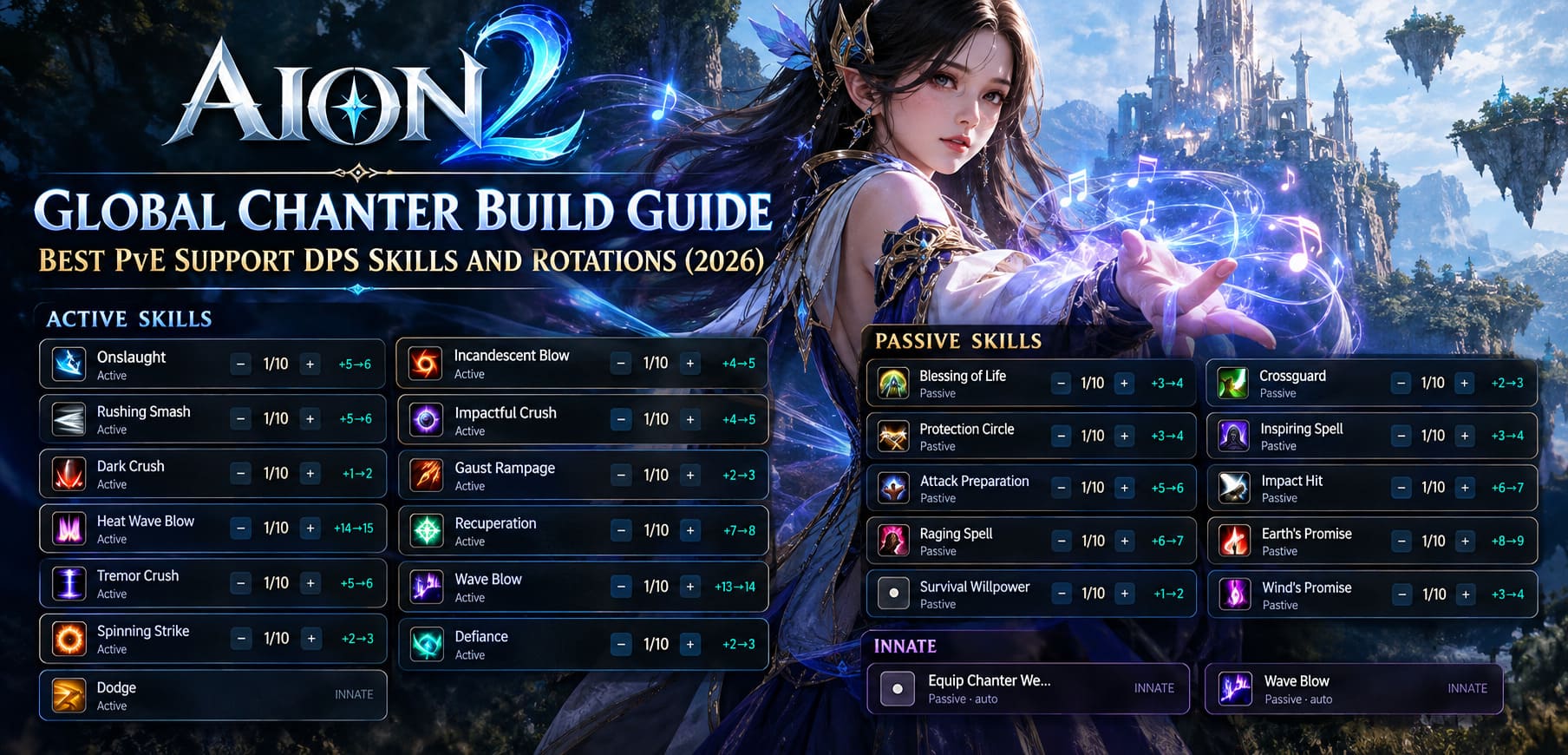
You are still fighting in melee range, but your focus shifts toward consistent physical damage, party utility, attack speed, critical scaling, and efficient cooldown usage.
In a serious dungeon or expedition, the Chanter should not simply spam attacks whenever they become available. You want your heavier abilities to line up with moments when the boss is vulnerable.
Dark Crush deserves particular attention. Its extremely efficient -1~-2 profile makes maintaining its activation windows one of the easiest ways to improve your sustained output.
At the same time, Heat Wave Blow and Wave Blow should be coordinated around major damage opportunities.
If your tank creates a clean opening against a boss, that is when you want your expensive abilities ready.
Recommended PvE Chanter Passives
| Passive | Efficiency | PvE Function |
|---|---|---|
| Attack Preparation | -5~-6 | Attack speed |
| Inspiring Spell | -3~-4 | Party offensive support |
| Raging Spell | -6~-7 | Personal offensive power |
| Impact Hit | -6~-7 | Critical-hit efficiency |
| Earth’s Promise | -8~-9 | Bonus elemental damage |
| Wind’s Promise | -3~-4 | Additional damage and utility |
Attack Preparation
Attack Preparation is arguably the centerpiece of this PvE setup.
The passive improves physical attack speed, which in turn accelerates your skill animations and allows you to cycle through your melee toolkit more quickly.
For a class that depends so heavily on maintaining uptime, that is a big deal.
Inspiring Spell
Inspiring Spell adds group value by providing an offensive aura to nearby party members.
This is exactly the kind of utility that separates the PvE Chanter from a generic melee DPS class. You are contributing damage while simultaneously improving the group’s offensive capability.
Raging Spell
Raging Spell pushes your own offensive output higher.
The passive fits naturally into the Support DPS identity because it prevents you from becoming the player who spends the entire dungeon buffing everyone else while barely contributing damage.
Impact Hit
Impact Hit improves critical-hit efficiency and strengthens the impact of your physical attack chains.
For sustained encounters, this kind of scaling becomes increasingly important because your damage comes from repeatedly cycling attacks rather than relying on a single giant nuke.
Earth’s Promise and Wind’s Promise
The two elemental Promises work together as additional offensive tools.
Earth’s Promise carries an -8~-9 efficiency profile, while Wind’s Promise operates at -3~-4. Together, they provide additional damage and utility for your physical attacks during long encounters.
PvE Chanter Rotation
The PvE rotation revolves around maintaining your efficient reaction damage while placing your expensive attacks inside meaningful burst windows.
Recommended PvE Support DPS Sequence
- Incandescent Blow — Establish your opening rhythm.
- Dark Crush — Fire immediately when its condition becomes available.
- Wave Blow — Begin the major sustained damage sequence.
- Heat Wave Blow — Capitalize on the optimal vulnerability window.
- Spinning Strike — Fill downtime while your major abilities recover.
The important part is the relationship between the abilities.
Don’t burn Heat Wave Blow just because the button is glowing.
If the boss is about to enter a vulnerable phase, holding the skill for a moment can produce more useful damage than immediately firing it into a normal defensive state.
Macro Optimization in Aion 2
Macros can make the Chanter considerably smoother to play, especially when you are dealing with fast reaction windows.
That said, I would avoid turning the entire class into one giant automated sequence.
The Chanter’s strength comes from adapting to the battlefield.
For PvP, the basic macro concept looks like this:
Onslaught → Dark Crush → Tremor Crush → Spinning Strike → Rushing Smash
For PvE:
Incandescent Blow → Dark Crush → Wave Blow → Heat Wave Blow → Spinning Strike
These sequences provide a useful starting structure, but actual combat still requires manual intervention.
The best players will know when to break the macro.
If a target escapes, switch to Rushing Smash. If incoming pressure becomes dangerous, use Recuperation. If an opponent tries to interrupt your engagement, Defiance can be more valuable than continuing the damage chain.
That flexibility is where the Chanter becomes genuinely fun.
PvP Bruiser vs PvE Support DPS
| Category | PvP Bruiser | PvE Support DPS |
|---|---|---|
| Main Goal | Disruption and survival | Damage and group utility |
| Key Skills | Onslaught, Tremor Crush, Rushing Smash | Dark Crush, Wave Blow, Heat Wave Blow |
| Defensive Focus | Very high | Moderate |
| Damage Focus | Sustained pressure | Sustained DPS and burst windows |
| Core Passive | Blessing of Life | Attack Preparation |
| Party Utility | Crowd control | Offensive support |
| Playstyle | Aggressive frontline | Melee support DPS |
Neither setup should be treated as a universal replacement for the other. They are designed around different combat demands.
The PvP Bruiser wants to survive chaos and control enemy movement. The PvE Support DPS wants to maintain high uptime while amplifying the group’s overall performance.
Aion 2 Cleric Build Guide: Best PvP and PvE Skills, Stigmas, and Skill Boost Priorities (2026)
How to Spend the 4,060 Chanter Skill Points
With 4,060 skill points available at high-end progression, allocation discipline matters.
The biggest trap is trying to spread points across every attractive option.
A Chanter has a huge number of useful tools, but “useful” does not automatically mean “mandatory.”
For PvP, prioritize the skills and passives that support mobility, crowd control, mitigation, and sustained frontline uptime.
For PvE, shift your investment toward attack speed, offensive scaling, critical efficiency, elemental bonuses, and reliable cooldown cycling.
Your final allocation should reflect what you actually spend most of your time doing.
If you are constantly fighting players, defensive passives are not wasted points. If you spend most of your week inside PvE instances, offensive acceleration provides much more practical value.
Aion 2 Global Release Guide 2026: Crossplay, Steam, iOS, Android, and Platforms Explained
Final Thoughts: Making the Chanter Work
The modern Aion 2 Chanter is a much more active class than the old “stand behind everyone and buff” stereotype suggests.
The class rewards players who enjoy being involved in every stage of a fight. You have mobility, crowd control, sustain, defensive reactions, fast attacks, heavy burst skills, and party utility. The catch is that you have to actually manage all of it.
For the PvP Bruiser, the game plan is straightforward: get into melee range, disrupt enemy positioning, stay on priority targets, and use your defensive passives to survive the inevitable counterattack. Onslaught, Tremor Crush, Rushing Smash, Crossguard, and Survival Willpower form the backbone of that identity.
For PvE Support DPS, the emphasis moves toward attack speed and sustained offensive output. Attack Preparation, Raging Spell, Impact Hit, Earth’s Promise, and Wind’s Promise turn the Chanter into a legitimate contributor while Inspiring Spell keeps the class’s support identity intact.
The most important lesson is not to play either build like a robot.
Dark Crush needs to be reacted to quickly. Heavy skills need proper damage windows. Recuperation needs to be saved for meaningful pressure. Defiance needs to answer disruption rather than being thrown away randomly.
Once those decisions become instinctive, the Chanter stops feeling like a complicated pile of buttons and starts feeling like a proper melee combat specialist.
And honestly, that is where the class shines.
You are not standing safely behind the party.
You are in the fight.