Aion 2 Gladiator vs Templar Specs: 2026 Combat & Tank Guide
There is something satisfying about playing a heavily armored class in an MMORPG. You walk into a dangerous pack of enemies, watch everyone else back away, and simply decide that the problem is now yours. In Aion 2, however, choosing a plate-wearing class is not as simple as picking whichever one looks tougher. The Gladiator and Templar may share heavy armor and a place on the frontline, but once you actually play them, the difference becomes obvious.
With the global launch scheduled for October 5, 2026, and Founder’s Pack early access beginning September 30, players have plenty of reasons to start thinking about their main class now. Aion 2 changes the traditional formula with large vertical environments, aerial combat, faster encounters, and a more reactive approach to skill chains. That makes the Gladiator vs Templar decision especially important if you plan to spend hundreds of hours in PvE, PvP, or open-world farming.
After looking at how both classes are designed, the biggest thing I would emphasize is this: the Gladiator is not a weaker Templar, and the Templar is not simply a slower Gladiator. They solve completely different problems. One wants to control the fight through defense and threat, while the other wants to overwhelm it through damage and pressure.
Gladiator vs Templar: The Biggest Difference
If I had to explain the difference in one sentence, I would put it this way: Templar protects the group, while Gladiator makes the group kill things faster.
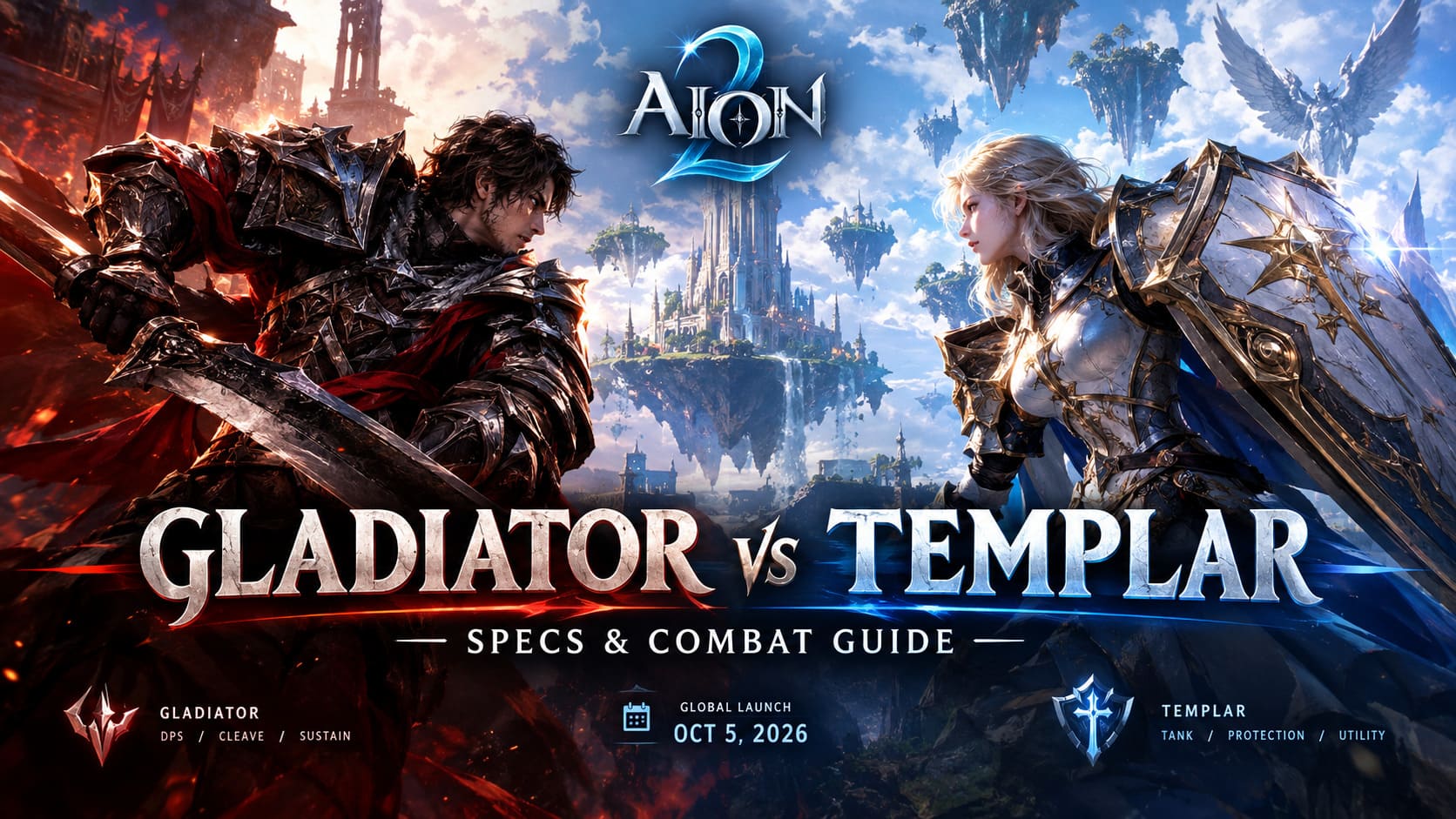
The Templar is built around classic tanking. Sword and shield, defensive cooldowns, threat generation, blocks, absorption effects, and party protection are the foundation of the class. When a boss is preparing something nasty, the Templar is the player everyone expects to have an answer.
The Gladiator takes a much more aggressive approach. Its greatsword-focused gameplay revolves around wide attacks, powerful cleaves, crowd control, and maintaining offensive pressure. Instead of preventing damage, the Gladiator often survives by making sure enemies do not get enough time to become a serious threat.
That difference becomes extremely noticeable once you leave basic leveling content.
Templar: The Defensive Anchor
The Templar feels like the traditional MMORPG tank, but Aion 2 gives the class enough tools to make the role more active than simply standing in front of a boss and holding block.
Its biggest strength is damage control. Templars can generate threat reliably, force enemies to focus on them, and use defensive abilities to reduce incoming pressure. Their shield-based abilities also provide protection for teammates, which becomes increasingly valuable during difficult PvE encounters.
One of the more interesting parts of the Templar kit is the potential for powerful party-wide defensive effects. High-end defensive specifications can provide substantial absorption shields, giving the class a way to respond to dangerous raid mechanics instead of simply relying on healers to repair the damage afterward.
That is where I think the Templar becomes particularly enjoyable. You are not just watching your own health bar. You are constantly thinking about the next mechanic, where the group needs to stand, when to use a defensive cooldown, and whether your party can survive the next attack.
The downside is obvious: you are not going to melt enemies nearly as quickly as a Gladiator. If you enjoy watching huge damage numbers appear constantly, the Templar can sometimes feel painfully slow.
Gladiator: The Aggressive Frontliner
The Gladiator is the class I would recommend looking at if your idea of tanking is more along the lines of “kill everything before it becomes a problem.”
Its greatsword attacks are designed around wide arcs and heavy area damage, making the Gladiator extremely comfortable against groups of enemies. Dungeon trash packs are exactly the sort of situation where the class starts to feel ridiculous in the best possible way.
The class also has access to life-steal and sustain mechanics, allowing it to recover health while continuing to attack. This creates a very different rhythm from the Templar. Instead of waiting for defensive cooldowns and carefully controlling incoming damage, the Gladiator is constantly looking for opportunities to keep attacking and turn offensive momentum into survivability.
There is a catch, though. A Gladiator is considerably more dependent on maintaining melee uptime. A stationary group of enemies is perfect. A boss that constantly moves, flies, or forces the player away from melee range is another story.
This is particularly relevant in Aion 2 because the game puts much more emphasis on vertical movement and aerial combat than a traditional MMORPG. If you cannot stay on your target, all that impressive Gladiator damage potential starts looking much less impressive.
Skill Synergy and the Buff Problem
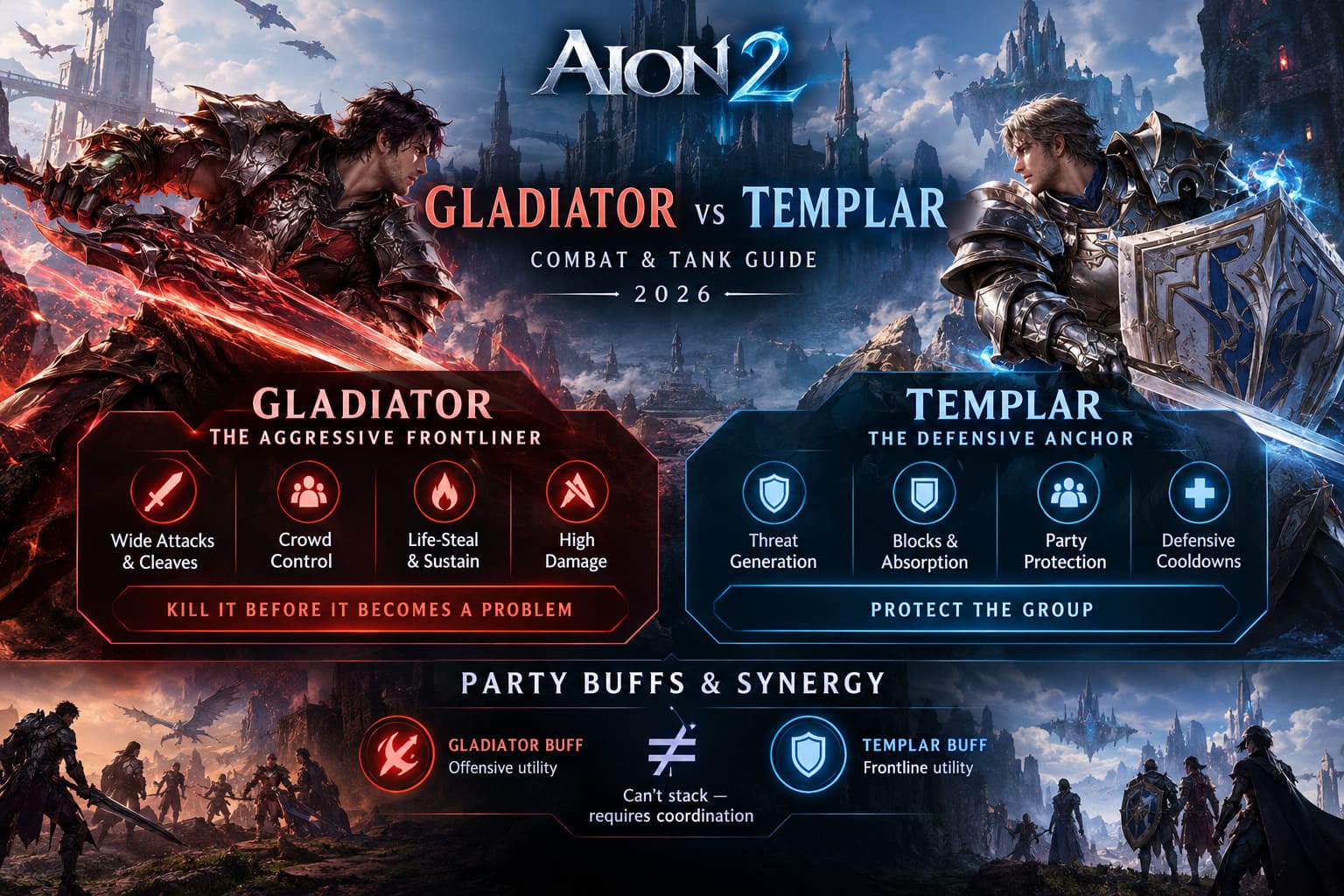
One detail that deserves more attention is how Gladiator and Templar party buffs interact. Their major frontline buffs are not simply two separate bonuses that you can stack together for an even stronger party.
The Gladiator’s offensive-oriented party utility and the Templar’s corresponding frontline buff can interfere with each other because they occupy the same mechanical space. That means raid groups cannot blindly stack both classes and expect every benefit to apply simultaneously.
In practice, this makes coordination more important. A group may need to decide which player is responsible for maintaining the relevant buff and how cooldowns should be timed.
I actually like this design because it prevents the answer from being “just bring both plate classes and get everything.” It forces players to think about what their group actually needs instead of treating every class as an additional source of free bonuses.
Aion 2 PvE: Gladiator or Templar?
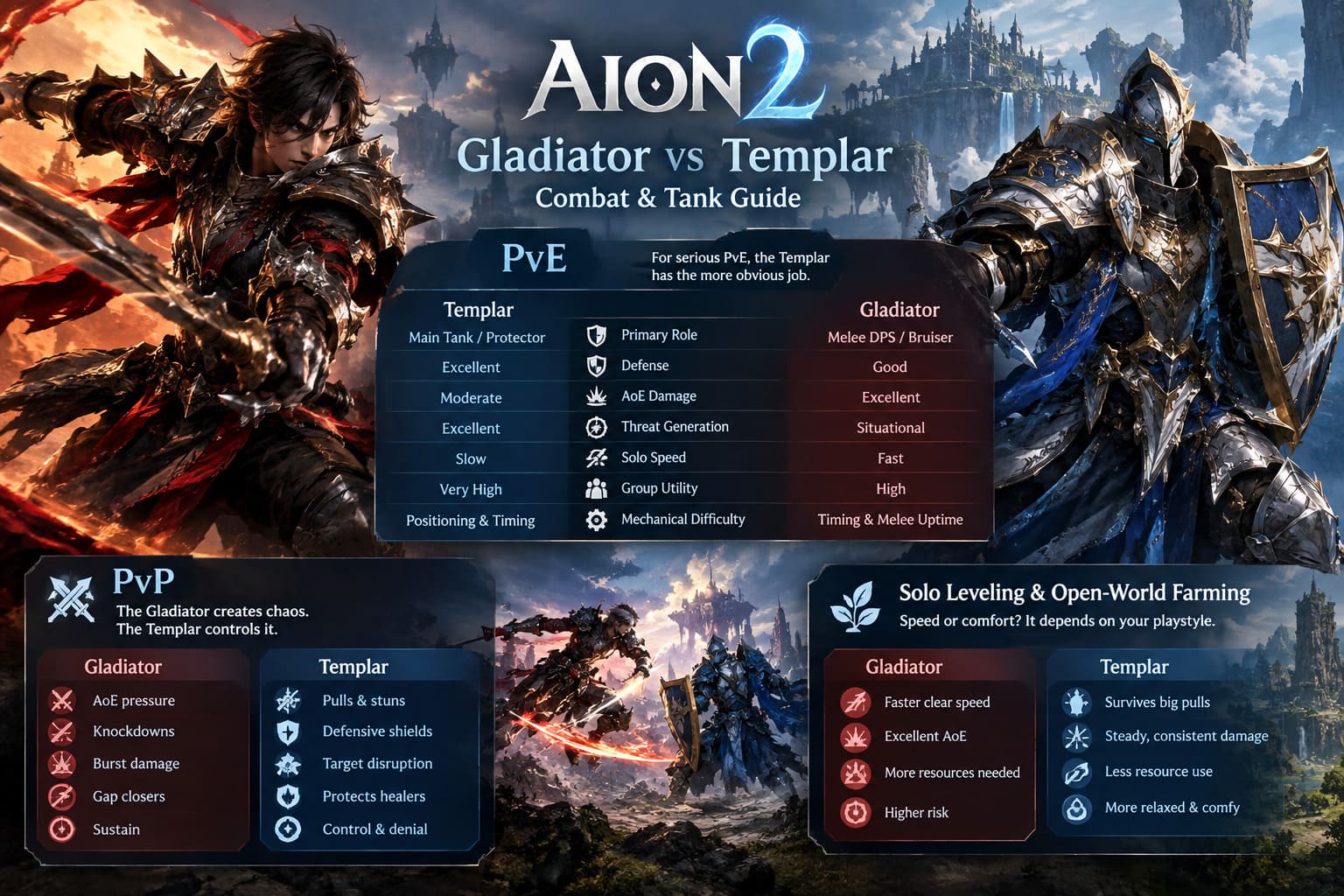
For serious PvE, the Templar has the more obvious job.
| Category | Templar | Gladiator |
|---|---|---|
| Primary Role | Main Tank / Protector | Melee DPS / Bruiser |
| Defense | Excellent | Good |
| AoE Damage | Moderate | Excellent |
| Threat Generation | Excellent | Situational |
| Solo Speed | Slow | Fast |
| Group Utility | Very High | High |
| Mechanical Difficulty | Positioning & Timing | Timing & Melee Uptime |
A difficult raid generally needs someone who can reliably control the boss, survive heavy attacks, and protect the rest of the party. That is where the Templar naturally fits.
For a well-organized 10-player group, the Templar’s defensive utility can be more important than personal damage. A tank that keeps the boss under control gives Clerics and other support classes much more room to focus on the mechanics rather than constantly recovering from mistakes.
The Gladiator is still extremely useful. In fact, this is where I think some players may underestimate it. Its ability to clear groups of enemies quickly can make dungeon runs significantly faster, particularly when dealing with elite mobs and additional targets.
For easier content, farming, and encounters where tanking requirements are less strict, an experienced Gladiator can even handle some off-tank responsibilities. I would not build the class around being a replacement for a dedicated Templar in the hardest encounters, though. The margin for error becomes much smaller.
Aion 2 PvP: Where the Gladiator Gets Interesting
If PvP is your main reason for playing Aion 2, the comparison becomes much less straightforward.
The Gladiator has almost everything you want from an aggressive frontline PvP class: AoE pressure, knockdowns, burst damage, gap closers, and sustain. It can enter a fight, disrupt several opponents at once, and punish players who position themselves badly.
That makes the class especially dangerous in chaotic fights. A Gladiator does not necessarily need to focus on a single opponent from the beginning. It can create pressure across several targets and wait for an opening before committing to a kill.
The Templar plays a completely different PvP game.
Instead of trying to top the kill count, the Templar is about control and denial. Pulls, stuns, defensive shields, and target disruption allow it to interfere with enemy positioning. Protecting allied healers can also make the Templar extremely annoying for teams that depend on diving the backline.
In other words, Gladiator PvP is about creating chaos. Templar PvP is about controlling that chaos.
Solo Leveling and Open-World Farming
This is probably the easiest category to understand.
Gladiator wins on speed. Its AoE damage allows you to move between enemy packs quickly and spend less time waiting for monsters to die. If your daily routine involves clearing maps, farming materials, or completing repetitive open-world objectives, that speed adds up.
The price is survivability management. Gladiators can take serious punishment while farming, which means potions, food, and other recovery resources can become part of the routine.
The Templar takes the opposite approach. You can gather a large number of enemies, survive their attacks, and slowly grind everything down without constantly worrying about your health disappearing.
It is slower, but extremely comfortable.
For players who like relaxed farming while watching something on a second monitor, the Templar’s ability to survive large pulls is honestly a major advantage. For players who want maximum efficiency per minute, the Gladiator is much more appealing.
Aion 2 Class Guide: All 8 Launch Classes Breakdown and Meta Tier List (2026 Global Release)
Which Class Feels Better to Play?
This is where the spreadsheet comparison stops being useful.
If you enjoy being the player everyone depends on when a boss mechanic goes wrong, Templar gameplay has a lot to offer. You have a clear responsibility, and your defensive decisions can directly determine whether an encounter succeeds.
If you would rather be in the middle of the action constantly swinging a massive weapon, Gladiator is the more natural fit. The class rewards aggression, positioning, timing, and the ability to maintain melee pressure.
I also think your personality as a player matters here. Some people genuinely enjoy being the defensive backbone of a raid. Others would rather have a giant greatsword and solve every problem by hitting it harder. Neither approach is inherently more enjoyable; they simply produce very different experiences.
Aion 2 Best Solo Classes Guide: Starter Class Tier List For Solo Players (2026 Launch)
Gladiator vs Templar: My Take
For my own playstyle, the Gladiator is the more immediately exciting class. The combination of huge AoE attacks, melee pressure, crowd control, and sustain gives it a much more aggressive combat loop. When everything lines up, it looks like exactly the kind of chaotic frontline gameplay that makes an MMORPG fun.
But I would not underestimate the Templar. In a serious group, its value becomes obvious very quickly. The class has a defined purpose, and when difficult mechanics start hitting hard, having a player who understands threat management, positioning, and defensive cooldowns can completely change how comfortable a group feels.
So rather than asking which class is universally better, I would ask what you actually want to do in Aion 2.
- Choose Templar if you enjoy tanking, protecting teammates, controlling encounters, and playing a defensive role in difficult PvE content.
- Choose Gladiator if you prefer aggressive melee combat, fast farming, AoE damage, PvP pressure, and a more damage-focused frontline role.
The global launch of Aion 2 will ultimately put both classes through a much larger variety of encounters than any test environment can provide. Builds, balance changes, gear progression, and player discoveries will continue to shape the meta after launch.
For now, though, the core distinction is remarkably clear: the Templar is the shield that keeps the group standing, while the Gladiator is the blade trying to end the fight before that shield is needed. If you know which side of that equation sounds more fun to you, the Gladiator vs Templar decision becomes a lot easier.