Sineus Arena Survivors Gameplay Walkthrough: Strategy Guide to Solo and Co-op Base Defense
The roguelike scene has seen dozens of promising releases over the last few years, but every now and then a game appears that feels genuinely different. After spending countless hours experimenting with builds, testing defense layouts, and getting absolutely demolished by late-game monster waves, I can confidently say that Sineus Arena Survivors is one of the most addictive indie releases of 2026.
At first glance, it looks like another survivor-style bullet heaven game. You jump into an arena, eliminate endless enemies, collect experience, level up, and become absurdly powerful. That familiar formula is definitely here, but Sineus Games decided to throw a massive wrench into the genre by adding real-time base defense, settlement management, exploration mechanics, and surprisingly intense risk-versus-reward decisions.
The result is a game that constantly forces players to choose between greed and survival. One wrong decision can cost an entire run.
Why Sineus Arena Survivors Feels Different
Most survivor-likes focus entirely on character progression. Your only concern is becoming stronger than the incoming horde.
Sineus Arena Survivors introduces another responsibility.
Your character isn’t the only thing that needs protection.
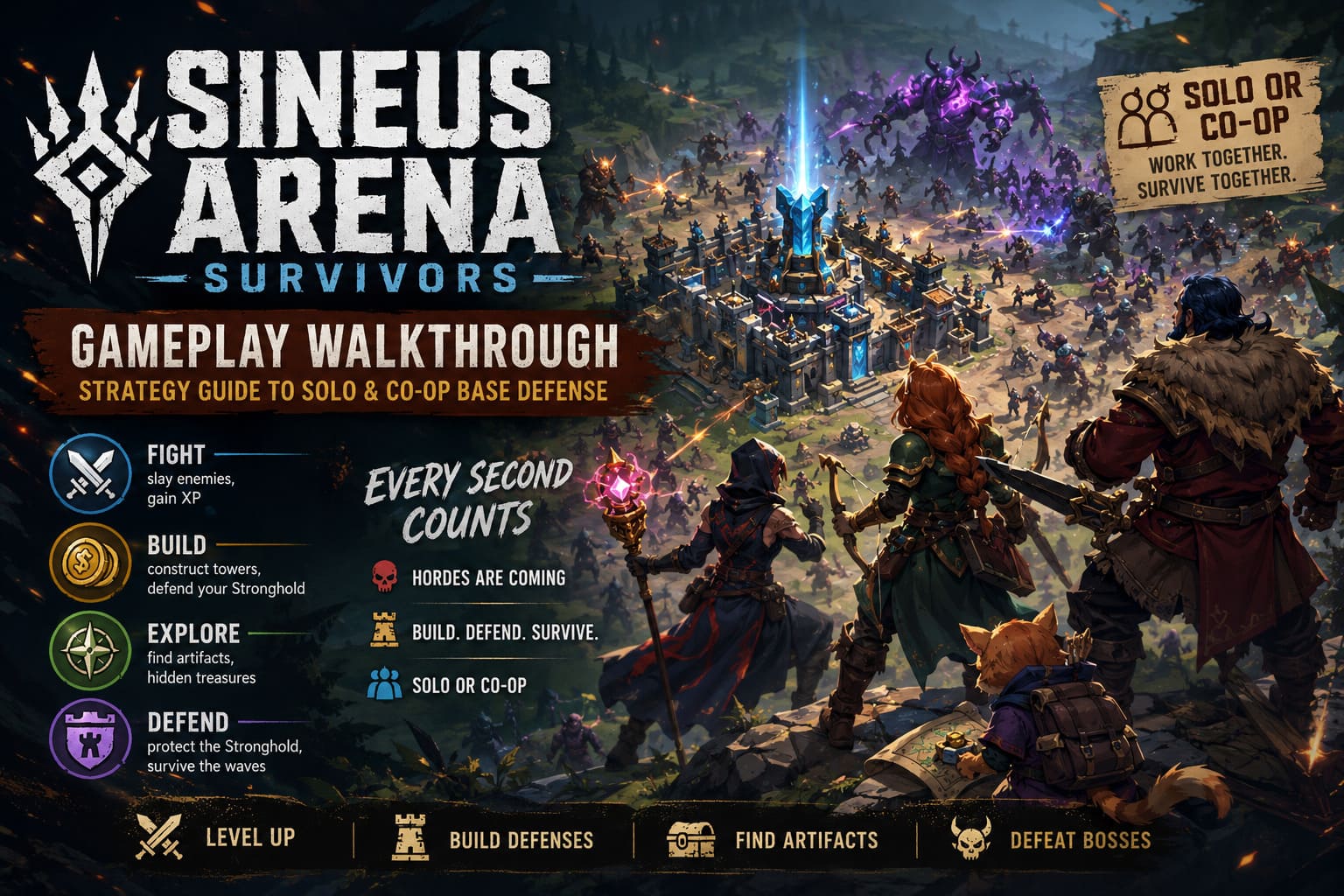
Right from the beginning, you’re tasked with defending a central Stronghold while simultaneously building your hero into a monster-slaying machine. Every second spent exploring the wilderness is a second your base might be under attack.
That pressure never disappears.
In fact, it gets worse as the run progresses.
The further you advance, the larger the enemy armies become, and the more difficult it is to balance exploration, resource gathering, tower placement, and personal survival.
It’s chaotic in the best possible way.
Understanding the Main Gameplay Cycle
Every successful run revolves around four core activities:
| Activity | Purpose | Risk Level |
|---|---|---|
| Eliminating enemies | Gain XP and level up | Low |
| Gathering gold | Construct defenses | Medium |
| Exploring outer zones | Find artifacts and treasures | High |
| Defending the Stronghold | Prevent game over | Critical |
The game constantly pushes players into dangerous territory because the best rewards rarely appear near the safety of the settlement.
Rare relics, elite enemies, hidden shrines, and powerful upgrades are usually located far beyond your defensive perimeter.
That’s exactly where things become dangerous.
I’ve lost multiple promising runs because I got greedy while chasing a legendary chest.
Trust me—those mistakes hurt.
Choosing the Right Hero
The starting roster may appear simple, but each character dramatically changes how a run unfolds.
Berserker
The Berserker is the easiest hero for new players to understand.
He excels in close-range combat and can shred through dense enemy packs with brutal efficiency. Strong health pools and excellent melee damage make him forgiving during the opening stages.
His biggest weakness arrives later when ranged enemies begin flooding the battlefield.
Without defensive upgrades, the Berserker can go from unstoppable warrior to corpse in seconds.
Archer
The Archer takes a completely different approach.
This class rewards positioning, movement, and precision. Elite enemies melt under sustained ranged attacks, while bosses become significantly easier to handle.
The downside is obvious.
A mistake that the Berserker might survive often becomes fatal for the Archer.
Players who enjoy kiting enemies and maintaining distance will feel right at home.
Unlockable Specialists
As progression systems open up, more unique heroes become available.
Some of the later characters introduce unusual mechanics that dramatically alter the flow of combat. These heroes often require more experience but can become ridiculously powerful when used correctly.
The First Five Waves Matter More Than You Think
One of the biggest mistakes I see new players making is playing too passively at the start.
Early waves should be treated like an investment phase.
Leave the immediate safety of your settlement and actively farm nearby enemies. Every experience crystal matters.
The faster you level, the sooner your build begins taking shape.
During the opening minutes, prioritize upgrades that improve:
- Area damage
- Projectile count
- Attack speed
- Crowd control
- Piercing attacks
Single-target damage feels tempting, especially when you know a boss encounter is coming later.
Ignore that temptation.
Bosses don’t matter if regular enemies overwhelm you first.
The early game is all about controlling crowds.
Building an Effective Stronghold
The construction system is where Sineus Arena Survivors truly separates itself from competitors.
Building never pauses the action.
You’re placing defenses while simultaneously dodging enemies and collecting resources.
That creates a frantic pace that feels fantastic once everything starts clicking.
Step 1: Secure Chokepoints
The first gold you earn should almost always be spent on basic barriers.
Walls don’t kill enemies.
They buy time.
That extra time allows towers and allied defenders to do their jobs.
Step 2: Establish Tower Coverage
Once major entrances are protected, begin installing offensive structures.
The strongest layouts create overlapping firing zones.
When multiple towers focus the same approach route, enemy waves disappear far faster than expected.
Step 3: Invest in Automated Defenders
Eventually you’ll unlock AI-controlled units that patrol and defend your Stronghold.
These defenders are game changers.
Their presence allows you to venture farther from home without constantly worrying about immediate disaster.
Exploring Beyond the Walls
This is where runs become memorable.
After your defenses are stable, the map opens up dramatically.
Hidden areas contain some of the strongest upgrades available in the game.
- Treasure chests
- Rare artifacts
- Special shrines
- Elite enemies
- Resource caches
The rewards are incredible.
The danger is equally impressive.
Unlike many roguelikes, death outside secure territory carries real consequences.
Losing valuable items after a long exploration trip feels devastating.
That’s why experienced players learn to recognize when it’s time to retreat.
Greed kills more runs than bosses.
Artifact Selection and Build Synergy

Artifacts are the backbone of every powerful run.
Random upgrades might help in the short term, but synergy wins games.
A build focused on chain lightning effects should continue stacking electrical bonuses whenever possible.
A projectile-focused setup becomes stronger when additional projectile upgrades support it.
Mixing unrelated bonuses often creates mediocre results.
Specialization generally outperforms versatility.
When evaluating artifacts, ask yourself one simple question:
“Does this strengthen my current strategy?”
If the answer is no, there’s a good chance another option will provide more value.
Preparing for the Final Boss
Eventually, exploration reveals the hidden Boss Lair.
This moment separates successful runs from failed experiments.
Too many players rush into the encounter immediately.
That’s usually a mistake.
Before engaging the boss, make sure:
- Your movement speed is respectable
- Core weapons are upgraded
- Defensive structures can survive without you
- Healing options are available
- Artifact synergies are fully developed
A prepared hero makes the encounter feel manageable.
An underprepared hero usually becomes another statistic.
Bosses hit hard, punish mistakes, and often fill large sections of the arena with dangerous attacks.
Movement is everything.
Standing still is rarely an option.
Co-op Strategy That Actually Works
The online co-op mode elevates the experience even further.
After dozens of multiplayer runs, one strategy consistently outperforms everything else.
Split responsibilities.
One player becomes the Stronghold engineer.
Their focus is:
- Building structures
- Repairing defenses
- Managing resources
- Monitoring enemy breaches
The second player becomes the expedition specialist.
Their role is:
- Exploring the map
- Finding artifacts
- Eliminating elites
- Hunting bosses
This division creates remarkable efficiency.
Both players maximize their strengths while minimizing wasted time.
When communication is strong, the game transforms into one of the most satisfying cooperative experiences currently available on Steam.
Advanced Tips for Longer Runs
Veteran players consistently follow a few simple principles:
- Keep moving at all times.
- Upgrade defense and mobility.
- Respect elite enemies.
- Don’t ignore the Stronghold.
- Know when to retreat.
Stationary players eventually get surrounded.
Pure damage builds often collapse during later waves.
Many runs end because players underestimate special monster variants.
A powerful hero can’t save a destroyed base.
The smartest players survive because they recognize danger before it becomes unavoidable.
You Are The Monster Steam PC Price, Game Review, Gameplay Trailer (2026)
Final Thoughts
Sineus Arena Survivors succeeds because it constantly creates meaningful decisions. Every expedition outside the Stronghold feels risky. Every artifact choice matters. Every tower placement can determine whether a run succeeds or collapses under pressure.
The blend of bullet heaven chaos, strategic base management, exploration, and co-op teamwork creates an experience that feels fresh in a genre overflowing with copycat releases.
After spending countless hours experimenting with builds and defenses, I still find myself saying, “just one more run.”
That’s probably the highest compliment a roguelike can receive.
If you enjoy survivor games but want something that demands more strategy and more decision-making, Sineus Arena Survivors deserves a spot at the top of your Steam wishlist.