Pao Pao by ArtDock: The Ultimate Guide to the Next Cozy Nintendo Switch Hit
There is something I have always liked about games that let you build a small life instead of constantly saving the world. After spending years jumping between huge RPGs, competitive multiplayer games, survival sandboxes, and the occasional brutally difficult action title, I still find myself coming back to cozy games when I want something different. That is exactly why Pao Pao caught my attention. Developed by indie studio ArtDock and published by Dreland Enterprises, this upcoming sandbox restaurant simulator mixes cooking, exploration, customization, farming, fishing, and cooperative multiplayer into one colorful seaside adventure.
On paper, Pao Pao might sound like another cute simulation game trying to ride the current cozy-gaming wave. After looking more closely at what it actually offers, though, I think there is more going on here. The interesting part is not any single mechanic, but the way the game appears to connect them. You can spend one part of the day desperately trying to keep hungry customers happy and then completely change gears by fishing, decorating your home, growing crops, or simply wandering around town. That contrast is what makes Pao Pao particularly interesting to me.
Pao Pao Crossplay PC and Xbox: Multiplayer Status, Release Dates, and Co-Op Details Explained
ArtDock Is Building More Than Just Another Cooking Game
Before talking about the gameplay, it is worth looking at the studio behind Pao Pao. ArtDock is an independent developer founded by Dumitru Gibinski and Andrei Masalskii, and the team has grown into an international studio of more than fifty people. Its previous work includes SOS OPS, a physics-driven multiplayer game that demonstrated the studio’s interest in cooperative experiences where things can go hilariously wrong.
That background is important because Pao Pao seems to take a similar philosophy and put it into a much more relaxed setting. Instead of relying exclusively on frantic multiplayer chaos, ArtDock appears to be building a game where chaos is optional. You can enjoy the management systems, explore the world at your own pace, or invite friends and turn the restaurant into four-player madness. Pao Pao was also recognized as a People’s Choice Winner at Nordic Game, which suggests that the concept managed to connect with players before its full release.
What Is Pao Pao Actually About?
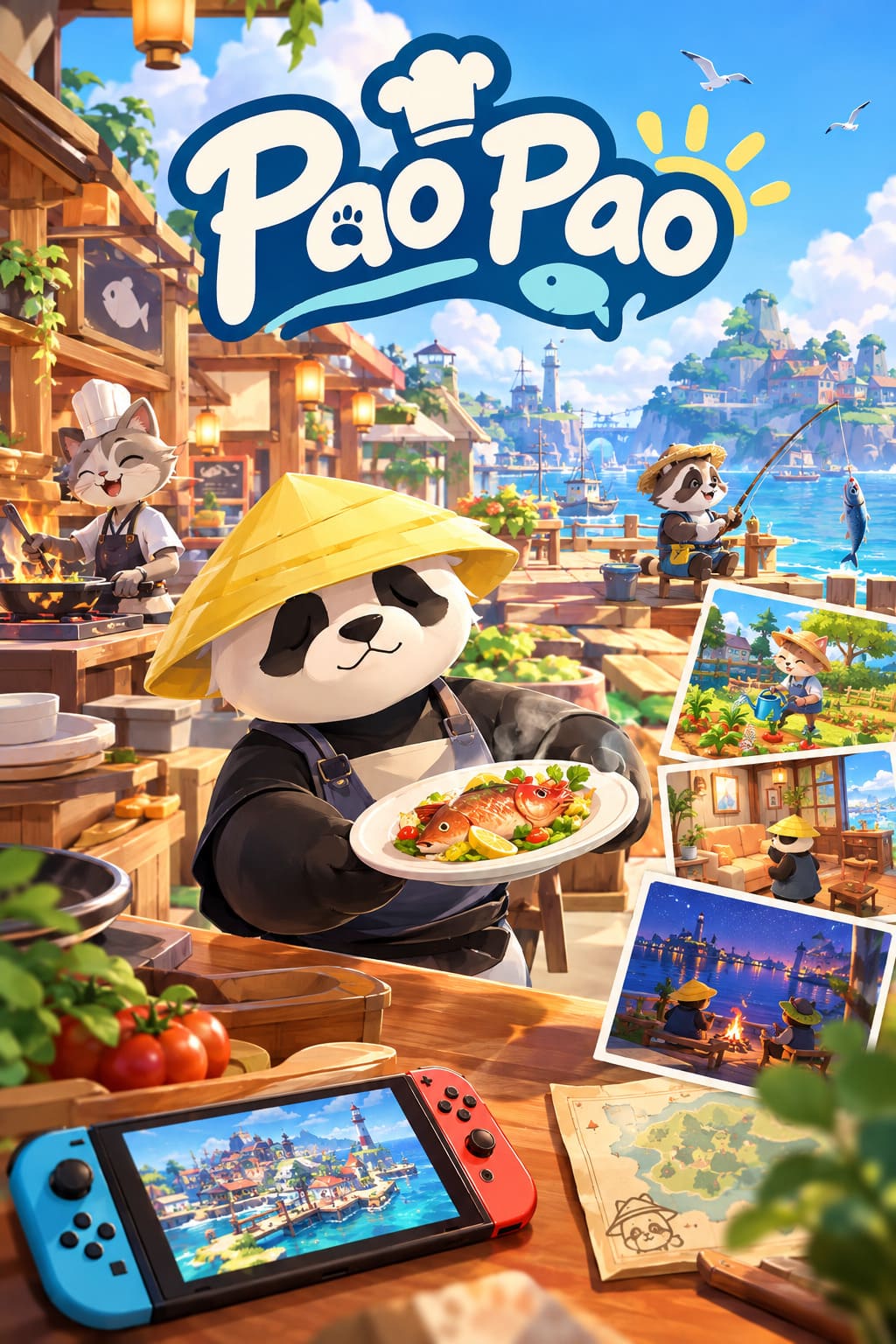
The easiest way to describe Pao Pao is as a cozy restaurant management sandbox with exploration and multiplayer. You play as an adorable anthropomorphic animal character and take responsibility for a seaside restaurant. The cast includes different furry characters such as cats, foxes, and raccoons, giving the world a playful personality without making the restaurant-management mechanics feel completely superficial.
The restaurant itself is the central part of the experience, but it is not the entire game. During the day, you gather ingredients, prepare meals, cook dishes, serve customers, and try to keep the operation running smoothly. Anyone who has played a hectic cooking game knows that even a simple order can become a disaster when several customers arrive at once. The difference here is that Pao Pao gives you an entire world to escape into once the restaurant closes.
| Gameplay Element | What You Can Do |
|---|---|
| Restaurant Management | Prepare dishes, serve customers, organize your kitchen, and improve your business. |
| Farming | Grow ingredients and develop your own garden. |
| Fishing | Spend quieter moments fishing around the seaside environment. |
| Exploration | Discover locations, meet NPCs, and complete side activities. |
| Customization | Decorate your home, restaurant, yard, and character. |
| Multiplayer | Play cooperatively with up to four players. |
The Day-Night Cycle Could Be the Secret Ingredient
For me, the most appealing feature of Pao Pao is the way its day-night structure changes the mood. A lot of management games can become exhausting because the main gameplay loop never really lets you breathe. Pao Pao seems designed around the opposite idea. The daytime restaurant shifts toward a more active and demanding experience, while the evening opens the door to slower activities and exploration.
Imagine spending an in-game day running around the kitchen, collecting ingredients, preparing orders, and trying not to fall behind. Once the work is finished, instead of being pushed immediately into another demanding task, you can head outside and go fishing. Maybe you want to grow some crops, explore the town, decorate your house, or complete a delivery mission. That change of pace is exactly what makes cozy games work for me. You get enough pressure to make success satisfying without turning every minute into a test of reflexes.
Cooking Could Get Surprisingly Chaotic
Despite the relaxing atmosphere, I would not mistake Pao Pao for a game with no challenge. Restaurant management naturally creates pressure because customers have expectations, orders have to be prepared, and the kitchen needs to stay organized. The more responsibilities you take on, the more important planning and prioritization become.
This is where the game could appeal to players who enjoy titles such as Overcooked but do not always want the relentless intensity. There is room for coordination and mistakes, but Pao Pao appears to surround that restaurant gameplay with a much larger sandbox. In other words, if the kitchen becomes a disaster, you can eventually leave it behind and go fishing rather than spending the entire evening screaming at your friends because somebody forgot an order.
Four-Player Co-Op Is Where Things Could Get Really Fun
Pao Pao supports up to four players in online cooperative multiplayer, and this could become one of its biggest strengths. Managing a restaurant with several people creates a completely different experience from playing alone. Instead of handling every task yourself, players can divide responsibilities and develop their own little system.
- One player can gather ingredients and resources.
- Another can focus on food preparation and cooking.
- A third player can manage customer orders and serving.
- The fourth can handle additional tasks around the restaurant or help wherever things are falling apart.
Of course, anyone who has played cooperative games knows that this plan will probably last about five minutes. Eventually somebody will wander off, somebody will burn something, and somebody will insist they know a faster way to do everything. Personally, that is exactly the kind of multiplayer experience I enjoy. The best co-op games are often memorable because of the stories created by mistakes, not because everyone played perfectly.
A Seaside World That Encourages You to Wander
The restaurant is surrounded by a semi-open seaside town populated by NPCs, side activities, and opportunities for progression. This is another area where Pao Pao seems to move beyond the basic cooking-sim formula. Instead of treating the world as a decorative background, the town appears to be an active part of the progression system.
Interacting with characters can lead to quests, new recipes, furniture, upgrades, and other rewards. That gives players a reason to explore rather than simply returning to the restaurant after every working day. I have always appreciated games where NPCs feel like more than quest dispensers, and the combination of side activities and customization could give Pao Pao’s town a surprisingly strong sense of personality.

Customization Looks Like a Big Part of the Experience
Cozy games live or die by customization for a lot of players, and Pao Pao appears to understand that. Character customization allows you to choose your animal identity and change clothing, with options ranging from more traditional chef outfits to much sillier accessories. That may sound like a small feature, but being able to make a character feel like your own is one of those details that keeps people invested.
The customization also extends to the environment. You can decorate your home, restaurant, and yard using furniture, wallpapers, and other decorative elements. The restaurant is not simply a business to manage; it becomes a personal space that reflects how you want to play. That is particularly appealing for players who enjoy the creative side of games such as Animal Crossing, Stardew Valley, or The Sims but also want more active gameplay around their decorating sessions.
Why Nintendo Switch Makes So Much Sense for Pao Pao
The Nintendo Switch feels like a natural home for Pao Pao because of how its gameplay is structured. A short restaurant session could work nicely when playing handheld, while the slower exploration and decorating activities are equally suitable for longer sessions on a television. The game does not appear to demand that every play session become a three-hour commitment.
That flexibility matters more than it might seem. I have played plenty of games that are fantastic but require me to mentally prepare for a long session before starting them. Cozy games are different. You can pick them up, accomplish something meaningful in twenty or thirty minutes, and put them down without feeling like you abandoned some massive quest. Pao Pao’s mixture of short-term restaurant objectives and longer-term customization could fit that style particularly well.
Pao Pao Release Plans and Early Access
According to the provided release information, Pao Pao is scheduled to launch on Steam Early Access on October 26, 2026. Early Access should give ArtDock an opportunity to gather player feedback while continuing to develop the game before its broader console launch. The planned console versions include Nintendo Switch, PlayStation 5, and Xbox Series X|S.
The Early Access approach could be especially useful for a game like this because balancing a simulation is rarely straightforward. Restaurant difficulty, progression speed, multiplayer responsibilities, resource availability, and customization rewards all need to work together. Community feedback can reveal problems that are almost impossible to identify during internal development, especially when hundreds or thousands of players begin experimenting with the systems in completely unexpected ways.
What Makes Pao Pao Stand Out to Me
After playing a lot of different genres, I think the biggest challenge for cozy games is avoiding the feeling that you have already played them before. Farming, fishing, decorating, crafting, cooking, and NPC quests are not new ideas anymore. What matters is how those systems interact, and Pao Pao’s restaurant-focused structure gives those familiar mechanics a different purpose.
The game also seems to understand something that many simulation games occasionally forget: relaxation does not mean the absence of gameplay. A good cozy game still needs satisfying decisions, progression, goals, and moments of failure. Pao Pao appears to be aiming for that middle ground where you can sweat over a difficult restaurant rush with friends one moment and peacefully decorate your house the next.
My Expectations for Pao Pao
I am particularly curious to see how deep the restaurant systems become once players have spent dozens of hours with the game. The initial concept is charming, but long-term progression will ultimately determine whether Pao Pao becomes something players return to for months or simply a pleasant weekend experience. More recipes, meaningful upgrades, interesting NPC relationships, and increasingly complex restaurant challenges could give the game the longevity it needs.
Multiplayer will also be worth watching closely. Four-player co-op can transform an ordinary simulation into something genuinely memorable, but only if the responsibilities are balanced properly. If ArtDock manages to make every player feel useful without forcing everyone into rigid roles, Pao Pao could have the kind of cooperative gameplay loop that keeps friend groups coming back long after they have unlocked the first batch of recipes.
Final Thoughts
Pao Pao is not trying to reinvent every part of the cozy gaming genre, and honestly, it does not need to. Its appeal comes from combining several familiar ideas into a package that feels unusually flexible. You can manage a restaurant, explore a seaside town, grow ingredients, fish, complete side activities, customize your character, decorate your surroundings, or invite friends and turn the whole thing into controlled multiplayer chaos.
For me, that variety is the most promising part. After spending time with games that demand constant attention and precision, there is something refreshing about a title that can let me work toward a goal without making every moment feel urgent. If ArtDock can deliver the depth suggested by its current design while maintaining that balance between hectic restaurant management and genuinely relaxing sandbox activities, Pao Pao could become one of those cozy games that is easy to start and surprisingly difficult to put down.
With its Steam Early Access launch planned for October 2026 and console versions on the horizon, Pao Pao is definitely a game worth watching if you enjoy restaurant simulators, life sims, sandbox games, or cooperative experiences. I am especially interested in seeing whether its combination of cooking chaos and seaside relaxation can find the same kind of long-term appeal that has made other cozy games so addictive. On paper, at least, ArtDock has cooked up a recipe that deserves a closer look.