Nightwater Guide: How to Play, Forage, and Automate Your Base
Nightwater is the kind of game that looks deceptively simple when you first start playing it. You arrive on a tiny island with almost nothing, collect a few basic materials, craft some primitive tools, and slowly begin turning that lonely patch of land into something resembling a functioning industrial operation. But after spending time with games built around automation and resource management, I quickly learned that this genre is rarely about simply collecting more stuff. The real challenge is understanding how to build an efficient production chain before the game forces you to scale it up.
Developed by Studio Ashty and published alongside Irox Games, Nightwater mixes survival, exploration, factory building, progression systems, and a surprisingly mysterious atmosphere. There are obvious influences from games such as Forager and industrial automation titles, but Nightwater has its own strange identity thanks to its isolated islands, dark waters, changing biomes, and the enormous Lighthouse that sits at the center of the game’s mystery. If you’re starting with the Steam demo or preparing for the full game, this Nightwater guide should help you understand the basic progression without turning your first few hours into a mess of disconnected machines and conveyor belts.
Nightwater Game Guide: How to Build, Automate, Explore, and Reach the Endings
How Nightwater’s Gameplay Loop Works
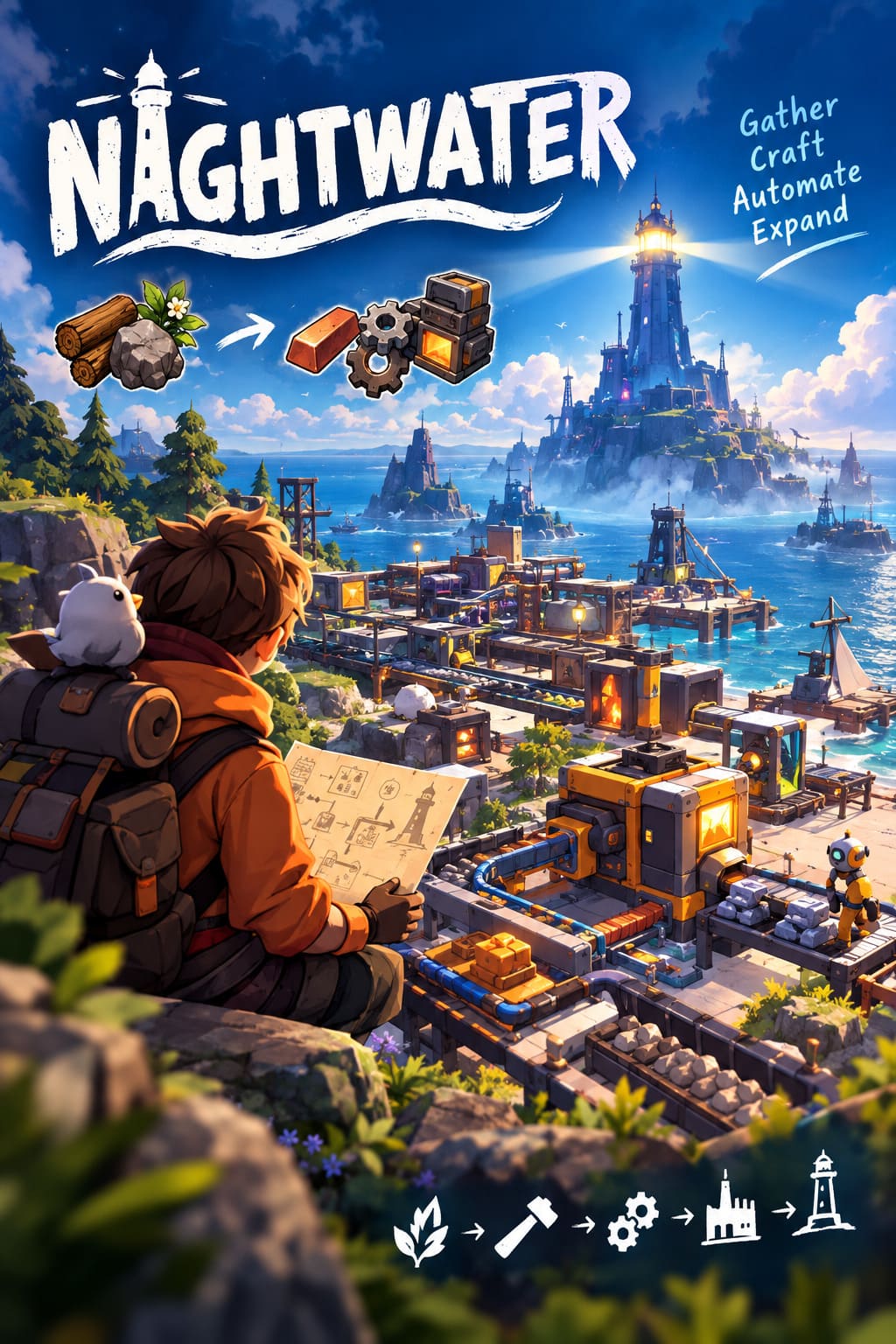
The basic Nightwater gameplay loop is easy to understand: gather resources, craft equipment, unlock technology, automate production, expand your territory, and repeat. What makes it interesting is how dramatically the scale changes as you move through the technological eras. At first, you are personally responsible for almost everything. Later, the factory handles the boring work while you concentrate on expansion, exploration, optimization, and uncovering the game’s secrets.
This transition is one of my favorite aspects of factory games in general. There is something satisfying about looking at a production line that once required constant manual attention and realizing that you no longer need to touch it. Nightwater appears to understand that feeling well, gradually replacing primitive gathering with machines, logistics, processing chains, and increasingly complicated infrastructure.
| Progression Stage | Main Focus | What Changes |
|---|---|---|
| Stone & Bronze | Manual gathering and basic crafting | Primitive tools, furnaces, copper and bronze processing |
| Industrial Era | Factory automation | Mechanical power, conveyors, extractors and processing machines |
| Future Era | Advanced production | Electronics, chemicals, complex energy systems and large-scale logistics |
Stone and Bronze Age: Don’t Overbuild Too Early
Your opening hours are deliberately primitive. The starting island is small, and your first job is simply to gather enough materials to survive and begin researching better technology. Sticks, stones, fibers, and other basic resources become the foundation for your first tools. You will spend a lot more time manually collecting materials at this point, but that is not something you should fight against too much.
One mistake I often make in automation games is building a massive infrastructure for resources that will become nearly irrelevant a few hours later. Nightwater rewards progression more than perfection in the early stages. Build enough to support your immediate needs, unlock the next technology tier, and start moving toward automation rather than spending ages creating a beautiful stone-age factory that you will eventually replace.
Bronze marks an important step forward because furnaces and metal processing begin changing the nature of the game. Copper and bronze materials allow you to create more advanced equipment and eventually unlock the machinery required for the next stage of your factory.
Industrial Era: When Nightwater Becomes a Factory Game
The Industrial Era is where I expect many players will suddenly realize what Nightwater is really trying to do. Manual transportation starts becoming a terrible use of your time, and machines become the obvious answer. Mechanical power, conveyor belts, automatic extractors, and processing buildings allow you to connect different parts of your base into a continuous production system.
Instead of carrying ore from a resource node to a furnace yourself, you can create a chain where extraction, transportation, processing, and storage happen automatically. That is the point where your little survival camp starts looking like an actual factory.
Do not think of conveyor belts as decoration. Their layout matters. Leave room for additional machines, avoid creating unnecessary crossing points, and think about where future production buildings might go. A production line that looks perfectly organized when you have two machines can become a nightmare once you need four or six.
How to Keep Your Production Lines Balanced
Factory games have one universal rule: the fastest machine in your chain does not matter if another machine is acting as a bottleneck. If an extractor produces resources faster than your furnace can process them, the conveyor will eventually fill up. That sounds obvious, but it is incredibly easy to overlook when you’re expanding several production chains at once.
Whenever you notice materials piling up before one particular machine, investigate that part of the chain first. Sometimes the solution is another processor. Sometimes you need additional extraction. In other situations, the problem is transportation rather than production. Think of every factory as a system rather than a collection of individual buildings.
Automated Extractors Should Become a Priority
Once automated resource extraction becomes available, use it aggressively. Manual mining and harvesting are useful when you’re starting out, but continuing to collect basic resources by hand after unlocking machines is usually a poor investment of your time.
- Place extractors directly on useful resource nodes whenever possible.
- Connect extraction to processing instead of creating unnecessary storage steps.
- Watch your production ratios so machines don’t constantly wait for materials.
- Leave expansion space around your core production areas.
This is also where planning becomes more important. You don’t want your entire base to depend on one tiny production area if later technologies require significantly more materials. A little empty space early on can save you from tearing apart half your factory later.
The Item Collector Can Save a Lot of Time
One particularly useful quality-of-life feature is the Item Collector. Instead of running around your factory and checking every output container individually, you can route production toward a central collection point. For anyone who has played automation games before, this kind of system may seem like a small convenience, but it makes a surprisingly big difference once your factory becomes large.
I strongly recommend designing your main production area around a central logistics concept. Keep important outputs accessible, reduce unnecessary walking, and try to make your factory readable at a glance. When you eventually have multiple resources, machines, and conveyor networks operating simultaneously, organization stops being cosmetic and becomes part of your gameplay strategy.
Expanding Into New Biomes
Your starting island is never going to be enough for the entire game. Resource availability is limited, and progressing through the technology tree eventually requires materials that cannot simply be found beside your original base. This makes territorial expansion an important part of Nightwater’s progression rather than an optional side activity.
Land extensions require specific materials, often increasingly advanced manufactured components. Once you meet the requirements, a new section of land emerges from the surrounding mist. These expansions provide more building room, but their real importance is that they introduce new biomes, resources, environmental conditions, and secrets.
This creates an interesting logistical problem. Your newest resource might be located far away from your primary factory, meaning you need to decide whether to establish a secondary production facility or transport everything back to your central base. Personally, I prefer a hybrid approach: keep basic processing close to the resource source when transportation becomes inefficient, while maintaining a central hub for higher-level manufacturing.
Why Factory Layout Matters More Than You Think
Nightwater encourages you to expand gradually, but it is worth thinking ahead. When you purchase another piece of land, don’t immediately fill every available square with buildings. Keep clear corridors between major resource areas and your production center.
Later technologies introduce more complicated production chains, which means more belts, machines, storage, and connections. The conveyor-belt spaghetti problem is real, and once a factory reaches that point, fixing it can be more painful than building it correctly in the first place.
A simple rule works surprisingly well: give important production chains their own lanes and keep enough open space around major intersections to add machines later. Your future self will appreciate it.
The Five Mini-Games Add More Than Just a Distraction
Nightwater isn’t entirely about watching machines process materials. The game also includes five separate mini-games that provide a break from the main factory loop. Each has its own mechanics, progression, and rewards, which makes them more meaningful than the typical optional activity you might ignore in another survival game.
Some players will probably be tempted to skip these systems because they are focused on building the biggest possible factory. I wouldn’t recommend doing that. The rewards from these activities can feed back into your main progression through special blueprints, crafting options, materials, and permanent efficiency improvements.
The best way to approach them is to treat the mini-games as part of your wider progression rather than completely separate content. If your factory is running smoothly, there is no reason to stand around waiting for a production cycle to finish. Go explore one of the alternative activities and let your machines work in the background.
Exploring the Mystery Behind the Lighthouse
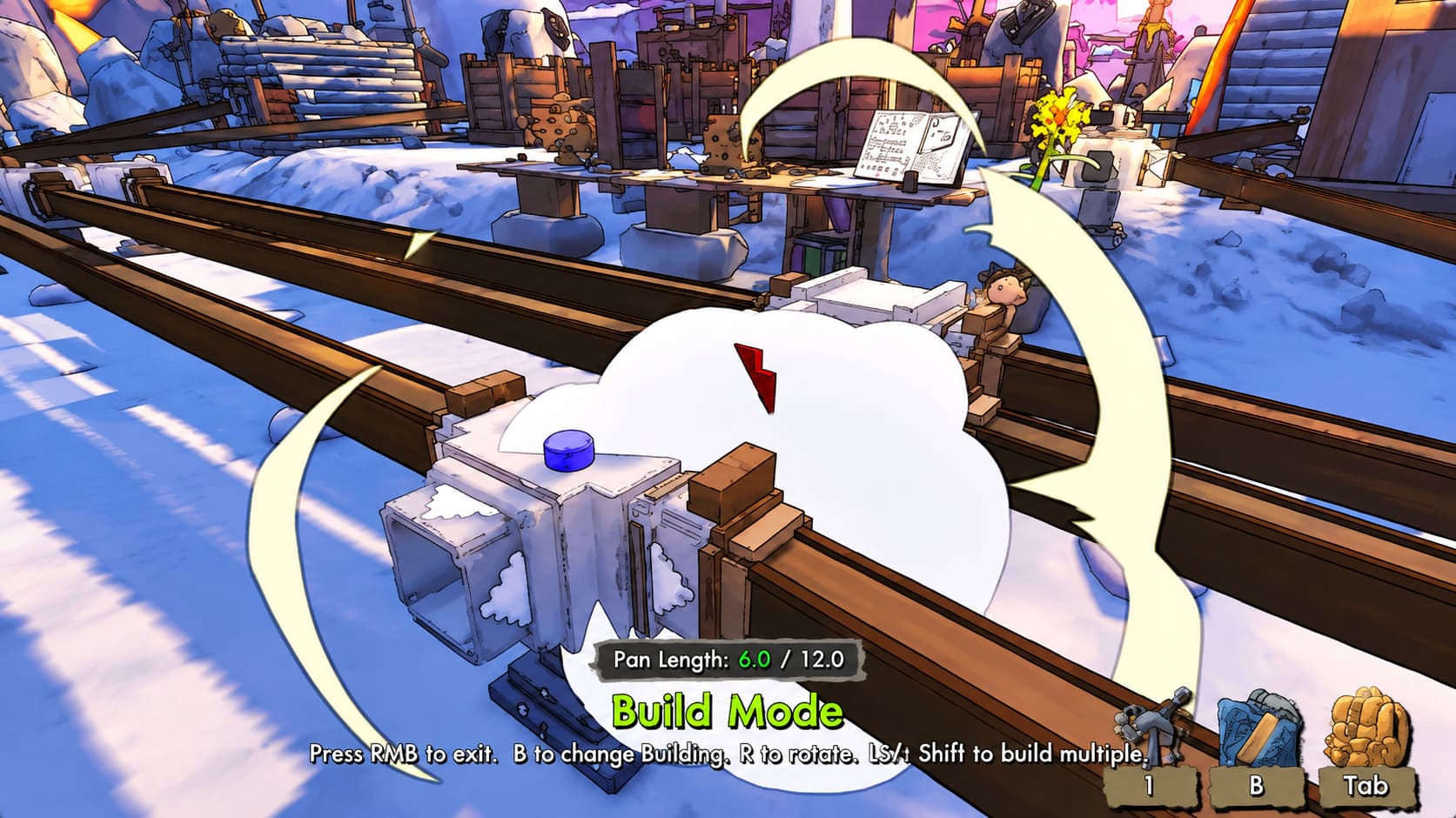
Underneath all the resource gathering and automation, Nightwater has another layer that gives the world its atmosphere. The Lighthouse is not simply another structure waiting for you at the end of a technology tree. It is connected to the central mystery of the world and the question of why your character is trapped in this strange reality in the first place.
The storytelling appears to favor environmental discovery over constant cinematic interruptions. Instead of stopping the game every few minutes for a long cutscene, you are encouraged to explore, investigate unusual locations, find anomalies, and gradually connect pieces of information. That approach fits Nightwater surprisingly well. The isolated islands and dark surroundings already create an uneasy atmosphere, so letting the player discover the story naturally makes the world feel more mysterious.
Your ultimate objective is to restore and power the Lighthouse, but reaching that point is not simply a matter of gathering one final resource. The game features four different endings, with deeper exploration and hidden objectives influencing how the journey concludes. Players who only focus on factory progression may therefore miss some of the game’s more interesting secrets.
Nightwater Beginner Tips I Wish I Had Followed Earlier
If you’re just starting Nightwater, there are a few habits that can make the progression considerably smoother. Most importantly, resist the temptation to perfect every early production line. Technology moves forward quickly, and advanced machinery can make your old setup obsolete before you know it.
- Prioritize technology progression. Build enough infrastructure to reach the next important upgrade instead of endlessly optimizing low-tier resources.
- Plan your factory vertically and horizontally. Leave room for future machines and conveyor routes rather than using every available tile immediately.
- Keep your production balanced. If one machine is constantly overflowing while another sits idle, your production chain probably needs adjustment.
- Check your factory before exploring. Start important production cycles before entering a mini-game or heading into a new biome.
- Study the terrain before expanding. Natural obstacles can affect how easily you can connect distant resource areas to your main factory.
Is Nightwater Worth Getting Into?
What makes Nightwater interesting to me is the combination of two very different moods. On one side, you have the familiar satisfaction of watching an automated production chain become faster and more complicated. On the other, there is a lonely and slightly unsettling world built around the dark water, isolated biomes, and the mystery of the Lighthouse.
I’ve played plenty of factory and survival games where the automation eventually becomes the entire point, and I’ve also played survival games where crafting feels like busywork rather than progression. Nightwater sits somewhere between those ideas. The factory is your tool for progressing through the world, but the world itself gives you reasons to keep expanding.
If you enjoy games where a tiny collection of basic resources eventually turns into a sprawling network of machines, Nightwater has an appealing progression structure. Just remember that efficiency isn’t about making everything complicated as quickly as possible. Build with the next stage in mind, automate the repetitive tasks, explore when your production is running, and keep an eye on what the Lighthouse is quietly asking you to discover.
Final Thoughts
Nightwater starts with sticks, stones, and a very small island, but its ambitions are considerably larger. The journey from primitive crafting to industrial automation and futuristic production gives the game a strong sense of progression, while the biome system prevents your factory from becoming completely disconnected from exploration.
The biggest tip I can give new players is simple: don’t rush to build the biggest factory possible; build a factory that can grow. Leave space, automate intelligently, watch your bottlenecks, and use the mini-games and exploration systems to supplement your main progression. If you do that, the journey toward the Lighthouse should feel less like a grind and more like watching a strange little survival camp evolve into a machine capable of changing the entire world around it.