Is WoW Forever Canon to Warcraft Lore? The New Timeline Explained
There is something strangely exciting about seeing World of Warcraft return to the place where it all began while refusing to simply repeat the past. After years of expansions, cosmic threats, world-ending disasters, time travel, and enough lore twists to make even longtime players reach for a wiki, Blizzard’s World of Warcraft: Forever is taking a much more unusual approach. It looks back at the classic version of Azeroth, but instead of treating that era as a museum piece, it uses it as the starting point for an entirely new story.
Naturally, one question has taken over the Warcraft community: Is WoW Forever actually canon? If you have followed Warcraft lore for years, this is an important distinction. Nobody wants to spend hundreds of hours learning a new version of Azeroth only to discover that its biggest events quietly contradict everything established in the main storyline. Fortunately, Blizzard’s explanation makes the situation considerably clearer.
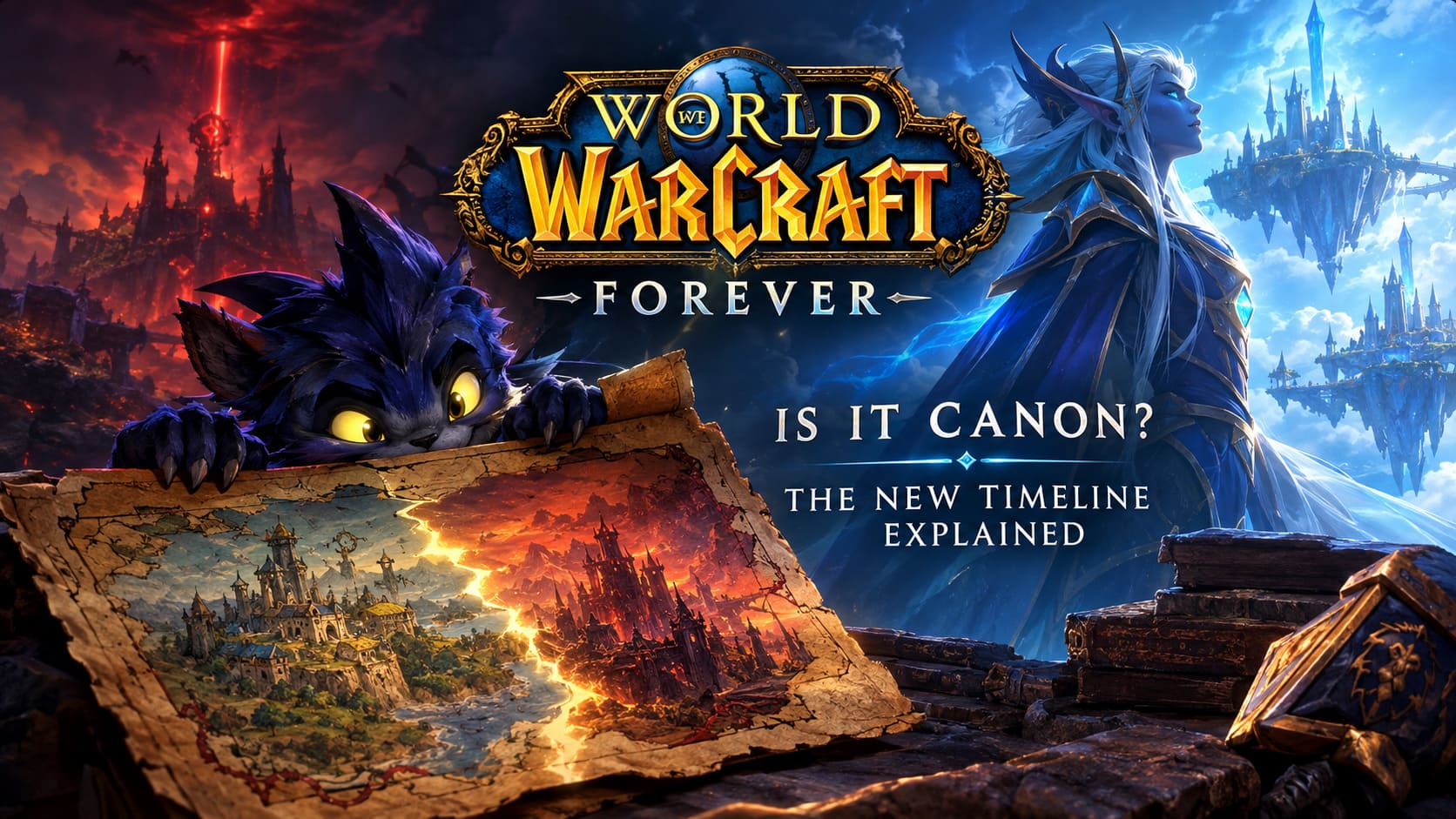
The simplest answer is this: WoW Forever is not part of the main Retail Warcraft timeline. It exists as an alternate continuity, effectively a separate version of Azeroth that begins with the foundations of the original World of Warcraft and then develops in a different direction.
Can Active Subscribers Use WoW Forever Friend Invite Codes? Blizzard’s Account Rules Explained
WoW Forever Is an Alternate Timeline, Not a Retail Retcon
The biggest thing to understand is that World of Warcraft: Forever is not trying to rewrite Retail WoW. Blizzard is instead treating the project as a parallel timeline, sometimes described as a narrative ‘time bubble.’
That distinction matters. In the past, Blizzard has experimented with alternate versions of classic Azeroth while still trying to fit new events into established continuity. Season of Discovery, for example, could be interpreted as uncovering things that existed around the original era but simply weren’t experienced by our characters. Forever goes much further than that.
The developers are essentially saying: this is another Azeroth.
That means the events of modern World of Warcraft still happen in the primary timeline. The major expansions, wars, characters, and disasters that shaped Retail Warcraft are not being erased. Instead, Forever takes the classic foundation and asks what might happen if history continued differently from that point.
For players, this creates a surprisingly clean separation:
| Warcraft Version | Narrative Status | What It Means |
|---|---|---|
| Original WoW | Historical Foundation | The starting point for Forever’s world |
| Modern Retail WoW | Main Canon | The primary Warcraft timeline |
| WoW Forever | Alternate Continuity | A separate Azeroth with its own history |
| Season of Discovery | Classic-era Experiment | Expands the original era without the same degree of timeline separation |
This is also why you shouldn’t approach Forever expecting every future event to line up with the Retail storyline. The rules are different because the history is different.
Why Blizzard Needed a Separate Timeline
This is probably the part I find most interesting.
When a game has been running for more than two decades, continuity becomes a creative constraint. Every new character, faction, location, war, and magical event has to coexist with an enormous pile of established lore. Warcraft has reached the point where the writers aren’t just creating a new story; they’re constantly negotiating with twenty years of previous stories.
That can be exhausting.
Retail Azeroth has already survived invasions from demons, ancient gods, dragons, alternate timelines, cosmic entities, death realms, and enough apocalyptic events to make the average citizen of Stormwind wonder why anyone still bothers rebuilding the city.
Forever gives Blizzard an escape hatch.
Instead of asking, ‘How can we introduce this idea without contradicting something from 2008?’ the writers can ask a much more interesting question: ‘What would Azeroth look like if history had taken another road?’
That’s a huge difference.
It also allows the developers to revisit parts of the original game that were never fully realized. Classic WoW contained unfinished areas, mysterious locations, and places that were clearly designed with larger plans in mind. Some eventually received completely different stories in later expansions, while others remained little more than fascinating pieces of Warcraft history.
Forever can take those old ideas and actually do something with them.
The Skyborne Are One of the Biggest Clues
Nothing demonstrates the alternate-universe concept better than the introduction of the Skyborne, also known as the Shen dorai.
According to Forever’s new lore, these elves are connected to a group of High Elves who sought an escape from the corruption surrounding the Shen dralar. Their solution was anything but ordinary: they formed a pact with the elemental powers of Skywall.
Over generations, that relationship transformed them into something distinctly different from the elves players know from the main Warcraft timeline.
They became Air Elves.
That is exactly the kind of concept Blizzard would have difficulty introducing into the established Retail continuity without creating a mountain of questions. Where were these elves during all the major events? Why did nobody mention them? Why weren’t they present during the events surrounding Skywall? How could such a significant group remain hidden for so long?
In Forever, those questions don’t have to be answered within Retail history.
The Skyborne exist because this timeline developed differently.
And personally, I think that makes their introduction much more interesting. Instead of feeling like another late addition awkwardly squeezed into existing lore, they can actually become part of a new version of Azeroth from the ground up.
Forsaken Paladins Push the Timeline Even Further
The Skyborne aren’t the only major departure.
Another particularly interesting change involves the Forsaken Paladins, connected to the Warcraft III: Reforged bonus campaign Forsaken Kingdom. The campaign explores the aftermath of Warcraft III and the fall of Lordaeron, providing additional context for the Forsaken and the creation of their kingdom.
The idea of undead characters wielding the Holy Light has always been controversial within Warcraft lore because of the obvious contradiction between undeath and holy power.
Yet Forever embraces that contradiction.
That opens the door to character combinations that would feel extremely unusual in the main continuity. And this is exactly where the alternate timeline becomes useful: Blizzard doesn’t have to spend years constructing increasingly complicated explanations for why something that previously seemed impossible suddenly exists.
It can simply say, ‘This happened differently here.’
For an MMO built around player freedom, that is a powerful storytelling tool.
The ‘Found Photographs’ Philosophy
One of the more fascinating ideas behind Forever’s development is Blizzard’s comparison of the original WoW world to found photographs.
Think about finding a box of old photographs from twenty years ago. You can see what was inside the frame, but you have no idea what was happening just outside it. You know the location existed, but you don’t necessarily know everything that happened there.
That is apparently close to how Blizzard views classic Azeroth for Forever.
The original 2004 game provides the visual and thematic foundation. Its atmosphere, locations, factions, and general identity remain important, but Blizzard isn’t treating every empty space or unfinished idea as a rigid historical document.
This is particularly useful for locations that existed in early WoW but later received radically different interpretations.
Mount Hyjal is a perfect example of the creative freedom this approach provides. Rather than being forced to follow every development that eventually happened in Retail, Forever can look at the classic-era concept and ask what story would make sense for this version of Azeroth.
That is less like remastering an old game and more like taking an old sketchbook and finishing the drawings differently.
What This Means for Warcraft Lore Fans
The reaction to this approach is understandably divided.
Some lore fans are probably breathing a massive sigh of relief. Warcraft continuity has become incredibly complicated, and not everyone enjoys having to remember events from multiple expansions just to understand what a character is doing today.
A separate continuity removes much of that baggage.
You can jump into Forever knowing that you don’t need to understand every development from modern Retail WoW to appreciate its story. The classic foundation matters, but the future belongs to this particular version of Azeroth.
For players who miss the smaller-scale Warcraft storytelling of the early years, that could be fantastic.
On the other hand, there is a legitimate criticism here. If nothing in Forever can affect the main Warcraft timeline, some players may question how much the story actually matters.
That is the biggest challenge Blizzard faces.
A good alternate-universe story still needs consequences. Even if those consequences don’t affect Retail Azeroth, they need to matter within Forever’s own world. If a new faction rises, a city falls, or a beloved character dies, players should feel that the event has permanently changed their version of the world.
Otherwise, Forever risks becoming little more than an enormous ‘what if?’ playground.
Why I Actually Like the Idea
I’ve played enough sequels, remakes, expansions, and live-service games to know that nostalgia can be a dangerous trap. Simply recreating an old game with better graphics doesn’t automatically recreate what made it special.
That’s why I find Forever’s approach more appealing than a straightforward Classic reboot.
It isn’t trying to pretend that 2004 never ended. It’s asking what could have happened next.
That distinction gives Blizzard room to experiment while preserving the identity that made classic Azeroth memorable. We can have familiar locations and factions alongside completely unexpected races, classes, quests, and conflicts.
And because Forever doesn’t have to eventually arrive at the same destination as Retail, the writers can actually surprise players.
That is something Warcraft could use.
After twenty years, the biggest danger isn’t necessarily bad storytelling. Sometimes it’s predictability. When players know that a particular character must survive because they appear in later canon, or that a certain location must eventually look a particular way, some of the tension disappears.
An alternate timeline solves that problem immediately.
Do You Need to Know Retail Lore Before Playing WoW Forever?
Not really.
If you’re a Warcraft lore fanatic, your knowledge will obviously make the experience more interesting because you’ll recognize the differences. You’ll notice when a familiar faction behaves differently or when an old location takes an unexpected turn.
But you shouldn’t need a complete encyclopedia of Retail Warcraft to understand Forever.
In fact, I suspect the game could be particularly appealing to players who left WoW years ago.
Someone who remembers classic Azeroth but stopped playing after a few expansions may find Forever easier to approach than modern WoW, simply because they aren’t being asked to catch up on every major event from the past decade.
The basic premise is refreshingly simple: start with the world you remember, then discover what happened differently.
The Bigger Picture for World of Warcraft
There is a larger lesson here about how Blizzard can handle Warcraft’s future.
Instead of forcing every new idea into one increasingly complicated timeline, the company now has an opportunity to maintain different kinds of Warcraft experiences. Retail can continue moving forward with its own enormous storyline, while Forever can explore classic-era possibilities without constantly looking over its shoulder.
That doesn’t make one version ‘more real’ than the other.
It simply gives them different purposes.
Retail is the continuing history of Warcraft. Forever is the history that could have been.
And that distinction might ultimately be the reason the project works.
Final Verdict: WoW Forever Has Its Own Canon
So, is WoW Forever canon to Warcraft lore?
Yes and no—but the important distinction is that it has its own canon rather than being part of the primary Retail canon.
The main Warcraft timeline remains intact. Forever branches away from it and creates a parallel Azeroth where Blizzard can explore new races, alternative character possibilities, unfinished locations, and entirely different conflicts without rewriting twenty years of established history.
For me, that’s a much more exciting proposition than another nostalgia-driven remake.
When World of Warcraft: Forever arrives on November 4, 2026, players won’t simply be walking through the past with higher-resolution textures. They’ll be exploring a version of Azeroth that remembers where Warcraft started but isn’t obligated to end up where Retail did.
And that is the part I’m most curious about.
If Blizzard is willing to let this world genuinely surprise us, Forever could become something much more interesting than ‘Classic WoW with new content.’ It could become Warcraft’s ultimate alternate history.