No Man’s Sky Worlds Update: Guide to Finding Perfect Earth-Like Planets
If there is one thing No Man’s Sky has taught me after countless hours of jumping between systems, scanning planets, and landing on worlds that looked promising from orbit only to turn out to be radioactive nightmares, it is this: finding a beautiful planet is easy; finding a truly perfect one is not.
And by “perfect,” I mean the kind of world that actually feels like an alternative Earth. Green grass. Blue water. A clean blue sky. Trees that look vaguely familiar instead of giant glowing mushrooms. No toxic storms forcing you into a shelter every few minutes. Ideally, Sentinels should leave you alone, too.
The Worlds updates made this hunt considerably more interesting. The revamped planetary visuals, improved water, atmospheric effects, wind, vegetation and new environmental details can make some planets look absolutely ridiculous in the best possible way. But they also mean that the old “this planet is green, so I guess it’s good” approach doesn’t really cut it anymore.
So, after spending far too much time staring at galaxy maps, here is my practical No Man’s Sky guide to finding an Earth-like planet in 2026, including which biome labels matter, where I would search, and what I actually check after landing.
What Counts as an Earth-Like Planet in No Man’s Sky?
First, let’s get one thing straight.
There isn’t a single procedural setting called “Earth clone.” The game combines a huge number of planetary variables to create each world. That’s why two planets belonging to the same general biome can look completely different.
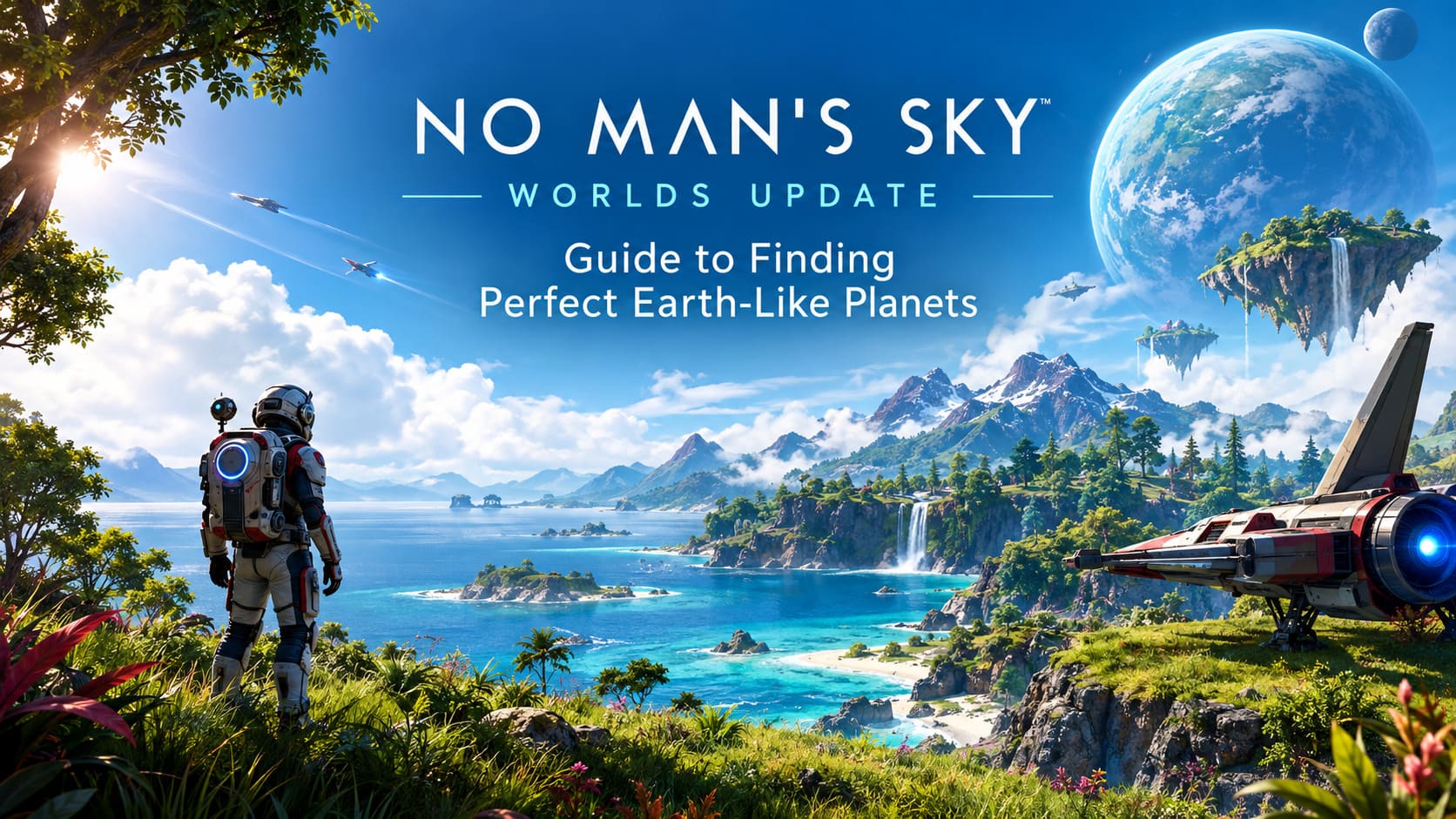
For my purposes, a great Earth-like planet should have most of these characteristics:
- Green or natural-looking grass
- Blue or turquoise oceans
- Clear blue daytime skies
- Earth-like trees and vegetation
- No regular hazardous storms
- Low or manageable Sentinel activity
- Comfortable temperatures
- A landscape that actually looks good for building
That last point matters more than people admit. A technically habitable planet can still be ugly. I’ve found plenty of worlds that checked the “lush” box but had bizarre purple grass, yellow skies and water that looked like someone had poured industrial chemicals into the ocean.
Personally, I would rather spend another hour searching than build my forever base on one of those.
The Lush Biome Is Where the Search Starts
In No Man’s Sky, Earth-like planets generally belong to the Lush biome family. The game can give these worlds several different names when you scan them from space.
Here are the major descriptors you may encounter:

| Lush Biome Descriptor | What It Usually Means |
|---|---|
| Paradise | One of the most desirable labels for comfortable worlds |
| Lush | Classic lush-world generation |
| Verdant | Green vegetation and potentially attractive terrain |
| Tropical | Warmer, heavily vegetated environment |
| Overgrown | Dense vegetation and organic landscapes |
| Flourishing | Rich vegetation and lush terrain |
| Grassy | Open green landscapes |
| Plentiful | Vegetation-heavy world |
| Humid | Lush environment with wetter characteristics |
| Temperate | Mild-looking planetary environment |
| Rainy | Lush world with more weather influence |
Important: don’t assume the word “Paradise” automatically means you’ve found a flawless Earth replacement.
That label is a fantastic starting point, but procedural generation can still produce worlds that aren’t visually perfect for what you’re trying to build. I have a much stricter definition of “perfect” than the scanner does.
A Paradise planet with purple grass, strange skies and ugly water isn’t winning my base location.
Should You Search in Eissentam?
This is where the whole process gets much more interesting.
You can absolutely find beautiful planets in Euclid, and there is no reason to abandon your starting galaxy if you already have everything there. But if your specific goal is to hunt for lush, comfortable worlds, moving into a Lush-type galaxy can make the search more appealing.
Eissentam is the obvious name most players will encounter. It has become one of the best-known destinations for players who enjoy finding beautiful planets and building elaborate bases.
There are also other Lush galaxies worth exploring, including Isdoraijung.
I wouldn’t treat galaxy choice as some magical guarantee that your next warp will produce an Earth clone. It doesn’t work that way. What it does is give you a better environment for this particular kind of planetary hunting.
And honestly, that’s enough reason for me.
The Galaxy Map Can Save You a Ton of Time
Once you’re in the right galaxy, don’t just pick random stars and hope for the best.
Look at the star information.

For an Earth-like search, I would concentrate heavily on yellow-star systems, particularly G- and F-class systems. These are the systems I would check first when I’m specifically hunting for lush worlds.
The basic spectral labels look something like:
- G-class — yellow-orange stars
- F-class — yellow-white stars
You don’t need to become an astrophysicist to use this system. The point is simply to narrow your search before wasting fuel.
I also pay attention to the system information indicating Water.
If I’m looking for a world with huge oceans and dramatic coastlines, I don’t want to discover halfway through my search that the entire system is basically a collection of dry rocks.
What About the Number After G or F?
You may see something like G4, G6, F5 or F7.
The number represents the star’s temperature classification. For a practical search strategy, I prefer the middle range rather than deliberately chasing the extreme ends.
My shortlist would be:
G4, G5, G6, G7, F4, F5, F6 and F7.
This isn’t a guarantee that one of these systems contains your dream planet. No Man’s Sky isn’t handing out Earths according to a simple checklist. Think of this as a filtering method, not a cheat code.
And that’s an important distinction.
The Freighter Method Is Easily My Favorite Shortcut
If you’re serious about planetary hunting, your freighter can become one of the most useful tools in the process.
The idea is simple: reduce the amount of time spent manually checking every planet.
With a suitable freighter setup and a Scanner Room, you can inspect a system much faster than repeatedly flying around and scanning every individual planet from your starship.
My preferred routine looks roughly like this:
- Pick a promising yellow-star system from the galaxy map.
- Warp into the system.
- Use the freighter’s Scanner Room to inspect the system.
- Check the discovered planets for lush or Paradise candidates.
- Ignore obvious toxic, frozen, barren or radioactive worlds.
- Visit only the planets that actually look promising.
- Repeat.
That’s the whole idea.
The goal isn’t to spend more time scanning. It’s to spend more time landing on interesting planets.
Once you’ve done this for a while, the difference becomes obvious. Instead of treating every planet as a potential home, you’re quickly eliminating 80–90% of the junk before you even leave orbit.
And there is a lot of junk.
The Star Bulb and Paraffinium Trick
There is another approach I really like when the random search starts getting annoying.
Open the Catalogue & Guide and look for resources associated with lush environments, such as Star Bulb or Paraffinium. Pinning one of these resources can influence the mission guidance system and direct you toward a system where that material can be found.
This is useful because you’re essentially asking the game:
“Take me somewhere that supports the biome I’m looking for.”
That doesn’t mean the resulting planet will automatically be your dream Earth. It won’t. You still have to inspect it.
But it can dramatically shorten the initial search.
For players who don’t enjoy jumping between dozens of random systems, this is probably one of the more comfortable ways to start the hunt.
The Real Test Starts After You Land
This is the part I think gets overlooked in most “find a Paradise planet” guides.
The scanner can tell you a lot, but your eyes are still the final judge.
Once you land, don’t immediately claim the planet and start building. Walk around.
Look up.
Look at the water.
Look at the vegetation.
Wait for the weather.
1. Check the Sky
A blue planet with a disgusting yellow or purple sky doesn’t feel particularly Earth-like to me.
Walk around during daylight and check the atmosphere. Ideally, I want a clean blue sky with natural-looking lighting.
Some planets have beautiful terrain but an aggressive color filter that changes everything. That’s a deal-breaker for me if I’m trying to create a believable Earth-style base.
2. Inspect the Grass
Green is good.
Natural green is better.
Some lush planets use extremely bright or unusual colors. They can look fantastic, but if your goal is Earth, you probably want something closer to familiar vegetation.
The Worlds updates make vegetation much more impressive, too. Wind-driven grass and environmental movement can completely change how a planet feels when you’re standing on it.
This is one of those details screenshots don’t always capture properly.
3. Check the Water
This is a huge one.
The newer water technology can make coastlines and oceans look dramatically better than they did in earlier versions of No Man’s Sky. Waves, reflections, foam and deeper colors can turn an ordinary shoreline into something genuinely spectacular.
For my ideal planet, I’m looking for deep blue, turquoise or natural teal water.
If the ocean looks radioactive green, dark red or strangely muddy, I’m moving on.
Even if everything else is perfect.
4. Look at the Trees
This is where personal preference comes in.
I like planets with trees that resemble something you’d actually recognize: pines, palms, broadleaf trees and other relatively natural-looking vegetation.
You can absolutely find incredible alien forests, and some are much more visually impressive than Earth forests. But if I’m specifically building an Earth-like home, giant glowing mushrooms aren’t exactly what I’m after.
5. Don’t Ignore Floating Islands
The Worlds-era planets can produce some spectacular combinations of terrain.
Floating islands with waterfalls are particularly impressive.
If you find a planet with green forests, blue oceans, clear skies and floating islands, stop searching for a second and enjoy it.
That’s the kind of world that makes the whole process worthwhile.
No Man’s Sky Best Corvette Ships Guide 2026: Top Meta Builds, Parts, and Min-Maxing Strategies
My Earth-Like Planet Checklist
When I’m judging a potential permanent base location, this is the shortlist I use:
| Feature | My Preference |
|---|---|
| Biome | Lush / Paradise |
| Star System | G or F |
| Temperature Range | G4–G7 / F4–F7 |
| Water | Yes |
| Grass | Natural Green |
| Sky | Clear Blue |
| Ocean | Blue / Turquoise |
| Vegetation | Earth-Like |
| Weather | Minimal or No Storms |
| Sentinels | Low / Passive |
| Extra Bonus | Floating Islands + Waterfalls |
I don’t expect every planet to hit every point.
That’s the fun part.
Sometimes you’ll find an incredible ocean world with terrible weather. Another planet will have perfect grass but an awful sky. A third will have everything you want except the trees look like something from a fever dream.
The perfect planet is usually the one that wins the most categories at once.
No Man’s Sky Crossplay Guide 2026: How to Play on PC, Xbox, and PlayStation
Don’t Let the Search Become a Chore
There is one final piece of advice I’d give anyone doing this.
Don’t turn No Man’s Sky into a spreadsheet simulator.
Yes, filtering star systems, checking biome labels and using scanners makes the hunt much faster. But the reason I still enjoy this game is the moment when you warp into a system and realize you’ve found something you weren’t expecting.
Maybe it’s the perfect coastline.
Maybe it’s a massive mountain range overlooking an ocean.
Maybe it’s a forest sitting underneath floating islands.
Or maybe it’s simply a world where you step out of your ship, look around and think, “Yeah. I could actually live here.”
That’s the feeling you’re chasing.
No Man’s Sky has an absurd number of planets, so there is no reason to settle for the first green world you encounter. Use the galaxy map to narrow the odds, prioritize Lush environments, check G/F systems, use your freighter to speed up scouting, and then trust your own eyes when you finally land.
Because ultimately, the best Earth-like planet in No Man’s Sky isn’t the one with the most impressive scanner description. It’s the one that makes you want to build a base before you’ve even unpacked your ship.