Best Starting Aniimo for PvP: Ultimate Day 1 Pathfinder Guide
If you are planning to jump into Aniimo when it launches globally in 2026, there is one thing I would think about before doing almost anything else: what kind of fighter do you actually want to be? The early hours can look like a relaxed creature-collecting adventure, with exploration, puzzles, your RV, and plenty of things to discover across Idyll. Once PvP enters the picture, though, those early decisions start to matter a lot more.
After playing a lot of creature battlers and action RPGs, I have learned that the strongest early-game team is rarely just the one with the biggest damage number. Positioning, crowd control, mobility, and how well your creatures cover each other’s weaknesses usually matter just as much. That is especially true for Egg Heist, the PVEVP mode set around the dangerous Lost Isles, where three-player teams have to fight while also dealing with objectives and constantly changing battlefield positions.
So, if your main goal is to build a strong PvP roster from the first day rather than simply collecting everything you see, your starter deserves some serious thought. Below, I will go through the two major starting options, explain why I currently favor one of them for competitive play, and then look at the early Aniimo I would prioritize catching for a complete Day 1 team.
How to Hatch Perfect Potential Eggs in Aniimo: Ultimate Breeding Guide
Helen or Lunara: Which Starter Is Better for PvP?
The first major decision for a new Pathfinder comes down to Helen and Lunara. They represent very different approaches to combat, and that difference becomes particularly obvious once you start fighting real players instead of predictable PvE enemies.
Helen is built around aggressive close-range combat and physical pressure, while Lunara gives you a much safer ranged playstyle. Neither choice is automatically bad, but if I were starting a fresh account specifically because I wanted to play competitive PvP, I would lean toward Lunara without much hesitation.
| Starter | Combat Style | Main Strength | Main Weakness | PvP Difficulty |
|---|---|---|---|---|
| Lunara | Ranged DPS | Kiting and zone control | Less forgiving when caught | Moderate |
| Helen | Melee DPS | Burst damage and pressure | Struggles against strong zoning | High |
Why I Would Pick Lunara for a PvP-Focused Start
Lunara is my preferred starting Aniimo for competitive play. The biggest reason is simple: ranged damage gives you more control over how a fight begins. You are not forced to run directly into an opponent’s attack range just to contribute damage, and that extra distance can make a huge difference when several players are fighting around an objective.
Her ranged attacks, mobility, and ability to maintain pressure make her particularly interesting for Egg Heist. This is not a traditional arena where everyone simply stands in front of each other and trades damage. Players are moving between objectives, trying to create openings, interrupting interactions, and looking for someone who has wandered too far away from their teammates.
That is where Lunara feels especially comfortable. You can sit behind your frontline, throw out consistent magical damage, and punish enemies who are trying to interact with an objective. Even if you are not getting eliminations every few seconds, forcing an opposing player to retreat can be just as valuable.
There is also something I generally appreciate about ranged characters in PvP games: they give you more time to react. If you see an enemy preparing an attack, you can reposition instead of immediately committing to a dangerous exchange. Good movement will not make Lunara invincible, of course, but it gives skilled players considerably more room to make decisions.
Lunara’s Biggest PvP Advantages
- Safe ranged damage without constantly committing to melee range.
- Strong kiting potential against slower melee-oriented opponents.
- Useful zone pressure around objectives and narrow areas.
- Good synergy with crowd-control Aniimo that can hold enemies in place.
- Strong hit-and-run potential when fights become chaotic.
For someone learning the PvP side of Aniimo, I think that flexibility is worth a lot. You can gradually learn positioning and timing without needing to master perfect melee engagement mechanics on day one.
Helen Is Still Dangerous in the Right Hands
Choosing Lunara does not mean Helen is a bad character. In fact, I suspect experienced players will eventually find some very nasty combinations around her. Helen’s biggest selling point is straightforward: when she gets into melee range and can complete her offensive sequence, the amount of pressure she can produce is frightening.
The problem is getting there. Anyone who has spent time playing melee characters against ranged opponents knows exactly how frustrating that matchup can become. You can spend half the fight chasing someone who keeps backing away, only to finally reach them and discover that your health bar is already dangerously low.
Helen therefore benefits enormously from teammates who can slow, stun, pull, or otherwise restrict enemy movement. Give her the right setup and she can turn a controlled target into a pile of broken armor very quickly. Leave her alone against a coordinated ranged team, however, and the matchup becomes much more difficult.
For that reason, I would recommend Helen more strongly to players who already know they enjoy aggressive melee gameplay. If you like taking risks, forcing engagements, and making plays rather than patiently controlling space, she could ultimately be the more satisfying choice.
The Best Day 1 Aniimo to Add to Your PvP Team
Your starter is only the beginning. One of the biggest mistakes new players can make is spending hours collecting random creatures without thinking about how their eventual team will actually function. For PvP, I would rather have a small group with clear roles than a huge collection of Aniimo that all perform roughly the same job.
There are several early creatures that stand out because they provide something your starter cannot easily do alone. Among them, Punny, Stellarys, Ember Pup, and Flutternym are particularly interesting for a competitive-minded Pathfinder.
Punny: The Crowd-Control Specialist
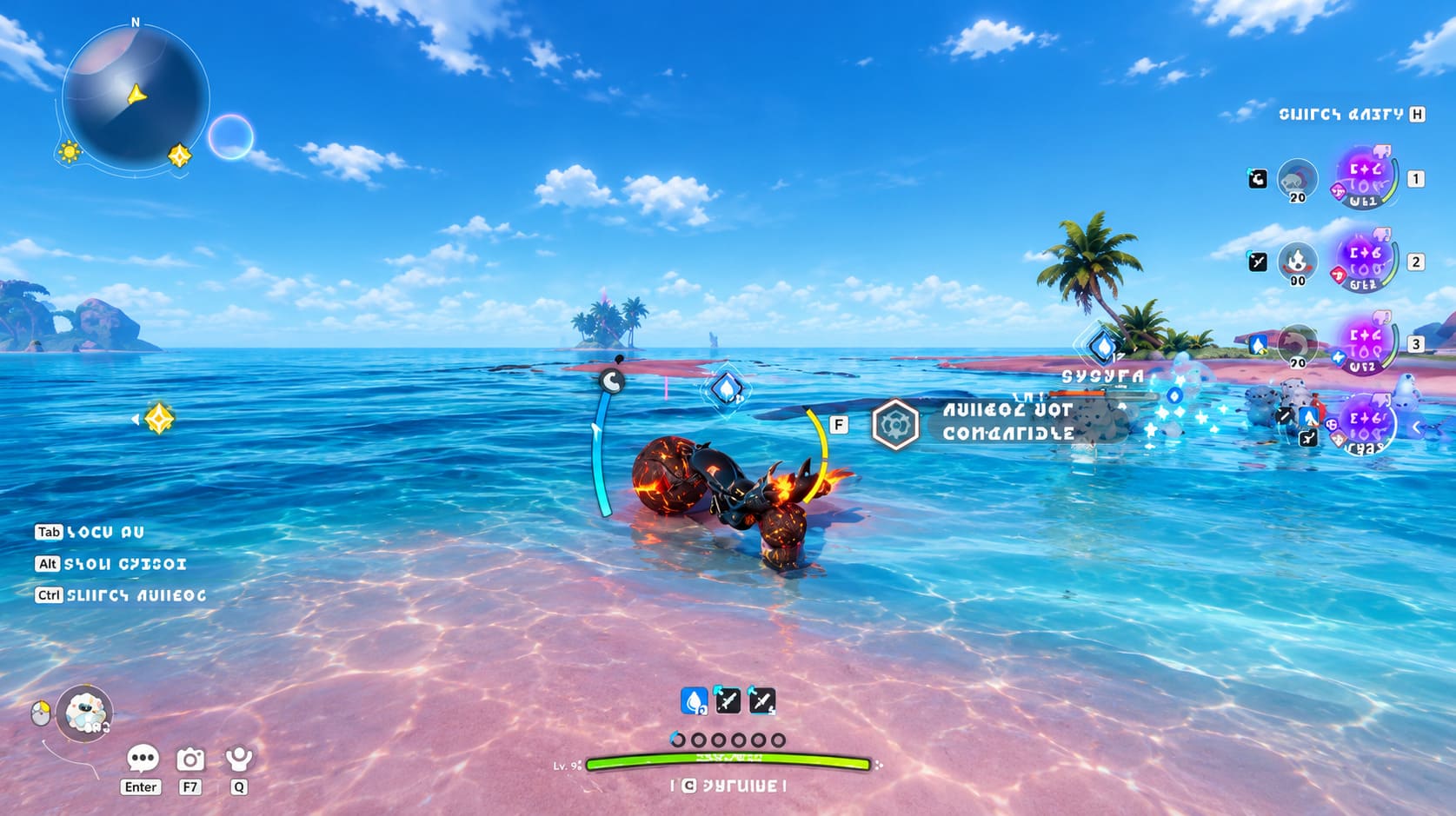
If you are serious about early PvP, I would put Punny near the top of your priority list. The creature begins as Helmoot and eventually evolves, giving you access to a kit that can provide something every team wants: reliable control over enemy positioning.
Punny’s grapple ability is particularly valuable because it can disrupt an opponent’s movement and pull them into a position that your team can exploit. In a coordinated three-player fight, that can be the difference between an enemy safely escaping and getting deleted before they have a chance to react.
Its Shadow Cut ability is also important because of the game’s defense or break system. Damaging the gray defense bar can create an opening where an enemy becomes far more vulnerable to incoming damage. This gives Punny excellent synergy with both Lunara and Helen.
With Lunara, you can pull or control an enemy and then punish them from range. With Helen, you can create exactly the opening a melee fighter needs to close the gap. That kind of versatility is why I would rather build around Punny than simply stack additional damage dealers.
Stellarys: The Early Stat Monster
Then there is Stellarys, which is much easier to understand. If Punny is about control, Stellarys is about raw power. With a reported base physical attack value of 145, it has the kind of offensive stat that immediately gets the attention of anyone interested in optimizing an early roster.
Stellarys is connected to a level 18 Alpha boss encounter, meaning you cannot simply wander into the world and expect to pick one up without preparation. However, if you are willing to challenge the boss early and have the right capture equipment available, the reward can be extremely valuable.
In a mode such as Egg Heist, high raw damage can be incredibly useful. You are constantly dealing with situations where you need to eliminate a target quickly, clear an obstacle, or win a short damage race before another team arrives. Stellarys gives you an answer when subtle tactics are not enough.
Do Not Ignore Ember Pup and Flutternym
I would also avoid looking at your roster purely through the lens of PvP damage. Ember Pup is a good example of a creature that can be useful for reasons beyond simply attacking another player. Its fire-related abilities can help with environmental puzzles, while its mobility gives you additional options when navigating the world or escaping dangerous situations.
Flutternym, meanwhile, brings sustainability into the equation. Healing and support can easily become underrated when players are focused on damage numbers, but longer fights often come down to which team can keep its important creatures alive. Having access to reliable recovery can prevent a winning fight from turning into a slow resource drain.
Personally, I like teams that can handle more than one situation. If an Aniimo helps me explore, solve environmental problems, move around the map, and survive fights, I am much more likely to keep it in my roster than something that only looks impressive on a damage chart.
My Recommended Early PvP Core
If I were starting Aniimo on launch day with PvP as my primary goal, my initial core would look something like this:
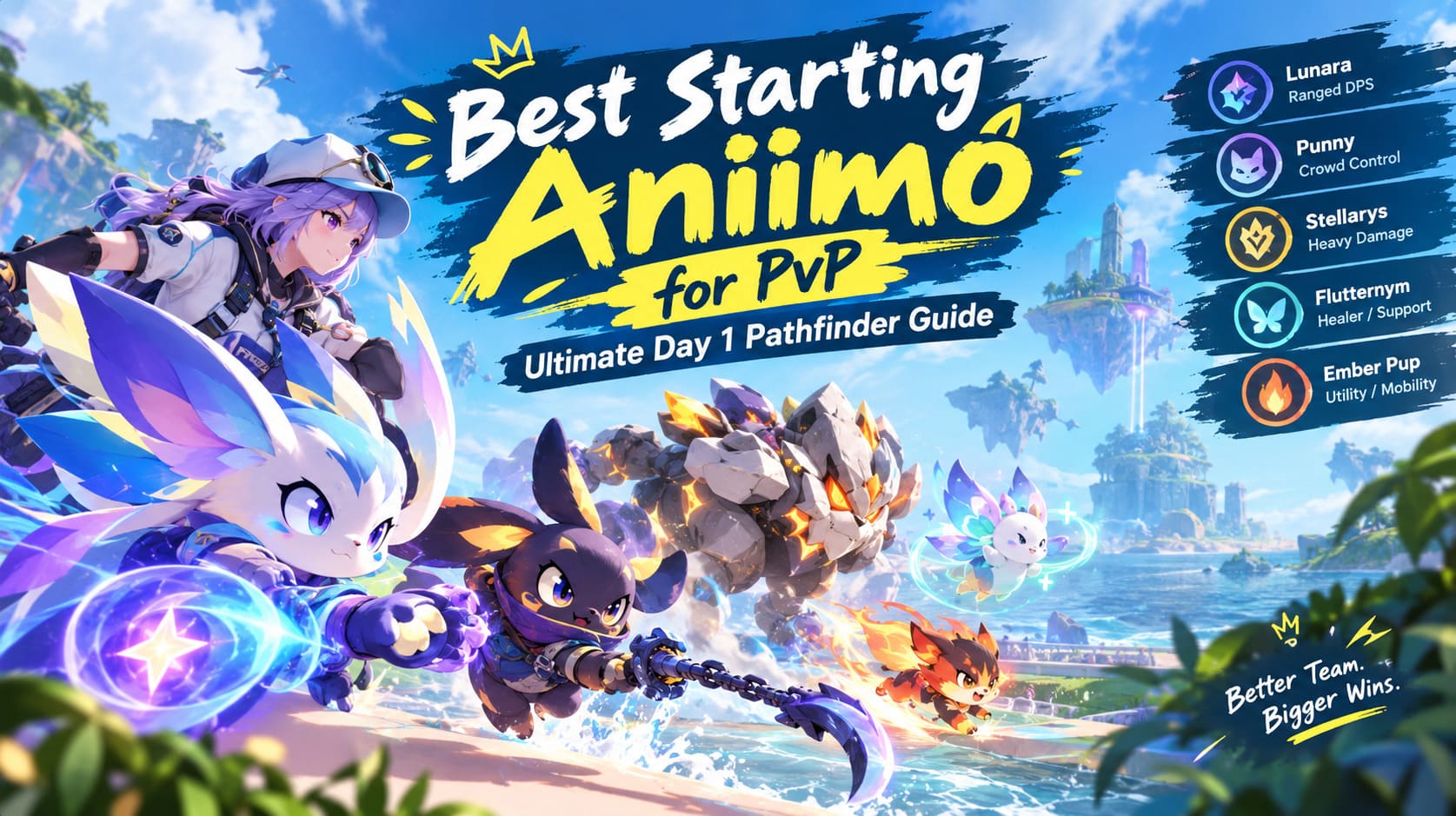
- Lunara — ranged damage, kiting, and battlefield pressure.
- Punny — crowd control, grappling, and defense-breaking.
- Stellarys — heavy physical damage and stat pressure.
- Flutternym — healing and sustained team support.
- Ember Pup — mobility, exploration utility, and fire-based abilities.
The important thing is not necessarily using every creature at once. Think of this more as an early collection of tools. Depending on the opposing team and the objective, you can adjust your lineup instead of trying to force the same three Aniimo into every encounter.
Innate Potential Could Be More Important Than You Think
There is another part of Aniimo’s progression system that PvP players should pay close attention to: Innate Potential. Capturing a creature with the right species and abilities does not necessarily mean you have found your final competitive version. Wild Aniimo can have different starting potential values across their six core statistics, and those initial rolls can dramatically change how much investment is required later.
The eventual maximum for a stat can reach 20, but improving a weak starting roll can be extremely expensive. A creature beginning with an Innate Potential of 3 can require a huge amount of Star Essence to reach its maximum, while a much stronger natural roll can require dramatically less.
| Innate Potential | Competitive Value | Resource Efficiency |
|---|---|---|
| Low | Usually worth replacing | Poor |
| Average | Fine for early progression | Moderate |
| High | Excellent long-term candidate | Very Good |
This is where I would advise new players not to rush their resources. Star Essence should be treated as a valuable competitive currency, especially during the early stages of the game. Instead of dumping everything into the first Punny or Ember Pup you capture, I would catch several copies and compare their natural potential first.
It may feel slower at the beginning, but this approach can save you a lot of resources later. If you are building a team specifically for PvP, investing heavily in a mediocre roll only to replace it a few days later is one of the easiest ways to waste your early progression materials.
How I Would Approach Day 1
If I were starting from zero, I would not immediately obsess over creating a perfect endgame build. The first objective would be to unlock enough of Idyll to begin collecting the important members of the team, while keeping an eye out for good Innate Potential rolls along the way.
My rough priority would be to choose Lunara, progress through the opening areas, search for Helmoot and potential Punny candidates, and then prepare for the level 18 Alpha encounter associated with Stellarys. Once those foundations are in place, I would start paying much more attention to team synergy and potential rather than simply chasing higher levels.
That approach also gives you something important that many early guides overlook: practice. Your first few Egg Heist matches should not be about obsessing over your win rate. Learn when to disengage, when to chase, how to protect an objective, and how to coordinate crowd control with your teammates. Mechanical knowledge will often beat a slightly better stat line.
Final Verdict: The Best Starting Aniimo for PvP
For a player whose main objective is early PvP performance in Aniimo, I would currently choose Lunara and Team Moon Fox. Her ranged pressure, mobility, and ability to influence fights without constantly entering melee range make her the safer and more flexible starting option. Helen can absolutely be powerful, but she demands more precise positioning and benefits much more from coordinated team support.
From there, I would focus on building around Punny and Stellarys. Punny gives the team the control tools needed to create openings, while Stellarys provides the raw damage necessary to capitalize on them. Add Flutternym for sustainability and Ember Pup for utility, and you have the foundation of a surprisingly well-rounded early PvP roster.
Most importantly, do not underestimate the value of good Innate Potential. A strong creature is useful, but a strong creature with excellent natural stats is the kind of investment that can stay relevant much longer. Catch smart, spend Star Essence carefully, and learn the combat system rather than relying entirely on numbers.
Aniimo’s competitive scene will inevitably change once thousands of players get their hands on the full game. New builds, balance patches, unexpected combinations, and undiscovered strategies will shake up the meta. But if you want a sensible Day 1 starting point, Lunara with a control-focused Punny and a heavy hitter like Stellarys is, in my opinion, one of the strongest foundations you can build around.