Is Shroom and Gloom Worth Buying? Price, Gameplay, and 2026 Review
There are plenty of roguelike deckbuilders on PC right now, and honestly, it takes something pretty special to make me stop scrolling and think, “Okay, this is actually different.” Shroom and Gloom did exactly that.
At first glance, it looks like someone threw together a dungeon crawler, a bizarre mushroom nightmare, a card game, and a little bit of psychedelic chaos. Somehow, it works. Developed by Team Lazerbeam and published by Devolver Digital, Shroom and Gloom takes the familiar roguelike deckbuilding formula and turns it sideways.
The most interesting part isn’t simply that cards are involved. The entire game is built around cards. Exploration, combat, progression, upgrades, and even some of the strangest interactions in the dungeon are tied to your decks.
After following the game through its earlier prototype and demo stages, I can understand why it has attracted so much attention. The upcoming September 10, 2026 Steam Early Access release feels less like another indie launch and more like the next step for a game that has already developed its own identity.
So, is Shroom and Gloom worth buying? For me, the answer is looking like a pretty confident yes.
A Deckbuilder Where Literally Everything Is a Card
The easiest way to explain Shroom and Gloom is to imagine a first-person dungeon crawler where someone decided that traditional controls were simply too boring.
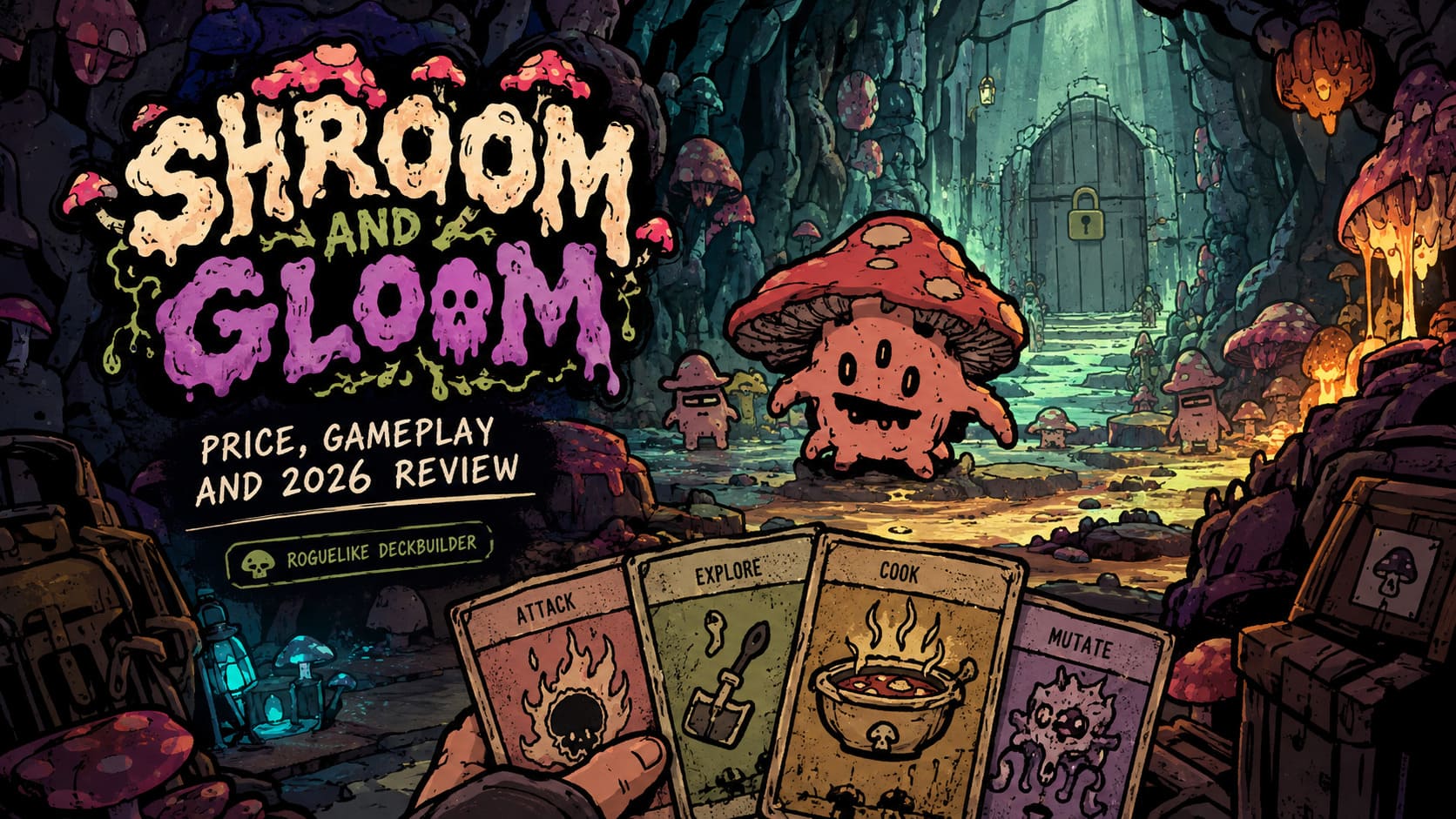
Instead of walking around a dungeon and opening a conventional inventory screen every few minutes, your actions are represented by cards. Your deck becomes your toolbox.
Need to explore? Draw cards.
Want to interact with something? Look at your available options.
Encounter an enemy? Your combat deck takes over.
It sounds restrictive on paper, but in practice, this design creates a surprisingly satisfying sense of improvisation. You aren’t simply asking, “What attack should I use?” You’re constantly asking yourself what resources you have available and how creatively you can use them.
The world itself is another huge reason I think the game stands out.
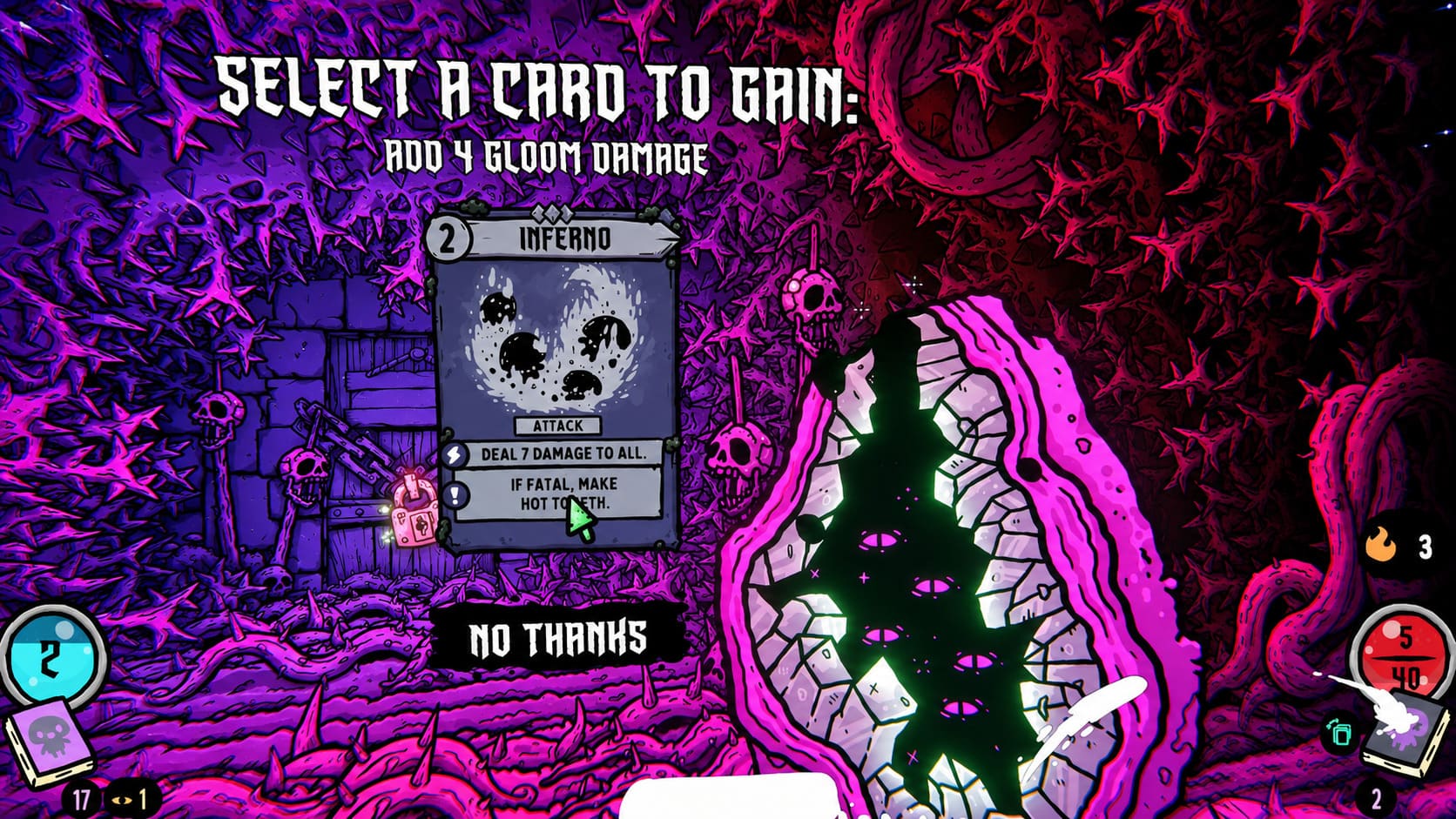
Shroom and Gloom combines hand-drawn 2D artwork with atmospheric 3D environments, creating a strange layered visual style. The underground world feels dirty, claustrophobic, colorful, and slightly uncomfortable in exactly the right way.
It doesn’t look like a traditional fantasy dungeon. It looks like a fungal fever dream.
And that’s a compliment.
The Double-Deck System Is the Real Star
The feature that immediately caught my attention is the game’s double-deckbuilding structure.
Most roguelike deckbuilders revolve almost entirely around combat. Shroom and Gloom takes a different approach by giving exploration its own importance.
Your Exploration Deck
The exploration deck controls how you interact with the dungeon.
You might find yourself using cards for things such as:
- Digging through suspicious locations
- Opening locked containers
- Discovering hidden equipment
- Interacting with environmental objects
- Improving abilities
The clever part is that the game doesn’t always give you the “correct” solution.
Imagine finding a locked door with no key and no lockpick. In a normal game, you’d probably need to backtrack or find another route.
Here, you can sometimes improvise.
You might literally smash your way through the problem, sacrificing some health in the process.
That kind of design is exactly what I want from an experimental deckbuilder. The cards aren’t merely combat buttons with fancy artwork. They become tools for solving problems.
Combat Without Traditional Blocking
This is where Shroom and Gloom gets seriously weird.
If you’ve played games like Slay the Spire, you’re probably used to the classic rhythm: attack, defend, manage energy, repeat.
Forget that here.
There are no traditional Block cards.
Instead of reducing incoming damage through a defensive card, the game encourages you to deal with threats aggressively. Enemies hurt you, and your job is to kill them before the damage becomes overwhelming.
But then comes the part that really sells the concept: you can eat your enemies.
Defeating creatures isn’t just about removing them from the battlefield. They can become a source of healing and ingredients. Certain enemies can also contribute to cooking recipes that provide powerful bonuses.
That creates an interesting combat question: How do I kill this thing, and what do I want to get out of it afterward?
Suddenly, combat isn’t just about surviving the encounter.
It’s about turning the encounter into a resource.
Cooking Makes Combat Much More Interesting
The cooking system might sound like a joke when you first hear about it, but I think it’s one of the game’s smartest mechanics.
If you’re constantly losing health and there are no conventional defensive cards, you need another way to recover.
That’s where food comes in.
Different enemies can provide different ingredients, and turning those ingredients into soups or other meals can give you powerful passive effects during a run.
This means that the way you defeat an enemy can actually matter.
You aren’t necessarily fighting every monster in the most efficient way possible. Sometimes you may want to manipulate an encounter because you need a particular ingredient.
That’s the kind of small strategic layer that can make a roguelike run memorable.
Cards Don’t Just Get Replaced — They Evolve
Another mechanic I’m particularly excited about is card mutation.
In many deckbuilders, finding a stronger version of a card means simply replacing the old one. Shroom and Gloom appears much more interested in letting individual cards grow with you.
A basic attack can potentially be upgraded into something far more powerful, while special cards can evolve as they’re used.
There are also volatile cards with limited uses. Once their charges are gone, they disappear permanently.
I really like this idea because it creates a natural reason to experiment.
You can take advantage of an absurdly powerful temporary card without worrying that your deck will become permanently bloated with something you no longer need.
That should make some runs feel completely ridiculous — and that’s exactly what I want from a game like this.
How Much Content Does Early Access Offer?
For an Early Access game, Shroom and Gloom appears to be aiming surprisingly high.
The launch version is expected to feature the Paper Boy as the introductory character, with additional classes and progression systems providing more variety as players continue playing.
The game also features two major pathways, including the heavily teased Facility area. Each route comes with its own exploration and combat cards, challenges, quests, and bosses.
The scale of the card pool is particularly impressive.
| Feature | Early Access Experience |
|---|---|
| Core Genre | First-Person Roguelike Deckbuilder |
| Main Mechanic | Double-Deckbuilding |
| Starting Class | Paper Boy |
| Major Routes | Two Distinct Pathways |
| Card Variety | Hundreds of Cards |
| Progression | Foresight And Persistent Unlocks |
For me, replayability is crucial in a roguelike. A beautiful first run isn’t enough. The game needs to make me want to start another run immediately after losing.
The combination of different pathways, card mutations, classes, cooking effects, and persistent progression gives Shroom and Gloom a solid foundation for that.
What About the Price?
One of the biggest questions surrounding any Early Access release is whether buying now is actually a good deal.
Team Lazerbeam has made its pricing philosophy unusually clear: the developers have stated that they do not intend to increase the game’s price between Early Access and the eventual 1.0 release.
That’s important.
Normally, buying an indie game during Early Access can feel like gambling. You’re paying less now, but there’s always the possibility that the price increases significantly later.
Shroom and Gloom’s planned approach makes the decision much easier.
The exact regional price is the number I’d personally check before buying, but if you’re already interested in roguelike deckbuilders, the promise of receiving the full game without an eventual Early Access price increase makes jumping in early considerably more appealing.
The Atmosphere Is Almost as Important as the Mechanics
Mechanically, Shroom and Gloom is interesting.
Visually, it’s bizarre.
And I mean that in the best possible way.
The combination of fungal creatures, unsettling underground environments, hand-drawn illustrations, and surreal presentation gives the game a personality that many deckbuilders simply don’t have.
There are obvious comparisons to games such as Inscryption because both games understand that atmosphere can be part of the gameplay rather than merely decoration.
But Shroom and Gloom doesn’t feel like it’s trying to copy Inscryption.
It has its own “fungal punk” identity.
The visual design constantly reinforces the feeling that you’re somewhere you probably shouldn’t be. The world feels strange without relying entirely on cheap horror tricks.
That makes the experience much more memorable.
The Biggest Strengths and Weaknesses
After looking at everything the game is trying to accomplish, these are the things that stand out most to me.
What I Like
- The double-deck system gives exploration genuine strategic value.
- Combat feels aggressive instead of relying on the usual attack/block routine.
- Cooking and eating enemies create an unusual but logical resource loop.
- Card mutations could lead to some wonderfully broken builds.
- The art direction is unmistakable and gives the game a personality of its own.
- Early Access pricing plans make buying early less risky.
What Could Hold It Back
The biggest concern is simply the fact that this is still an Early Access game.
Even with a substantial amount of content, players who expect a completely finished campaign, all characters, and the final version of every system may be better off waiting.
The other potential problem is the aggressive combat.
If you love defensive deckbuilding and carefully stacking Block every turn, Shroom and Gloom may initially feel uncomfortable. The game wants you to accept damage and respond to danger rather than simply preventing it.
Personally, I think that’s refreshing.
But I can absolutely see it frustrating players who prefer a slower, safer style.
Honeycomb The World Beyond Save File Location: PC Windows 11 Complete Guide
Is Shroom and Gloom Worth Buying?
So, let’s get back to the original question.
Is Shroom and Gloom worth buying in 2026?
If you’re completely uninterested in roguelikes or card games, probably not. The entire experience is built around mechanics that require you to enjoy experimentation, resource management, and replaying runs.
But if you’re someone who has already spent dozens of hours with games like Slay the Spire, Inscryption, Balatro, or other roguelike deckbuilders, I’d definitely put Shroom and Gloom on the wishlist.
What makes me optimistic is that it isn’t trying to win by having more cards or simply copying an established formula.
It’s trying to change what a card can actually represent.
A card can be a weapon. A card can be a key. A card can solve an environmental problem. A card can become stronger. A monster can become food. Food can become a buff. A terrible situation can potentially become an advantage if you have the right combination of cards.
That’s a surprisingly elegant philosophy hiding underneath all the mushrooms and weirdness.
Final Verdict
Shroom and Gloom looks like one of the more genuinely experimental roguelike deckbuilders coming to PC in 2026.
I’m especially interested in the fact that the game doesn’t separate dungeon exploration from deckbuilding. Instead, it makes exploration part of the deckbuilding experience.
The absence of traditional defensive cards is another bold decision. It could easily have gone wrong, but the eating and cooking mechanics provide a logical alternative that encourages aggressive play.
And then there’s the presentation.
This is the kind of indie game that can be recognized from a single screenshot.
For me, that’s a big deal.
There are thousands of games that are technically competent but instantly forgettable. Shroom and Gloom doesn’t have that problem. It knows exactly what it wants to be: weird, aggressive, strategic, grotesque, and occasionally ridiculous.
If the Early Access version delivers on the systems and content Team Lazerbeam has been building toward, I think this could become a very easy recommendation for fans of unusual deckbuilders.
My verdict: Buy it if you love experimental roguelikes; wishlist it if you’re still unsure about the Early Access format.
Either way, I’m definitely keeping an eye on this one.
The fungal apocalypse has never looked this entertaining.