Hell Let Loose Vietnam Game Modes Explained: Tactical Guide (2026)
If you’ve played the original Hell Let Loose for any serious amount of time, you already know that the game doesn’t really care about your kill count. It cares about whether your squad is in the right place, whether somebody remembered to build a spawn, and whether the commander has enough resources to keep the whole operation from falling apart.
Hell Let Loose: Vietnam takes that philosophy and throws it into a completely different kind of war.
The jungles, rivers, villages, tunnels, helicopters, and asymmetric US-versus-NVA combat make the familiar tactical formula feel considerably less predictable. And after spending time looking at how the launch modes work, my biggest takeaway is pretty simple: Vietnam isn’t just a reskinned version of classic Hell Let Loose.
The four major modes — Warfare, Offensive, Conquest, and Domination — each encourage a noticeably different style of play. Some reward patience and logistics, while others practically beg you to grab your squad and run straight into the jungle.
So, if you’re wondering which Hell Let Loose: Vietnam game mode is actually worth your time, here’s how I would break them down from a player’s perspective.
1. Warfare — Still the Mode That Defines Hell Let Loose
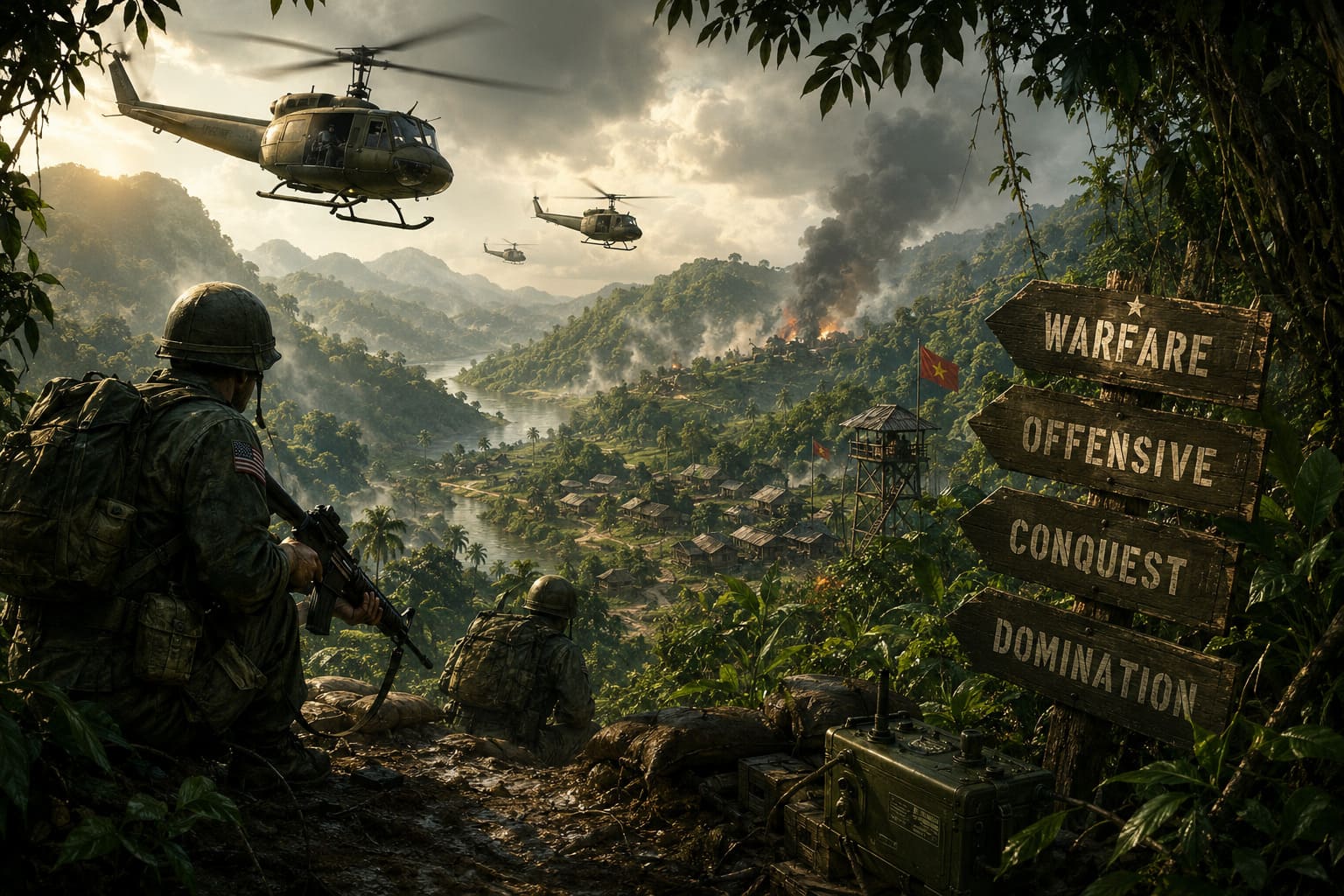
Let’s start with Warfare because, honestly, this is probably the mode that will feel most familiar to veteran players.
The basic concept remains the classic tug-of-war: two teams fight over a chain of sectors, gradually pushing the frontline toward the enemy’s territory. The central objective becomes the first major battlefield, and from there the entire match can swing back and forth depending on who maintains momentum.
On paper, it sounds straightforward.
In practice, Vietnam makes Warfare considerably messier.
Why Warfare works so well in Vietnam
The US and NVA approach the battlefield very differently.
US forces can use helicopters for rapid transportation and forward deployment, giving commanders an option that simply doesn’t exist in the traditional World War II setting. A smart Squad Leader can turn that mobility into an enormous advantage by getting troops onto the flank before the enemy realizes what is happening.
The NVA, meanwhile, has a completely different trick: underground tunnel networks.
That is where Warfare becomes genuinely interesting. You aren’t simply fighting over a line on the map anymore. You’re fighting over the hidden infrastructure underneath that line.
A squad can appear to have been pushed out of an area, only for NVA troops to emerge somewhere nearby minutes later.
That’s exactly the kind of chaos I want from a Vietnam tactical shooter.
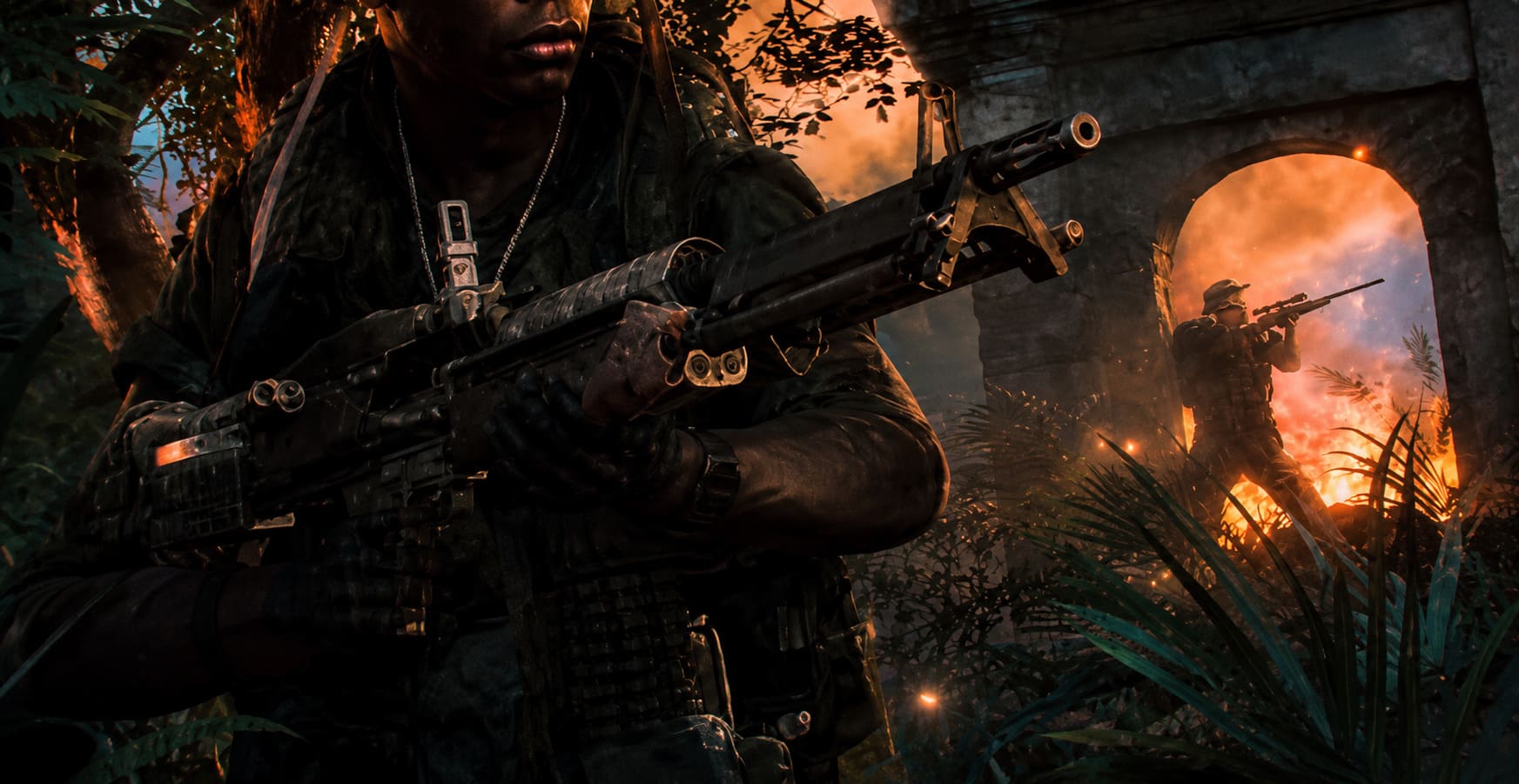
Warfare victory conditions
There are essentially two ways the match ends:
- Total breakthrough: Your team captures the entire chain of sectors and reaches the enemy’s final territory.
- Time limit: If nobody takes the entire battlefield, the team controlling more sectors when the timer expires wins.
The important lesson is that Warfare isn’t won by attacking constantly.
Sometimes the smartest move is to stop pushing, secure your spawn network, protect your resources, and wait for the opposing team to overextend.
That boring-looking decision is often what separates a coordinated squad from 20 players running around independently.
2. Offensive — The Mode Where Every Minute Hurts
If Warfare is about momentum, Offensive is about pressure.
One side attacks. The other side defends.
Simple, right?
Not even close.
Offensive is probably the most stressful mode for anyone who enjoys playing Squad Leader because every sector becomes its own mini-campaign. Attackers have to break through defensive positions before the clock runs out, while defenders have to survive long enough to force a timeout.
The big thing to remember is the 30-minute phase timer.
Attackers capture a sector and the clock resets, giving them another 30 minutes to break the next defensive line. Fail to capture the active objective before time expires, and the defenders win.
That creates a fascinating rhythm.
At the beginning of a phase, attackers can afford to probe and gather information. As the clock gets lower, however, the entire team starts feeling the pressure.
Offensive is all about preparation
Defenders have a massive advantage because they know where the battle is coming.
That means fortifications, machine-gun positions, traps, mines, and carefully placed spawn points can turn a relatively small defensive position into a nightmare.
For the NVA, the jungle itself becomes part of the defense.
For the US, the answer is generally concentrated firepower and mobility.
Helicopters can move troops around difficult terrain, while artillery and other forms of support can help dismantle defensive strongholds.
But here’s my biggest tip for attackers:
Don’t confuse movement with progress.
I’ve seen plenty of tactical shooters where an attacking team spends 20 minutes throwing bodies at the same doorway without actually changing the battlefield.
Vietnam rewards players who think about why they’re attacking a particular position.
Sometimes you need a flank.
Sometimes you need smoke.
Sometimes you need a different squad to attack from the opposite direction.
And sometimes you simply need everyone to stop running forward for 30 seconds and let the Commander do their job.
3. Conquest — The Mode That Could Become the Wildest
Of all the modes, Conquest is the one I’m most interested in watching develop.
Why?
Because it throws away one of the defining assumptions of traditional Hell Let Loose: the idea that the frontline tells you where the battle is.
In Conquest, it doesn’t.
Multiple objectives are distributed across the map, and teams can attack them without following a predetermined capture sequence.
That means the battlefield can effectively have frontlines in every direction.
One squad might be fighting around a major objective while another discovers that the enemy has quietly captured a point near the rear.
That’s where the mode becomes less about brute force and more about awareness.
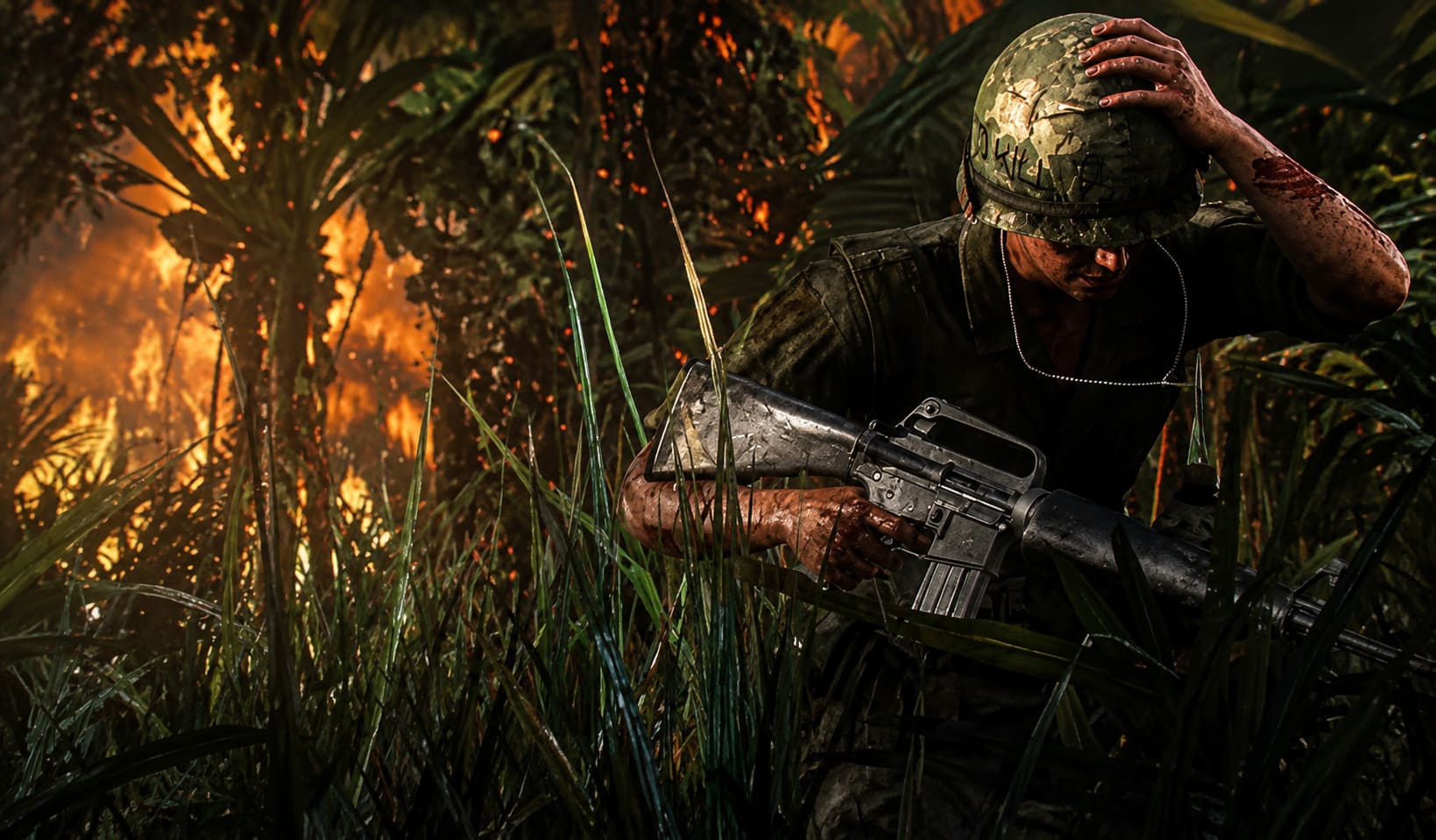
The Morale system changes everything
Conquest also introduces a morale-based ticket system.
Deaths reduce the team’s available resources, while losing objectives creates additional pressure through passive morale loss.
In other words, you can lose Conquest without constantly losing firefights.
You can lose because your team is slowly bleeding control of the map.
That makes reconnaissance incredibly important.
A squad that spends the entire match chasing kills might have an impressive scoreboard and still contribute almost nothing to the actual victory.
My favorite part: mobility
This is where Vietnam’s helicopters and boats become particularly valuable.
US players can use helicopters to rapidly move squads toward threatened objectives. NVA squads can exploit jungle routes and waterways to appear where the enemy least expects them.
If your squad likes improvising, Conquest is probably going to be your playground.
If you hate checking the map every 20 seconds, you’re going to have a bad time.
4. Domination — Smaller Battlefield, Bigger Problems
Domination is the most concentrated mode of the four.
Instead of spreading the battle across an enormous frontline, the action focuses heavily around three central objectives.
All three can be contested, and the pressure to control them is immediate.
This creates a very different experience from Warfare.
There is less time spent wondering where the enemy might be and more time spent trying to determine which objective your squad should reinforce right now.
And that decision matters because controlling all three objectives can unlock the enemy HQ for a final push.
That creates a surprisingly brutal endgame.
A team can spend an hour fighting over the center, finally gain control of all three points, and suddenly find itself needing to organize one last coordinated attack.
Domination rewards aggressive squads
This isn’t the mode where I would recommend playing ultra-conservatively.
Squads need to rotate.
They need to communicate.
They need to know when to abandon a losing position and reinforce another objective.
Infantry roles become especially important because combat tends to happen at much closer ranges.
For players who enjoy the chaotic village fights and close-range jungle engagements, Domination could easily become the most addictive mode.
Game Mode Comparison
| Mode | Main Focus | Battlefield Style | Best For |
|---|---|---|---|
| Warfare | Frontline control | Linear tug-of-war | Balanced tactical squads |
| Offensive | Breaking/holding defenses | Sequential sectors | Organized attackers and defenders |
| Conquest | Map-wide control | Non-linear | Recon and mobile squads |
| Domination | Central objectives | Concentrated combat | Aggressive infantry players |
The Real Game Changer: Asymmetric Warfare
For me, the biggest selling point of Hell Let Loose: Vietnam isn’t actually the individual game modes.
It’s how the same mode can feel completely different depending on which faction you’re playing.
That’s something the Vietnam setting is perfectly suited for.
The US has technology, air mobility, heavy fire support, and logistical flexibility.
The NVA has concealment, underground infrastructure, terrain familiarity, and unconventional movement options.
Neither side should feel like a simple mirror image of the other.
Helicopters Are Powerful — But Don’t Treat Them Like Magic
US helicopter mobility can completely change a match.
A squad can bypass terrain that would otherwise take several minutes to cross. Supplies can be moved rapidly. Reinforcements can arrive before the enemy has time to establish a defensive perimeter.
But there is a catch.
Helicopters are extremely obvious.
Everyone can hear them.
Everyone can see them.
And if the opposing team has the right weapons and positioning, that expensive transport can become a flying target.
Good pilots aren’t simply taxi drivers. They have to understand the battlefield.
A great pilot knows when to take the long route, when to stay low, when to avoid a hot zone, and when getting a squad into position is worth the risk.
NVA Tunnels Are the Opposite Philosophy
The NVA doesn’t need to dominate the sky when it can dominate the ground underneath you.
Tunnel networks fundamentally change how the enemy has to secure an area.
Normally, if you clear a jungle position, you expect the threat to disappear.
With tunnels, clearing the visible battlefield doesn’t necessarily mean you’ve cleared the battlefield at all.
That uncertainty is powerful.
It forces US squads to think about where the enemy can spawn, rather than simply where the enemy is currently standing.
And that’s exactly the sort of psychological warfare that makes Vietnam feel different.
Movement Matters More Than You Think
Another major part of the Vietnam experience is movement.
Dense vegetation isn’t just decorative scenery. It affects visibility, positioning, traversal, and firefights.
Players can use crawling to remain hidden beneath vegetation, climb obstacles to create unexpected angles, and cross rivers to approach objectives from directions that traditional infantry tactics wouldn’t normally allow.
This makes map knowledge incredibly valuable.
The squad that knows a river crossing exists 200 meters behind the objective has an option that the squad staring at the front gate simply doesn’t have.
And that’s why I would strongly recommend learning the maps rather than memorizing only the capture points.
Learn the routes between them.
Those routes are often more important.
The Medic and Dragging Mechanic Could Save Entire Attacks
One smaller feature that deserves more attention is the ability to drag downed teammates out of dangerous areas.
This sounds like a minor quality-of-life feature until you play a serious Offensive match.
Imagine your Squad Leader gets hit in the open near an important spawn location.
Normally, the squad either risks another casualty trying to revive them or abandons them.
Dragging gives the squad another option.
Pull the player behind cover.
Then revive.
That can preserve not only manpower but also the squad’s ability to maintain pressure.
In a game where forward positions and spawn infrastructure determine whether an assault succeeds, those few seconds can make a ridiculous difference.
Servant of the Lake Ending Explained: Vanderboom Lore & Full Story Breakdown
Which Hell Let Loose: Vietnam Mode Should You Play?
If you’re completely new, I’d start with Warfare.
It gives you the best overall introduction to the game’s systems without immediately throwing you into the extreme conditions of the other modes.
Once you’re comfortable with squad communication and map movement, move into Offensive.
That’s where you’ll really learn the importance of timing and defensive preparation.
After that:
- Play Conquest if you love reconnaissance, flanking, and unpredictable battles.
- Play Domination if you want constant infantry action.
- Play Offensive if you enjoy coordinated assaults and defensive engineering.
- Play Warfare if you want the classic Hell Let Loose experience with a Vietnam twist.
Final Verdict
The thing I like most about Hell Let Loose: Vietnam is that the game modes aren’t simply different rule sets.
They encourage different ways of thinking.
Warfare asks whether your team can maintain a stable frontline.
Offensive asks whether attackers can create enough momentum before the clock destroys their chances.
Conquest asks whether your team can actually understand the entire battlefield instead of obsessing over one fight.
Domination asks whether your squad can win a concentrated battle while constantly rotating between objectives.
And underneath all of that, the US-versus-NVA asymmetry gives every match another layer.
Personally, Conquest is the mode I’d keep coming back to once I understood the fundamentals. The possibility of an enemy squad appearing behind your lines, a helicopter suddenly dropping reinforcements onto a distant objective, or a hidden tunnel turning a supposedly secure position into a disaster sounds exactly like the kind of unpredictable tactical nonsense that makes these games memorable.
But if you’re looking for the purest Hell Let Loose experience, Warfare remains the safest recommendation.
Just remember one thing before you deploy:
Your squad is more important than your kill count.
Check the map. Talk to your Squad Leader. Protect your spawn network. Watch your flanks. And if you’re playing as the NVA, never assume that the jungle behind you is actually empty.
That’s where the fun begins.