Pax Autocratica Guide: Capture and Indoctrination System Explained
There are plenty of colony management games where you worry about food, housing, production chains, and whether your settlers are having a meltdown because someone moved their favorite chair.
Pax Autocratica takes that formula and throws it straight into a dystopian meat grinder.
Developed and published by Multiverse, Pax Autocratica entered Steam Early Access on August 10, 2026, combining a totalitarian colony simulator with first-person roguelite combat. On paper, that sounds like a bizarre genre mashup. After spending time thinking through its systems, though, the combination starts making a surprising amount of sense.
You aren’t simply building a colony.
You’re building a state.
Every resource, worker, law, military operation, and prisoner feeds into the same enormous machine. The strategic layer asks how effectively you can run your society, while the FPS layer puts you directly into the violence required to expand it.
And sitting right between those two halves is arguably the most important system in the entire game: Capture and Indoctrination.
Enemies aren’t merely targets to eliminate. They can become resources, workers, soldiers, or another problem waiting to explode inside your walls. That creates a gameplay loop where every successful raid can potentially strengthen your colony — provided you know what to do with the people you bring home.
If you’re planning to build the most efficient authoritarian colony possible, this is where the real game begins.
How the Pax Autocratica Gameplay Loop Actually Works
The easiest way to understand Pax Autocratica is to stop thinking of it as two separate games.
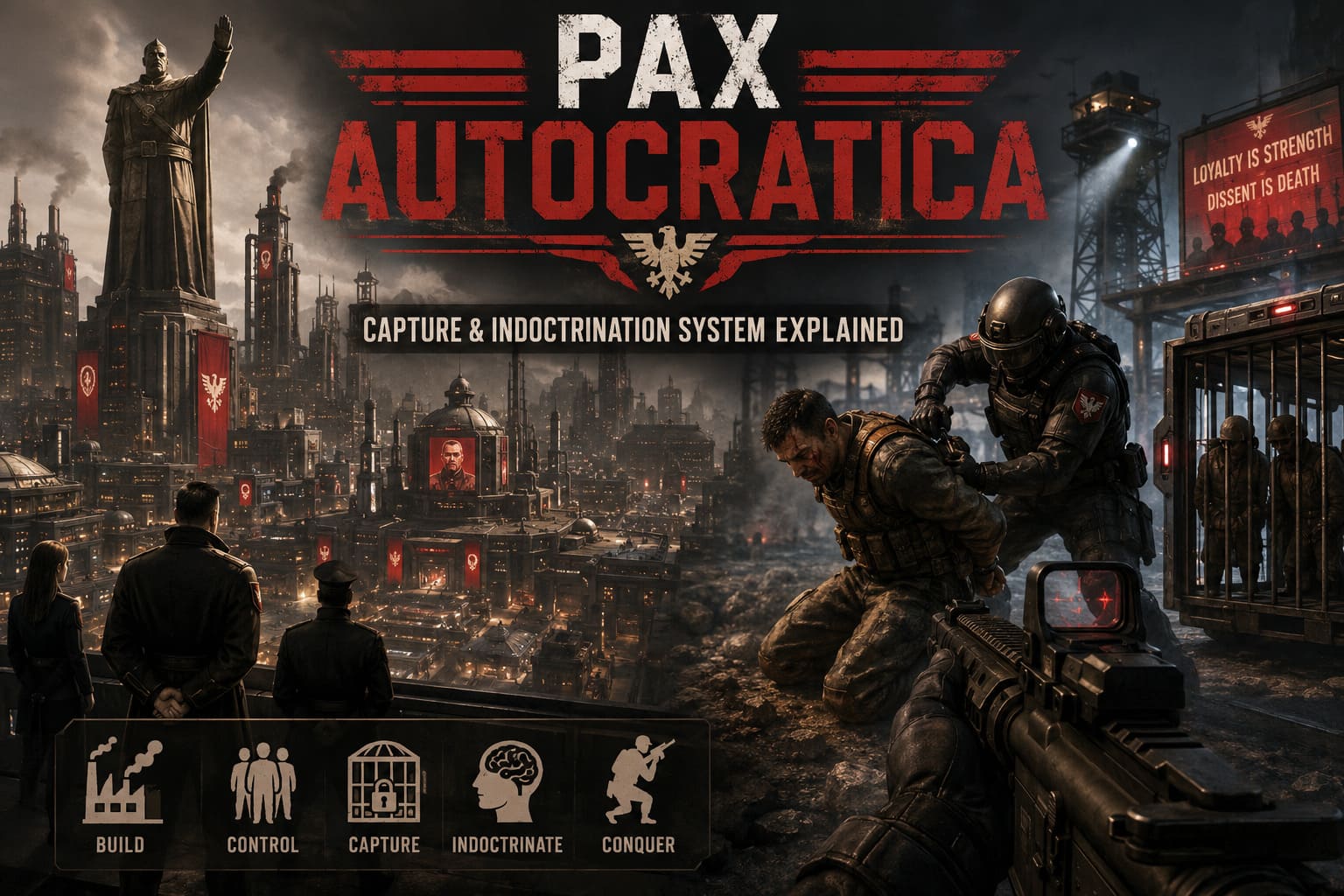
The colony simulator and FPS are constantly feeding one another.
Your colony produces the equipment, manpower, and infrastructure needed for military operations. Those military operations bring back resources, territory, and potential captives. Those captives can then become part of your workforce, which increases production and makes future expeditions more effective.
It’s a beautifully circular system.
| Gameplay Layer | Primary Goal | Why It Matters |
|---|---|---|
| Colony Management | Build and maintain your state | Generates resources and manpower |
| Social Control | Manage Fear, Hunger, Happiness, and Loyalty | Prevents instability |
| Capture System | Bring enemies back alive | Expands your workforce |
| Indoctrination | Convert prisoners into compliant citizens | Turns captives into productive assets |
| FPS Combat | Defeat hostile forces | Provides territory and materials |
| Technology | Unlock stronger policies and equipment | Improves every part of the loop |
The clever part is that failure in one layer can quickly become a problem in another.
Run out of industrial materials and your combat gear suffers. Lose too many soldiers and your colony’s defenses weaken. Let civilian loyalty collapse and you may suddenly have an internal crisis while you’re already struggling against external enemies.
Pax Autocratica doesn’t let you solve one problem forever. It keeps moving the goalposts.
Building the Perfect Totalitarian Colony
The strategic side of Pax Autocratica revolves around several competing population statistics.
Fear, Happiness, Hunger, and Loyalty are the numbers you should constantly monitor.

Push workers too hard and hunger rises. Poor living conditions can damage happiness. Excessive oppression can create instability beneath the surface. On the other hand, giving everyone comfortable lives without maintaining production can leave your colony dangerously underpowered.
That’s the central balancing act.
You want a population that is productive enough to keep the industrial machine running, scared enough to obey, and stable enough that you don’t spend every five minutes putting down another rebellion.
This is where infrastructure becomes more than decoration.
Surveillance towers, security checkpoints, propaganda systems, industrial facilities, prisons, and indoctrination centers should be considered pieces of the same machine.
A common mistake would be to build everything independently.
I would instead think in terms of systems and proximity.
Your industrial zones need workers. Your workers need food. Your prisoners need security. Your security infrastructure needs manpower. Your military needs weapons. Your weapons need factories. Your factories need resources.
Once those relationships click, the colony starts feeling less like a collection of buildings and more like a giant machine that you’re constantly tuning.
The Capture System: Stop Killing Everything
This is the mechanic that changes how you approach FPS combat.
In most shooters, an enemy charging toward you is a problem that gets solved with ammunition.
In Pax Autocratica, sometimes you want that enemy alive.
During expeditions into hostile territory, including areas controlled by factions such as the Urslan, you’ll encounter different classes of enemy units. Some are disposable cannon fodder. Others can potentially become extremely valuable additions to your colony.
The trick is bringing them down without killing them.
As an enemy approaches a critical health threshold, the capture opportunity becomes available. The exact chance of success can depend on factors such as:
- Remaining enemy health
- Your active policies and technological upgrades
- Enemy unit tier
- Capture-related equipment
- Your progression through the relevant technology branches
The higher-value the target, the more difficult the process tends to become.
This creates a fantastic little dilemma during combat.
Do you finish the enemy immediately and remove the threat, or do you risk trying to capture them?
Against a weak unit, the answer may be obvious. Against an elite enemy in the middle of a bullet storm, suddenly it’s a much more interesting decision.
That risk-reward tension is exactly what I want from a system like this.
Getting Captives Back to Your Colony
Successfully subduing an enemy is only the first step.
Captured units have to be transported back to your colony, where they enter your prison infrastructure and become part of your management problem.
And yes, they are absolutely a management problem.
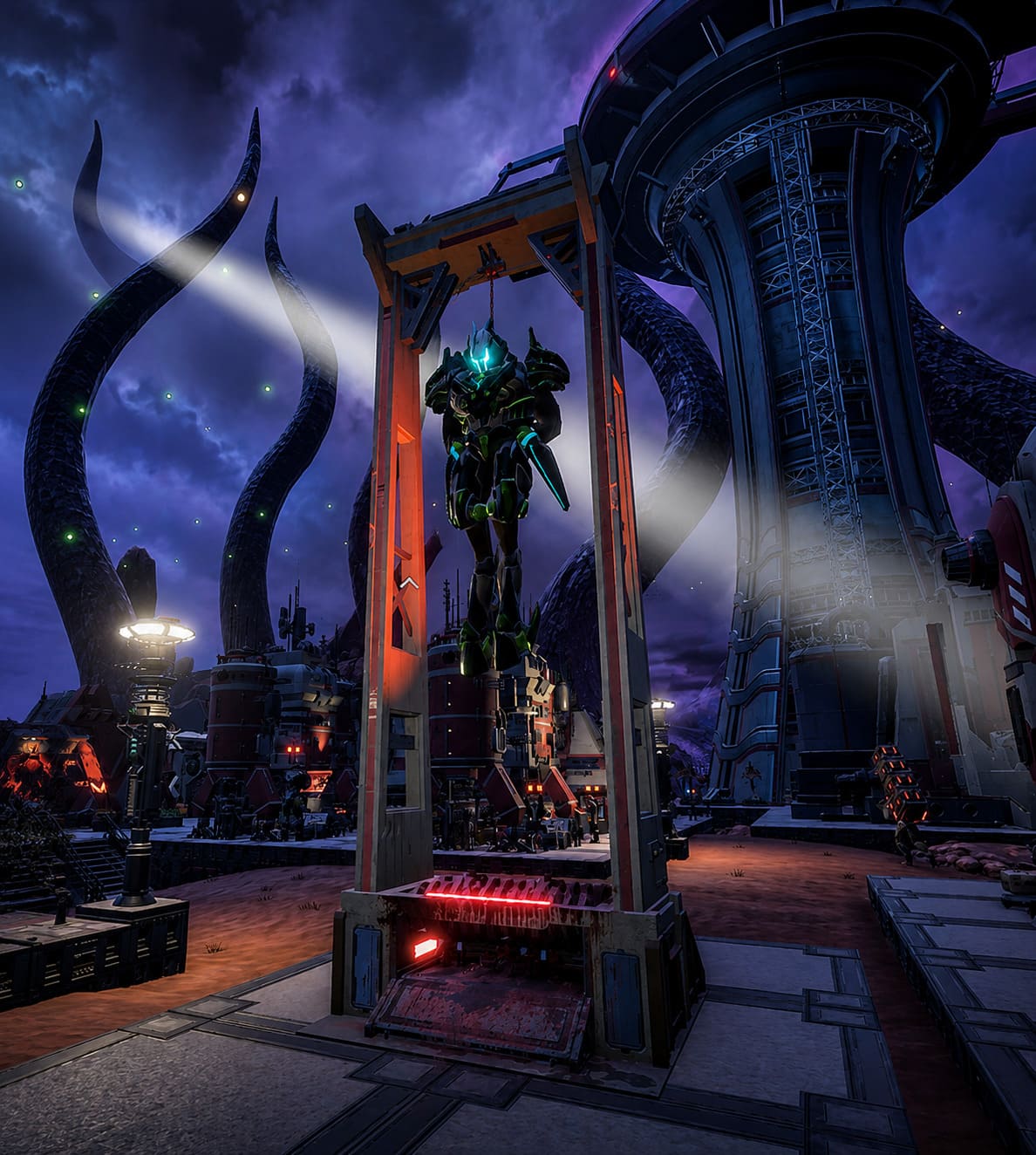
Captives aren’t instantly converted into obedient workers. They begin with resistance and no loyalty to your regime. If your prison infrastructure is poorly designed or inadequately defended, your carefully captured personnel can become a security nightmare.
Prison blocks therefore need to be treated as strategic infrastructure rather than an afterthought.
Security personnel, controlled access, adequate supplies, and appropriate monitoring all contribute to keeping the situation from spiraling.
This is one of those systems where overconfidence can bite you hard.
Capturing ten enemies might sound fantastic on paper. Capturing ten enemies while your prison has inadequate security and your colony is already suffering from low food supplies is another story entirely.
Indoctrination: Turning Prisoners Into Workers
Once your captives are secured, the next question is obvious:
What are you going to do with them?
Pax Autocratica gives you several approaches, each with different consequences for your colony.
Psychological Indoctrination
This is the slower, more structured approach.
Indoctrination centers, propaganda systems, isolation mechanics, and related policies gradually reduce resistance while increasing loyalty. The goal is eventually to turn prisoners into compliant members of your society.
It’s not necessarily the fastest route, but it can be one of the most sustainable.
Once converted, these individuals can leave the prison system and become productive members of your colony.
Rule Through Fear
Need results immediately?
The authoritarian answer is simple: increase pressure.
Fear-based systems can reduce resistance much faster, but the trade-off is long-term instability. A population that obeys because it is terrified isn’t necessarily loyal.
That distinction matters.
You can create an obedient worker who follows orders today while simultaneously increasing the possibility of future resistance.
This is where Pax Autocratica gets more interesting than a simple “evil dictator simulator.”
The game constantly asks whether short-term efficiency is worth long-term instability.
Executions and Extreme Policies
Highly resistant prisoners may represent more trouble than they’re worth.
The game allows extremely harsh state policies, including executions that can generate a substantial Fear effect across your colony.
From a purely mechanical perspective, this can suppress dissent and discourage rebellion.
But it also creates a fascinating strategic question: how much fear is too much?
A colony where everyone is terrified may be productive for a while, but pushing that system too far can create an unstable society that is constantly one disaster away from collapse.
The Best Strategy: Balance Fear With Stability
If I were building a colony from scratch, I wouldn’t attempt to maximize Fear at all costs.
That sounds powerful.
It also sounds like a fantastic way to turn your entire colony into a pressure cooker.
Instead, I would use what I like to call the Iron Fist + Velvet Glove strategy.
The Iron Fist comes from surveillance, security infrastructure, enforcement, and strong state policies. These systems establish control and discourage open rebellion.
The Velvet Glove comes from keeping basic living conditions stable.
Food.
Healthcare.
Public services.
Reasonable access to essential resources.
You don’t need everyone to be happy. You need them stable enough to keep working.
That distinction is incredibly important.
A population with moderate Happiness and strong Loyalty can be much more useful than a miserable population that is technically terrified into obedience.
Don’t Ignore the Technology Trees
Pax Autocratica’s technology and policy systems can dramatically change how efficiently your colony operates.
If your strategy revolves around capturing enemies and converting them into productive citizens, several progression paths deserve special attention.
Pacification Technologies
These upgrades improve your ability to capture enemies without accidentally killing them.
Non-lethal modifications, tactical stun options, and capture-related bonuses can completely change how you approach difficult encounters.
If you’re serious about building a prisoner-based workforce, this should be one of your earliest priorities.
Correctional Policies
This branch improves the prison and indoctrination infrastructure.
Early upgrades can reduce the resources required to maintain captives, while later technologies can improve conversion efficiency and reduce resistance more quickly.
The more prisoners you capture, the more valuable these upgrades become.
Sacrifice and Military Synergy
The more extreme policy branches connect your colony’s population directly with military operations.
These systems can unlock unusual interactions between conscripts, combat abilities, and battlefield survivability.
They’re certainly not subtle, but Pax Autocratica isn’t trying to be subtle.
The important thing is to remember that every technology choice should reinforce your overall strategy rather than simply grabbing whatever upgrade looks strongest in isolation.
Turning Your Colony Into an FPS War Machine
Here’s where the entire system finally comes together.
Your citizens aren’t just numbers on a management screen.
They are the workforce powering your factories.
Your factories produce the gear used by your military.
Your military captures enemies.
Those enemies can become additional workers.
Those workers increase your production.
And increased production makes your next military operation stronger.
That’s the Pax Autocratica feedback loop.
Resources such as alloys and advanced materials can be redirected into manufacturing weapons, armor, and other combat equipment. Once your production network becomes efficient, you can start preparing dedicated loadouts for increasingly dangerous expeditions.
Weapons such as the Bioplasma Shotgun and Bowblaster give you different tools for dealing with hostile forces, while defensive equipment such as Shield Grenades becomes especially important when enemy projectile patterns start filling the battlefield.
The FPS combat isn’t simply a side activity.
It is the dangerous end of your entire economic chain.
Surviving the Bullet-Hell Battlefield
The FPS side of Pax Autocratica is where your carefully constructed empire gets tested.
Procedural battlefields throw infantry, drones, armored enemies, and larger threats at you. Eventually, you’re dealing with Sector Overlords capable of turning the screen into a wall of projectiles.
At that point, raw firepower isn’t enough.
You need positioning.
You need movement.
You need to recognize attack patterns.
And most importantly, you need to know when not to chase a capture.
This last point is easy to overlook.
If an elite enemy is sitting at low health while dozens of projectiles are flying across the arena, trying to capture them may be greed rather than strategy.
Sometimes the correct decision is to eliminate the threat and survive.
The best players will learn to recognize when a potential prisoner is worth the risk and when they’re simply baiting you into getting flattened.
Pax Autocratica Best Squad Weapon Loadouts: Meta Combat Guide (2026)
My Recommended Pax Autocratica Progression Strategy
If you’re starting a fresh colony, I’d approach the game in roughly this order:
- Establish a reliable food and resource economy.
- Build basic security and surveillance infrastructure early.
- Invest in capture and pacification technology.
- Create enough prison capacity before aggressively hunting captives.
- Improve indoctrination efficiency once your prisoner population grows.
- Upgrade industrial production to support military operations.
- Build combat equipment around your preferred FPS playstyle.
- Expand territory only after your colony can support the additional pressure.
The biggest mistake would be expanding faster than your economy can handle.
A larger colony isn’t automatically a stronger colony.
Every new sector creates additional demands for food, security, workers, infrastructure, and military protection. If your economy is already stretched, expansion can turn a manageable situation into total chaos surprisingly quickly.
Pax Autocratica FPS Mode Guide: How to Command Squads and Win Sector Raids
What Makes Pax Autocratica Stand Out
The biggest strength of Pax Autocratica isn’t any individual mechanic.
It’s how all the mechanics collide.
The colony sim influences the FPS.
The FPS influences the colony sim.
Your technology affects both.
Your population affects production.
Your production affects your military.
Your military affects your prisoner population.
And your prisoner population feeds back into production.
That circular structure gives the game a sense of momentum that many colony simulators struggle to achieve.
I’m especially interested in how far the game can push this concept during Early Access. There is a lot of potential here because the foundation supports extremely different playstyles.
You could focus heavily on industrial efficiency.
You could create a security-focused state.
You could prioritize military expansion.
Or you could build a system that revolves almost entirely around capturing enemies and converting them into the workforce that keeps everything else running.
None of these approaches are completely isolated.
That’s the fun part.
Final Verdict: Build the State, Then Try to Keep It Alive
Pax Autocratica is at its most compelling when you stop thinking of yourself as a player and start thinking like the administrator of a gigantic machine.
Every citizen is part of the economy. Every prisoner is a potential resource or security problem. Every military raid is an investment. Every policy has consequences.
The Capture and Indoctrination system is particularly important because it connects the game’s two seemingly incompatible genres.
The FPS gives you enemies.
The colony sim gives you somewhere to put them.
The technology tree determines how efficiently you can process the entire situation.
And your social policies determine whether the resulting society remains productive or collapses into rebellion.
That’s a surprisingly strong foundation.
If you approach Pax Autocratica like a conventional shooter, you’ll miss half the game. If you treat it purely as a colony simulator, you’ll leave an enormous amount of power on the table.
The real trick is learning to move between both worlds without letting either one fall apart.
Build your economy. Secure your colony. Capture strategically. Upgrade the systems that support your preferred playstyle. Then take your best equipment into the next battlefield and see how much stronger your machine has become.
Just don’t get too comfortable.
In Pax Autocratica, the empire you’re building is only as stable as the weakest link in its chain.
And sooner or later, something is going to break.