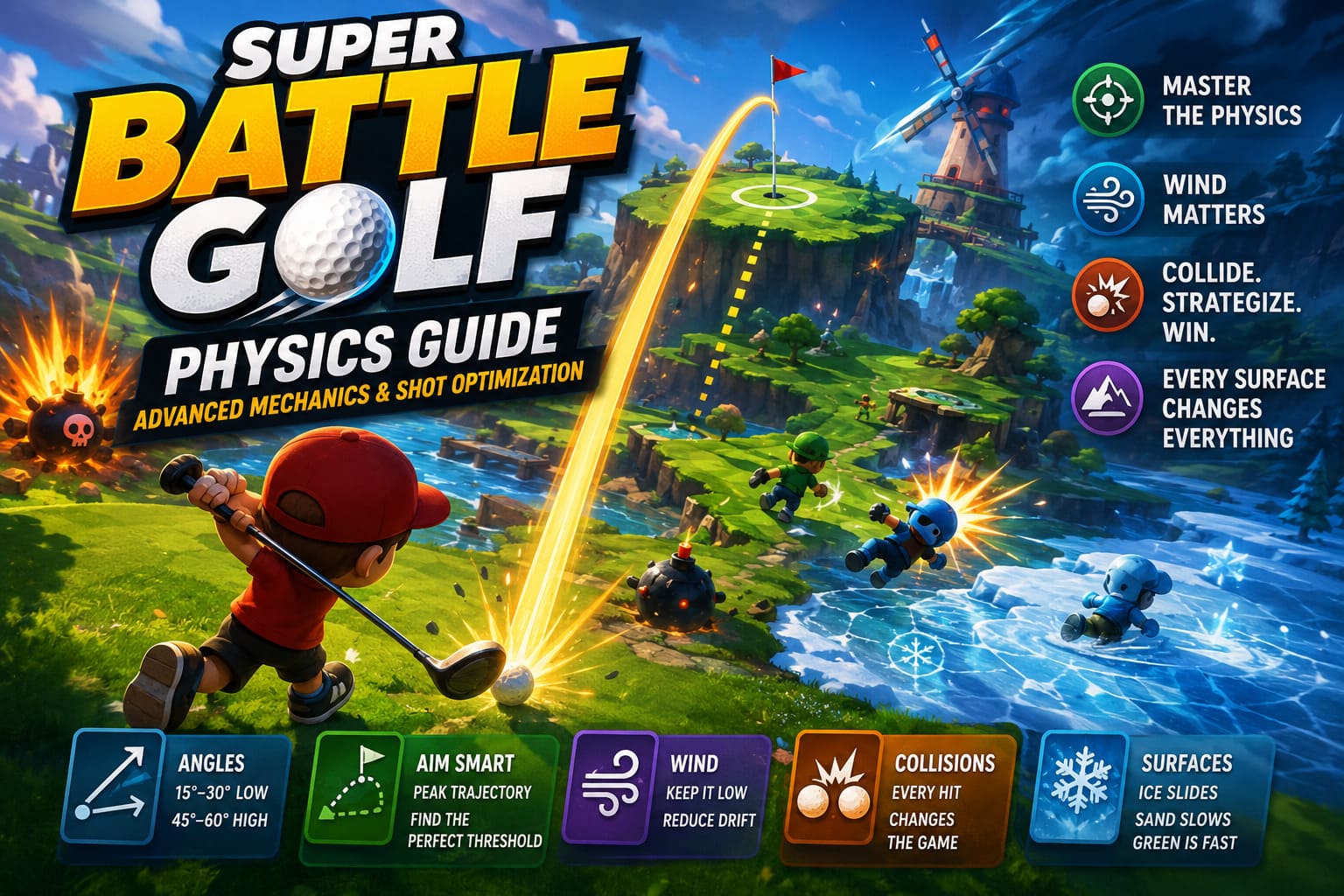
Super Battle Golf Physics Guide: Advanced Mechanics and Shot Optimization
When I first jumped into Super Battle Golf, I expected nothing more than another chaotic multiplayer party game where luck decides who wins. Five matches later, I realized I had been completely wrong.
Sure, eight players sprinting across a course while swinging clubs, firing rockets, and knocking each other into hazards looks like total madness. But after spending dozens of hours studying competitive matches, community discussions, and high-level gameplay, one thing became obvious—there is a surprisingly sophisticated physics system hiding underneath the chaos.
The players who consistently dominate public lobbies aren’t simply getting lucky. They’re taking advantage of launch angles, friction values, wind behavior, collision mechanics, recoil movement, and environmental interactions that many casual players never even notice.
If your goal is climbing community rankings, improving your consistency, or simply frustrating your friends by winning far more often than you probably should, understanding these mechanics changes everything.
Why Physics Matters More Than Aim
Many newcomers believe landing powerful shots is the key to victory. That’s only part of the equation.
Every shot in Super Battle Golf is affected by multiple systems working together:
- Launch velocity
- Vertical angle
- Surface friction
- Wind direction
- Gravity
- Ball collisions
- Weapon recoil
- Environmental hazards
Miss one of those variables, and even a perfectly aimed drive can become a disaster.
Understand all of them, and suddenly every course starts feeling predictable instead of random.
Learning the Swing System
The entire gameplay loop begins with the drag-and-release swing mechanic.
Dragging farther increases shot power, while adjusting the vertical aiming angle changes how your ball behaves after launch.
Many players assume the power meter scales perfectly from beginning to end.
It doesn’t.
Although maximum drag reaches 100% power, the engine compresses acceleration near the upper limit. Small adjustments below roughly half power produce much more noticeable differences than tiny adjustments near maximum strength.
That becomes incredibly important for delicate chip shots and precision approaches.
Instead of thinking about “more power,” think about efficient power.
High Launch vs Low Launch
Changing your launch angle completely changes how kinetic energy is distributed throughout the shot.
High Arc Shots (45°–60°)
These are perfect when you need to:
- Clear rivers
- Reach elevated platforms
- Avoid dangerous terrain
- Cross giant gaps
The tradeoff is obvious once the ball lands.
Because it falls almost vertically, much of its momentum disappears during impact. Instead of rolling across the fairway, it often stops surprisingly quickly.
That makes steep shots fantastic for controlled landings but poor choices if maximum distance is your goal.
Low Arc Shots (15°–30°)
Low-angle drives behave very differently.
Horizontal momentum stays high from launch until impact, allowing the ball to continue rolling long after touching the ground.
These shots shine on:
- Wide fairways
- Straight courses
- Fast racing sections
- Wind-heavy maps
The downside?
Your ball spends much more time interacting with mines, rough terrain, and unexpected obstacles.
The Community’s Favorite Long-Distance Trick
Competitive players eventually uncovered one of the smartest aiming techniques currently used.
During aiming, the trajectory guide becomes an incredibly valuable measurement tool.
For long-range shots in calm weather:
- Aim toward the flag.
- Increase launch angle slowly.
- Watch the trajectory peak.
- Position the flag just beneath the highest visible point.
- Raise the angle one final increment.
If the trajectory suddenly disappears or extends beyond the visible map, you’ve reached what many experienced players call the perfect threshold.
Using full power at this point often produces remarkably accurate long-range shots with far fewer unpredictable bounces than traditional aiming methods.
It’s one of those tricks that feels almost like cheating until you realize everyone at the highest level already knows it.
Understanding Surface Physics
Different terrain dramatically changes how the ball preserves—or loses—momentum.
| Surface | Ball Behavior | Best Strategy |
|---|---|---|
| Fairway | Balanced rolling | Standard drives |
| Green | Extremely low friction | Reduce putting power |
| Rough | Heavy speed reduction | Escape quickly |
| Sand | Strong momentum loss | Prioritize clean exits |
| Ice | Nearly frictionless | Plan for long slides |
Fairways
This is where the game’s physics feels the most natural.
Rolling distance is predictable, player movement remains fast, and shot planning is relatively straightforward.
Greens
Many players actually lose more matches on the green than anywhere else.
The reason?
Very little friction.
Even small putting mistakes can send the ball racing straight past the cup.
Learning restraint here wins far more games than trying flashy trick shots.
Rough and Sand
These areas punish aggressive play.
Once the ball enters either surface, momentum disappears rapidly.
Players also move noticeably slower while standing inside these hazards, making them vulnerable to attacks from nearby opponents.
Whenever possible, avoiding rough entirely saves both time and positioning.
Ice Changes Everything
The Frozen Fairway update introduced one of the most entertaining surfaces in the game.
Ice preserves an incredible amount of kinetic energy.
Instead of stopping, balls continue sliding far beyond their normal distance.
Players experience similar problems.
Momentum becomes difficult to control, making sudden direction changes almost impossible.
Experienced players intentionally under-hit shots on icy courses because the surface supplies the remaining distance automatically.
Gravity Isn’t Quite Realistic
Super Battle Golf deliberately exaggerates hang time.
High-angle shots remain airborne slightly longer than expected, giving players extra time to analyze the course ahead.
It’s an arcade design choice rather than realistic simulation, but it creates interesting strategic opportunities.
Large drops introduce another surprise.
Balls falling from cliffs strike the ground with enormous downward force.
Instead of settling naturally, they often rebound much higher than standard shots.
Uneven terrain can transform those giant bounces into completely unpredictable final positions.
Wind Became a Meta-Changer
Before the Frozen Fairway expansion, many experienced players relied almost exclusively on high-arching shots.
That strategy disappeared almost overnight.
Wind now applies continuous force throughout the ball’s flight.
The longer your shot stays airborne, the greater the horizontal drift.
Here’s the basic rule every competitive player eventually learns:
| Wind Condition | Recommended Shot |
|---|---|
| Calm | Any trajectory |
| Moderate Wind | Medium angles |
| Strong Crosswind | Low trajectory |
| Strong Headwind | Extra power |
| Strong Tailwind | Reduce power slightly |
Keeping the ball low dramatically reduces exposure to wind, making low-angle drives far more reliable during difficult weather.
Collision Physics Can Win Entire Matches
One feature separating Super Battle Golf from traditional golf games is the fully interactive multiplayer environment.
Everything collides.
Everything moves.
Everything can ruin someone’s perfect shot.
Ball-to-Ball Collisions
Whenever golf balls collide, kinetic energy transfers between them.
This creates countless tactical opportunities.
You can intentionally:
- Knock opponents into hazards.
- Push rivals away from the cup.
- Break clustered groups.
- Redirect your own ball toward better positioning.
Watching experienced players often feels more like billiards than golf.
Player Collisions
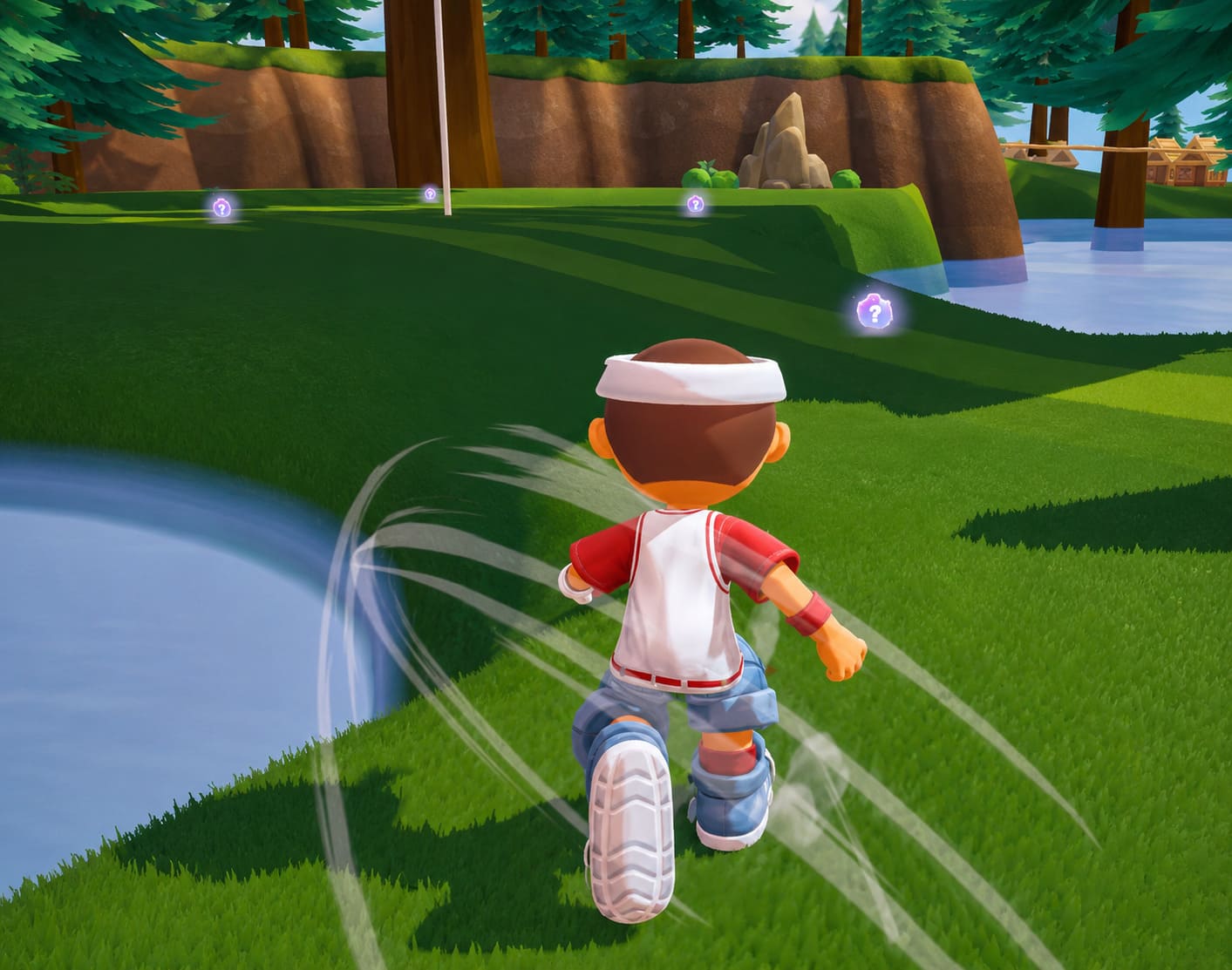
Characters have physical bodies rather than ghosting through one another.
Running into opponents slows both players.
The real strategy, though, revolves around club attacks.
Landing a successful hit launches your opponent backward while giving you a temporary movement boost.
Competitive players abuse this immediately after the countdown.
Rather than rushing their first drive, they’ll smack nearby opponents to gain extra movement speed before the race truly begins.
It’s aggressive.
It’s annoying.
And honestly…
It works.
Shields Reward Perfect Timing
The defensive shield is much stronger than many players realize.
Instead of merely blocking attacks, it reflects incoming objects using their original momentum.
That means:
- Rockets fly back.
- Golf balls reverse direction.
- Projectiles punish careless attackers.
A perfectly timed shield can completely reverse the momentum of an entire hole.
Weapon Physics Are Secret Mobility Tools
The best movement options in Super Battle Golf aren’t always designed for movement.
Physics makes them useful.
Elephant Gun Recoil
Every shot generates backward force.
The Elephant Gun simply produces far more recoil than normal.
By jumping before firing, players convert that backward impulse into forward movement, allowing enormous shortcut opportunities across certain maps.
Some advanced routes become impossible without mastering recoil movement.
Rocket Jumping
Classic shooter mechanics return here.
Fire a rocket at your feet while airborne, combine jump velocity with explosion force, and suddenly rooftops, cliffs, and hidden pathways become accessible.
The first successful rocket jump usually changes how players view entire maps.
Explosives Aren’t Just Weapons
Most players waste rockets during the opening moments of a hole.
Experienced players almost never do.
Instead, they wait.
Eventually several opponents gather near the green for careful putts.
That’s the perfect opportunity.
One rocket into the center of the group scatters balls across the course, resets multiple players, and creates a huge opening for anyone approaching from behind.
Landmines provide another clever trick.
Rather than leaving them stationary, advanced players deliberately detonate their own mines using accurate shots, effectively launching explosives toward distant targets that never expected incoming danger.
Super Battle Golf Item Tier List 2026: Strategy Guide For Team Mode
My Match Strategy for Consistent Wins
After spending countless matches experimenting with different approaches, this routine has become the most reliable.
Opening Seconds
Instead of rushing immediately, use nearby players to gain momentum through club combat.
Read the Environment
Check wind before every drive.
High winds demand lower trajectories.
Ice rewards conservative shot power.
Save Mobility Items
Never waste recoil weapons or movement tools early.
Courses with giant shortcuts reward patience.
Watch Behind You
Rotate the camera frequently.
Incoming rockets usually provide enough warning if you’re paying attention.
Control the Green
If reaching the cup isn’t possible before an opponent finishes, disrupt them.
A well-timed shot into another player’s ball often delays victory long enough for you to steal the hole.
Super Battle Golf Attack on City Update & Multiplayer Guide (2026)
Final Thoughts
Super Battle Golf may look like pure multiplayer insanity, but beneath every explosion, every ridiculous launch, and every accidental collision sits a remarkably consistent physics engine.
That’s exactly why the game remains so addictive.
The more time you invest into understanding launch angles, friction, gravity, collision behavior, recoil movement, and wind dynamics, the less random every match begins to feel.
Eventually you stop reacting to the chaos.
You start predicting it.
And once you reach that point, you’ll discover something most casual players never realize—Super Battle Golf isn’t just about hitting the ball first. It’s about manipulating the game’s physics better than everyone else on the course.