33 Immortals Tier Lists Explained: All Weapon Stats & Beginner’s Tips
When I first jumped into 33 Immortals, I expected a chaotic co-op roguelike with some light mythological dressing. I’ve played enough multiplayer action games to know how this usually goes: fun mechanics, messy coordination, and lore that exists mostly as background texture. But this game immediately felt different. It doesn’t just borrow from literature—it rebuilds its entire structure around it.

At its core, the game draws heavily from Dante Alighieri’s The Divine Comedy, but instead of treating it as a historical or religious text, it transforms it into a playable system of rebellion. What surprised me most is how consistent that reinterpretation is across mechanics, pacing, and even player count design.
After spending time with it, I stopped seeing it as “a Dante-inspired game” and started seeing it as a reinterpretation of divine hierarchy through multiplayer chaos.
A 33-Player Design That Actually Means Something
The most obvious structural decision is the 33-player limit per run. At first glance, it feels like a performance constraint or a gimmick. But the deeper you go, the more intentional it becomes.
The number mirrors the structure of Dante’s poetic work, where each major section is built around a repeated numerical rhythm. In the game, this becomes a gameplay identity rather than just symbolism. Thirty-three players aren’t just a group—they function like a living system that mirrors literary architecture.
From a player’s perspective, this creates a unique feeling: you’re never just “in a party.” You’re part of a large, unstable organism that only works when coordination actually happens.
33 Immortals Beginner Guide: A Veteran Gamer’s Take on Surviving the Chaos
Three Realms Reimagined as Gameplay Systems
The game divides its progression into three major realms, each echoing Dante’s journey but reinterpreting its meaning entirely.

Dark Woods – The Starting Point
The Dark Woods serve as the hub area. Instead of being purely narrative, it acts like a preparation layer where builds are refined, upgrades are unlocked, and players regroup between runs. It reflects the idea of confusion and transition, but in a functional gameplay way.
Inferno – Combat and Pressure
Inferno is where the game fully commits to chaos. This is the most mechanically dense part of the experience, filled with hazardous zones, enemy waves, and multi-stage encounters. It feels like the game is constantly testing whether players understand coordination under stress.
What stood out to me is how structured the chaos actually is. The environment looks overwhelming, but every encounter has logic once you learn to read it.
Purgatorio – Coordination Over Power
Purgatorio shifts the focus away from raw survival and into group efficiency. Objectives matter more than individual performance. If Inferno is about enduring pressure, Purgatorio is about proving that your group can function as a system.
This is where the game starts to feel less like a hack-and-slash and more like a coordinated raid structure.
Paradiso – Reversal of Expectations
Paradiso is the most controversial reinterpretation. Instead of peace or rest, it becomes an active conflict zone. The design choice flips expectations completely. Rather than reaching calm, players are pushed into one final confrontation that challenges the idea of divine order itself.
From my experience, this is where the game either fully clicks or completely surprises players who expected a traditional narrative arc.
Characters Rebuilt as Gameplay Functions
One of the most interesting design decisions is how classical figures are transformed into functional systems rather than narrative-only characters.
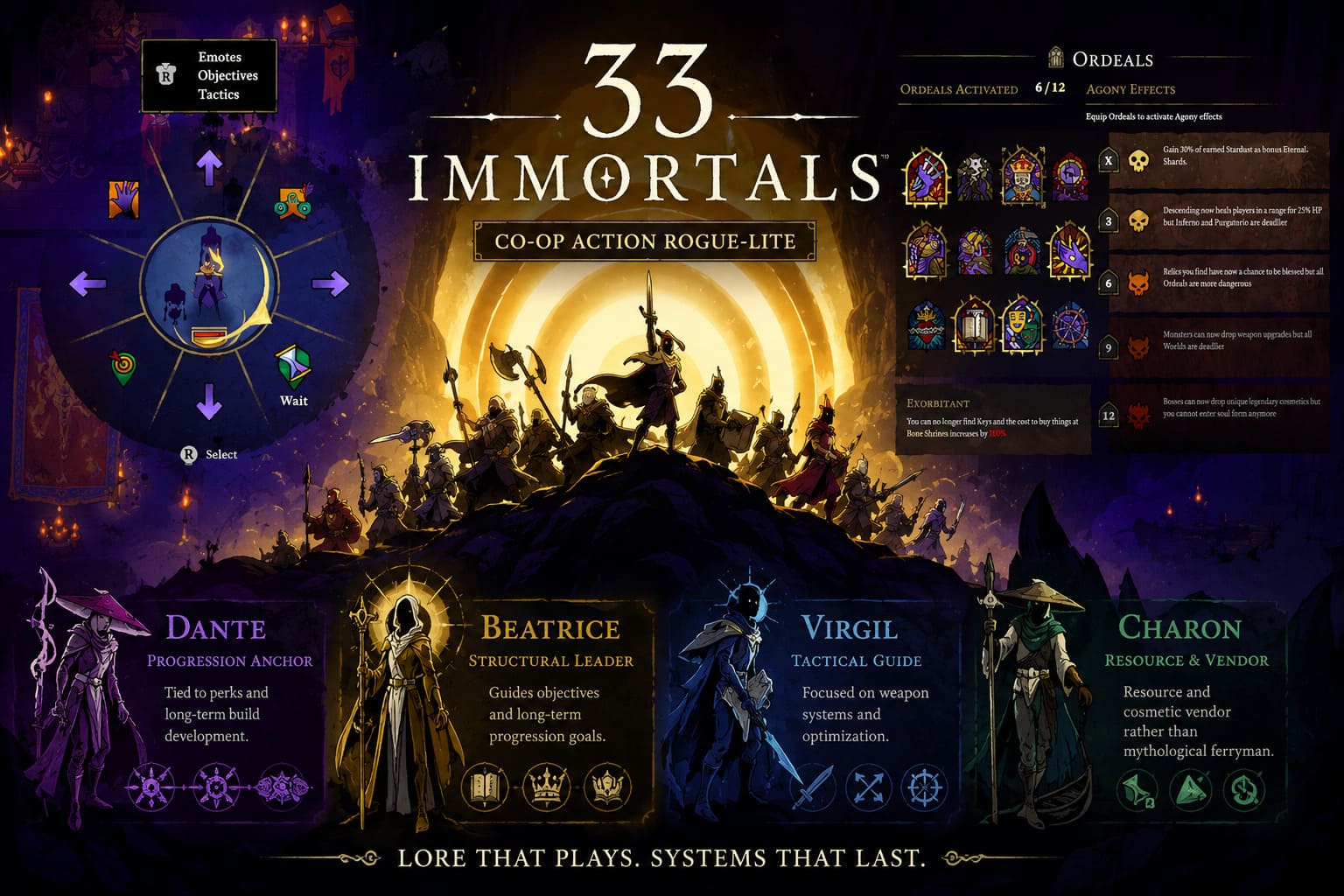
- Dante acts as a progression anchor tied to perks and long-term build development.
- Beatrice becomes a structural leader guiding objectives and long-term progression goals.
- Virgil is reinterpreted as a tactical guide focused on weapon systems and optimization.
- Charon shifts into a resource and cosmetic vendor role rather than a mythological ferryman.
What impressed me is that these aren’t just reskins. Each character actually supports a gameplay loop, making the lore feel embedded rather than attached.
Cooperation as the Core Theme
If there’s one design philosophy that defines the entire experience, it’s cooperation. But not cooperation as a soft suggestion—cooperation as a required system.
Abilities often require synchronized activation. Progression relies on group performance. Even survival during boss fights depends on whether players understand timing and positioning together.
This creates a very different emotional rhythm compared to most co-op games. You don’t feel like an individual contributing to a team—you feel like a single component in a larger machine that either functions or collapses.
How Each Realm Feels in Practice
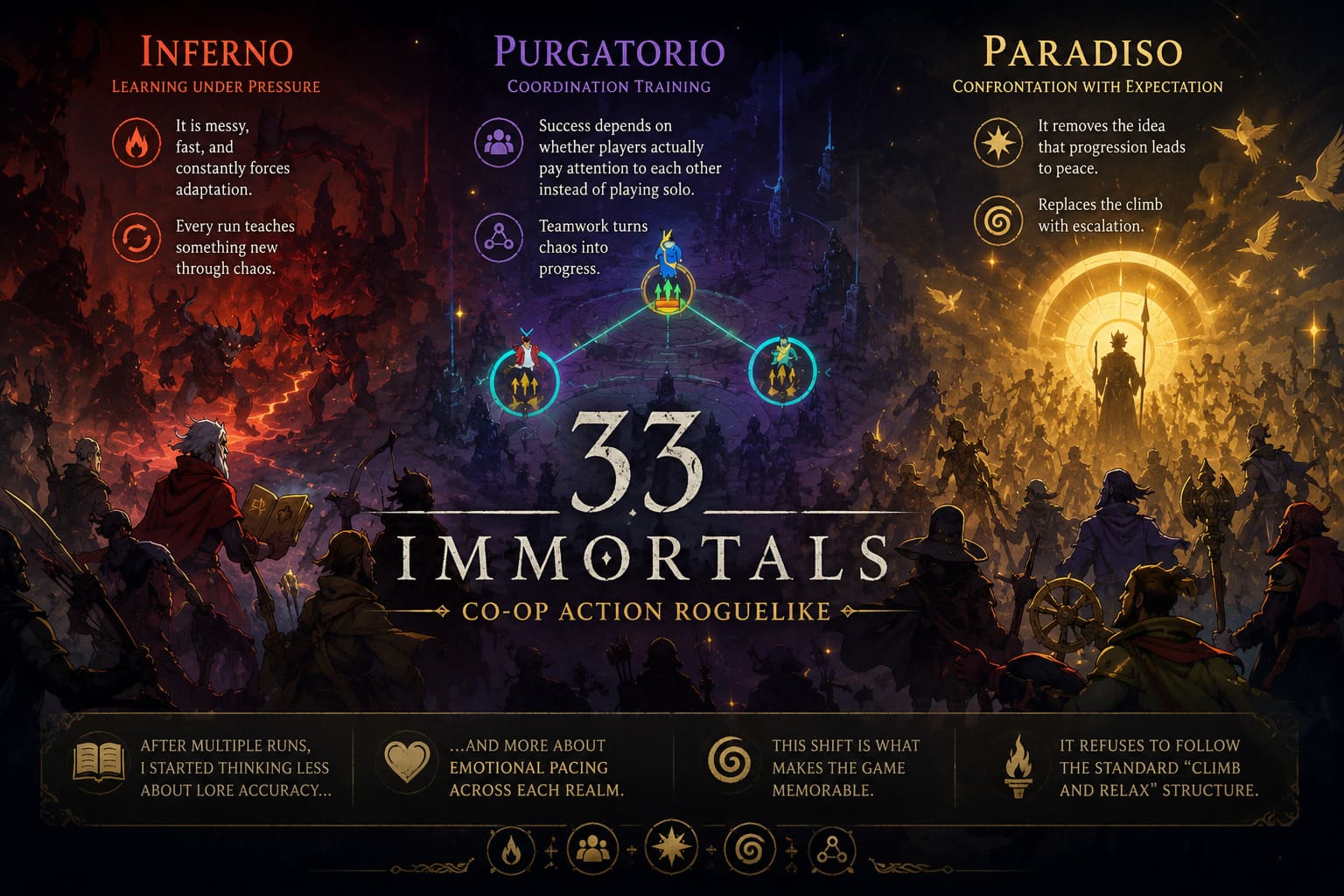
After multiple runs, I started thinking less about lore accuracy and more about emotional pacing across each realm.
Inferno feels like learning under pressure. It is messy, fast, and constantly forces adaptation.
Purgatorio feels like coordination training. Success depends on whether players actually pay attention to each other instead of playing solo.
Paradiso feels like confrontation with expectation itself. It removes the idea that progression leads to peace and replaces it with escalation.
This shift is what makes the game memorable. It refuses to follow the standard “climb and relax” structure most games rely on.
Boss Design as Symbolic Conflict
Boss encounters feel like interpretations of concepts rather than traditional enemies. Instead of simple difficulty spikes, they represent thematic resistance.
Some fights emphasize control mechanics, others punish disorganization, and the final encounters escalate into full-scale coordination tests that push the entire group to its limit.
What I found interesting is how bosses don’t feel isolated from the world—they feel like extensions of the system you are trying to break through.

What Stands Out After Extended Play
After spending significant time with 33 Immortals, a few things consistently stood out:
- The 33-player structure is not cosmetic—it defines the entire design philosophy.
- Lore is not separate from gameplay; it is embedded into systems and mechanics.
- Cooperation is not optional; it is the foundation of progression.
- The game consistently subverts expectations about ascent, reward, and completion.
Most multiplayer games inspired by literature treat their source material as aesthetic inspiration. This game treats it as structural logic.
Final Thoughts
What makes 33 Immortals interesting is not just its scale or its combat systems, but how confidently it reinterprets a foundational literary work into something interactive. It doesn’t try to faithfully retell Dante’s Divine Comedy. Instead, it rebuilds it as a system of rebellion and cooperation.
From my perspective as someone who has played a wide range of co-op and roguelike games, this one stands out because it has a clear thematic identity that directly affects how you play. It’s not just lore in the background—it’s something you actively participate in.
And that’s what makes it memorable long after the run ends.