WARDOGS Ultimate Arms Dealer & Mechanic Guide: Bulkhead Cash Mechanics and Upgrades
If there is one thing that becomes obvious after spending enough time with tactical shooters, it is that having the best gun does not automatically make you the best player. WARDOGS takes that idea and pushes it much further by making money management part of the actual combat loop. You are not simply choosing a loadout and jumping into a match; every weapon, attachment, vehicle, repair and tactical decision has a cost attached to it.
That makes the WARDOGS Arms Dealer and Mechanic system one of the most important things to understand if you want to perform consistently. The game throws 100 players into a three-team battlefield spread across a harsh industrial mountain environment in Eastern Europe, and the chaos can get ridiculous very quickly. From my experience with large-scale shooters, this is exactly the kind of system that can look complicated at first but becomes incredibly satisfying once you understand where your money should go.
WARDOGS Steam Deck Compatibility Settings: Best Performance Guide
Why Cash Matters So Much in WARDOGS
WARDOGS does not treat money as some secondary reward that you spend when you have nothing else to do. Cash is effectively another resource alongside ammunition, health and map control. You earn it through useful actions, but you can also burn through it incredibly fast if you play without thinking.
Capturing objectives, eliminating opponents, transporting teammates and reviving squad members all contribute to your income. The important part is that your financial situation changes throughout the match. A successful push can leave you with enough money for better equipment and heavier support, while a few careless deaths can put you right back into basic gear.
That risk-and-reward structure changes how I approach fights. In a traditional FPS, losing a fully customized rifle usually means nothing more than respawning and picking another one. In WARDOGS, an expensive loadout represents an actual investment, so dying with it can hurt far more than simply losing a gunfight.
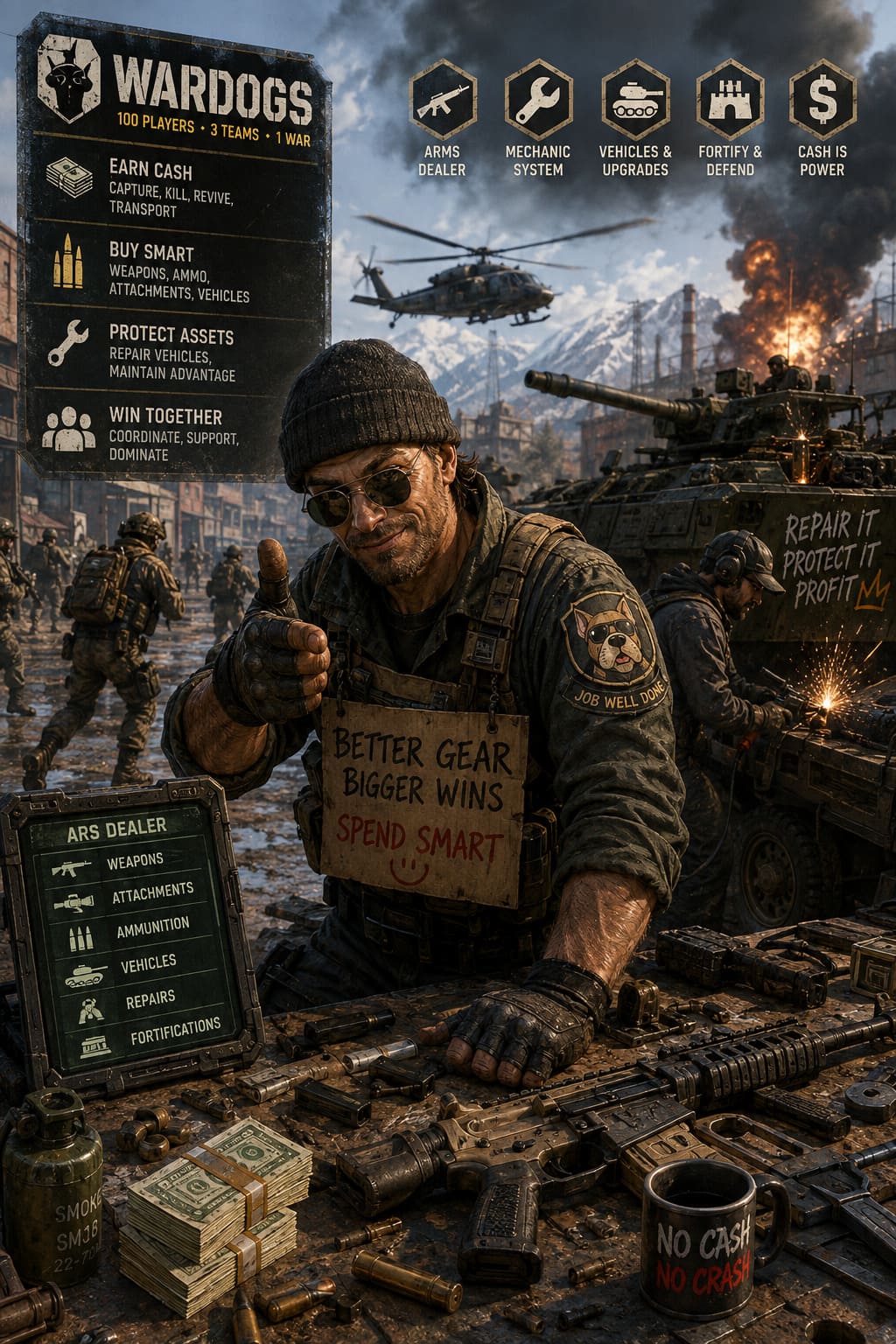
The Basic Cash Loop
The economic cycle is fairly easy to understand:
- Earn cash by playing objectives and helping your squad.
- Spend cash on weapons, ammunition, attachments and vehicles.
- Protect your investment by avoiding unnecessary deaths.
- Reinvest your profits into stronger equipment or coordinated attacks.
The tricky part is knowing when to spend and when to hold your money. That is where experienced squads should have a major advantage.
The Arms Dealer: Building the Right Loadout
The Arms Dealer is essentially your gateway to better infantry equipment. Instead of treating every weapon as a free selection from a preset class, WARDOGS asks you to think about what you actually need for the situation in front of you.
This sounds simple, but it creates some surprisingly interesting decisions. A fully upgraded assault rifle may be fantastic for pushing an objective, yet spending most of your savings on that rifle might leave you without enough money for another important purchase later.
I have always preferred shooters that make loadout decisions matter, and this system has the potential to reward players who understand the battlefield rather than simply copying whatever weapon currently feels strongest.
Weapons and Ammunition
Your weapon is only the beginning. Ammunition choices can also affect how much money you are committing to a particular deployment.
Different ammunition types are designed around different combat situations, including options such as armor-piercing rounds, tracer ammunition and high-velocity ballistic setups. The temptation is obviously to buy the expensive stuff whenever you can afford it, but that is not always the smartest move.
If you are defending a position and expect prolonged infantry combat, investing in the right ammunition can make sense. If your squad is broke and preparing for a counterattack, however, spending a huge percentage of your cash on premium ammunition can leave you financially exposed.
Attachments Can Quietly Drain Your Budget
Attachments are another place where players can accidentally waste a fortune.
Suppressors, optics, laser designators, extended magazines and recoil-control attachments can all improve a weapon, but more attachments do not automatically equal a better loadout. A rifle with every possible upgrade might be incredibly comfortable to use, but there is a point where the extra expense stops being worthwhile.
For example, if I am playing aggressively around an objective, an optic and extended magazine may be far more valuable than spending additional money on specialized equipment that I might rarely use. On the other hand, a sniper or support player may benefit much more from investing heavily in optics and specialized ammunition.
The best loadout is therefore not the most expensive one. It is the loadout that gives you the highest practical value for the situation.
The Mechanic System Changes the Scale of the Fight
The Arms Dealer handles personal firepower, while the Mechanic system takes WARDOGS into much larger territory.
This is where the game’s vehicles become especially important. Armored personnel carriers, tanks and helicopters can completely change how an engagement develops, but these assets are expensive enough that you cannot treat them like disposable killstreak rewards.
A vehicle should be viewed as a squad investment.
If three players save enough money to deploy heavy armor and immediately drive into an enemy-held position without infantry support, there is a good chance that investment will disappear in minutes. If the same vehicle is supported by infantry, repaired when necessary and used to control important terrain, its value can be enormous.
Vehicle Deployment
Before purchasing a vehicle, ask yourself a few basic questions:
- Does our squad actually need this vehicle right now?
- Do we have enough infantry to protect it?
- Is there a safe route to the area where we want to use it?
- Can someone repair it if the vehicle takes serious damage?
These questions may sound obvious, but large multiplayer battles are full of players who see a tank available and immediately want to drive it.
That is usually how expensive hardware turns into expensive scrap metal.
Repair and Maintenance Are Part of the Economy
One of the mechanics I find particularly interesting is the relationship between vehicle damage and the team’s economy.
A damaged vehicle is not simply an inconvenience. If you leave an important armored asset sitting around with severe hull, tread or rotor damage, you are potentially throwing away a major investment. Repairing it at the right moment can keep that investment active for considerably longer.
This is where dedicated Mechanics become extremely valuable.
A good Mechanic is not the player who blindly follows a tank around with a repair tool. The role is much more about understanding when maintenance is safe, when the vehicle needs to retreat and when continuing the fight is simply throwing money away.
Sometimes the best repair decision is actually getting the vehicle out of the fight before it becomes impossible to save.
Fortifications and Defensive Spending
The economic system also reaches into defensive construction.
Teams can invest money into obstacles, reinforced positions and resupply infrastructure around important areas. This becomes particularly useful when your squad has already established control of a strategically valuable zone.
There is a big difference between capturing an objective and actually making it difficult for another team to take it back. Fortifications can turn a temporary position into a much more difficult target, especially when combined with vehicles and coordinated infantry.
I would not recommend spending everything on defenses simply because the option is available, though. If the enemy is preparing a major offensive, keeping enough cash available for weapons, ammunition and mobile support can be much more important than building another wall.
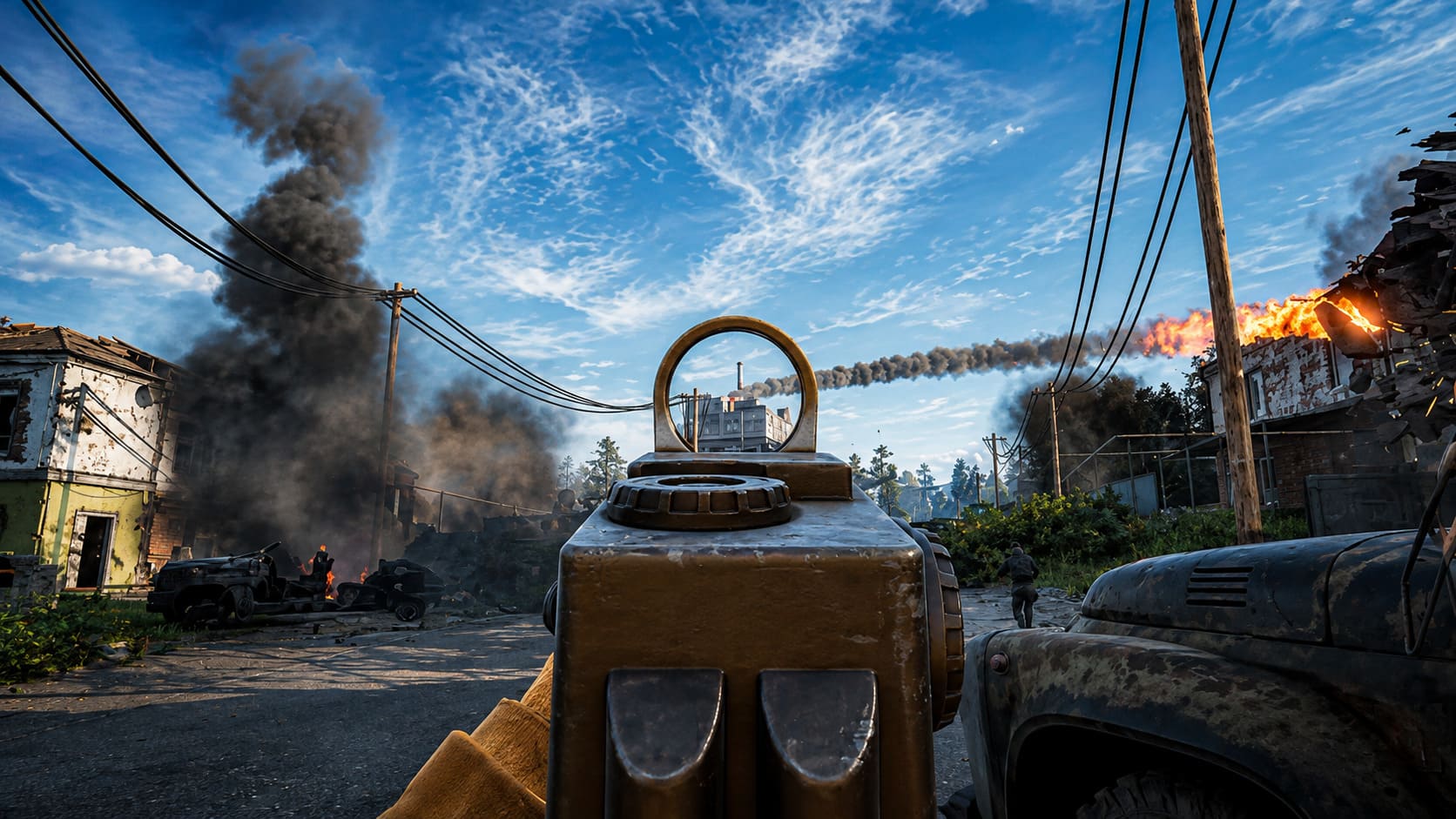
The Best Way to Make Money
The easiest mistake is focusing too heavily on kills.
Kills obviously matter, but the economic system rewards players who contribute to the broader battle. Objective play should be one of your biggest priorities if you want reliable income.
Capturing and defending control zones, moving teammates toward important areas and reviving squad members all contribute to the team’s momentum. A player who consistently performs these jobs can potentially generate more useful value than someone sitting on a distant hill farming occasional kills.
That is one of the things I like about the concept. It gives support-oriented players a real reason to stay involved rather than forcing everyone to chase the scoreboard.
Stop Treating Every Spawn Like a Shopping Spree
One of the biggest habits I would recommend changing is buying the most expensive equipment every time you spawn.
There will be matches where you can afford a premium rifle, expensive ammunition and heavy support. There will also be moments when your team is losing territory and your bank account is nearly empty.
In that situation, going cheap is not necessarily a disadvantage.
A basic infantry setup can allow you to stay active while rebuilding your cash reserves. You can defend a position, secure kills, revive teammates and wait for the squad to accumulate enough resources for a coordinated counterattack.
Think of it almost like an economy round in a competitive shooter. Saving money is not doing nothing. You are preparing for the next power spike.
Squad Coordination Is More Important Than Individual Wealth
WARDOGS becomes much more interesting when everyone understands that their money affects the squad rather than just themselves.
Imagine four players spending nearly all their cash on separate vehicles. It sounds impressive until you realize that there may be nobody left to provide infantry support, repair the vehicles or protect them from anti-armor attacks.
A coordinated squad should divide responsibilities.
| Squad Role | Primary Focus | Smart Spending |
|---|---|---|
| Assault | Objective pushes and close combat | Reliable weapons, ammunition and useful attachments |
| Support | Team sustain and defensive fire | Ammo, utility equipment and defensive upgrades |
| Mechanic | Vehicles and battlefield logistics | Repair equipment and vehicle-related upgrades |
| Anti-Armor | Enemy vehicle control | Specialized weapons and ammunition |
| Recon | Information and long-range pressure | Optics and specialized long-range equipment |
You do not need to lock every player into one role for an entire match. The point is simply to prevent everyone from making the same purchase at the same time.
My Biggest WARDOGS Money Management Tips
After playing enough tactical shooters, I have learned that complicated systems usually become much easier once you stop trying to maximize everything simultaneously. The same principle applies here.
1. Spend according to the objective. If you are attacking a fortified position, invest in equipment that helps you break it. If you are defending, prioritize survivability and ammunition.
2. Do not overbuild your weapon. A rifle with five expensive attachments is not automatically better than a cheaper setup you can afford to lose.
3. Treat vehicles like squad assets. Never assume that buying a tank means you should immediately drive toward the loudest explosion.
4. Repair expensive hardware. Keeping a valuable vehicle alive is often much cheaper than replacing it.
5. Save for coordinated pushes. One expensive purchase rarely changes a battle as much as several players spending their money together.
6. Play objectives. If you only chase kills, you are ignoring one of the most important parts of WARDOGS’ economy.
What Separates Good Players From Great Squads?
For me, the most interesting part of the WARDOGS economy is that it adds consequences to decisions that are normally forgettable in shooters.
In most games, you can experiment with weapons without worrying about the long-term cost. Here, buying an expensive setup and immediately losing it can change what you are capable of doing during the next few minutes. That makes positioning, teamwork and patience much more important.
The same applies to vehicles. A tank supported by a disciplined squad can dominate an area, while the exact same tank driven by a lone player can disappear almost instantly. The equipment itself is powerful, but the players protecting that investment determine whether it is actually worth the price.
Final Thoughts
WARDOGS has the ingredients for a tactical shooter where economic decisions are almost as important as aim. The Arms Dealer, Mechanic system, vehicle economy and defensive upgrades all encourage players to think beyond the next firefight.
The biggest lesson is simple: do not spend money just because you have it. Build equipment around the situation, protect expensive assets, repair vehicles whenever it is practical and communicate with your squad before making major purchases.
If your team can maintain a healthy cash flow while controlling objectives, WARDOGS’ battlefield starts to feel very different. Instead of five players independently running around with expensive toys, you become a functioning military unit with a budget, a plan and enough firepower to actually execute it.
And honestly, that is where I think the game’s economic system could become its most addictive feature. Winning a firefight is satisfying, but winning one because your squad managed its resources better than the other two teams feels like a much bigger achievement.