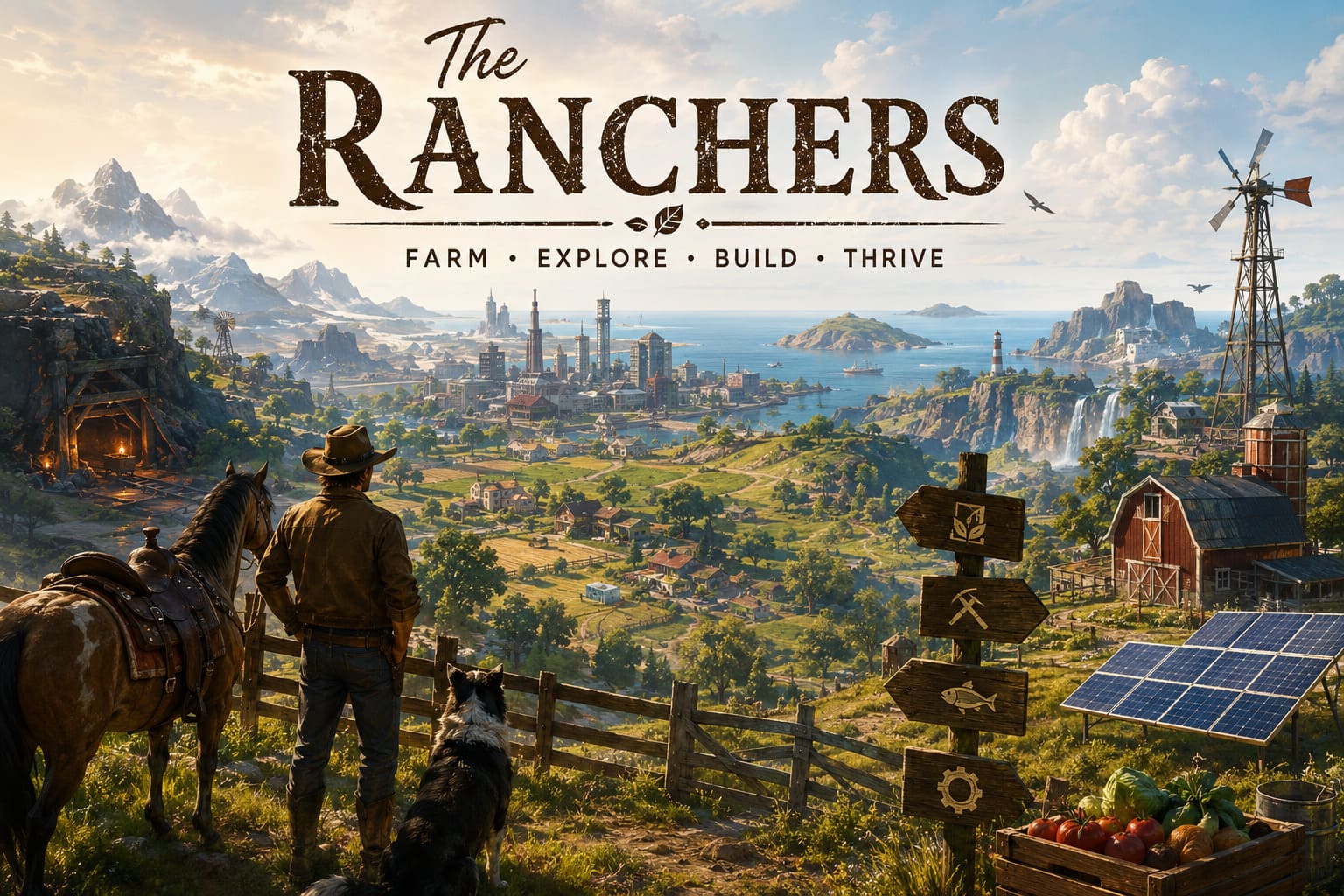
The Ranchers Lore Explained: The Deep Secrets Behind 2026’s Most Ambitious Open-World Farming RPG
When I first looked at The Ranchers, I honestly expected another relaxing farming simulator where I’d plant tomatoes, raise chickens, decorate a cozy house, and slowly expand my land. After spending time following developer updates, community discussions, and analyzing everything shown so far, I realized there’s something much more interesting happening beneath the surface.
What excites me isn’t just the farming or automation. It’s the feeling that this world already existed long before the player arrived. Every biome, abandoned mine, forgotten island, and even the nearby city seems to tell part of a larger story. The game never screams its lore at you—instead, it quietly lets you discover it through exploration.
That approach reminds me of some of my favorite open-world games. Instead of forcing long cutscenes, The Ranchers appears to trust players to connect the dots themselves.
More Than Just Escaping City Life
Most farming games begin with the same setup: you’re tired of urban life, inherit or purchase land, and start over.
The Ranchers certainly follows that formula, but I think it gives the idea a more believable modern context.
You’re not simply leaving because city life is “too busy.” Instead, you’re escaping a world that feels completely driven by corporations, efficiency, and endless pressure. The countryside represents something entirely different—a chance to create your own future instead of living someone else’s schedule.
Interestingly, that doesn’t mean you’ve escaped capitalism entirely.
The regional economy is still alive through the game’s online marketplace, where every crop, crafted item, or resource has real value inside the game’s ecosystem. Rather than pretending money doesn’t matter, The Ranchers builds its progression around learning how to become independent within an active economy.
That creates a surprisingly mature foundation for the entire adventure.
A World That Feels Like Someone Actually Lives There
One thing that immediately stands out is how large the world appears compared to traditional farming games.
Instead of being locked inside one valley, players can travel almost anywhere.
Some of the locations already shown include:
- Peaceful ranchlands
- Dense forests
- Mountain regions
- Coastal areas
- Underground mines
- Remote islands
- Modern town districts
- Open ocean
Each location feels designed for more than gathering resources.
The abandoned places especially caught my attention because they naturally create questions instead of giving answers.
Who built these structures?
Why were they abandoned?
What happened before the player arrived?
Those kinds of questions are exactly what makes environmental storytelling work.
The Mines Probably Hide the Biggest Mystery
Every time new gameplay footage appears, I find myself paying more attention to the underground sections than the farming itself.
Most farming RPGs include mines simply because players need ore.
Here, however, combat seems much more important.
Dangerous creatures occupy underground tunnels filled with valuable minerals required for advanced technology.
That immediately raises another question:
Why are monsters protecting industrial resources?
Obviously nothing has been officially confirmed, but my favorite interpretation is that the underground ecosystem existed long before modern settlers arrived.
As technology expanded, people likely dug deeper and deeper searching for increasingly valuable materials.
Eventually something changed.
Whether the monsters are ancient guardians, corrupted wildlife, or survivors of forgotten experiments, they don’t feel like random fantasy enemies thrown into the game simply because combat needed variety.
They seem connected to the world’s history.
That makes every expedition underground feel less like dungeon crawling and more like uncovering pieces of forgotten history.
The City Isn’t the Enemy
One misconception I’ve noticed is that some players assume the nearby city exists only as the “bad place” you escaped.
I don’t think that’s true.
Instead, the city feels like another side of the same world.
It offers:
| Feature | Why It Matters |
|---|---|
| Shops | Connect local production with commerce. |
| Citizens | Expand relationships beyond farming. |
| Laws | Make the world feel believable. |
| Police | Create consequences for illegal actions. |
| Businesses | Show that civilization still depends on rural production. |
| Events | Keep the town feeling alive throughout the year. |
Rather than existing as a villain, the city creates balance.
If the countryside represents freedom, the city represents structure.
Both depend on each other.
I Love the Environmental Storytelling
One reason I’m optimistic about The Ranchers is because so much of its storytelling appears visual instead of verbal.
You don’t necessarily need NPCs explaining every historical event.
Sometimes a ruined dock tells a better story than ten pages of dialogue.
Sometimes a broken windmill or abandoned campsite says more than a cinematic ever could.
Games like this become memorable because players create their own theories.
Every community discussion eventually becomes filled with ideas like:
- Maybe previous settlers disappeared.
- Maybe mining caused ecological collapse.
- Maybe the islands belonged to older trading routes.
- Maybe today’s villages were rebuilt after earlier disasters.
Whether those theories prove true almost doesn’t matter.
The world encourages curiosity.
Building Technology Doesn’t Feel Out of Place
At first I wondered whether solar panels, automated production, and modern machinery would clash with the relaxing farming atmosphere.
Now I actually think they’re one of the game’s strongest ideas.
Instead of glorifying endless manual labor, The Ranchers treats technological progress as something positive—provided it’s used responsibly.
The progression feels natural:
- Gather basic materials.
- Craft simple tools.
- Build workshops.
- Automate production.
- Generate renewable energy.
- Create a self-sufficient ranch.
That’s a satisfying evolution because your farm gradually transforms from a survival project into an efficient ecosystem.
Rather than destroying nature, technology becomes another tool for protecting it.
Multiplayer Makes the World Feel Larger
Another aspect I appreciate is how multiplayer fits naturally into the game’s setting.
You’re not portrayed as the world’s only rancher.
Instead, multiple people can build together, explore together, and contribute to the same economy.
That changes the atmosphere completely.
Instead of feeling isolated, the countryside starts to resemble a network of independent communities connected through trade.
The shared marketplace reinforces this idea.
Every successful ranch isn’t just producing food for itself.
It’s participating in something much bigger.
That subtle piece of world-building makes the online systems feel like part of the universe instead of a disconnected gameplay feature.
The Biggest Theme Isn’t Farming
After thinking about everything we’ve seen so far, I don’t believe farming is actually the main theme of The Ranchers.
Freedom is.
Every major system seems built around giving players meaningful choices.
- Do you focus on livestock?
- Do you become an industrial producer?
- Do you spend weeks exploring islands?
- Do you master fishing?
- Do you hunt rare minerals underground?
- Do you build a fully automated renewable-energy ranch?
There isn’t one “correct” path.
Instead, the game appears designed around letting players define success for themselves.
That’s a much stronger philosophy than simply asking players to grow larger crops every season.
Why I Think Players Will Stay for Hundreds of Hours
The best sandbox games aren’t remembered because they have the biggest maps.
They’re remembered because players always feel like there’s one more mystery waiting somewhere.
Based on everything revealed so far, The Ranchers seems built around exactly that feeling.
You’re constantly balancing exploration, business management, crafting, social relationships, construction, automation, and combat while slowly uncovering how the world became what it is today.
Even if the central story remains relatively simple, the environmental details could easily become the real star of the experience.
Personally, that’s exactly the kind of game I enjoy most.
I want to wander into an abandoned mine because I’m curious—not because a quest marker tells me to.
I want to sail toward a distant island wondering what happened there decades earlier.
And I want my ranch to become something I built through my own decisions rather than following a perfectly scripted progression.
How to Fix Shards of Order Crashing on Launch in Windows 11 (2026 Guide)
Final Thoughts
If The Ranchers successfully delivers that sense of discovery alongside its ambitious simulation systems, I think it has every chance to become one of the standout sandbox farming RPGs of 2026.
It’s easy to focus on the crops, animals, and automation, but I believe the real strength of the game lies in its world-building. A believable setting filled with unanswered questions keeps players invested long after they’ve harvested their first field, and that’s what could separate The Ranchers from dozens of other life simulators arriving on Steam.
Whether my theories end up being completely accurate or not, that’s honestly part of the fun. The best open-world games leave room for players to speculate, debate, and slowly piece together their own understanding of the setting. Based on everything shown so far, The Ranchers looks ready to deliver exactly that kind of experience, blending relaxing farm life with exploration, mystery, and meaningful progression in a way that feels surprisingly fresh for the genre.