Reincarnation Insurance Program Play With Friends: Multiplayer Guide And Co-Op Status
There is something wonderfully addictive about games that combine the screen-filling chaos of Vampire Survivors-style survivor mechanics with the loot obsession of an action RPG. You start a run with what feels like a fairly ordinary character, then twenty minutes later you are surrounded by ridiculous weapons, stacked bonuses, rare equipment, and enough enemies to make the screen look completely unhinged. R.I.P. – Reincarnation Insurance Program fits comfortably into that formula, but it adds its own post-apocalyptic personality and a surprisingly deep gear system.
After spending time with the game and playing plenty of other roguelites and loot-heavy games over the years, I can see exactly why players are searching for Reincarnation Insurance Program play with friends. The combat feels naturally suited to cooperation. There are different character styles, specialized weapons, powerful abilities, and plenty of opportunities to create wildly different builds. The obvious question is whether you can actually bring another player into your run.
Unfortunately, this is where expectations need to be adjusted. R.I.P. – Reincarnation Insurance Program is a single-player game at its Version 1.0 release. There is no traditional online co-op mode, local split-screen option, or PvP system that allows friends to enter the same battlefield. That may disappoint players who were hoping for a cooperative zombie massacre, but it also explains why the game’s systems are so heavily focused on making one character increasingly powerful.
How to Fix Stuttering in Reincarnation Insurance Program (R.I.P. Performance Guide)
What Is R.I.P. – Reincarnation Insurance Program?
The basic idea behind R.I.P. is surprisingly clever. You play as an elite agent working under a mysterious corporate system in a world overwhelmed by infection, mutants, and hordes of hostile creatures. The strange corporate premise gives the roguelite structure a narrative excuse: death is not necessarily the end because your character is protected by the Reincarnation Protocol. In other words, dying is less of a failure and more like another expensive business expense.
That concept works particularly well because the game expects you to die, experiment, rebuild, and return stronger. Each run becomes an opportunity to discover new weapons, improve your character, test different combinations, and eventually create a build that can survive situations that would have destroyed you earlier. I have always liked this kind of progression because it turns failure into information rather than simply punishing the player.
The moment-to-moment gameplay revolves around fighting enormous groups of infected enemies while managing your movement, positioning, weapons, and abilities. The further you progress, the more ridiculous the battlefield becomes. Enemies can cover huge portions of the screen, while your own weapons start producing increasingly spectacular visual effects.
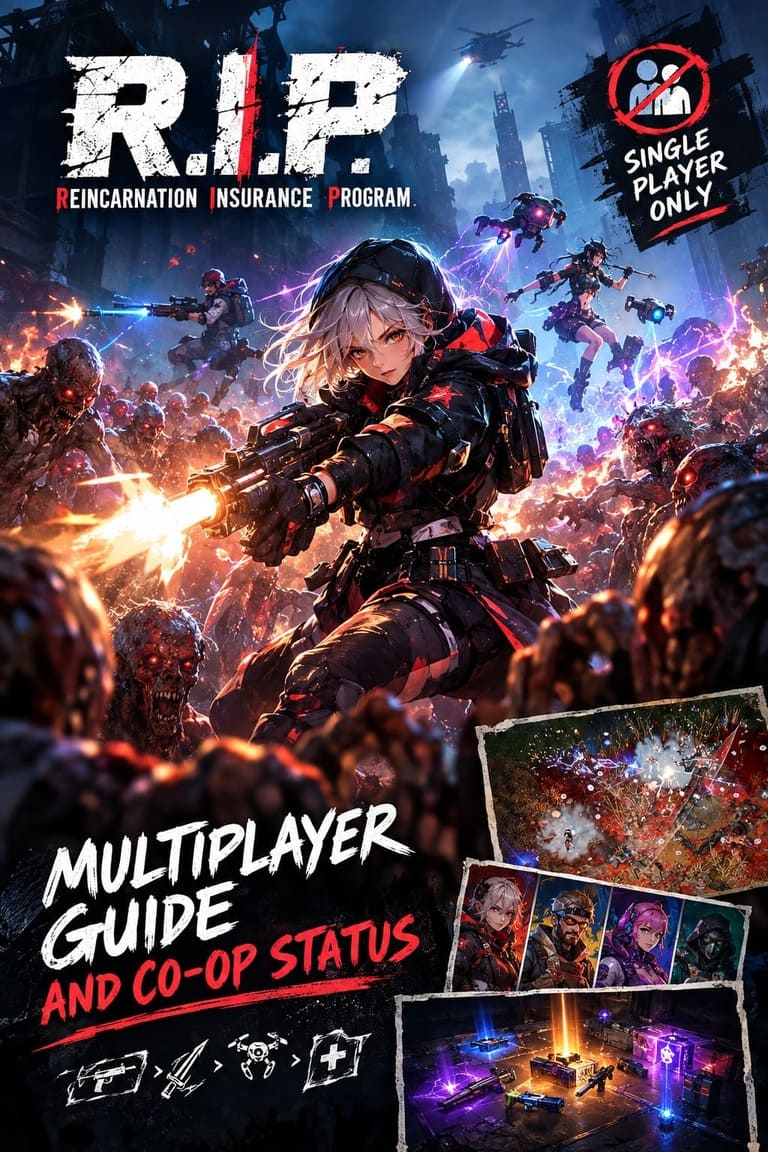
Is Reincarnation Insurance Program Multiplayer?
If you are specifically looking for Reincarnation Insurance Program multiplayer, the answer at the Version 1.0 launch is straightforward: no, the game does not offer multiplayer co-op. R.I.P. is designed as a solo experience, so you cannot invite a friend into your current run and fight through the infected zones together.
| Feature | Availability |
|---|---|
| Online Co-Op | No |
| Local Co-Op | No |
| Split-Screen | No |
| Player Versus Player | No |
| Solo Gameplay | Yes |
| Leaderboards | Yes |
That distinction is important because some players see the game’s character variety and loot systems and naturally assume there must be a multiplayer component somewhere. There simply isn’t one in the current release. If your main reason for buying the game is to sit down with a friend and clear hundreds of zombies together, this is not the experience you are looking for right now.
Why Does R.I.P. Feel Like It Should Have Co-Op?
This is probably the most interesting part of the discussion. Even though R.I.P. is completely playable as a solo game, many of its mechanics practically invite players to imagine a cooperative mode. When you have different specialists, specialized equipment, elemental effects, drones, melee attacks, ranged weapons, and powerful passive bonuses, it is almost impossible not to start thinking about possible team combinations.
Take a fast melee-focused character such as Ling. Her katana-based fighting style gives her a completely different battlefield presence compared with a character who prefers to stand farther away and unload heavy ranged attacks. In a hypothetical four-player party, you could imagine one player constantly cutting through enemies at close range while another specializes in rockets, another focuses on drones, and a fourth player provides defensive or support abilities.
That kind of build synergy is one of the main reasons ARPG fans love multiplayer. It is not simply about having another gun on the screen. It is about watching completely different builds interact. One player creates an enormous crowd-control zone while another melts bosses, and suddenly a combination that looked mediocre in solo play becomes incredibly powerful in a team.
The Loot System Makes Multiplayer Even More Tempting
The equipment system is another reason I would love to see some form of co-op eventually. R.I.P. leans heavily into randomized loot, with enemies and bosses dropping equipment of different rarities and with various modifiers. Weapons can be customized around different effects, while more powerful equipment can dramatically change the direction of a build.
There is a particular satisfaction in finding an absurdly powerful item after surviving a difficult run. In a multiplayer game, that moment could become even more entertaining because you would immediately have someone else to react to it. Imagine defeating a giant mutant with a friend, watching a rare item fall onto the ground, and then arguing over which build can make better use of it.
At the moment, however, those experiences remain hypothetical. The loot system is designed around individual progression rather than a shared party economy. Your build, equipment, talents, and progression are all part of your personal journey.
What Makes the Solo Experience Work?
The absence of multiplayer does not mean R.I.P. feels empty. Quite the opposite. The solo structure gives the developers room to concentrate heavily on character progression and build experimentation. You are responsible for every decision during a run, which makes surviving an especially difficult wave feel much more personal.
The talent system is a major part of that progression. By earning Contribution Points, you can gradually unlock permanent improvements and develop your preferred playstyle. Some players will naturally gravitate toward raw damage, while others may prefer survivability, utility, or combinations that make specific weapons considerably more effective.
I generally enjoy progression systems like this because they give me a reason to return after a failed run. If I know that the next attempt will allow me to unlock another talent or experiment with a different weapon combination, losing does not feel like wasted time. It becomes part of the larger build-crafting process.
Version 1.0 Adds More Reasons to Keep Playing
The Version 1.0 release is also important because R.I.P. is no longer simply an Early Access curiosity. The full release expands the experience with additional content, balance changes, progression adjustments, and a more complete campaign structure. Loot progression has also received attention, making the pursuit of higher-tier equipment an important part of the late-game experience.
The campaign takes players through multiple infected regions before eventually leading toward a final confrontation. For players who enjoy the feeling of gradually turning an underpowered character into an absurd killing machine, there is plenty here to experiment with.
What I particularly appreciate about this structure is that the game does not stop being interesting immediately after the main story. Once your character becomes powerful enough, the focus shifts toward testing just how far that build can go.
Void Spire Provides a Competitive Alternative
One of the more interesting endgame additions is Void Spire. Instead of simply repeating the standard campaign, this mode gives players an escalating challenge designed to push their established builds further and further. The tower-style structure works well for a game built around increasingly powerful equipment and permanent character progression.
Each stage provides another opportunity to test your build against increasingly demanding enemies. Better rewards and additional upgrades encourage players to keep climbing, while the scaling difficulty gives veteran players something to chase after they have already mastered the basic campaign.
This is also where the game’s leaderboards become relevant. They do not replace genuine multiplayer, but they provide an asynchronous way to compete with friends. Instead of joining the same match, you can compare scores, completion times, tower progress, and character builds.
Can You Play R.I.P. With Friends in Any Way?
There is no direct co-op workaround that magically turns R.I.P. into an online multiplayer game. You cannot create a private lobby and have your friends control additional agents. However, that does not mean the game has to be played in complete isolation.
One option is the classic couch-side-by-side approach. If you and a friend both have access to the game, you can play your own runs simultaneously and compare builds, discoveries, and results. This may sound old-fashioned in an era dominated by online multiplayer, but honestly, some of the most enjoyable gaming sessions I have had involved two people playing separate games while constantly commenting on what was happening.
The leaderboards and community discussions provide another layer of indirect competition. Players can compare their builds, share screenshots, discuss talent choices, and challenge each other to beat particular scores. It is not the same as fighting through a zombie horde together, but it does give competitive-minded players something to chase.
Could Reincarnation Insurance Program Get Co-Op Later?
This is the question that is much harder to answer. Developers sometimes add major features after launch, particularly when there is clear demand from the community, but there is no guarantee that R.I.P. will eventually receive multiplayer. Adding co-op to a game built around solo combat would require substantial technical and design changes rather than simply adding an invitation button.
Enemy targeting, difficulty scaling, loot distribution, character balance, UI elements, network synchronization, and performance would all need to be reconsidered. This is particularly relevant for R.I.P. because the game can already place an enormous number of enemies and effects on screen during intense encounters. Supporting several human players simultaneously could create a very different technical challenge.
For that reason, I would treat multiplayer as a potential future feature rather than something players should purchase the game expecting to receive. If cooperative play is the main feature you are looking for, the current version should be evaluated strictly on what it offers today.
Final Thoughts on Reincarnation Insurance Program Play With Friends
R.I.P. – Reincarnation Insurance Program is currently a solo-only experience, and that is the most important thing to know before buying it specifically for multiplayer. There is no online co-op, local multiplayer, split-screen mode, or PvP system in the Version 1.0 release. The game’s character variety and loot mechanics may make you wish for cooperative play, but the actual experience is built around developing one extremely powerful agent.
Personally, I think the game’s strongest appeal is the combination of chaotic survivor-style combat and deeper ARPG-inspired progression. The randomized equipment, talent development, character differences, and escalating endgame create plenty of reasons to keep experimenting. It is the kind of game where a failed run can make you immediately think, ‘Okay, I know exactly what I want to change next time.’
If you came here searching for Reincarnation Insurance Program play with friends because you want a cooperative zombie shooter, keep the current multiplayer status firmly in mind. If you are happy with a single-player roguelite where you can compete indirectly with friends through builds, scores, and leaderboards, there is considerably more to explore. And if WarmCore Studio ever decides to introduce co-op, the game’s existing systems provide an interesting foundation for some seriously chaotic team-based runs.
Bottom line: R.I.P. is built for solo players right now, not cooperative parties. Its progression and combat systems are deep enough to stand on their own, but the potential for team-based build synergy is one of the game’s most intriguing ‘what if?’ possibilities for the future.