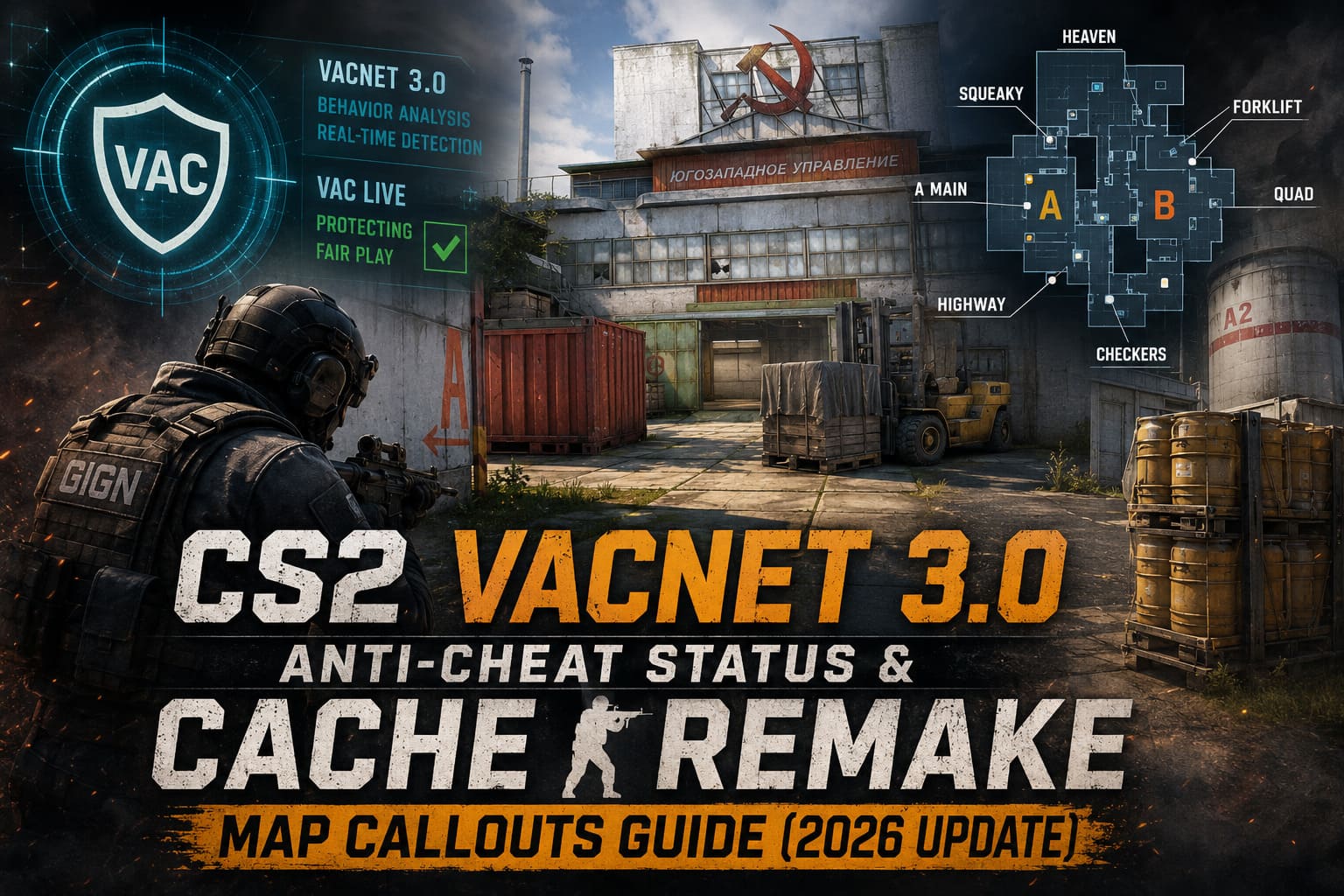
CS2 VacNet 3.0 Anti-Cheat Status & Cache Remake Map Callouts Guide (2026 Update)
Counter-Strike has always been a game where every tiny detail matters. One perfect flash, one missed footstep, or one delayed rotation can decide an entire match. That’s exactly why 2026 feels like one of the biggest years in modern CS2. It’s not just because an iconic battlefield returned to the Active Duty rotation—it’s because competitive matches finally feel noticeably cleaner.
After spending dozens of hours in Premier, watching professional matches, and grinding solo queue, I can honestly say the combination of VacNet 3.0 and the Source 2 version of Cache has changed how the game feels from round one.
Neither feature is perfect, but together they create a much healthier competitive experience than we had just a couple of years ago.
Why VacNet 3.0 Feels Different
Older Counter-Strike anti-cheat systems often felt invisible. You reported someone, finished the match, and maybe weeks later you received a notification that a player had been banned.
That always left one frustrating question:
“Why did I have to finish an obviously ruined match?”
VacNet 3.0 changes that philosophy.
Instead of relying mostly on detecting cheat software itself, Valve’s latest AI-driven security system focuses heavily on player behavior. It studies how someone aims, reacts, moves, and interacts with opponents over time instead of simply looking for suspicious programs.
As a player, you don’t really notice the technology working.
You notice the results.
What Makes the New Detection System Feel Smarter?
Rather than judging one isolated action, the system appears designed to recognize entire behavioral patterns.
Some examples include:
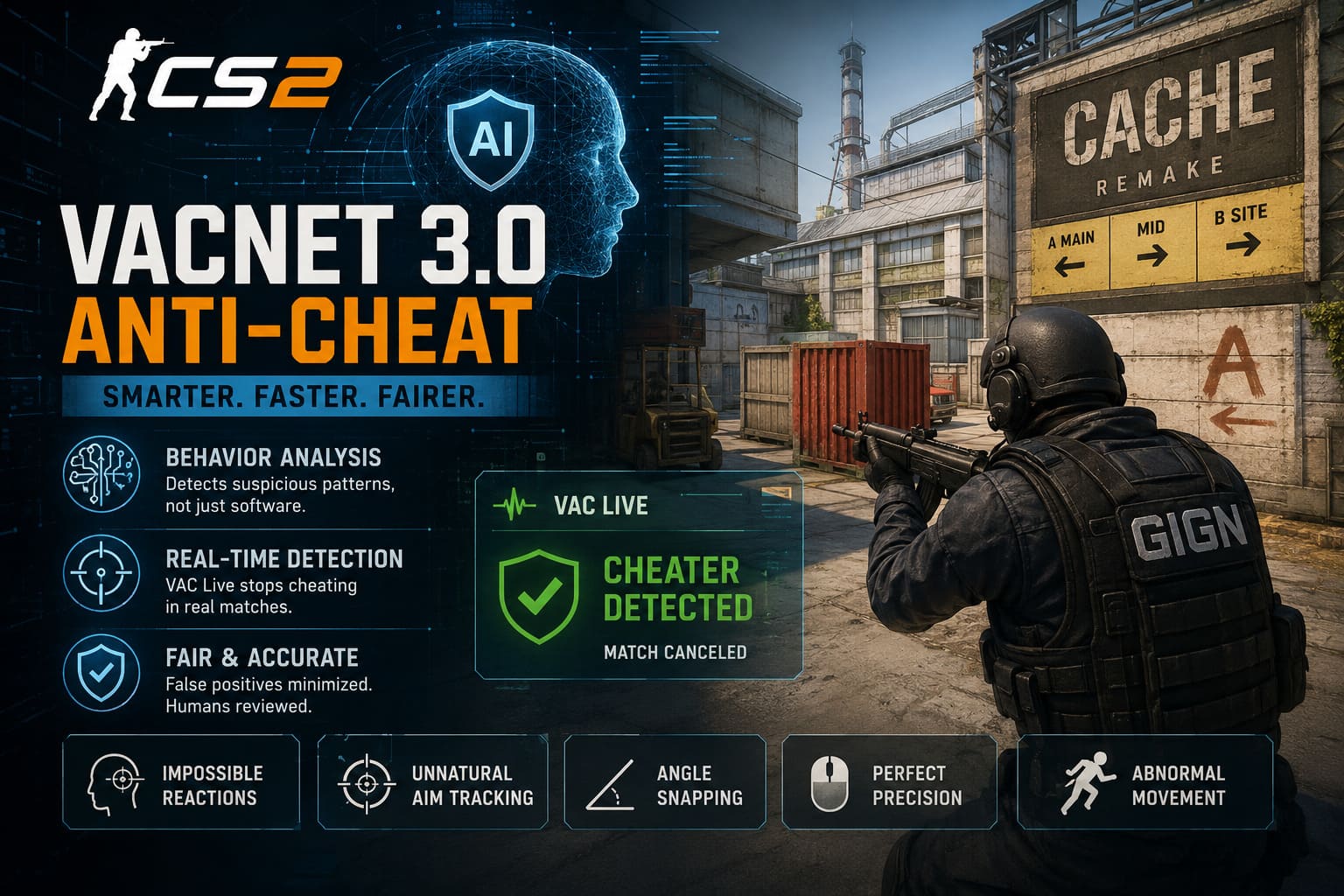
- Impossible reaction consistency.
- Unnatural crosshair tracking.
- Suspicious angle snapping.
- Repeated aim corrections beyond normal human precision.
- Abnormal movement combined with perfect information.
This makes sense because experienced cheaters rarely use obvious rage hacks anymore. Many try to stay just believable enough.
The goal isn’t simply catching blatant spinbot users.
It’s identifying players who consistently perform in ways that don’t match legitimate human input.
VAC Live Has Become One of My Favorite Features
If there’s one improvement that immediately earns player trust, it’s VAC Live.
Few things feel better than watching a suspicious match suddenly end because the system detected obvious cheating.
Instead of wasting another twenty minutes in a compromised game, the match simply stops.
- No rating loss.
- No pointless overtime.
- No arguing in chat about whether someone is cheating.
For competitive players, this creates something incredibly valuable:
Confidence that your time isn’t being wasted.
That’s probably the biggest psychological improvement more than any technical change.
Suspicious Doesn’t Always Mean Guilty
One thing I appreciate is that Valve doesn’t appear to treat every unusual performance as instant proof of cheating.
Some players genuinely have incredible aim.
Others have one unbelievable match.
Instead of immediately banning every statistical outlier, suspicious accounts can reportedly be separated for additional evaluation.
From a competitive standpoint, that feels like the right balance.
Nobody wants false bans simply because someone had the best game of their life.
Cleaner Matches Mean Better Competitive Games
I’ve noticed something interesting while playing Premier.
The biggest improvement isn’t that cheating has magically disappeared.
It’s that obvious cheating feels far less common.
That changes the atmosphere dramatically.
People spend more time discussing utility usage, rotations, and economy instead of accusing every strong opponent of hacking.
That alone makes matches more enjoyable.
Cache Is Back—and It Still Feels Like Cache
Some maps lose their identity after a remake.
Cache somehow avoided that.
The first time loading into the new version, everything immediately felt familiar while also looking noticeably cleaner.
The brighter lighting makes enemy models easier to identify.
Textures look modern without becoming distracting.
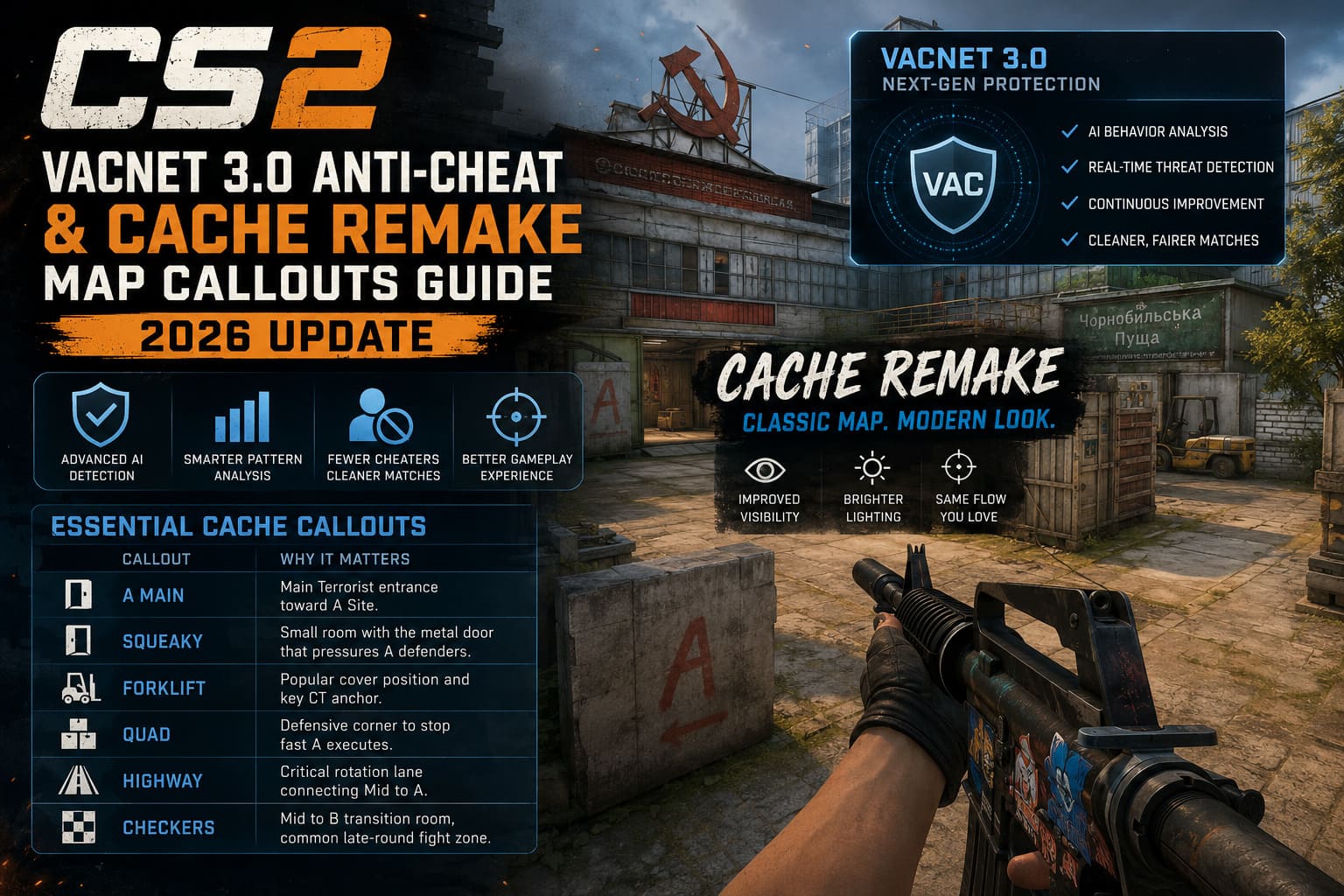
Most importantly, the classic flow remains intact.
- You still get those explosive Mid battles.
- A Main still demands careful utility.
- B executes still reward coordinated teamwork.
It simply feels like Cache grew up alongside Source 2.
The Biggest Difference Is Visibility
One criticism older versions of Cache occasionally received involved visual clutter.
Dark corners.
Heavy green coloring.
Objects blending together.
The updated version dramatically improves readability.
Whether you’re holding an angle from Heaven or swinging through Highway, spotting opponents generally feels more consistent.
That matters more than many people realize.
Competitive maps should challenge decision-making—not eyesight.
Cache Callouts You Absolutely Need to Know
Communication wins rounds.
Even incredible mechanical skill won’t help much if teammates have no idea where enemies are.
Here are the locations every player should memorize.
| Callout | Why It Matters |
|---|---|
| A Main | Main Terrorist entrance toward A Site and one of the earliest points of contact. |
| Squeaky | Small room with the famous metal door that creates constant pressure on A defenders. |
| Forklift | Classic cover position and one of the most common CT anchor spots. |
| Quad | Defensive corner used to slow fast A executions. |
| Highway | Critical rotation lane connecting Mid to A. |
| Checkers | Transition room between Mid and B that frequently becomes the center of late-round fights. |
Learning these six names alone instantly improves communication in solo queue.
Mid Still Controls the Entire Map
If you’ve played Cache before, you already know one truth:
Whoever controls Mid usually controls the pace of the round.
Winning Mid creates options.
You pressure Highway.
You threaten Vent.
You force defenders to split attention.
Suddenly every bombsite becomes vulnerable.
Important Mid locations include:
- Boost.
- White Box.
- Vent.
- Sandbags.
- Mid Window.
- Highway.
Even if your team never commits through Mid, forcing defenders to respect it creates opportunities elsewhere.
B Site Rewards Patience More Than Ever
B has always been deceptive.
On paper it looks straightforward.
In reality it’s filled with dangerous angles.
Players should always clear these positions carefully:
- Heaven.
- Headshot.
- Hell.
- Pit.
- Back Site.
- Checkers entrance.
One unchecked defender hiding beneath Heaven can completely destroy an otherwise perfect execute.
That’s why utility matters just as much as aim.
Utility Is More Reliable on the New Cache
One pleasant surprise is how consistent grenade lineups feel.
Cleaner geometry and improved visual clarity make many throws easier to repeat.
Some of my favorite utility ideas include:
- Smoking Heaven before entering B.
- Flashing through A Main before challenging Forklift.
- Blocking Highway during A splits.
- Using Molotovs to clear Quad.
- Denying Headshot before planting on B.
Small utility advantages often become round-winning advantages.
Solo Queue Communication Can Be Simple
You don’t need professional-level vocabulary.
Short, accurate information works best.
- “Two Checkers.”
- “One Highway.”
- “AWP Heaven.”
- “Bomb Default A.”
- “Player Forklift.”
Quick, specific callouts are infinitely better than yelling, “They’re everywhere!”
How to Fix eBaseball PRO SPIRIT 2026 Crash on Launch on Steam: Complete PC Troubleshooting Guide
My Biggest Takeaway After Playing the 2026 Version
I think many longtime players expected Cache to return mostly because of nostalgia.
Instead, it feels relevant.
The map still rewards smart positioning, coordinated utility, and strong teamwork without feeling outdated.
At the same time, VacNet 3.0 quietly improves the overall experience in a way that’s difficult to appreciate until you’ve played dozens of matches.
You simply spend less time wondering whether someone is cheating and more time thinking about strategy.
That’s exactly how competitive Counter-Strike should feel.
Final Thoughts
Counter-Strike has survived for decades because its core formula rarely changes. Great maps, precise gunplay, and intelligent teamwork remain the foundation of every match.
The 2026 updates don’t reinvent that formula—they polish it.
VacNet 3.0 gives players more confidence that competitive integrity actually matters, while the Cache remake reminds everyone why it’s considered one of the greatest community maps ever created.
If you’re returning to CS2 after taking a break, now is arguably one of the best times to jump back into Premier. Spend a little time learning the updated Cache callouts, communicate clearly with your teammates, and don’t underestimate how much good utility can change a round.
Counter-Strike has always rewarded preparation more than luck. In 2026, that feels truer than ever.