Best Solo Survival Class in Dune: Awakening (Update 1.5 Guide)
If you are stepping into Dune: Awakening Update 1.5 without a regular squad, there is one thing you learn pretty quickly: Arrakis does not care that you are playing alone.
A patrol finds you at the wrong moment. A ranged enemy strips your shield while you are fighting a melee group. Your stamina disappears just when you need one last dodge. Then you are lying in the sand wondering why you thought going solo was a good idea in the first place.
That is exactly why the current Swordmaster solo build feels so comfortable.
I have always liked classes that can solve their own problems instead of asking the rest of the party to cover every weakness. Swordmaster fits that philosophy almost perfectly. It can close distance, parry, control groups, mitigate incoming damage and keep moving when other builds start running out of options.
Update 1.5 makes that identity even more noticeable. With the new focus on solo play, offline/custom server options and changes to PvE encounters, the question is no longer simply which class looks strongest with a coordinated group. The much more interesting question is: which class gives you the most tools when nobody is coming to help?
For me, the answer is Swordmaster.

Why Swordmaster Is So Strong for Solo Players
The biggest reason is simple: Swordmaster does not have to specialize in surviving one particular kind of encounter.
A good solo build needs damage, mobility and defense at the same time. If you invest too heavily into one of those areas, the game eventually exposes the weakness.
Swordmaster has a much more forgiving toolkit.
Update 1.5 also makes stamina management particularly important. Successful parries now restore part of your stamina with melee weapons, which gives aggressive players a very useful feedback loop. You defend yourself, regain stamina, stay in the fight and then use that stamina to reposition or attack.
That sounds like a small mechanical adjustment on paper. In actual solo combat, it can completely change the rhythm of a fight.
When you are alone, stamina is effectively another health bar.
No stamina means no comfortable dodging. No emergency movement. No easy escape from a bad position. You can have excellent armor and still get demolished if you burn through your stamina at the wrong time.
Swordmaster naturally encourages you to play around that resource rather than constantly fighting against it.
The Swordmaster Skills I Would Prioritize
You do not need every ability in the class to make Swordmaster work. A few skills form the backbone of the solo playstyle.
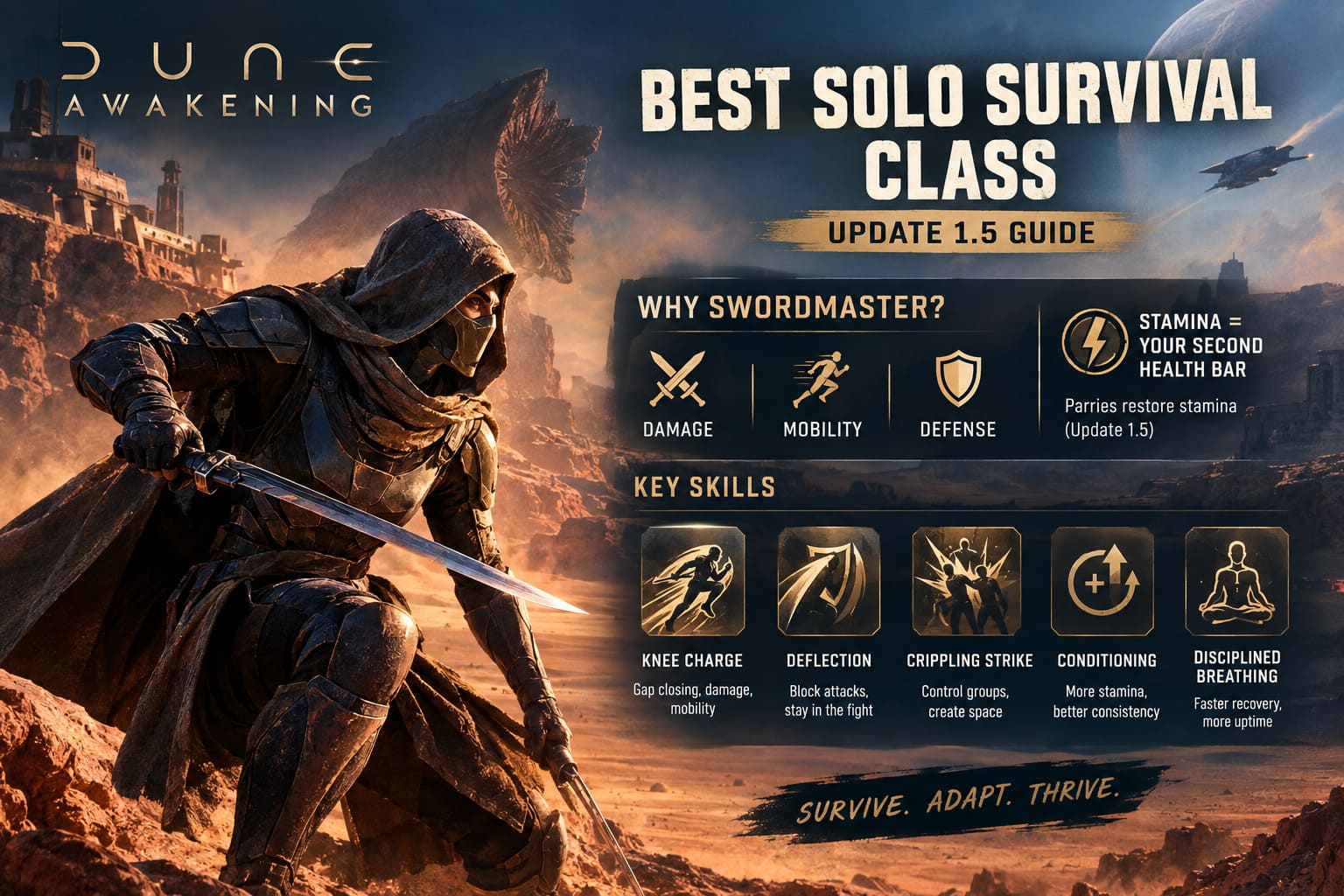
| Skill | Why It Matters Solo |
|---|---|
| Knee Charge | Gap closing, burst damage and emergency repositioning |
| Deflection | Front-facing protection against melee and ranged attacks |
| Crippling Strike | Crowd control and breathing room against groups |
| Conditioning Passives | More stamina and better combat consistency |
| Disciplined Breathing | Faster stamina recovery between engagements |
Knee Charge
Knee Charge is probably the ability I would miss first if I had to play without it.
It is much more than a damage button. Against ranged enemies, it gives you an immediate way to remove the distance they desperately want to maintain.
A sniper or ranged NPC can be extremely annoying when you are fighting several enemies at once. Instead of slowly walking through incoming fire, Knee Charge lets you make the first move.
It also works in the opposite direction.
If a fight goes wrong, the same mobility tool can help you create distance. That versatility is incredibly valuable when you do not have a teammate nearby to rescue you.
Deflection
Deflection is where Swordmaster starts feeling genuinely comfortable for solo PvE.
You will regularly fight from bad positions when exploring camps, underground locations and testing stations. Enemies can approach from multiple angles, and your shield is not going to solve every problem.
Deflection gives you another layer of protection.
The important part is learning when to stop attacking and actually use it. Solo Swordmaster is not about permanently holding the attack button. You want to recognize incoming pressure, defend at the right moment, recover your stamina and immediately return to the offensive.
Crippling Strike
This is the ability that saves you when the fight gets crowded.
One enemy is manageable. Two or three are still fine. Then suddenly a patrol joins the fight and the entire encounter turns into chaos.
Crippling Strike gives you that little bit of space you need.
Slow the group, reposition, parry, swap weapons or simply run to a better location. Crowd control is often more valuable for a solo player than another flashy damage ability.
The Solo Hybrid Build: Swordmaster + Mentat + Trooper
Eventually, sticking to one class becomes less attractive.
This is where the mentor system becomes one of the best parts of building a solo character. You can take the Swordmaster foundation and borrow specific tools from other archetypes to cover its weaknesses.
My preferred direction is a Swordmaster / Mentat / Trooper hybrid.
It does not try to turn you into a master of everything. Instead, each class solves a different problem.
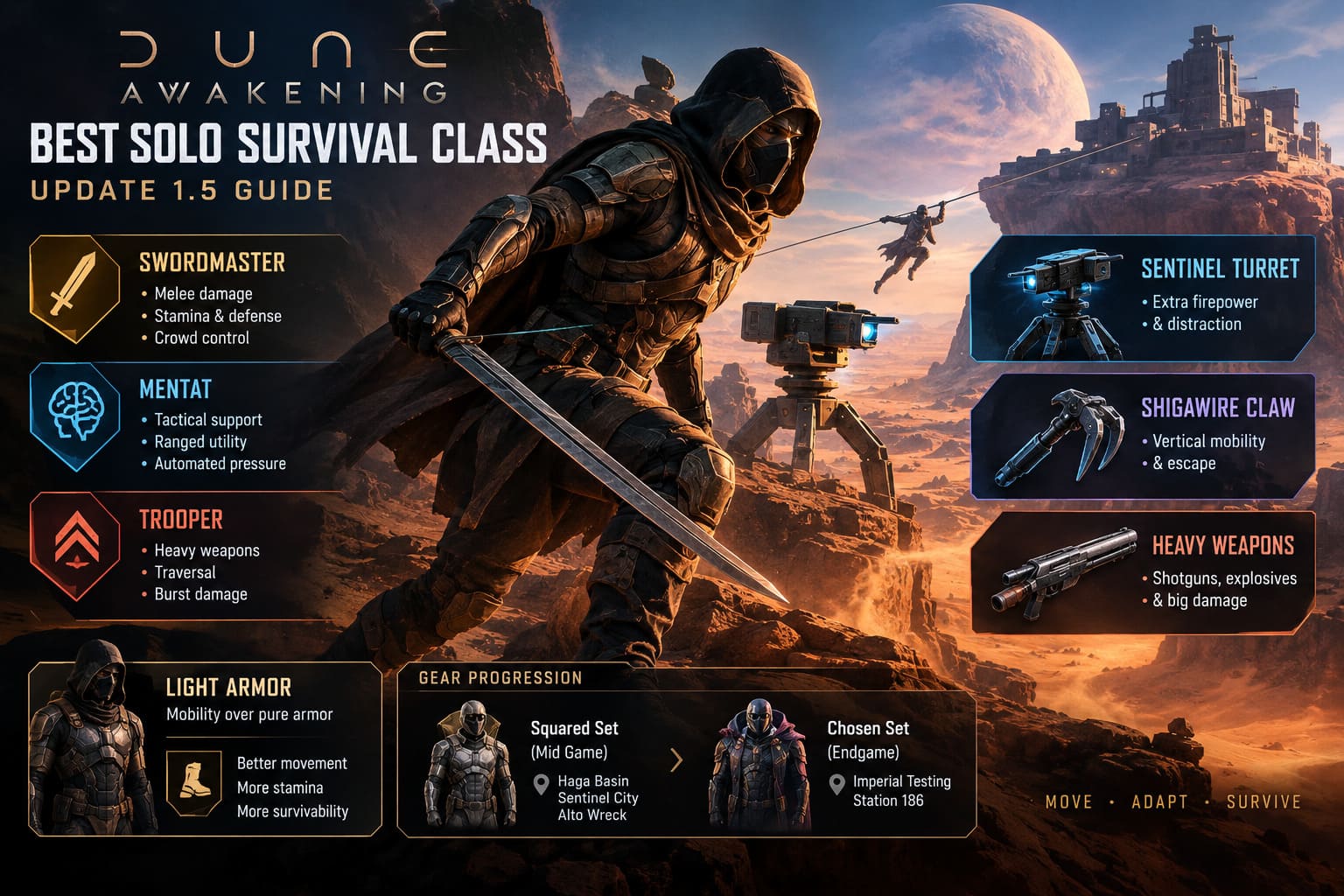
| Class | Role in the Hybrid |
|---|---|
| Swordmaster | Melee damage, stamina, defense and crowd control |
| Mentat | Tactical support, ranged utility and automated pressure |
| Trooper | Heavy weapons, traversal and burst damage |
Swordmaster: Build the Foundation
The Swordmaster tree should remain the core of the build.
I would put particular attention into stamina-related passives such as General Conditioning and Disciplined Breathing. More stamina is not glamorous, but it makes almost every other part of the build better.
For weapons, your choice between long blades and short blades ultimately comes down to playstyle. Personally, I prefer the reach and sweeping attacks offered by a strong Long Blade, especially when dealing with groups.
The important thing is not chasing theoretical damage numbers at the expense of survivability.
When you are playing solo, the build that survives an extra thirty seconds is often more useful than the build that theoretically kills something a little faster.
Mentat: Your Substitute Teammate
This is where the hybrid starts getting really fun.
The Sentinel Turret is almost the closest thing a solo player gets to having another person in the fight.
It is not a replacement for a real teammate, obviously. But it can create enough distraction and additional damage to change how an encounter develops.
Drop the turret, let enemies react to it, and use that moment to isolate a target.
Suddenly, instead of fighting five enemies simultaneously, you can create a series of smaller engagements.
That is exactly what Swordmaster wants.
Mentat also adds useful ranged-oriented bonuses, which makes the hybrid less dependent on closing distance immediately. Against tougher targets, you can soften them from range before committing to melee.
Trooper: Mobility and Big Damage
Trooper fills the other major gap.
The Shigawire Claw is incredibly useful outside combat, but its combat applications are just as important. Vertical movement gives solo players options that simply do not exist for a character who is forced to stay on the ground.
A high ledge can become an escape route. A cliff can become a firing position. A difficult encounter can sometimes be avoided altogether.
And then there is the heavy weapon side of the tree.
Shotguns, explosives and other heavy ordnance give you a way to deal with enemies that are simply not worth fighting with a sword.
This is particularly useful against elites and bosses where committing to prolonged melee combat can become unnecessarily dangerous.
Gear: Mobility Over Pure Armor
One of the easiest mistakes to make with a solo character is assuming that the highest armor value automatically equals better survivability.
I do not think that is the right way to look at Swordmaster.
Mobility is defense.
If you can spend less stamina moving, reposition more quickly and escape a dangerous attack, you are effectively preventing damage before it happens.
That is why Light Armor makes so much sense for this style of play.
For mid-game progression, the Squared Set is a practical target, with farming options around areas such as Haga Basin, Sentinel City and the Alto Wreck. Later on, players pushing deeper into endgame content can start looking toward the Chosen Set from Imperial Testing Station 186.
Your exact gear progression will obviously depend on what you find and what content you are farming, but the principle remains the same: do not sacrifice your ability to move simply because another piece of armor has a bigger number.
The Weapons I Would Carry
For general solo exploration, I like having two very different weapons available.
Primary: Long Blade
Secondary: Scattergun or Sniper Rifle
The idea is straightforward.
Use the ranged weapon to damage shields or weaken priority targets. Deploy the Mentat turret when several enemies begin closing in. Then use Knee Charge to enter melee range and finish the weakened target.
If the group collapses on you, Crippling Strike gives you an opportunity to regain control.
That rhythm is much safer than blindly running into every encounter with your sword already drawn.
How Other Classes Feel When Playing Solo
Swordmaster may be my preferred option, but that does not mean the other archetypes are bad for solo players. In fact, depending on how you like to play, one of them may fit you better.
Trooper
Trooper is probably the easiest alternative to understand.
You get strong ranged options, explosives, mines and excellent mobility through the grappling hook. Exploration is especially comfortable because vertical traversal opens up many routes across Arrakis.
The downside is that extended close-range fights can become less forgiving. When enemies surround you indoors, you do not have quite the same defensive rhythm that makes Swordmaster so comfortable.
Bene Gesserit
Bene Gesserit is the more technical option.
The Voice and its crowd-control potential can make certain encounters much easier, while the class’s mobility gives experienced players plenty of ways to control positioning.
The catch is that getting the most out of the archetype requires more deliberate play.
If you enjoy learning enemy behavior, positioning carefully and squeezing value from utility abilities, Bene Gesserit can be extremely rewarding. For relaxed solo progression, though, I find Swordmaster easier to rely on.
Mentat
Mentat is fascinating if you prefer a slower and more calculated approach.
Scanning, information gathering and turret-based combat provide excellent utility. Instead of charging into every camp, you can prepare the battlefield and let your tools do part of the work.
The trade-off is tempo.
Swordmaster can crash into an encounter and start deleting targets immediately. Mentat generally feels better when you have time to establish control.
Dune Awakening Spice Farming Guide: Best Extraction Equipment and Meta Loadouts
My Solo Combat Routine
Once the hybrid build comes together, my preferred combat loop looks something like this:
- Scout the encounter first and identify ranged enemies or elites.
- Open from range to weaken shields and remove priority targets.
- Deploy the Sentinel Turret when enemies start grouping.
- Use Knee Charge to close the distance quickly.
- Use Deflection and parries rather than endlessly spending stamina on dodges.
- Trigger Crippling Strike when several enemies collapse on your position.
- Finish priority targets in melee, then immediately reassess the battlefield.
- Use the Shigawire Claw whenever vertical movement gives you a safer position.
The biggest change for me is that the build does not force you into one combat pattern.
You can fight aggressively, retreat, shoot, climb, block or reset the encounter depending on what is happening.
That flexibility is what makes a solo build feel powerful.
Final Thoughts: Is Swordmaster the Best Solo Class in Update 1.5?
For my money, Swordmaster is the class I would start with if my main goal was to experience Dune: Awakening alone.
Not because it magically makes Arrakis easy. It absolutely does not. The desert will still punish careless decisions, and endgame encounters can still expose weaknesses in your build.
What Swordmaster gives you is something arguably more valuable: options.
You have mobility when enemies are too far away. You have defense when they get too close. You have crowd control when the fight gets messy and stamina tools that reward good timing rather than passive waiting.
Then, once the mentor system opens up, Mentat and Trooper can fill the gaps.
The result is a character that feels less like a specialist and more like a survivor who can adapt to whatever Arrakis throws at them.
That is exactly what I want from a solo build.
Master your parries, protect your stamina, keep moving, and never let the desert dictate where the fight happens.