Assassin’s Creed Black Flag Resynced vs Original: Every Major Difference Explained
When Ubisoft first revealed Assassin’s Creed Black Flag Resynced, I expected exactly what most players probably expected—a prettier version of the 2013 classic with sharper textures, better frame rates, and a handful of quality-of-life improvements. Instead, what we got feels much closer to a complete reinterpretation of one of the most beloved entries in the franchise.
The original Assassin’s Creed IV: Black Flag has always occupied a special place in the series. It wasn’t just another Assassin’s Creed game—it was arguably the greatest pirate adventure ever made. Sailing across the Caribbean, hunting legendary ships, singing sea shanties with your crew, and watching Edward Kenway slowly transform from selfish privateer into a true Assassin created an experience that has aged surprisingly well.
That said, nostalgia often hides the rough edges. Returning to the 2013 version today quickly reminds you how dated many of its mechanics actually are. Combat was almost effortless, stealth lacked flexibility, tailing missions could become frustrating, and the modern-day Abstergo sequences constantly interrupted the pacing.
Black Flag Resynced doesn’t simply polish those systems—it rebuilds nearly all of them from the ground up.
A Caribbean That Finally Matches Modern Hardware
The visual improvements are impossible to ignore.
The original release had to support PlayStation 3 and Xbox 360 hardware, meaning its ambitions were limited by technology available more than a decade ago. Resynced completely leaves those restrictions behind thanks to Ubisoft’s latest Anvil engine.
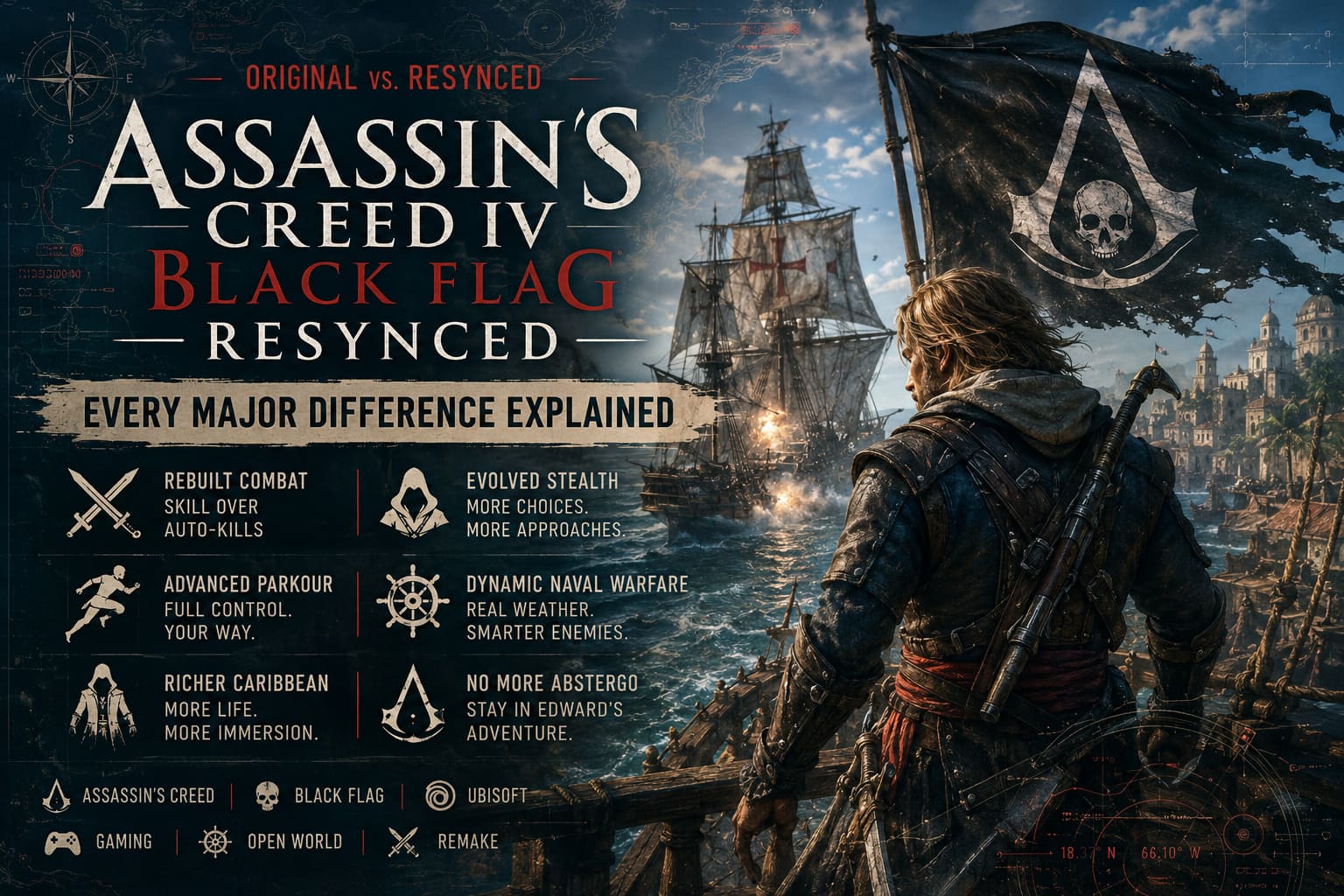
The difference goes well beyond texture resolution.
Sunlight now naturally bounces across ocean waves through advanced ray-traced lighting, tropical storms build gradually instead of appearing suddenly, and every major city feels dramatically more alive than before.
Walking through Nassau or Havana no longer feels like navigating streets filled with identical NPCs following predictable loops. Citizens talk, react to weather, gather around merchants, and generally make these historical locations feel inhabited rather than staged.
Edward himself also benefits enormously.
His updated facial model closely resembles the promotional CGI version fans admired years ago, complete with far more expressive animations, realistic hair rendering, and detailed clothing materials that respond naturally to rain, sunlight, and movement.
Combat Finally Demands Actual Skill
If there’s one area where Resynced makes the boldest statement, it’s combat.
The original game practically encouraged standing still while enemies attacked one at a time.
- Press counter.
- Watch an execution animation.
- Repeat.
It looked stylish, but after several hours every encounter played almost identically.
Resynced completely abandons that philosophy.
Instead of waiting for automatic kill opportunities, every fight revolves around managing enemy posture and endurance. Guards defend themselves intelligently, forcing you to pressure them before creating an opening for a finishing strike.
Perfect parries still exist, but they require considerably tighter timing.
Missing the window isn’t just a minor mistake anymore—it often means eating a heavy hit that can completely change the flow of battle.
Even better, enemy AI now reacts to your habits.
Repeatedly relying on identical attacks eventually causes opponents to dodge or counter them, while glowing red attacks force immediate evasive movement since they cannot be parried at all.
Personally, this is one of my favorite changes.
The older combat system looked cinematic but lacked tension. The new approach feels much closer to modern action games while still preserving Edward’s fast, aggressive fighting style.
Another controversial adjustment is the treatment of the Hidden Blades.
Instead of serving as overpowered combat weapons, they’re now reserved almost entirely for stealth assassinations and contextual executions. Likewise, Edward can no longer grab fallen rifles or axes from defeated enemies during combat.
Not everyone will love those decisions, but they create a much more focused identity for both stealth and swordplay.
Stealth Finally Evolves Beyond Bushes
Long-time Assassin’s Creed fans know exactly how restrictive stealth could feel in Black Flag.
If a mission didn’t provide bushes or blending crowds, your options were surprisingly limited.
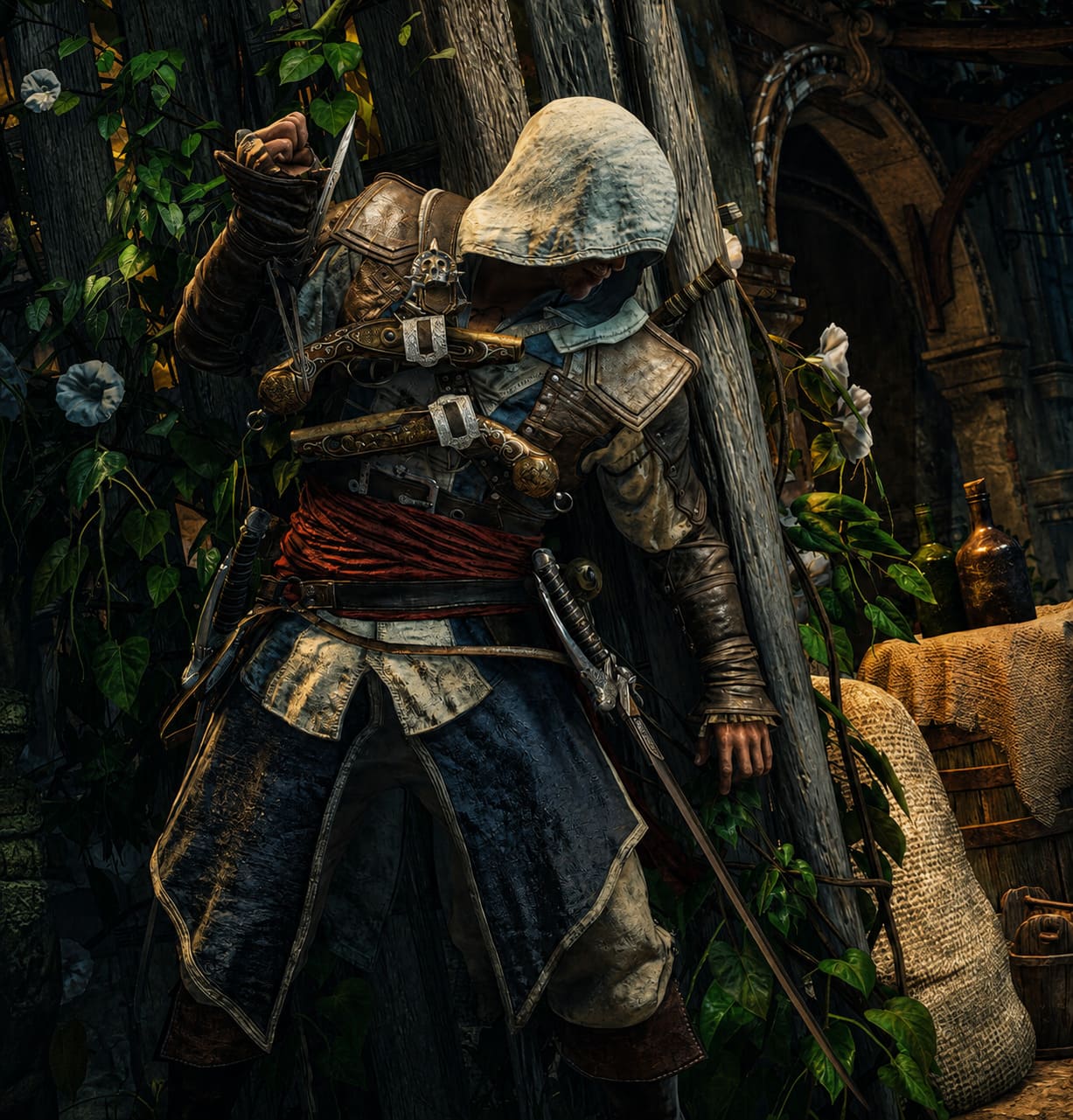
That changes dramatically here.
The introduction of manual crouching immediately transforms infiltration.
Being able to lower your profile whenever you want opens dozens of new approaches inside forts, plantations, naval bases, and city districts.
Lighting now matters as well.
Dark corners genuinely conceal Edward more effectively, while extinguishing lanterns becomes a useful tactical option instead of simple environmental decoration.
Perhaps my favorite addition is unrestricted underwater movement.
Rather than only diving during scripted underwater sequences, players can now approach docks, ships, and coastal forts from beneath the surface almost anywhere.
It adds another welcome layer to the pirate fantasy while naturally expanding stealth possibilities.
Enhanced Eagle Vision also deserves recognition.
Instead of functioning solely as an enemy-highlighting tool, it now allows players to observe patrol behavior from greater distances, encouraging planning before taking action.
Parkour Finally Feels Like Player Choice Again
Traversal has always been one of Assassin’s Creed’s defining features.
Ironically, Black Flag sometimes felt surprisingly restrictive despite its enormous world.
Edward frequently jumped somewhere you never intended or stubbornly grabbed ledges while trying to escape.
Resynced introduces a far more flexible movement system.
Some of the biggest improvements include:
- Dedicated manual jumping
- Separate Parkour Up and Parkour Down controls
- Reliable side ejects and back ejects
- Smooth wall corner swings
- Additional zipline routes throughout cities
The excellent part is that Ubisoft didn’t completely abandon accessibility.
Players who prefer the simpler automatic traversal from the original game can disable the advanced movement options in the settings.
That’s exactly the kind of player choice remakes should offer.
Tailing Missions No Longer Punish Every Tiny Mistake
Almost every veteran remembers at least one infamous Black Flag tailing mission.
- Lose sight of the target for a few seconds? Mission failed.
- Accidentally get spotted? Mission failed.
- Repeat everything from the last checkpoint.
Thankfully, those frustrations have largely disappeared.
Instead of ending immediately, missions now adapt dynamically.
For example:
- A discovered target may trigger a rooftop chase.
- Escaping enemies might leave clues behind instead of causing failure.
- Lost objectives can often be recovered by searching surrounding areas later.
This approach keeps tension high without constantly punishing experimentation.
It’s a simple change, yet it dramatically improves pacing across the campaign.
Naval Combat Is Bigger Than Just New Cannons
The Jackdaw remains the true star of Black Flag.
Fortunately, Ubisoft clearly understood that rebuilding naval gameplay required much more than visual improvements.
Weather itself has become part of combat.
Storm systems gradually form across the horizon, winds physically influence steering, and massive waves create unpredictable encounters that feel far more believable than the scripted storms from 2013.
Ship customization also expands strategically.
New shrapnel barrels can cripple enemy sails, while upgraded cannons target structural weak points capable of triggering devastating localized explosions.
Enemy fleets no longer behave identically either.
Different colonial factions now field unique equipment, hull designs, firing patterns, and tactical behavior depending on their allegiance.
That extra variety keeps naval battles feeling fresh much longer than before.
More Story Without Changing Edward’s Journey
One thing I appreciate is Ubisoft’s restraint.
Edward Kenway’s story remains fundamentally unchanged.
Rather than rewriting established events, Resynced expands the world surrounding them.
Historical figures like Blackbeard and Stede Bonnet receive significantly more screen time, additional cinematics, and entirely new questlines exploring their personal histories.
The Jackdaw also gains three recruitable officers:
- Lucy Baldwin
- Padre
- Deadman Smith
Each officer introduces unique side missions alongside passive upgrades benefiting your crew.
Meanwhile, optional Animus “What If” Rifts offer alternate-history scenarios that feel like enjoyable bonus content without interfering with the main narrative.
Goodbye, Abstergo Office
This may actually become the remake’s most universally celebrated decision.
The first-person Abstergo office sequences are gone.
Completely.
No more walking around sterile offices.
No more reading emails.
No more hacking mini-games breaking the pacing every few hours.
Instead, players remain immersed in Edward’s adventure almost continuously.
For a game whose greatest strength has always been its historical setting, removing those interruptions feels like the right call.
Some Familiar Features Didn’t Return
Not every omission will please longtime fans.
The competitive multiplayer mode has been removed entirely, allowing Ubisoft to focus exclusively on the single-player campaign.
Likewise, Freedom Cry isn’t bundled into the base package, meaning Adewale’s standalone adventure remains separate.
Another surprising removal is mission replay.
Completed memories cannot be revisited individually through the campaign menu as they could previously.
These aren’t deal-breakers for me, but they’re worth knowing before diving in.
Original vs. Resynced at a Glance
| Feature | Black Flag (2013) | Black Flag Resynced |
|---|---|---|
| Engine | Original AnvilNext | Modern Anvil Engine |
| Graphics | Cross-generation visuals | Fully rebuilt next-generation presentation |
| Combat | Counter-based chain kills | Posture system with precise parries |
| Stealth | Contextual hiding | Manual crouch, lighting, underwater infiltration |
| Parkour | Mostly automated | Advanced manual traversal options |
| Hidden Blades | Combat and stealth | Primarily stealth assassinations |
| Naval Battles | Classic ship combat | Dynamic weather, expanded weapons, smarter AI |
| Tailing Missions | Instant failure conditions | Adaptive objectives with multiple outcomes |
| Modern-Day Gameplay | Playable Abstergo office sections | Removed entirely |
| Multiplayer | Competitive modes included | Single-player only |
Assassin’s Creed Black Flag Resynced Remake Release Date, Leaks, and Gameplay Overhaul Explained
Final Thoughts
After looking at everything Resynced changes, it’s difficult to describe it as a traditional remaster.
Mechanically, it feels much closer to a full remake that respects the original’s identity while refusing to preserve mechanics that have clearly aged poorly.
Some players will inevitably miss the effortless counter-kill combat or competitive multiplayer, and opinions will vary regarding changes like restricting Hidden Blades to stealth. Those debates are understandable because Black Flag built a passionate fanbase over more than a decade.
Still, most of the redesigns appear to solve genuine problems rather than replacing systems simply for the sake of modernization.
The richer Caribbean world, more demanding combat, flexible stealth, advanced parkour, dynamic naval warfare, and streamlined campaign structure all point toward the same goal: keeping everything people loved about Edward Kenway’s unforgettable pirate adventure while removing many of the frustrations that repeatedly interrupted it.
If the original Black Flag captured the fantasy of becoming a pirate captain, Assassin’s Creed Black Flag Resynced feels determined to deliver that fantasy with modern technology and mechanics that finally match players’ expectations. For veterans, it offers compelling reasons to raise the black flag once again, while newcomers are likely to discover why Edward Kenway’s journey continues to rank among the finest adventures the Assassin’s Creed series has ever produced.