Agent 64 Spies Never Die Walkthrough: Complete Strategy Guide, Missions, and Cheats
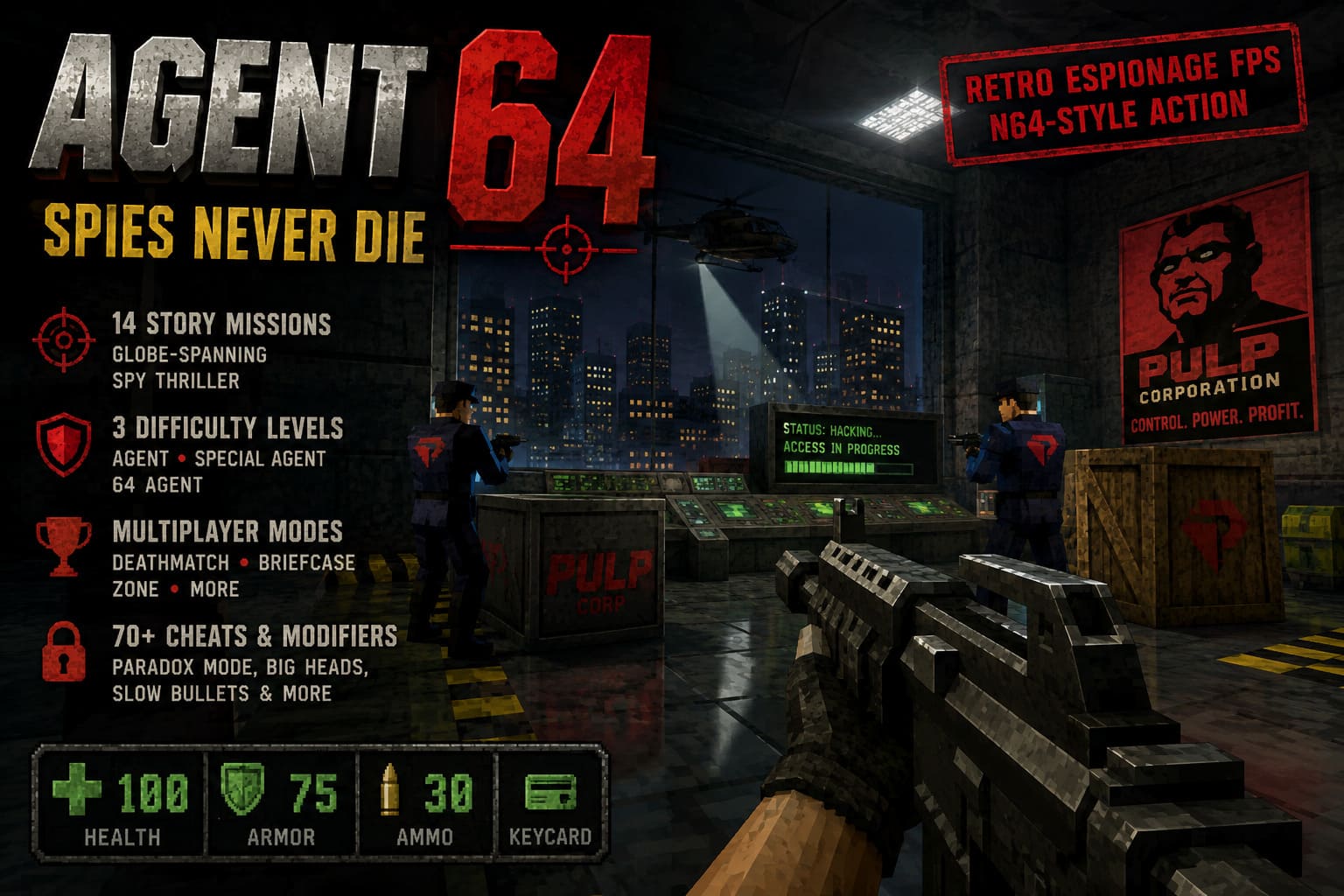
Agent 64: Spies Never Die is the kind of game that immediately makes you remember why old-school console shooters were so damn addictive. Released on August 11, 2026, Replicant D6’s retro espionage shooter doesn’t simply copy the look of late-90s FPS games. It understands what made them work: compact but clever level design, fast movement, chunky weapons, secret rooms, escalating objectives, and that wonderfully chaotic feeling when half the map suddenly knows exactly where you are.
As elite operative John Walter, you are thrown into a globe-spanning spy thriller against the wonderfully ridiculous villain Dominic Pulp. The campaign contains 14 story missions, each built around multiple objectives that become considerably more demanding as the difficulty rises. You will infiltrate corporate towers, crawl through ancient catacombs, assault frozen military facilities, raid nightclubs, and deal with plenty of situations where simply shooting everyone in sight is a terrible idea.
I’ve always had a soft spot for shooters that trust the player to actually pay attention to the environment. Agent 64 absolutely does. Keycards matter. Doors matter. Enemy patrol routes matter. A random-looking wall might hide an armor pickup, while an apparently harmless terminal can turn into a five-second panic attack once every guard on the floor decides to rush your position.
This guide breaks down the game’s core mechanics, difficulty system, major campaign missions, multiplayer modes, and the classic cheat modifiers that make Agent 64 worth revisiting long after you’ve finished the story.
Why Agent 64 Feels Like a Lost N64 Classic
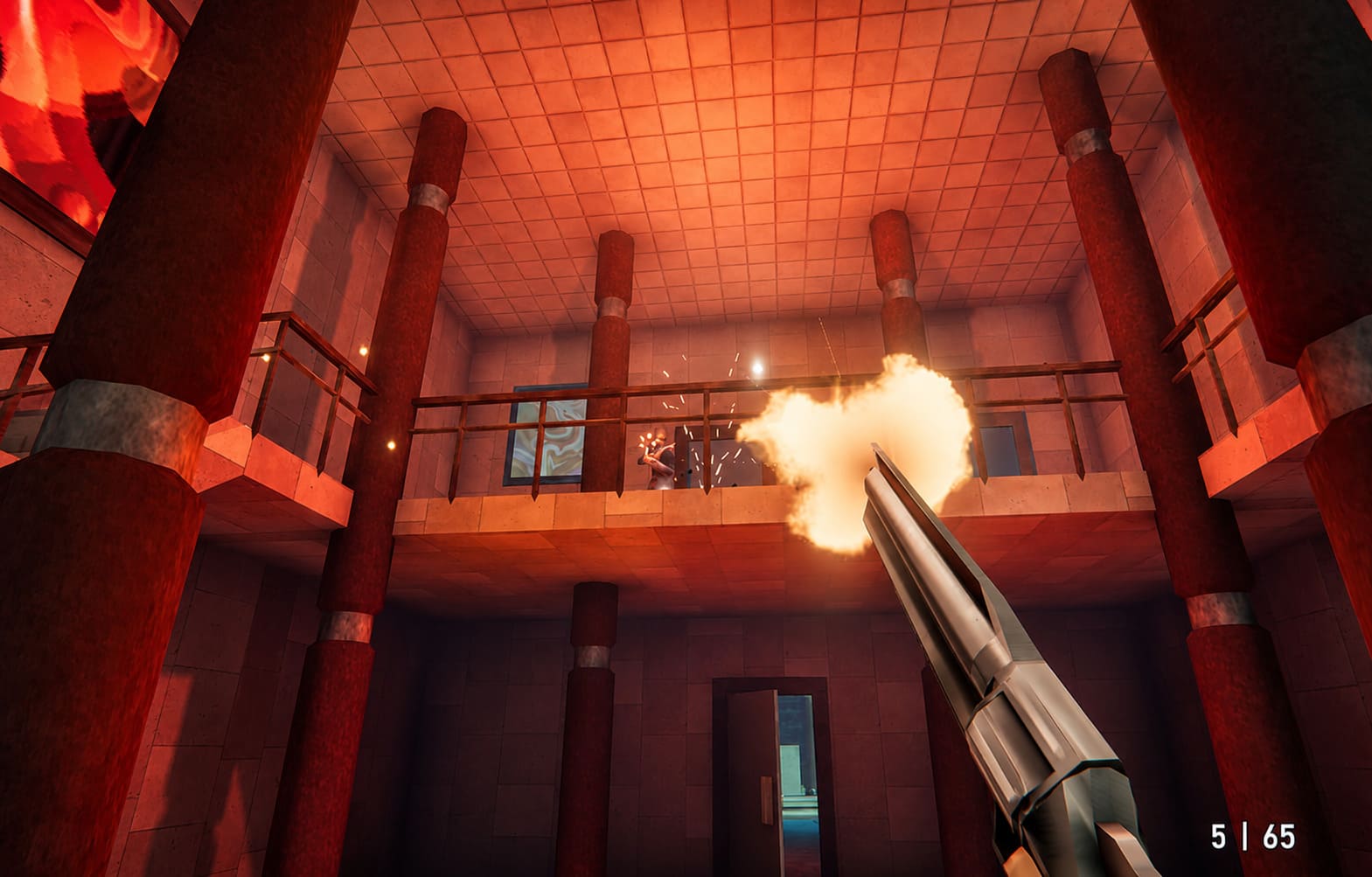
The first thing that grabs you is the presentation. Agent 64: Spies Never Die deliberately leans into the low-poly visual style, CRT-inspired effects, chunky character models, and old-school weapon presentation that defined the late 1990s. But underneath that nostalgia trip is a much more modern shooter.
Enemy AI isn’t simply walking toward you waiting to become target practice. Guards can flank your position, react to your movements, use cover, and push through doors when they know you’re hiding nearby. That makes the old visual style surprisingly deceptive. The game may look like something you would have played on a CRT television in 1997, but the enemies are much less cooperative than their polygonal ancestors.
The result is a shooter where positioning is every bit as important as accuracy. You can still charge into a room with a shotgun and make a complete mess of it, but you’ll quickly learn that smart movement is usually the difference between finishing a mission with a comfortable armor reserve and limping toward the extraction point with almost no health.
Difficulty Modes Explained
The campaign features three difficulty levels: Agent, Special Agent, and 64 Agent. If you’ve played classic console shooters, the structure will feel very familiar, but there’s an important twist: higher difficulties don’t simply turn enemies into damage sponges.
| Difficulty | What Changes | Recommended For |
|---|---|---|
| Agent | Standard objectives, more forgiving resources, easier enemy pressure | First playthrough |
| Special Agent | Additional objectives, tougher encounters, fewer resources | Experienced players |
| 64 Agent | Extra map sections, mandatory objectives, scarce health and armor, tougher encounters | Veterans and challenge hunters |
This is one of the smartest parts of the design. 64 Agent isn’t just an artificial difficulty slider. It changes how you approach missions. New areas open up, additional tasks appear, and resources become something you actually have to plan around.
For your first run, I’d stick with Agent. There’s no shame in it. You want to learn the maps first. Memorize where keycards appear, figure out which doors lead where, watch patrol routes, and discover which rooms contain useful supplies. Once you know the basic architecture of a level, higher difficulties become much more interesting because you’re solving problems rather than wandering around hoping the right door opens.
Gunplay, Auto-Aim and Movement Tips
Agent 64 doesn’t play like a modern ADS-heavy military shooter. The heart of combat is hip-fire movement and fast target tracking. You’re expected to strafe, reposition, snap toward enemies, and use the environment to control engagements.
The retro-style auto-aim option is particularly useful if you want the classic console experience. It gently pulls your aim toward nearby targets and makes close-range firefights feel wonderfully old-school. Personally, I’d keep it enabled for the first few missions and then experiment with manual aiming once you become comfortable with the weapon handling.
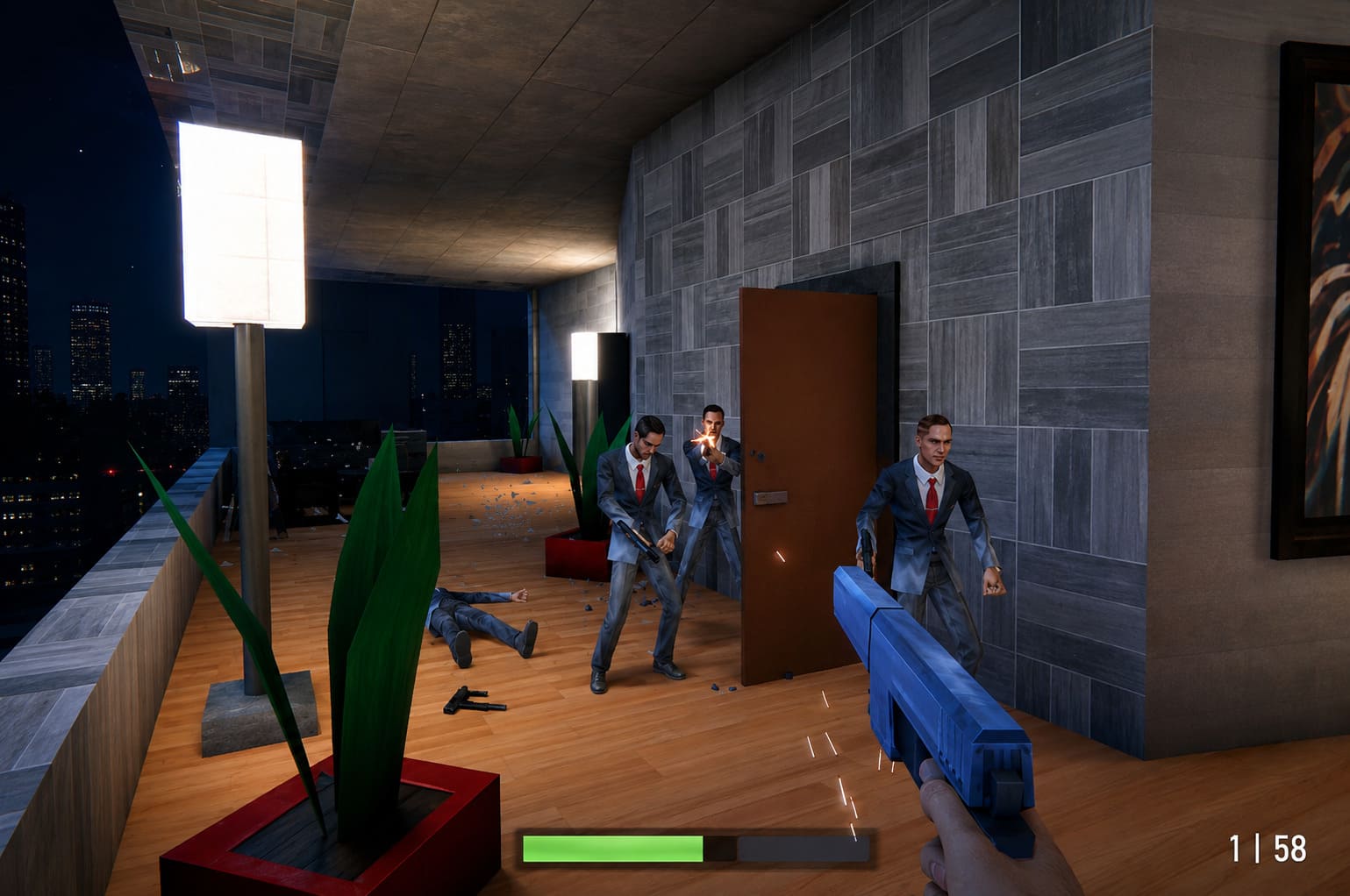
Long-range encounters are different. The manual aim button becomes extremely valuable when you’re dealing with snipers or guards positioned across large areas. Don’t try to outshoot a distant enemy with frantic hip-fire. Take a second, line up the shot, and remove the threat before crossing the open ground.
Movement is your real defensive tool. Strafe around corners, retreat through doorways, break enemy lines of sight, and use narrow entrances to create bottlenecks. If six guards are trying to enter a room through one doorway, you’ve suddenly turned a messy firefight into a shooting gallery.
Health and Armor: Don’t Waste Your Safety Net
There is no passive health regeneration in Agent 64. Once your health disappears, it stays gone until you find a medical kit. That makes reckless damage much more expensive than it initially seems.
Armor is just as important. Body Armor vests can be found in lockers, storage areas, hidden rooms, and secret panels. On Agent difficulty you can sometimes get away with taking a few hits, but higher difficulties punish that habit brutally.
My biggest recommendation is simple: don’t treat armor as permission to play badly. Armor is there to save you when something goes wrong, not to absorb every bullet because you couldn’t be bothered to move.
Mission 1: The Skyscraper Infiltration
The opening mission throws John Walter into a corporate headquarters controlled by one of Dominic Pulp’s front companies. It’s a great introduction because it teaches you almost every basic principle the campaign will continue using later.
- Agent: Hack the central server, locate the safe room, and steal the classified launch plans.
- Special Agent: Rescue three civilian hostages in the executive boardroom without allowing them to be killed.
- 64 Agent: Plant trackers on three rooftop satellite dishes and escape through the helicopter pad under a time limit.
Start with the silenced pistol. The early guards are perfect targets because you can remove them without turning the entire floor into an emergency response drill.
Move through the cubicles carefully and avoid rushing toward the boardroom. If the hostages are part of your objectives, opening the door and immediately spraying bullets is a great way to fail the mission. A flash or smoke grenade can give you a few precious seconds, but prioritizing the guard closest to the civilians is often the safer play.
The server hack is where things get interesting. Once the process starts, enemies will attempt to reach your position. Use the room itself as cover. Position yourself near a corner with a clear view of the entrance and be ready to deal with anyone trying to interrupt the hack.
On 64 Agent, the rooftop section becomes a completely different beast. The satellite trackers add pressure, while the extraction timer means you can’t leisurely clear every room before leaving. Know where you’re going before activating the final objective.
Mission 3: The Underground Catacombs
The Catacombs are a sharp change of pace. Gone are the clean corporate corridors. You’re now dealing with cramped stone tunnels, blind corners, pillars, hidden passages, and enemies who love appearing from places you just checked.
Your main tasks are to find the hidden laboratory entrance, destroy four weapon crates with remote mines, and recover an encrypted keycode.
Shotguns and SMGs are excellent here. Long-range weapons lose some of their value because engagements happen at extremely short distances. Keep your crosshair ready whenever you’re approaching a blind corner.
Watch the stone walls carefully. Off-color bricks are often worth investigating. Interacting with suspicious sections can reveal hidden rooms containing ammunition and valuable armor pickups.
There’s also a nasty little lesson here about explosives. Don’t plant a remote mine and immediately stand beside the crate admiring your work. The blast can chew through your armor incredibly quickly. Move back, find a safe position, and then detonate.
Mission 7: Snow Base Assault
The Snow Base is one of the missions where Agent 64’s larger environments really start to shine. The exterior is wide open, with long sightlines and sniper threats, while the interior transforms into a maze of bunkers, patrols, and automated defenses.
- Disable the perimeter radar dishes.
- Enter the primary research facility.
- Clone the security clearance card.
- Eliminate the base commander.
Don’t sprint across the snowfield blindly. The sniper towers will punish you for it. Use manual aiming and eliminate visible snipers before moving between areas.
Inside the bunker, your first priority should be the security control room. Deactivating automated turrets makes the rest of the mission significantly easier and gives you more freedom to explore.
The clearance-card objective is particularly fun. You need to locate the base commander in the upper offices, take his keycard, and bring it to the mainframe terminal so you can create the master pass. Whether you knock him out or eliminate him depends on your approach, but don’t forget that grabbing the card is only half the job.
Agent 64 Multiplayer Guide
Once you’ve finished the campaign, multiplayer is where Agent 64 can become dangerously addictive. The game supports local four-player split-screen as well as online matches for up to eight players. Full bot support is also available, which is a huge plus when your friends mysteriously disappear five minutes before game night.
| Mode | How It Works | Best Approach |
|---|---|---|
| Deathmatch | Free-for-all or team-based combat | Learn weapon routes and control chokepoints |
| Briefcase | Hold a classified briefcase for as long as possible | Stay mobile and protect the carrier |
| Zone | Teams capture rotating tactical zones | Prioritize positioning over kills |
| Score Challenges | Timed battles against AI opponents | Master maps and improve reaction speed |
Briefcase is probably the mode that creates the most ridiculous matches. Carrying the briefcase prevents you from using two-handed heavy weapons, so you’re forced to rely on pistols, movement, and your teammates. Suddenly the player who normally charges around with the biggest gun on the map has to think.
Zone rewards discipline. Chasing kills feels great, but standing on the objective and controlling the surrounding approaches is what actually wins games.
Score Challenges are also worth playing even if you’re mainly interested in multiplayer. Completing them can unlock additional maps, character skins, and music tracks.
Classic Cheats and Paradox Mode
This is where Agent 64 really shows its retro credentials. Replicant D6 has packed the game with more than 70 cheats and gameplay modifiers, bringing back the kind of unlockable nonsense that modern shooters rarely bother with anymore.
Some modifiers are tied to time-trial accomplishments, while tougher unlocks require completing missions on 64 Agent. One particularly entertaining reward is Paradox Mode, which turns ordinary matches into complete chaos by randomly cycling the weapons used by players and bots at set intervals.
And yes, the modifiers get gloriously stupid.
- Big Heads Mode: Characters get enormous heads, making headshots much easier and every firefight substantially funnier.
- Melee Disarms: Firearms disappear and everyone is forced into close-range melee combat.
- Slow-Motion Bullets: Projectiles travel incredibly slowly, allowing you to watch and even dodge incoming shots.
- No Reloads: Weapons can be fired continuously until the reserve ammunition is exhausted.
These aren’t the sort of cheats you activate when you’re trying to prove how skilled you are. They’re for the nights when you’ve already completed the serious stuff and want to turn Agent 64 into a ridiculous playground.
Agent 64 Spies Never Die Nintendo Switch Release Date: Is a Console Version Coming in 2026?
My Best General Tips for Agent 64
If you’re starting the campaign today, there are a few habits I’d recommend developing immediately.
- Learn the maps before chasing speed. Knowing where you’re going is more valuable than shaving a few seconds off every encounter.
- Use silencers whenever stealth is an option. A quiet kill can prevent an entire squad from converging on your location.
- Check suspicious walls and rooms. Secret areas can contain exactly the armor or ammunition you need later.
- Save heavy weapons for important encounters. Don’t burn rare ammunition on enemies that a pistol can handle.
- Use doors as defensive tools. A narrow doorway can completely change a fight in your favor.
- Don’t ignore manual aiming. Snipers and distant targets are much easier to handle when you stop relying on auto-aim.
Final Verdict
Agent 64: Spies Never Die succeeds because it doesn’t treat nostalgia as a substitute for good gameplay. The N64-style visuals, CRT presentation, chunky weapons, and retro menus are the obvious hook, but the reason the game stays fun is the actual level design underneath them.
The 14-mission campaign gives you enough room to experiment with different approaches, while the three difficulty settings add meaningful changes rather than simply making enemies absorb more bullets. Multiplayer provides the expected old-school chaos, and the huge collection of cheats and modifiers gives the whole package a playful personality that modern shooters often lack.
There are moments when the retro design can feel unforgiving. Limited health, obscure objectives, and maze-like areas won’t be everyone’s cup of tea. But honestly, that’s part of the appeal. Agent 64 wants you to learn its levels. It wants you to remember where the keycard was. It wants you to notice the weird brick wall that looks slightly different from the others.
After spending enough time with it, those little details become second nature. You stop playing it like a modern FPS and start thinking like a player from the N64 era again: check the corners, watch the radar, conserve armor, memorize the route, and never trust a suspicious-looking wall.
For fans of classic espionage shooters, that’s a pretty damn good deal. Whether you’re hunting Dominic Pulp through the campaign, working through the brutal 64 Agent objectives, playing split-screen with friends, or turning an eight-player match into a Big Heads disaster, Agent 64: Spies Never Die has plenty of reasons to keep coming back.