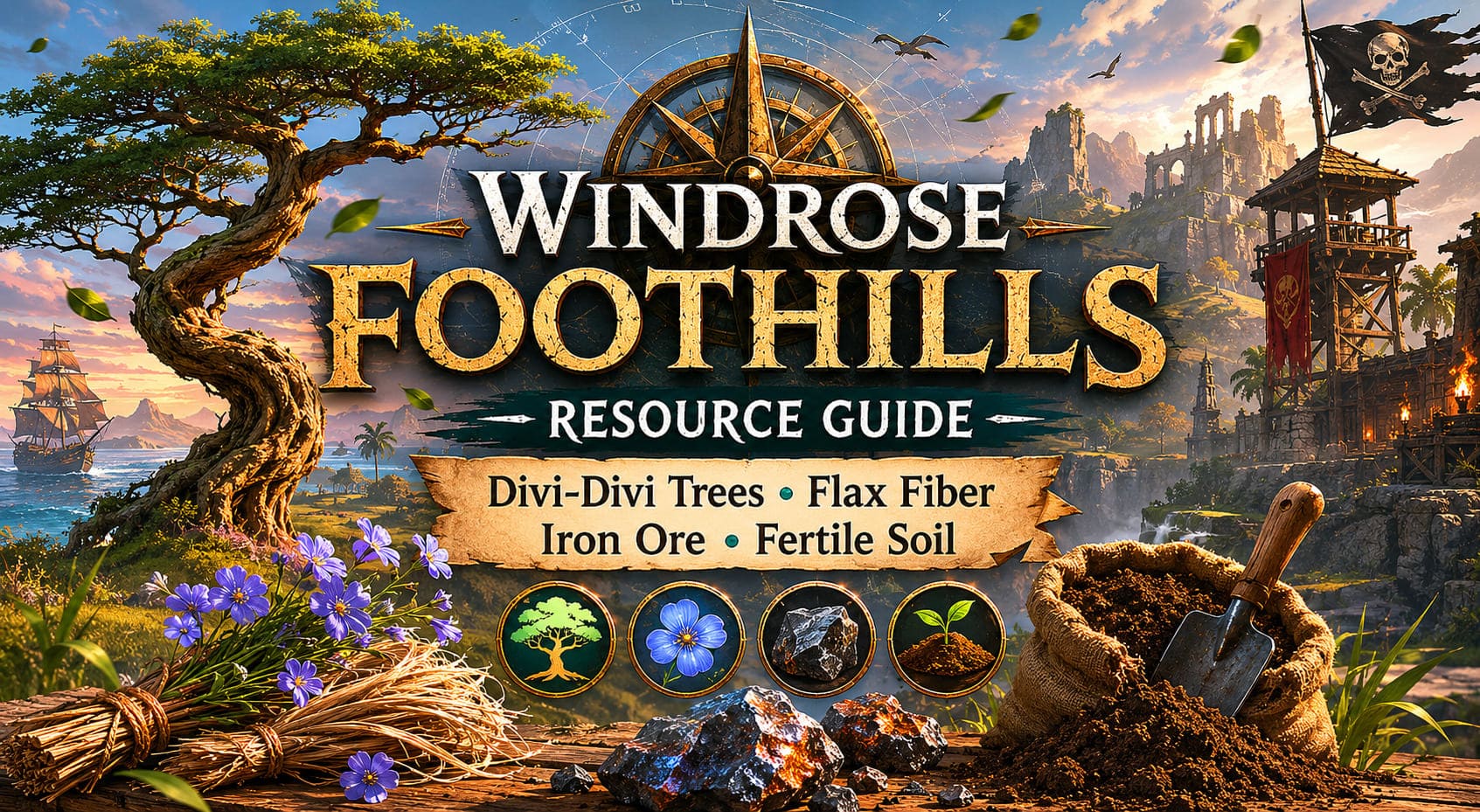
Windrose Foothills Resource Guide: Where to Find Divi-Divi Trees, Flax Fiber, Iron Ore, and Fertile Soil
If there is one moment in Windrose where the game suddenly stops holding your hand, it is the second you leave the Coastal Jungle behind and sail toward the Foothills. Up until that point, survival feels manageable. You chop a few trees, mine some copper, build a basic ship, and slowly learn the systems. Then the Foothills hit you like a cannonball.
Suddenly, every upgrade demands rare materials. Wolves start appearing out of nowhere. Pirates carry firearms instead of rusty swords. Your inventory fills instantly with heavy ore, and crafting your Brigantine starts looking less like a fun goal and more like a full-time job.
But honestly? That is exactly why the Foothills became my favorite biome in Windrose.
It feels dangerous, rewarding, and surprisingly immersive once you understand how the resource loops work. After spending way too many hours exploring islands, dying to musketeers, and optimizing farming routes, I realized the Foothills are less about raw combat and more about preparation and efficiency.
This guide covers the best resources to farm, where to find them, and the strategies that genuinely save time during the mid-game grind.
Why the Foothills Matter So Much
The Foothills biome is basically the gateway into the “real” version of Windrose. Most advanced crafting systems become available here, including:
- Iron equipment
- Linen crafting
- Tanning upgrades
- Larger ship progression
- Advanced cooking
- Merchant delivery systems
Without Foothills resources, your progression slows to a crawl.
The biggest mistake new players make is treating this area like an extension of the starter islands. It is not. Enemy damage scales fast, and resource management becomes far more important than pure exploration.
Before heading into the biome, I strongly recommend:
| Recommended Prep | Minimum Suggestion |
|---|---|
| Character Level | 7-8 |
| Weapon Tier | Copper or better |
| Pickaxe | Copper Pickaxe |
| Armor | Reinforced Leather |
| Healing Supplies | Large supply |
| Ship Storage | Expanded if possible |
If you rush in underprepared, wolves and pirate patrols will absolutely destroy you.
Best Place to Find Divi-Divi Trees
One of the first materials every player desperately needs in the Foothills is Hardwood, and that means farming Divi-Divi trees.
These trees are easy to recognize once you know what to look for. Unlike the normal tropical trees from the Coastal Jungle, Divi-Divi trees have twisted trunks that almost look bent sideways by constant wind. They usually grow in clusters across grassy hills or elevated plateaus.
The first time I discovered a full grove, I basically marked the island permanently because Hardwood becomes useful for almost everything later.
What Divi-Divi Trees Drop
| Resource | Main Usage |
|---|---|
| Hardwood | Construction, ship upgrades, stations |
| Tree Bark | Tannin production |
| Saplings | Regrowth and farming loops |
A lot of players ignore the stumps after chopping the tree. Huge mistake.
The stump gives additional Hardwood, and over time that missing extra yield becomes massive. If you are farming for Brigantine components, every piece matters.
Another important thing the community discovered: building structures too close to natural groves can interfere with tree respawns. I tested this myself and noticed fewer mature trees appearing after placing camp structures nearby.
So if you want a reliable infinite farming loop:
- Clear mature trees completely
- Leave natural saplings alone
- Avoid placing permanent structures directly inside the grove
That small detail saves hours later.
Flax Fiber: The Most Annoying Resource Early On
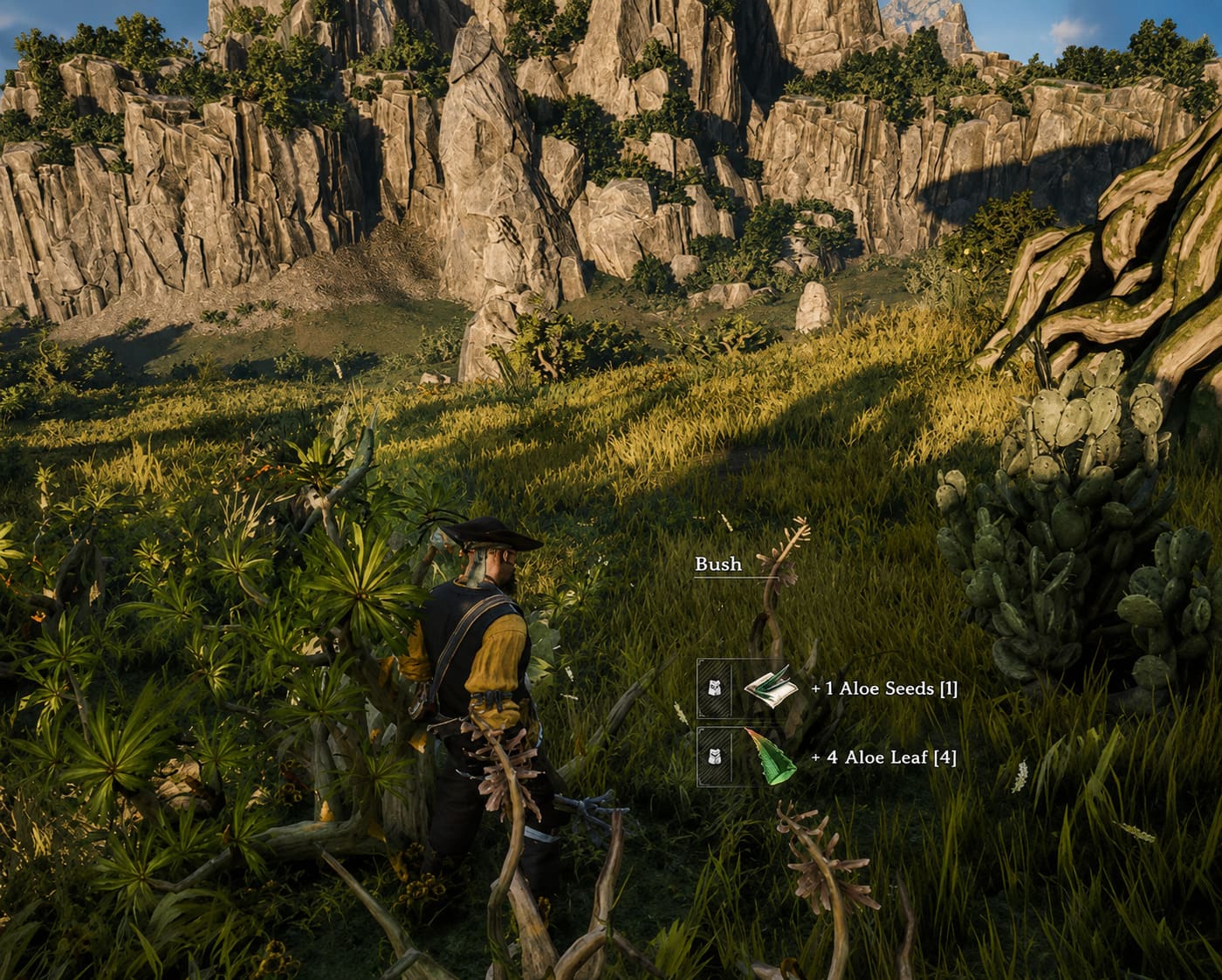
I genuinely think Flax Fiber is the first real bottleneck in Windrose.
Not because it is hard to gather, but because it is scattered everywhere in tiny amounts. You spend more time searching than actually collecting.
Still, unlocking Linen Fabric changes the game completely.
The moment you gather your first Flax Fiber, you unlock:
- Spinning Wheel
- Linen crafting
- Shoemaker recipes
- Advanced clothing upgrades
- Brigantine sail progression
And suddenly you realize you need hundreds of fibers.
How to Spot Flax
Wild Flax grows as thin green stems topped with blue-purple flowers. They stand out clearly once you know their shape, especially on hill ridges during daylight.
The best farming strategy I found is simple:
- Walk elevated ridges
- Circle plateau edges
- Scan open grasslands instead of forests
- Harvest every visible cluster immediately
Most players only interact with the mature plant itself. However, swinging an axe through nearby immature bushes often gives bonus fibers too. It sounds strange, but it works surprisingly well.
Iron Ore Farming Becomes Your New Obsession
The second major progression wall is Iron Ore.
Once you unlock iron crafting, everything suddenly becomes expensive:
- Better weapons
- Iron tools
- Ship cannons
- Reinforced structures
- Advanced crafting benches
Iron deposits usually appear as dark stone nodes with metallic veins running through them.
Most reliable locations include:
| Location Type | Chance of Iron |
|---|---|
| Valleys | High |
| Mine Entrances | Very High |
| Cliffsides | Medium |
| Pirate-Controlled Areas | High |
You absolutely need at least a Copper Pickaxe to mine these nodes.
One thing I learned quickly: never overfarm a single island. Iron respawns slowly enough that rotating between multiple islands is far more efficient than waiting around.
Fertile Soil Is More Valuable Than It Looks
At first, Fertile Soil sounds boring compared to Iron or Hardwood.
It is not.
Honestly, this resource quietly becomes one of the most important long-term investments in the game because it allows sustainable farming.
You can only gather it from ruined agricultural locations like:
- Ancient Farms
- Ancient Villages
- Abandoned stone gardens
Look for rectangular planter beds or old ruined farmland sections.
Once I started building organized farming plots at my base, the entire game became less stressful.
Instead of endlessly searching for Flax and food ingredients, I could produce resources safely behind walls while focusing on exploration and combat.
That changes everything.
The Foothills Are Full of Hostile Wildlife
The biome itself fights back constantly.
Wolves are probably the deadliest natural threat because they attack in packs and move incredibly fast. A single mistake while overloaded with ore can end your entire farming run.
Mountain goats are less dangerous individually, but their knockback attacks become annoying near cliffs.
Then there are the pirate camps.
These enemies are much more dangerous than early-game bandits because musketeers can stagger you at range while grenadiers completely destroy defensive positioning.
Most Dangerous Enemies in the Foothills
| Enemy | Threat Level | Valuable Drops |
|---|---|---|
| Wolves | Very High | Wolf Fangs |
| Mountain Goats | Medium | Bezoars |
| Musketeers | High | Salt, Nuts |
| Grenadiers | Very High | Explosives |
I learned very quickly that ignoring enemies while gathering resources is usually a terrible idea.
Clear the area first. Farm second.
Windrose Leveling Guide: Best Stats And Talents To Level Up First
The Smartest Farming Strategy Most Players Ignore
The single best decision I made in Windrose was building temporary outposts instead of hauling everything back manually.
Seriously, this changes the entire pacing of the game.
A good Foothills outpost should include:
- Bonfire
- Tent
- Storage
- Fast Travel Bell
- Repair Bench
Because dismantling refunds full materials, there is almost no downside.
You can effectively create mobile mining camps across multiple islands and massively reduce travel downtime.
This becomes especially powerful once your inventory starts filling with Iron Ore and Hardwood stacks.
Windrose Piastre Farming Guide: Where to Sell Items and Make Money Fast
Final Thoughts
The Foothills biome is where Windrose truly becomes addictive.
It stops being a casual survival game and starts rewarding smart planning, efficient farming routes, and long-term resource management. Every new material feels meaningful, and every upgrade genuinely changes how you play.
Yes, the grind can feel brutal sometimes. Flax farming alone nearly broke my sanity more than once.
But once your base starts producing Linen, your Iron stockpiles grow steadily, and your Brigantine finally comes together piece by piece, the entire progression system suddenly clicks into place.
And honestly, that feeling is what makes Windrose so hard to stop playing.