Aion 2 Cleric Build Guide: Best PvP and PvE Skills, Stigmas, and Skill Boost Priorities (2026)
Aion 2 is finally giving the Cleric something I have always wanted from a healer: a reason to stay active instead of spending an entire dungeon staring at party health bars.
The Cleric is still the class everyone wants when a dungeon goes wrong, but that does not mean you should play it like a passive heal bot. The 2026 version of the class has a surprisingly aggressive toolkit built around elemental damage, smart healing, defensive utility, and constant spell weaving. When played properly, a Cleric can heal a struggling group, contribute meaningful DPS, manage its own resources, and survive situations that would flatten a less prepared support class.
With the global launch of Aion 2 in October 2026, there will be plenty of players experimenting with different skill priorities and gear combinations. This guide focuses on a practical Cleric build for both PvE and PvP, including skill upgrades, passives, macros, stigmas, Arcana choices, stats, and combat priorities.
Why the Cleric Is More Than Just a Healer
The first thing to understand is that the Cleric’s identity in Aion 2 is much more flexible than the traditional MMORPG healer template.
You have the obvious healing tools such as Healing Light, Light of Regeneration, and Radiant Recovery, but you also have earth and wind attacks that allow you to contribute damage whenever the party is healthy.

That creates a simple rule that I think every new Cleric should remember:
If nobody needs healing, you should be attacking.
There is no reason to stand around waiting for the next damage mechanic. A good Cleric constantly switches between healing, debuffing, attacking, and preparing for the next dangerous phase.
Core Cleric Skills
| Skill | Main Role | Priority |
|---|---|---|
| Earth’s Retribution | Damage / MP sustain | Very High |
| Judgment Thunder | AoE damage | Very High |
| Condemnation | Single-target burst | Very High |
| Bolt | Wind damage / finishing | High |
| Healing Light | Direct healing | Very High |
| Radiant Recovery | Burst AoE healing | Very High |
| Light of Regeneration | Healing over time | High |
| Divine Aura | Group utility | Very High |
| Debilitating Mark | Defense reduction | High |
| Defiance | Survival / utility | High |
Earth’s Retribution deserves special attention because it is not simply another attack. It forms an important part of the Cleric’s resource-management loop.
Judgment Thunder is your major AoE damage tool, while Condemnation provides the kind of single-target pressure that makes the Cleric surprisingly comfortable when questing alone.
On the healing side, Healing Light is your reliable everyday heal. Radiant Recovery is the button you want when things get ugly, especially because its charge mechanic gives you additional control over its radius and healing output.
Best Cleric Skill Boost Priorities
One of the easiest mistakes to make in Aion 2 is spreading your upgrade resources across everything.
Don’t.
You will get much more from specializing your investment around a handful of important skills.
1. Earth’s Retribution — Level 8
If you are still leveling your Cleric, Earth’s Retribution should be one of your earliest major investments.
Taking it to Level 8 unlocks the Mana Specialization rune, which can restore roughly 10% of maximum MP after completing the skill chain. That sounds like a small convenience until you are several minutes into a boss fight and realize you are no longer burning through mana potions just to maintain your rotation.
For me, this is one of those upgrades that makes the entire class feel smoother rather than simply stronger.
2. Judgment Thunder — Push Toward Level 16
Judgment Thunder is one of the most important damage investments for a Cleric.
Taking it toward Level 16 unlocks the Divine Punishment follow-up, giving the skill much more value in both dungeon encounters and general PvE.
The Cleric is not supposed to compete with dedicated DPS classes in raw damage, but that does not mean your contribution is irrelevant. Faster kills mean fewer mechanics, fewer opportunities for mistakes, and less healing pressure.
3. Condemnation — Prioritize Critical Resets
Condemnation is particularly valuable when you can take advantage of its critical-hit reset specialization.
A successful reset can dramatically improve your burst sequence and make the skill especially satisfying during solo content. It is also one of the reasons I would not build a Cleric that completely ignores offensive stats.
4. Bolt — Keep Upgrading It
Bolt is another skill I would never leave behind.
It is quick, hits hard, and works beautifully between movement and healing casts. In PvP, its value becomes even more obvious because you can use it while repositioning and look for opportunities to finish weakened targets.
5. Healing Light and Radiant Recovery
Your healing skills should generally stay relevant to your character level.
There is not much point in having impressive damage numbers if your main healing abilities are several levels behind. Healing Light provides consistent recovery, while Radiant Recovery is your major answer to incoming group-wide damage.
Divine Aura also deserves a high priority because its specialization can be adjusted according to the encounter. Attack-speed-focused bonuses can help with single-target boss damage, while wider AoE-oriented options are more attractive for grinding groups of enemies.
Best PvE Cleric Build
The PvE Cleric should be built around one idea:
Keep everyone alive without wasting the damage window.
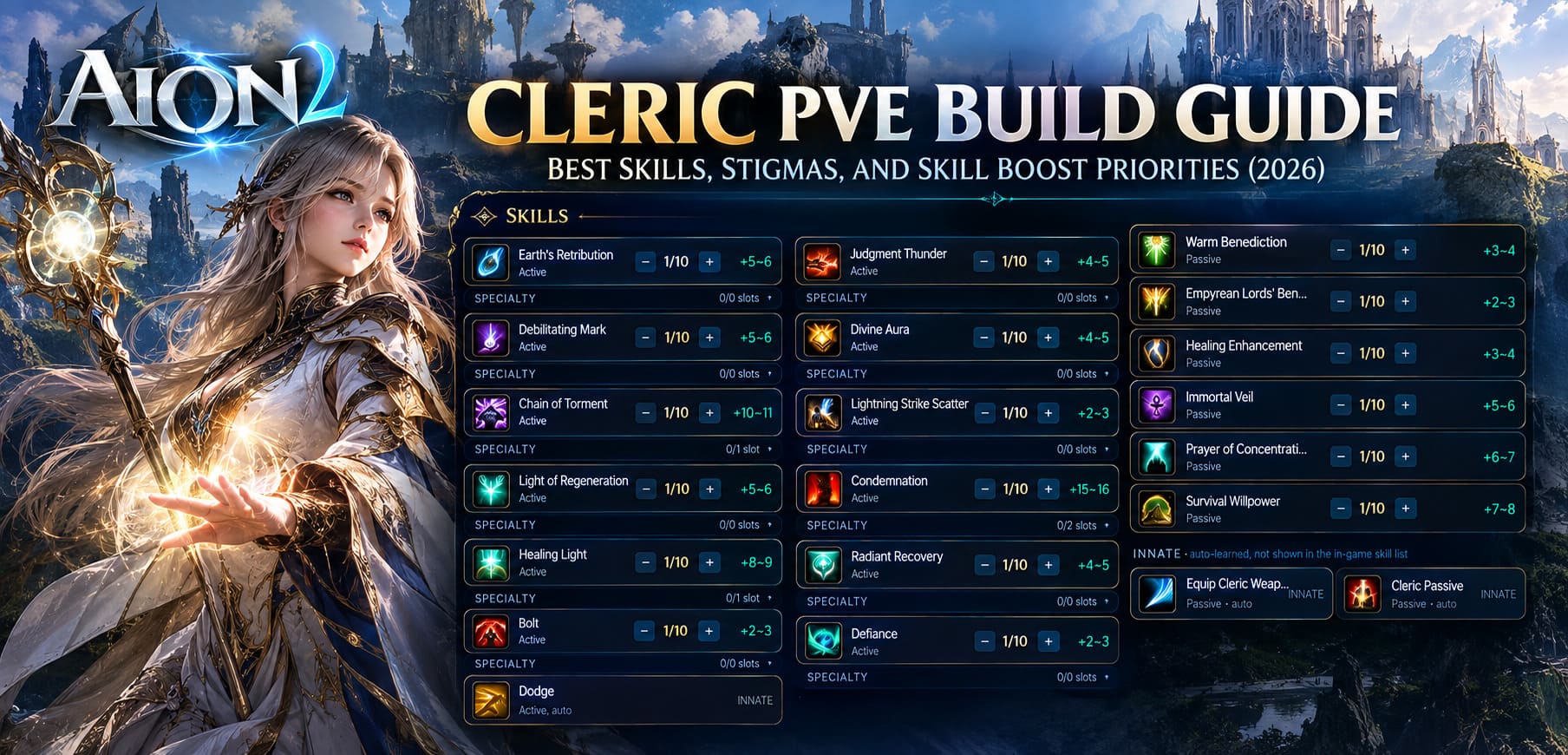
During a normal dungeon pull, your first instinct should not be to immediately spam heals. Watch the party, understand the incoming mechanic, and use your offensive toolkit while health bars are stable.
The basic PvE framework looks like this:
- Healing Enhancement
- Radiant Benediction
- Empyrean Lord’s Grace
- Earth’s Grace
- Warm Benediction
- Divine Aura
- Healing Light
- Radiant Recovery
- Light of Regeneration
The exact balance can change with gear and encounter mechanics, but the philosophy remains the same: maximize healing efficiency while retaining enough offensive pressure to contribute meaningfully.
PvE Cleric Macro
Macros can make the Cleric considerably more comfortable, especially when you are juggling buffs, debuffs, and offensive cooldowns.
A practical offensive sequence can look like:
- Divine Aura
- Earth’s Retribution
- Debilitating Mark
- Lightning Strike Scatter
- Chain of Torment
- Condemnation
- Judgment Thunder
This lets you establish your buff, trigger your resource loop, apply the defense reduction, and then move into your damage sequence.
But there is one rule I would strongly recommend:
Do not macro your important healing reactions.
Healing Light, Radiant Recovery, and Defiance should remain under your direct control.
A macro cannot predict that your tank is about to take a massive hit. It cannot recognize a dangerous boss animation the way a player can. If you automate your emergency tools, you are essentially giving away the most important advantage you have as a healer: timing.
Aion 2 Cleric PvP Build
PvP changes the Cleric completely.
In the Abyss, you are not simply trying to maximize healing numbers. You are trying to survive while several players are actively attempting to remove you from the fight.
Assassins, Rangers, and Sorcerers can all put enormous pressure on a support player. That means your PvP Cleric build needs survivability, mobility, crowd-control resistance, and enough offensive pressure to punish enemies who overextend.

The defensive core should include:
- Warm Benediction
- Immortal Veil
- Prayer of Concentration
- Defiance
- Light of Regeneration
- Healing Light
- Radiant Recovery
Immortal Veil is especially valuable when you are being focused. Having an emergency defensive layer can give you the extra few seconds required to escape, heal yourself, or receive assistance from your team.
Prayer of Concentration also becomes more important in situations where interruptions can prevent you from completing critical healing casts.
How to Play the PvP Cleric
Do not stand still unless you absolutely have to.
Keep Light of Regeneration active, reposition constantly, and use Bolt when you have an opportunity to pressure an enemy without compromising your team’s survival.
Save Defiance for dangerous status effects and high-pressure moments rather than throwing it away whenever something mildly inconvenient happens.
Your objective is not to become a front-line tank. It is to make yourself an extremely frustrating target who keeps moving, keeps healing, and refuses to give the enemy an easy kill.
Cleric Stigmas and Passive Priorities
Your passive setup should support the role you are actually playing.
For PvE support, I would prioritize healing consistency and survivability before chasing unnecessary offensive optimization.
Healing Enhancement is particularly important because it strengthens the connection between your attack power and healing output.
Radiant Benediction improves your overall healing performance, while Empyrean Lord’s Grace and Earth’s Grace provide additional offensive value.
Here is a simple priority framework:
| Content | Main Priorities | Secondary Priorities |
|---|---|---|
| PvE Healing | Healing, HP, Defense | Attack, Critical |
| PvE Solo | Attack, Critical | Healing, MP |
| PvP Healing | HP, Defense, CC Resistance | Precision, Magic Penetration |
| PvP Hybrid | Precision, Intelligence | Critical, Magic Penetration |
The important part is not blindly copying a stat list. Your gear should answer the problems you are actually encountering.
If you constantly die before you can heal, more damage is not going to fix the problem.
Best Cleric Stats for PvE and PvP
For PvE support, Constitution and Willpower are excellent foundations.
They improve your durability and give you more room to survive unavoidable mechanics. Once your defensive base is comfortable, Attack becomes increasingly attractive because Cleric healing benefits from weapon attack scaling.
For PvP, the priorities shift.
Precision and Intelligence become more valuable for a hybrid setup, particularly when you are relying on debuffs, damage-over-time abilities, and control effects against geared opponents.
For offensive progression boards, destruction-oriented paths such as Ezekiel and Death Trin can support a more aggressive Cleric by improving offensive statistics such as magic penetration and critical-related bonuses.
Arcana Choices for Cleric
The Arcana system adds another layer of customization, and it is easy to get lost in the number of possible combinations.
For a PvE-oriented Cleric, three bonuses stand out:
Empyrean Lord’s Grace — increases critical potential and adds additional offensive proc value.
Earth’s Grace — improves critical damage performance and supports the Cleric’s earth-based offensive identity.
Healing Enhancement — directly supports the relationship between attack power and healing output.
For Arcana set pieces, the Chalice of Vigor four-piece combination is particularly useful for a support-focused setup because of its combat-speed benefits.
A Parchment piece can add useful HP, while a Compass option can provide additional utility through accuracy and related offensive metrics.
Aion 2 Global Release Guide 2026: Crossplay, Steam, iOS, Android, and Platforms Explained
What I Would Actually Prioritize
If you are starting a fresh Cleric and don’t want to overthink every single upgrade, this is the progression path I would follow:
- Earth’s Retribution to Level 8 for the mana specialization.
- Keep Healing Light and Radiant Recovery appropriately leveled.
- Push Judgment Thunder toward Level 16.
- Invest heavily into Condemnation and its critical-reset specialization.
- Keep Bolt upgraded for both PvE and PvP.
- Build around Healing Enhancement and Radiant Benediction for support.
- Add defensive passives before chasing extreme DPS.
- Keep emergency skills outside your offensive macro.
- Adjust Divine Aura according to the encounter.
- Only specialize heavily into offensive stats after your survival and healing are comfortable.
This approach gives you a Cleric that does not collapse the moment the content becomes difficult.
Aion 2 Combat Power & Gear Progression Strategy Guide (2026 Global Launch)
Final Thoughts
The Cleric is probably at its most interesting when you stop thinking of it as “the healer.”
Yes, healing is still the reason your party wants you around. But Aion 2 Cleric gameplay is about everything you do between those healing windows.
You are debuffing bosses, restoring MP, applying damage-over-time effects, firing wind spells, managing cooldowns, watching positioning, and preparing for the next mechanic. In PvP, you are constantly making small decisions about movement, defensive cooldowns, target selection, and when it is safe to stop healing and attack.
That is what makes the class appealing to me.
The strongest Cleric is not necessarily the player with the biggest healing number on the post-fight screen. It is the player who knows when not to heal, when to attack, when to move, and when to hold an emergency cooldown for the five seconds that actually matter.
For the 2026 Aion 2 launch, start with Earth’s Retribution, Judgment Thunder, Condemnation, Healing Light, and Radiant Recovery as your core investment targets. Build your PvE character around survivability and healing efficiency, then add offensive stats as your gear improves. For PvP, shift toward durability, mobility, Precision, and CC resistance while keeping enough damage to punish enemies who give you an opening.
Get that balance right, and the Cleric becomes much more than the person standing behind the group with a health bar open. You become the player who quietly holds the entire fight together — and that is exactly the kind of healer I want to play.