EA FC 27 Holographic Cards Guide: Rarity, FUT Gallery Set Scores, and Collection Rewards
EA SPORTS FC 27 has quietly changed one of the things that has always been at the heart of Ultimate Team: why you keep a card after you pack it.
For years, the FUT routine was pretty straightforward. Pack a player, check whether he fits your squad, and if he doesn’t, decide whether he’s SBC fodder, a bench option, or something you can sell for coins. That’s still part of the game, of course. But FC 27 adds another layer with the FUT Gallery and its rare Holographic Player Items.
And honestly, this is where Ultimate Team starts feeling less like a simple squad-building mode and more like a proper collectible card game.
A Holographic card isn’t necessarily going to make your starting XI stronger. It isn’t secretly faster, doesn’t have hidden shooting boosts, and won’t suddenly give your striker an extra PlayStyle. Its value comes from something completely different: rarity, collection progress, and FUT Gallery scoring.
If you’re planning to push your Gallery Level as far as possible, understanding these cards is going to save you a lot of wasted coins.
What Exactly Is a Holographic Card in EA FC 27?
Holographic Player Items are rare visual versions of eligible special cards. When a qualifying special player enters the active pack pool, there is a chance that the item you receive will be the Holographic version rather than the standard version.
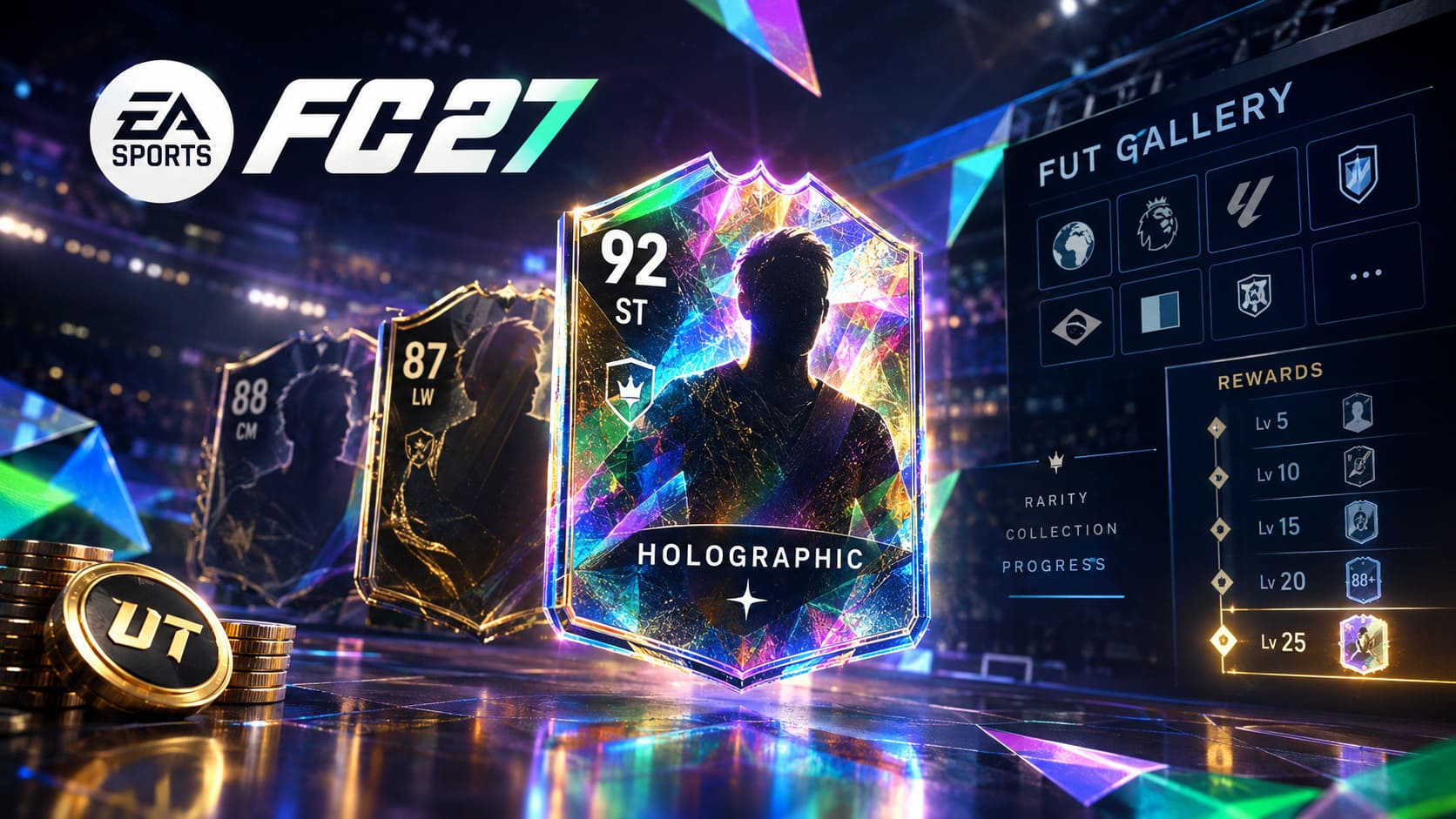
That can apply to cards such as:
- Team of the Week (TOTW) players
- Active campaign and promo cards
- Heroes
- ICONs
The important part is that Holographic versions are not designed to change the player’s performance on the pitch.
If you somehow own a standard TOTW version of a player and his Holographic equivalent, their gameplay attributes remain the same. The difference is what happens around the pitch — specifically inside your FUT Gallery.
That’s a pretty important distinction because I can already imagine players seeing a Holographic card on the Transfer Market and assuming there’s some hidden gameplay advantage attached to it. There isn’t. You’re paying for rarity and collection value, not extra pace or shooting.
Regular vs. Pristine Holographics
EA FC 27 doesn’t treat every Holographic card as identical. There are two main presentation tiers, determined by the rating of the eligible special item.
| Holographic Tier | Player Rating | Main Difference |
|---|---|---|
| Regular Holographic | 87 OVR or lower | Animated foil-style visual treatment |
| Pristine Holographic | 88 OVR or higher | Premium animated design and upgraded presentation |
Regular Holographics are already rare enough to attract collectors, but Pristine Holographics are the real luxury items.
The higher-tier cards receive a more premium visual treatment, including a cleaner border and stylized player-name presentation. In other words, these are the cards you’re much more likely to stare at in your club than actually use because they’re better-looking trophies than gameplay upgrades.
One important rule is that an eligible special item receives one Holographic version, not both Regular and Pristine versions.
The FUT Gallery Is the Real Reason Holographics Matter
This is the mechanic that changes everything.
The FUT Gallery works as a permanent record of the unique player items you’ve collected throughout the FC 27 cycle. Previously, serious collectors had an annoying problem: keeping every interesting card meant keeping a huge amount of value locked inside the club.
FC 27 separates ownership history from simply having the item sitting in your inventory.
Once a valid item is registered to your Gallery, that collection progress remains even if you later sell or discard the card.
That means you don’t necessarily have to choose between being a collector and having coins.
There are exceptions. Loan items and Evolution cards don’t count toward permanent Gallery tracking, so don’t expect every card entering your club to automatically become part of your collection history.
Gallery Sets Turn Your Club Into a Collection
The Gallery isn’t just one giant list of players. Your collection is organized into themed Gallery Sets, allowing you to build progress around different football categories.
These include:
- Nations — Brazil, France, England and others
- Leagues — Premier League, LaLiga, Serie A and more
- Clubs — Real Madrid, Manchester City and other teams
- Campaigns — TOTW and individual promotional campaigns
As you collect eligible players, your Set Grade increases. And this is where Holographics become particularly interesting.
A normal card might help complete a requirement, but a rare Holographic item can provide considerably more weight toward your Set Score.
That’s why the market around these cards can look completely irrational at first glance. You might see a Holographic player selling for dramatically more than the normal version and wonder who in their right mind would pay that much.
Then you remember the Gallery exists.
Holographic Gallery Tag Bonuses
The FUT Gallery includes a system of 21 unique Gallery Tags, which can provide additional multipliers to your progression.
One of those tags is specifically tied to Holographic cards.
The basic idea is simple: collect enough Holographic items inside a qualifying set and you unlock progressively stronger bonuses.
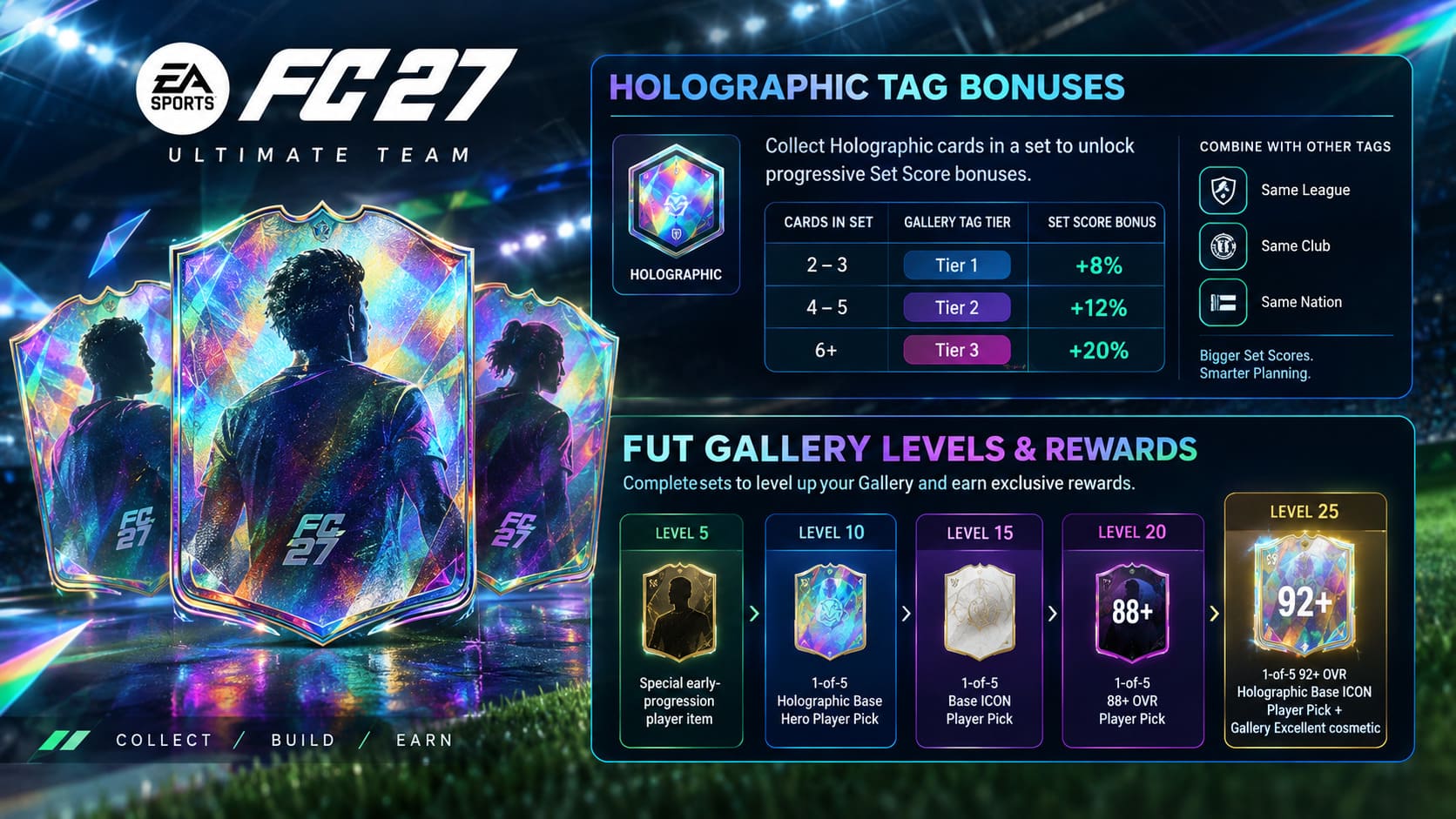
| Holographic Cards in Set | Gallery Tag Tier | Set Score Bonus |
|---|---|---|
| 2–3 | Tier 1 | +8% |
| 4–5 | Tier 2 | +12% |
| 6+ | Tier 3 | +20% |
That final 20% bonus is the number serious collectors should pay attention to.
The fun part is that the Holographic Tag doesn’t have to work alone. Combining it with other relevant tags — such as Same League, Same Club, or Same Nation — can push your Set Score much higher.
This is where FC 27 starts rewarding planning rather than simply opening packs and hoping for something expensive.
FUT Gallery Levels and the Rewards Worth Chasing
Your individual sets contribute toward your overall FUT Gallery Level, which functions somewhat like a long-term progression track for collectors.
The difference is that this isn’t just another short seasonal checklist. The Gallery is designed to remain relevant throughout the FC 27 cycle.
Some of the major milestones include:
| Gallery Level | Reward |
|---|---|
| Level 5 | Special early-progression player item |
| Level 10 | 1-of-5 Holographic Base Hero Player Pick |
| Level 15 | 1-of-5 Base ICON Player Pick |
| Level 20 | 1-of-5 88+ OVR Player Pick |
| Level 25 | 1-of-5 92+ OVR Holographic Base ICON Player Pick + Gallery Excellent cosmetic |
And Level 25 is clearly where the long grind starts to pay off.
A 92+ OVR Holographic Base ICON Player Pick is the sort of reward that gives the entire Gallery system a purpose beyond collecting cards for the sake of collecting them.
Getting there won’t happen overnight, though. You’ll need to think about which sets you’re completing and where your Holographic cards can create the biggest scoring impact.
How to Get Holographic Player Items
There are three main ways to build a Holographic collection.
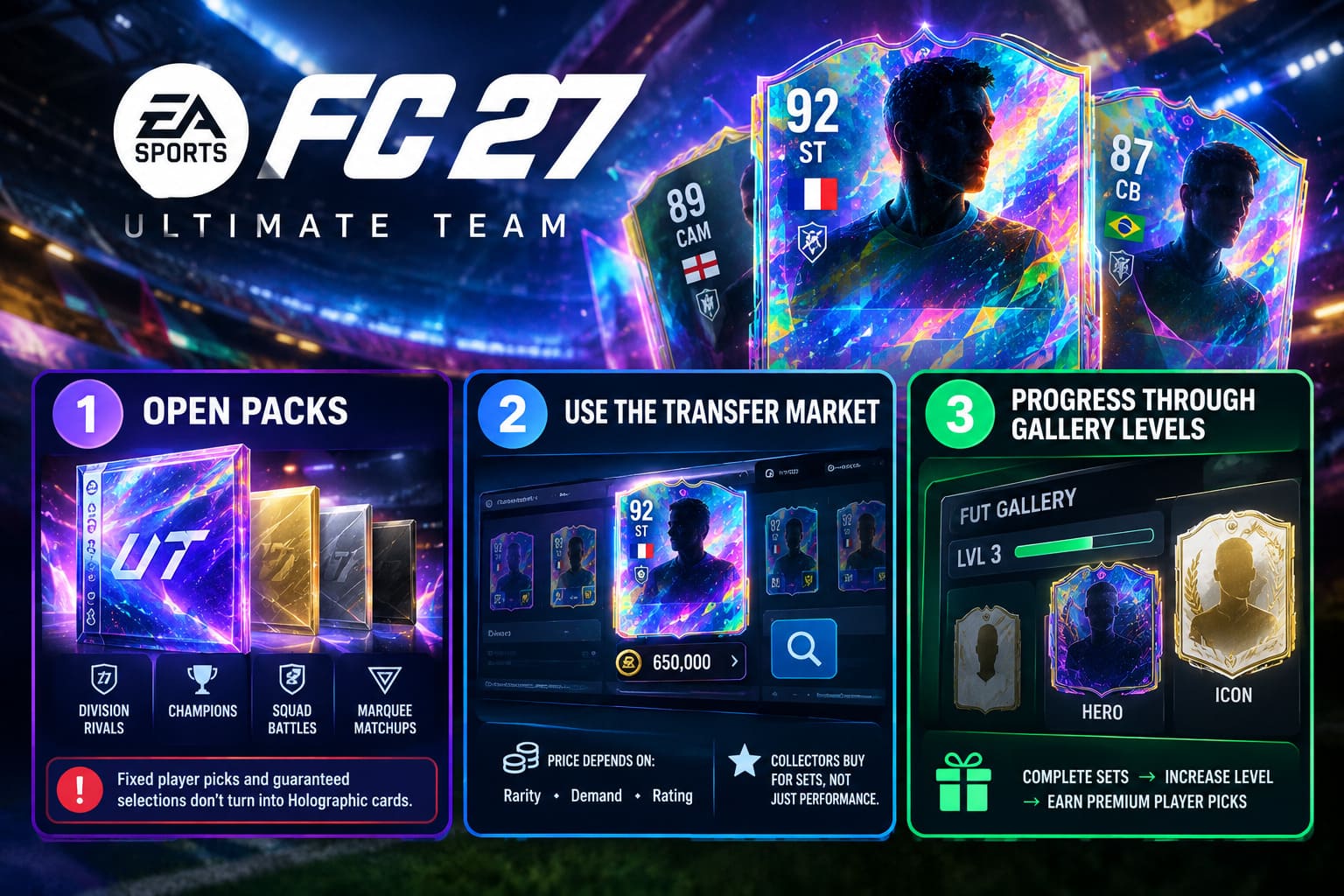
1. Open Packs
The most obvious method is also the least predictable.
When an eligible special card is active in the pack pool, its Holographic version can potentially appear as well. That means Holographics may come from various sources, including store packs and reward packs associated with modes such as Division Rivals, Champions, Squad Battles, and Marquee Matchups.
However, there’s an important limitation.
Fixed player picks and guaranteed player selections don’t randomly convert into Holographic versions.
So don’t assume every special-player reward is secretly another chance at a Holographic.
2. Use the Transfer Market
If luck isn’t cooperating, the market becomes your second option.
Holographic cards are tradeable, and collectors can search for specific variants directly. Naturally, the price depends heavily on rarity, demand, player rating, and how useful the card is for completing Gallery Sets.
This is also where the FUT Gallery creates some genuinely weird market situations.
A player who would never make your starting lineup can still be expensive because collectors don’t care about his chemistry or in-game performance. They care about whether his card completes something.
3. Progress Through Gallery Levels
The Gallery eventually feeds back into itself.
The more sets you complete, the higher your Gallery Level becomes, and those milestones can provide premium player picks — including Holographic Hero and ICON rewards.
This gives collectors a more predictable long-term route instead of relying entirely on pack luck.
The Quick-Sell Trick: Useful or Just Clever Coin Management?
One of the more interesting strategies surrounding the Gallery is buying relatively cheap Holographic cards, registering them to your collection, and then discarding them.
The logic is straightforward.
A qualifying Holographic item can register to your Gallery when it enters your club. Once that happens, you can potentially get rid of the card rather than keeping it locked in your club forever.
Some players have been discussing buying lower-rated Holographic TOTW cards close to their market floor, registering them, and then quick-selling them for roughly 9,700+ coins, depending on the item.
The exact economics obviously depend on the purchase price and market conditions.
I wouldn’t blindly do this with every card. You still need to calculate the difference between the buying price, discard value, and the benefit you’re getting from the Gallery progress.
But as a concept, it’s one of the more interesting changes to Ultimate Team’s usual economy: you can effectively collect the history of a card without permanently owning the card itself.
EA FC 27 Ultimate Team Beginner Guide: Top Tips to Build a Meta Squad Fast
Should You Care About Holographic Cards?
If you’re only interested in building the strongest possible starting XI, Holographics aren’t automatically something you need to chase.
They don’t give you extra attributes simply because they’re shiny.
But if you enjoy the collecting side of Ultimate Team — and plenty of players absolutely do — the situation is very different.
A Holographic card can contribute to your Gallery progress, help activate valuable Set Tags, increase your Set Score and ultimately push you toward the higher Gallery Level rewards.
That’s why I’d treat them as collection assets rather than football assets.
Don’t look at a Holographic card and ask, “Is this player good enough for my team?”
Ask instead:
“What does this card do for my Gallery?”
That change in mindset is probably the biggest thing to understand about EA FC 27’s new system.
EA SPORTS FC 27 PC System Requirements: 100GB Storage, Editions Guide, and Full 2026 Game Review
Final Thoughts
The FUT Gallery gives EA SPORTS FC 27 something Ultimate Team has been missing for a while: a reason to care about cards after their immediate squad value disappears.
Holographic Player Items are the centerpiece of that idea. They’re visually rare, commercially valuable and, most importantly, useful for pushing collection-based progression.
The cards don’t make your players magically better on the pitch. What they do is make your club itself more valuable from a progression standpoint.
For me, that’s the more interesting part of the system. A random special card doesn’t necessarily have to become another forgotten SBC submission anymore. If it’s Holographic, it can become a permanent piece of your Gallery history even after you’ve sold it.
So when that unusual animated card finally appears in a pack, don’t immediately check whether you can squeeze a few extra coins out of it.
Check your FUT Gallery first.
That little bit of foil might be worth considerably more to your long-term progression than its face value suggests.