Dressmaker Game Beginner’s Guide: Essential Tips, Tricks, and Crafting Strategies
There is something surprisingly satisfying about Dressmaker. At first glance, it looks like another cozy crafting game where you make pretty clothes, chat with friendly townsfolk, and slowly upgrade your little shop. After spending time with it, though, I found that there is considerably more depth hiding underneath that relaxing presentation.
Developed by Cozy Lives and published by Free Lives, Dressmaker turns the process of making clothes into a hands-on gameplay loop. You are not simply selecting a dress from a menu and watching your character produce it. You measure customers, adjust your mannequin, design garments, buy materials, cut fabric, operate a sewing machine, and finally decorate the finished piece.
That level of interaction can be both charming and slightly overwhelming when you are just starting out.
So, if you’re opening your first boutique and wondering why your beautiful dress suddenly received a disappointing quality score, this Dressmaker beginner’s guide should help. These are the things I wish I had paid more attention to during my first commissions.
The Dressmaker Gameplay Loop Explained
Most jobs follow the same basic structure, and learning this rhythm is probably the single most important thing you can do early in the game.
| Stage | What You Do | Why It Matters |
|---|---|---|
| Consultation | Read the customer’s request | Determines the design direction |
| Measurements | Measure bust, waist, and hips | Creates the correct fit |
| Design | Build the garment in the sketchbook | Defines the final appearance |
| Shopping | Buy fabrics and trims | Materials must match the commission |
| Cutting | Position and cut pattern pieces | Affects construction and fabric quality |
| Sewing | Guide fabric through the machine | Determines seam quality |
| Decoration | Add buttons, lace, bows, etc. | Improves style and thematic appeal |
| Delivery | Present the finished garment | Earns money, prestige, and relationships |
It sounds complicated on paper, but after a few commissions the workflow becomes almost meditative. Measure, design, shop, cut, sew, decorate, deliver.
The trick is not to rush through those stages.
1. Always Take Measurements Seriously
The first few customer interactions might seem like simple introductions, but their requests contain useful information. Pay attention to words describing the desired clothing, such as elegant, practical, lightweight, durable, formal, or playful.
Those details aren’t just flavor text. They give you clues about the kind of garment you should eventually create.
Once you accept a commission, get the measuring tape out and record the customer’s:
- Bust
- Waist
- Hips
After that, head to your workshop mannequin and manually adjust it to match those measurements.
This is one of those mechanics that is easy to underestimate. I initially treated the mannequin as something I could roughly configure and then forget about. That was a mistake.
A poorly adjusted mannequin can lead to an obviously bad fit, and there is very little point in spending ages creating beautiful clothing if the final garment doesn’t fit the person who ordered it.
My advice: don’t think of measurements as a boring requirement you need to complete before the fun begins. They are the foundation of the entire commission.
2. Treat the Sketchbook Like Your Design Blueprint
The sketchbook is where Dressmaker starts feeling less like a basic crafting game and more like a genuine tailoring simulator.
You can experiment with different garment components, including bodices, necklines, sleeves, skirts, and hemlines. Options such as Princess Seams, Sweetheart Necks, Square Necks, and Teddy Bear Collars can dramatically change the personality of the finished outfit.
One particularly useful beginner trick is to experiment with fabric swatches before spending your money.
Drag different swatches onto the sketchbook and see how the combination looks first. This is much better than buying an expensive fabric, returning to the workshop, and realizing that your supposedly elegant outfit looks completely wrong.
I also recommend keeping the customer’s original style request visible in your mind while designing. A beautiful dress isn’t automatically a successful commission. A beautiful dress that matches what the customer actually wanted is.
3. Be Careful With Your Money at the Emporium
This might be the most important financial tip in the entire Dressmaker beginner guide:
Don’t buy fabric just because it looks nice.
The Emporium offers plenty of tempting options, from cotton and linen to wool, silk, velvet, lace, and sequins. When you are starting with limited funds, however, buying expensive materials for the sake of experimenting can put unnecessary pressure on your budget.
Before purchasing anything, check the customer’s requested material characteristics and tags.
If the commission asks for a specific fabric type or quality, make sure what you’re buying actually satisfies the requirement.
I especially recommend avoiding the habit of building a huge personal fabric collection during the early game. Your boutique will eventually have more financial freedom, but early money is better spent on materials you know you actually need.
A little restraint here can save you from a surprisingly frustrating restart.
4. Learn the Cutting Table Before Taking Difficult Commissions
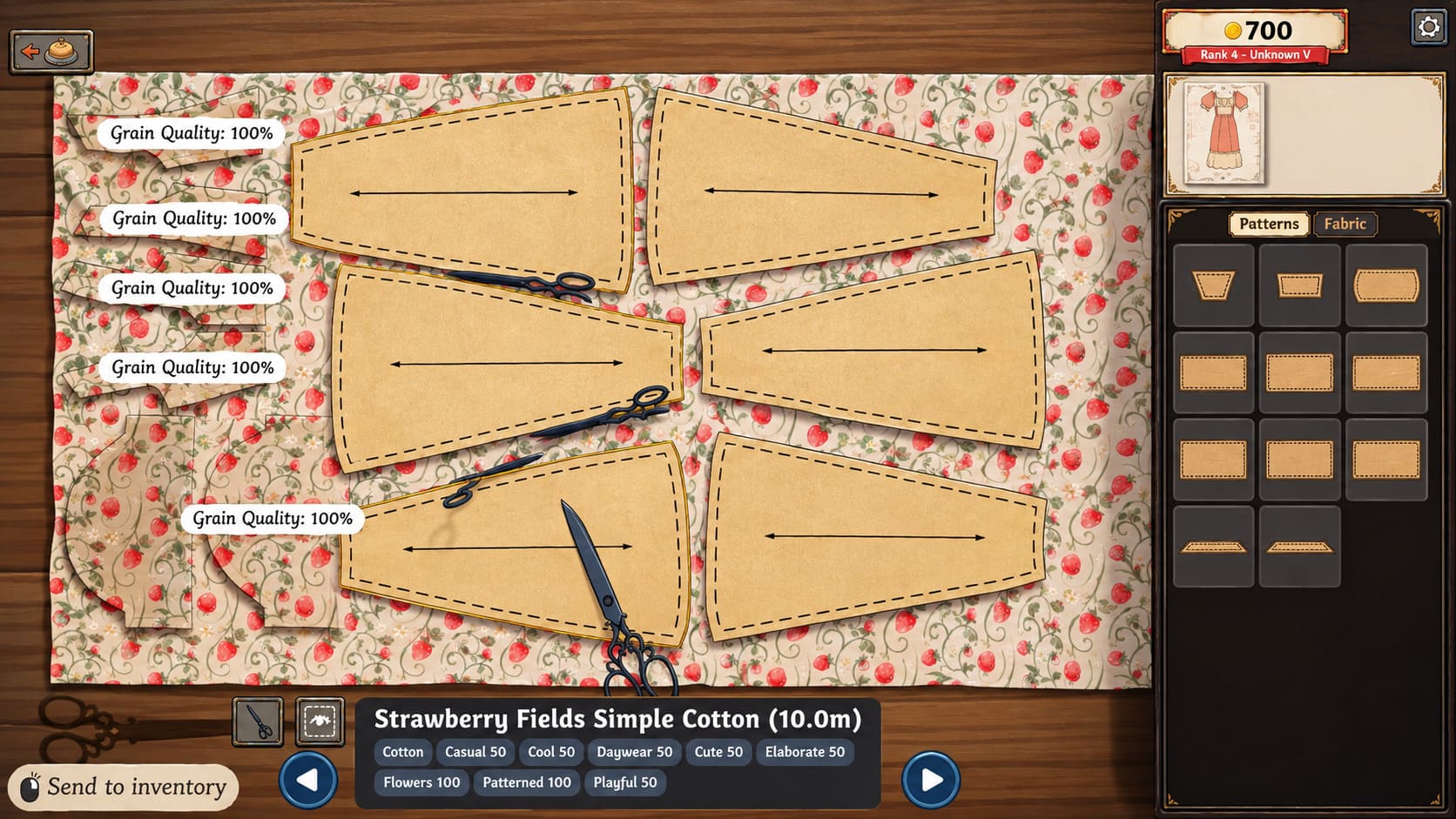
The cutting table is probably my favorite part of Dressmaker because this is where the game really rewards paying attention.
You need to place your pattern pieces over the fabric and consider their orientation rather than simply dropping them wherever there is empty space.
Understanding Grainlines
The basic idea is straightforward:
On-grain cutting keeps the pattern aligned with the fabric’s normal grain. This is generally the safest approach and works well for structured garments.
Then there is the bias cut. Rotating a piece approximately 45 degrees changes how the fabric behaves and can create a much softer, more flowing drape.
For elegant dresses and certain evening designs, experimenting with the bias can produce much more interesting results.
There is another detail that is easy to miss: pattern matching.
If you are working with stripes, plaid, or a large repeating floral pattern, where you place the pattern pieces matters. Matching the visual pattern across seams can make the finished garment look dramatically more professional.
It is a small detail, but those small details are exactly what make Dressmaker so satisfying.
5. Don’t Fight the Sewing Machine
The sewing machine is where a relaxing crafting session can suddenly become surprisingly intense.
Dressmaker gives you control over the fabric while the machine is operating. You can use keyboard controls or mouse-based movement, with the Spacebar controlling the foot pedal.
The biggest beginner mistake is trying to go too fast.
When the machine is moving quickly, sharp turns become much harder to manage. If you swing the fabric aggressively around a corner, your seam can become crooked, and that can hurt the final quality.
Instead, use short controlled movements.
For difficult curves, I personally prefer slowing down and using brief bursts rather than holding the pedal continuously. It feels slower, but it gives you much more control.
Think of it like driving:
Straight line = speed.
Tight corner = slow down.
Once the movement starts feeling natural, sewing becomes one of the most enjoyable mechanics in the game.
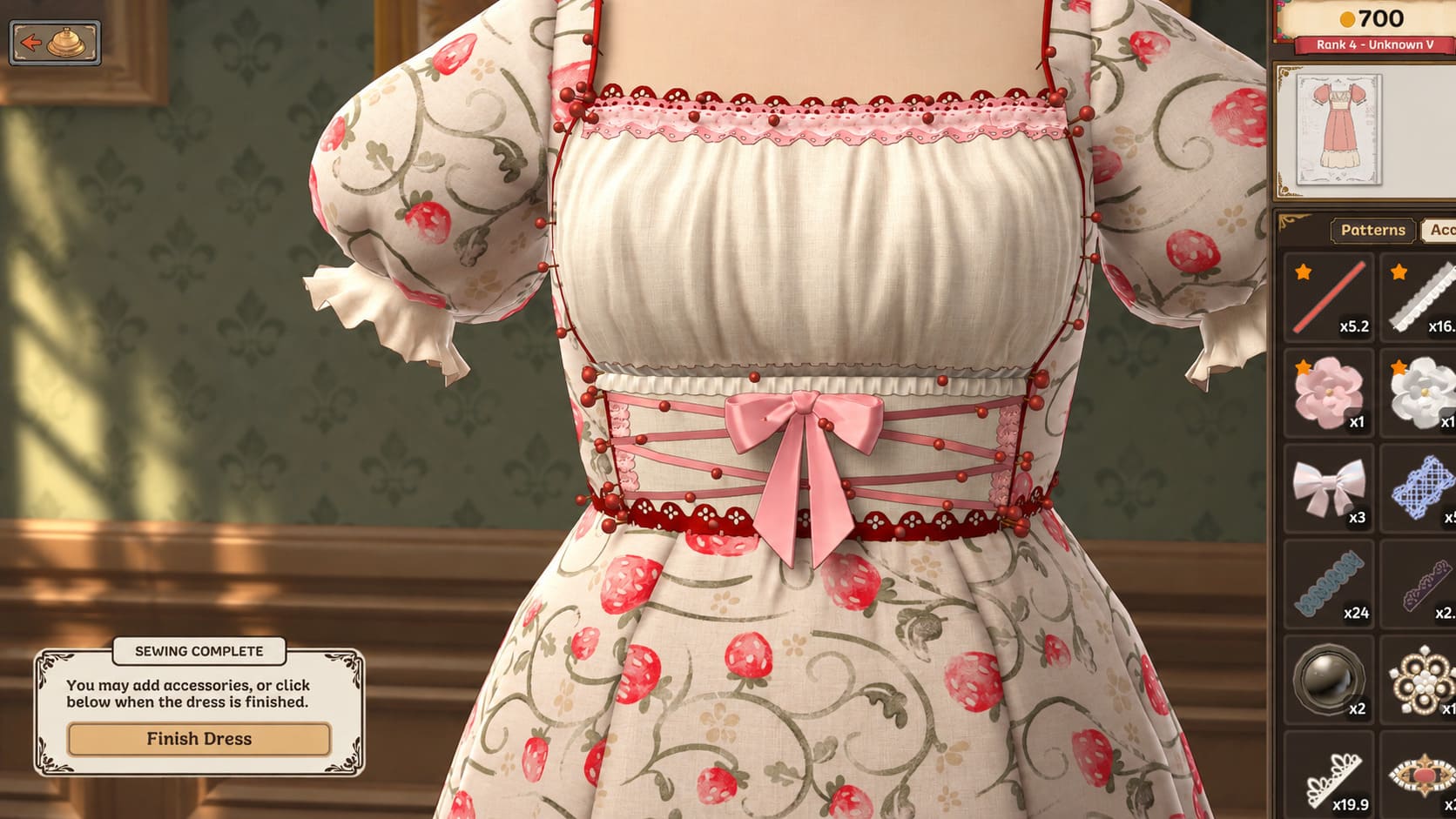
6. Decoration Is Where You Can Really Show Personality
After the main construction is complete, you get to play with the details.
Buttons, bows, lace, zippers, appliqué, and other decorations can be placed manually, giving you considerably more freedom than I expected.
This is also where you can push a design toward a particular theme.
For example, an elegant silk outfit can benefit from delicate buttons and restrained lace, while a playful commission can become much more interesting with colorful patches and more unusual accessories.
Don’t assume that adding more decorations automatically makes a dress better.
Sometimes a simple design with a few carefully chosen details looks far more convincing than covering every available surface with accessories.
Match the decoration to the garment instead of decorating for the sake of decorating.
My Favorite Dressmaker Tips for New Players
After understanding the main mechanics, there are a few smaller habits that can make the entire experience easier.
Don’t Rush Expensive Commissions
If a client has a complicated request, take your time. A rushed garment can turn into wasted materials and lost money.
Check Your Mannequin Twice
Before cutting fabric, quickly verify the mannequin’s measurements again. It is much easier to correct a mistake before construction begins.
Save Your Money Early
Your first coins are valuable. Avoid unnecessary luxury materials until your boutique has a more comfortable financial cushion.
Practice Sewing
If the sewing machine feels awkward, don’t wait for a difficult commission to practice. Spend some time learning how the fabric reacts to your movements.
Watch for Physics or Seam Glitches
Because Dressmaker relies heavily on physical interactions, objects can occasionally behave strangely. If a pattern piece clips through something or a seam doesn’t register correctly, moving back to the previous workstation or reloading the area can sometimes reset the situation.
You Can Also Be a Little Evil
One of the funniest things about Dressmaker is that not every customer has to receive your absolute best work.
The relationship system gives you some room to respond to the personalities of the townsfolk. Nice customers can receive beautiful, carefully constructed garments. Rude customers, meanwhile, can become tempting targets for a little creative revenge.
You can intentionally make questionable design decisions, including mismatched patterns, strange color combinations, poor fabric orientation, or absurd decorations.
Obviously, this isn’t the approach I’d recommend for every commission. But as a sandbox feature, it adds a lot of personality to the game.
Sometimes making the perfect gown is satisfying.
Sometimes watching a rude customer react to a deliberately terrible dress is even funnier.
Don’t Forget the Workshop Cat
This isn’t going to make you richer, improve your sewing score, or magically fix a crooked seam.
Still, pet the cat.
Dressmaker is at its best when you stop thinking about optimization for a moment and simply enjoy the atmosphere. Between commissions, there are little interactive details around the workshop that make the space feel lived in.
The workshop cat is probably the most important of these completely non-essential features.
No stat bonus. No secret crafting recipe. Just cat.
That’s good enough for me.
What Could Make Dressmaker Even Better?
As a relatively new release, Dressmaker has plenty of room to grow. The developers have discussed several additions that could make the experience even more interesting.
Among the features to watch are:
- Improved controller support, including a smoother Steam Deck experience.
- Better transparency rendering for delicate and sheer fabrics.
- Community-focused challenges where players can showcase their designs.
- Additional platform versions, including mobile and Nintendo Switch releases.
The community features are particularly interesting because Dressmaker’s customization system seems naturally suited to showing off unusual designs.
I would love to see challenges based around specific fabrics, historical-inspired outfits, limited materials, or bizarre customer requests.
WoW Forever Low End PC Optimization Guide: Best Graphics Settings for Maximum FPS
Final Thoughts
What I like most about Dressmaker is that it doesn’t try to turn tailoring into a complicated spreadsheet. Instead, it makes the individual steps feel tangible.
Measuring a customer, adjusting the mannequin, arranging a pattern, cutting fabric, guiding the sewing machine, and finally adding decorations all feel like parts of the same creative process.
The game is definitely more enjoyable once you stop trying to rush through commissions. Take the extra moment to check the measurements. Think about your fabric choice. Pay attention to grainlines. Slow down around difficult sewing sections.
And most importantly, don’t spend all your early money on pretty fabric simply because you want it.
If you approach the game patiently, your small workshop can grow into something that feels genuinely personal. Some commissions will be elegant masterpieces, others will be hilarious disasters, and occasionally you’ll probably create something that looks much better than you expected.
For a cozy crafting game, that’s exactly the kind of unpredictability I want.
Dressmaker is at its best when it lets you experiment. Learn the basics, make a few mistakes, and then start bending the rules to create garments that actually feel like your own.
Quick Beginner Checklist
- Measure every client carefully.
- Match the mannequin to their proportions.
- Use the sketchbook to test designs before shopping.
- Buy only the materials required for the current commission.
- Pay attention to fabric grainlines.
- Match patterns when working with plaid or stripes.
- Slow down when sewing difficult curves.
- Use decorations that support the requested theme.
- Keep an eye out for workshop glitches.
- Leave some time to enjoy the cozy parts of the game.
Dressmaker may look simple from the outside, but once you get into the details, there is a surprisingly satisfying amount of depth here. And honestly, that combination of cozy atmosphere, tactile crafting, and just enough room for chaos is what makes it so easy to lose an evening inside the boutique.