Pao Pao Game Split Screen Support: Can You Play Couch Co-Op?
There are certain games that seem almost designed for couch co-op. Pao Pao, the colorful restaurant sandbox from ArtDock and Dreland Enterprises, is one of them. With adorable animal chefs, a seaside town to explore, farming, fishing, cooking, decorating, and the inevitable kitchen panic when several customers are waiting at once, it has the kind of gameplay that practically begs for a second controller.
After spending a lot of time with different co-op games over the years, I can understand why people immediately compare Pao Pao to games such as Overcooked, Stardew Valley, and Animal Crossing. They all have that special quality where doing something simple together can become surprisingly entertaining. One minute you’re calmly collecting ingredients, and the next you’re running around trying to save a restaurant shift from complete disaster. That makes the question of Pao Pao split screen support especially important for players who prefer gaming together in the same room.
Unfortunately, there is a catch.
Pao Pao Game Multiplayer Guide: Ultimate Co-Op Strategy, Tips, and Kitchen Management
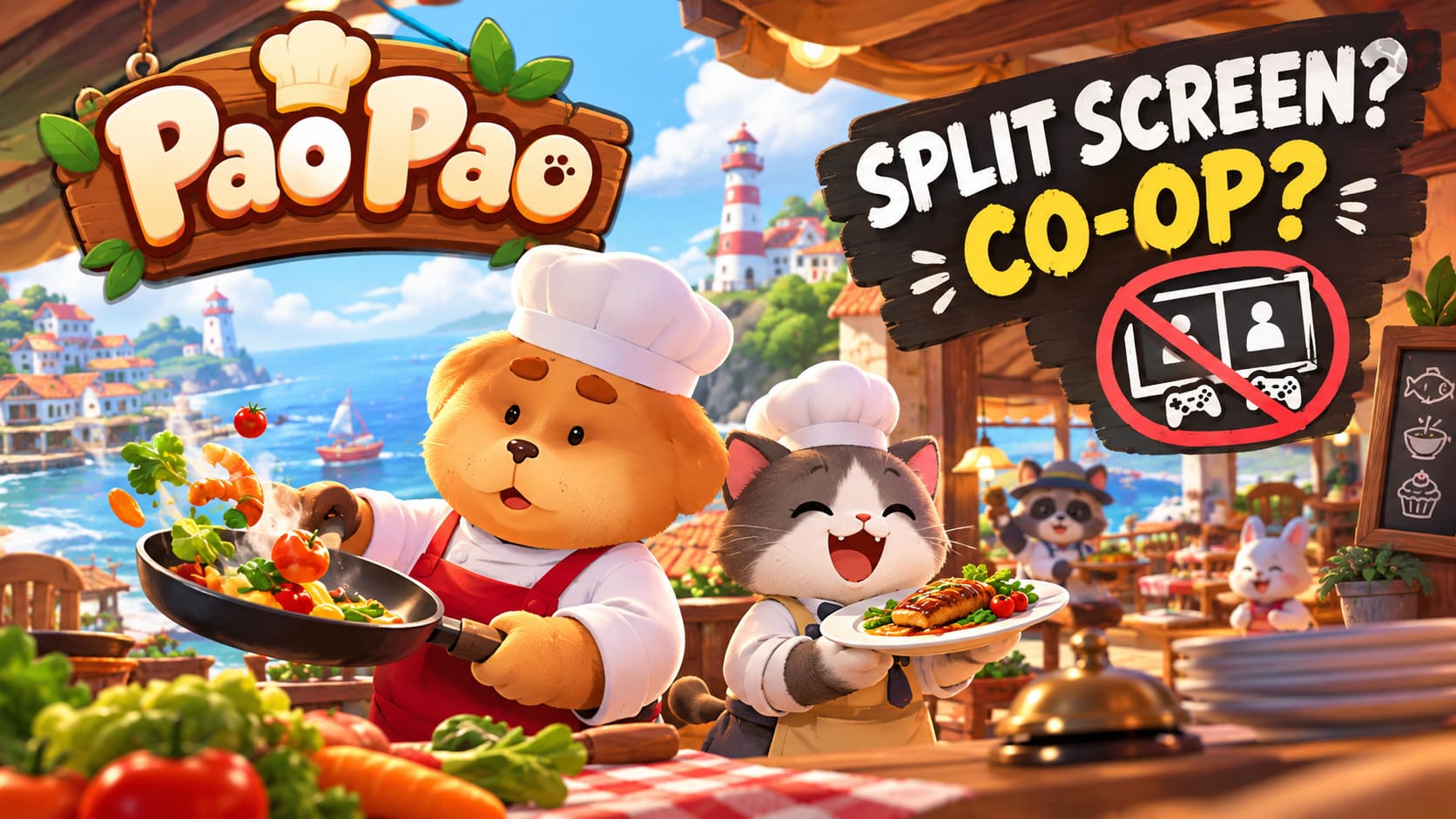
Does Pao Pao Have Split-Screen or Couch Co-Op?
The short answer is no, Pao Pao does not currently offer native split-screen or local couch co-op.
This is probably the biggest disappointment for players who were hoping to sit down with a partner, friend, or family member and share one screen. The game’s design certainly makes local multiplayer feel like a natural fit, but its current multiplayer implementation is built around online cooperative play instead.
That distinction is important. Pao Pao isn’t a single-player-only game with no multiplayer features. Quite the opposite: cooperative gameplay is a major part of its appeal. The problem is simply that each player needs their own device and online connection rather than everyone playing together on one television or monitor.
| Feature | Pao Pao |
|---|---|
| Online Co-Op | Yes |
| Local Couch Co-Op | No |
| Native Split Screen | No |
| Multiplayer | Up to 4 players |
| Separate Devices | Required |
| Shared-Screen Multiplayer | Not currently available |
For anyone coming from games where everyone can grab a controller and immediately start playing, this limitation is worth knowing before buying.
Why Pao Pao Feels Perfect for Local Multiplayer
This is where I think Pao Pao becomes particularly interesting. I’ve played plenty of cooperative games where multiplayer feels like something added after the fact, but the restaurant concept here naturally encourages players to divide responsibilities.
During the busy daytime portion, there is a lot going on. You might need to gather ingredients, fish, farm crops, prepare food, serve customers, clean dishes, and keep the restaurant running. Doing all of that alone can be satisfying, but having another player around creates an entirely different rhythm.
One player could concentrate on cooking while another handles customer orders. Someone else could gather ingredients or take care of other tasks around the restaurant. With four players, the potential for organized teamwork—or complete chaos—is even greater.
And honestly, that chaos is part of the appeal.
I’ve always found cooperative management games more memorable when things go slightly wrong. Someone forgets an order, another player brings the wrong ingredient, the kitchen gets overwhelmed, and suddenly everyone is shouting instructions at each other. Those moments are exactly why couch co-op has remained so popular despite the growth of online multiplayer.
The Nighttime Gameplay Changes the Mood
Pao Pao isn’t just about surviving a hectic restaurant shift. One of the things I like about its concept is the contrast between the working hours and the more relaxed exploration sections.
When the restaurant closes and nighttime arrives, the pace becomes considerably more comfortable. Players can explore the seaside environment, interact with NPCs, participate in activities and mini-games, customize their restaurant, and prepare for another day.
That structure makes Pao Pao feel like more than another cooking simulator.
It has the stress-and-relaxation loop that I personally enjoy in games such as Stardew Valley. You can spend part of your session worrying about customers and ingredients, then switch gears and simply wander around the world. With friends, that transition could make for some genuinely fun multiplayer sessions.
It is also one of the reasons I think the lack of couch co-op feels more noticeable than it would in some other games.
Why Players Want Pao Pao Couch Co-Op
The community’s interest in local multiplayer isn’t difficult to understand. Cozy games are often played by couples, families, siblings, and friends who aren’t necessarily hardcore gamers.
A shared-screen option removes several barriers. You don’t need two gaming PCs, two copies of the game, separate online accounts, headsets, or a second place to sit. You can simply put the game on the TV, hand someone a controller, and start playing.
That simplicity is a huge part of the appeal of classic couch co-op.
For someone trying to introduce a non-gamer to gaming, a game like Pao Pao could also be an excellent choice. The colorful visuals and cute animal characters are approachable, while the restaurant mechanics provide enough depth to keep more experienced players interested.
Online multiplayer gives you convenience across distance, but couch co-op gives you a completely different social experience.
That is something I don’t think developers should underestimate.
How Many Players Can Play Pao Pao Together?
While split-screen is missing, Pao Pao does support online cooperative multiplayer for up to four players.
That means you can build a small team and tackle the restaurant together, with every player participating from their own device. The basic setup follows the familiar online co-op formula:
- Everyone needs access to the game and a compatible platform.
- One player creates the multiplayer session and acts as the host.
- Other players join through the available online invitation or lobby system.
- Up to four players can participate in the same cooperative experience.
A stable internet connection is obviously important, particularly for a game where several players are interacting with the same environment.
The developers have also spent time improving the online experience during development, addressing issues involving loading, connection stability, multiplayer synchronization, and situations where players leave a session.
That is encouraging because online co-op is currently the primary way to experience Pao Pao with other people.
What About Steam Remote Play?
This is where things get a little more complicated.
Players naturally look at Steam’s Remote Play features and wonder whether they can somehow turn Pao Pao into a couch co-op experience. In some games, Remote Play Together allows multiple people to interact with a single copy of a game, but that depends heavily on how the game handles controllers and multiplayer input.
It should therefore not be treated as an official Pao Pao split-screen solution.
If you’re experimenting with Steam’s remote features, your mileage may vary depending on the current version of the game and its input implementation. Even if you manage to connect additional controllers, that doesn’t necessarily mean you’ll get a proper shared-screen multiplayer experience.
Personally, I wouldn’t buy Pao Pao specifically expecting Remote Play to magically solve the missing couch co-op feature.
Could PC Players Create Their Own Split-Screen Setup?
Technically minded PC players may be tempted to experiment with third-party tools that allow multiple game instances or controller input to be separated between windows.
There are applications designed to simulate local multiplayer by running several instances of a game and assigning different controllers or input devices to each instance. In theory, something along those lines could potentially be explored with Pao Pao.
However, this is not an official feature, and I wouldn’t recommend treating it as a simple plug-and-play solution.
Running multiple instances of a game can consume considerably more CPU, RAM, and GPU resources. You may also run into networking problems, synchronization issues, input conflicts, crashes, or restrictions imposed by the game itself.
For most players, the official online multiplayer mode will be considerably less frustrating.
Will Pao Pao Ever Get Local Co-Op?
This is the question I’m most interested in.
Because Pao Pao is being developed with community feedback in mind, the lack of split-screen doesn’t necessarily mean the feature can never happen. Early Access is often where developers discover which seemingly small features players care about the most.
That said, players shouldn’t assume that local multiplayer is guaranteed.
Implementing proper couch co-op can be significantly more complicated than simply adding another controller. The developers would need to consider camera behavior, UI scaling, player input, menus, interactions, performance, and potentially how multiplayer progression works when several characters occupy the same screen.
The good news is that Pao Pao’s gameplay structure seems naturally compatible with cooperative play, so the idea itself doesn’t feel unreasonable.
Whether ArtDock ultimately decides that the development time is worth investing in is another question.
My Take After Looking at Pao Pao as a Co-Op Game
From the perspective of someone who has played a lot of different multiplayer games, I think Pao Pao is one of those titles where local multiplayer would make a lot of sense.
The restaurant management systems already encourage teamwork. The slower exploration sections give players time to relax together. The cute visual style makes it accessible to people who might not normally play management games, and the four-player online setup shows that multiplayer is clearly an important part of the design.
The missing split-screen mode is therefore less a problem with the game’s concept and more a limitation of how that concept is currently delivered.
If you’re specifically looking for a couch co-op game, I would keep that limitation in mind. Pao Pao currently isn’t the game where you can sit on the sofa with three controllers and immediately start running a restaurant together.
If everyone has their own device, however, the situation is much better. Online co-op gives Pao Pao plenty of room for teamwork, experimentation, and the kind of hilarious kitchen disasters that make cooperative games worth playing in the first place.
For now, I would treat Pao Pao as an online co-op restaurant sandbox rather than a split-screen game. If ArtDock eventually adds local multiplayer during development, it could be a fantastic addition—and probably one of the easiest ways to make the game even more appealing to couples, families, and casual co-op players.