Dimraeth Best Starter Class Guide: Top Builds for Early Access (2026)
Picking your first character in Dimraeth is one of those decisions that looks simple until you actually start reading what the game is doing with its character system.
You aren’t just choosing between a warrior, mage, or rogue and calling it a day. Dimraeth ties your race and class together, then adds a third skill tree based on that combination. That means your first choice can have a much bigger impact on how the early game feels than it does in most action RPGs.
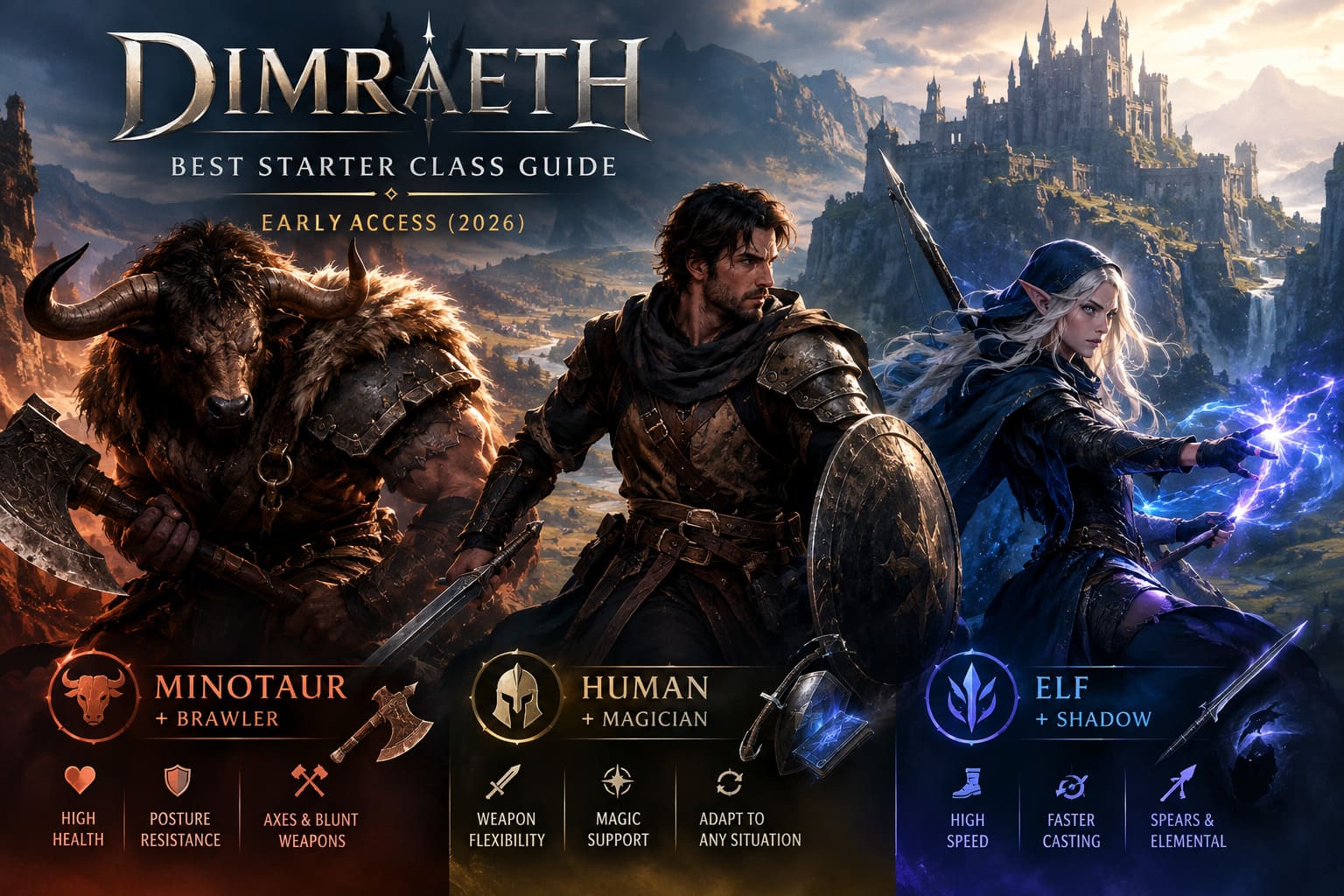
After looking closely at the Early Access lineup, I keep coming back to three combinations: Minotaur Brawler, Human Magician, and Elf Shadow. They cover three very different approaches to combat, and each one has a legitimate reason to be your first character.
But if you’re asking me which one I’d actually recommend to a new player, I have a pretty clear answer.
Minotaur + Brawler is the safest starting point.
It’s not necessarily the flashiest build, but Dimraeth’s combat is exactly the kind of combat where having a little extra room for mistakes can make a huge difference.
How Dimraeth’s Race and Class System Actually Works
Before getting into the individual builds, there’s one thing worth understanding: your race isn’t just cosmetic in Dimraeth.
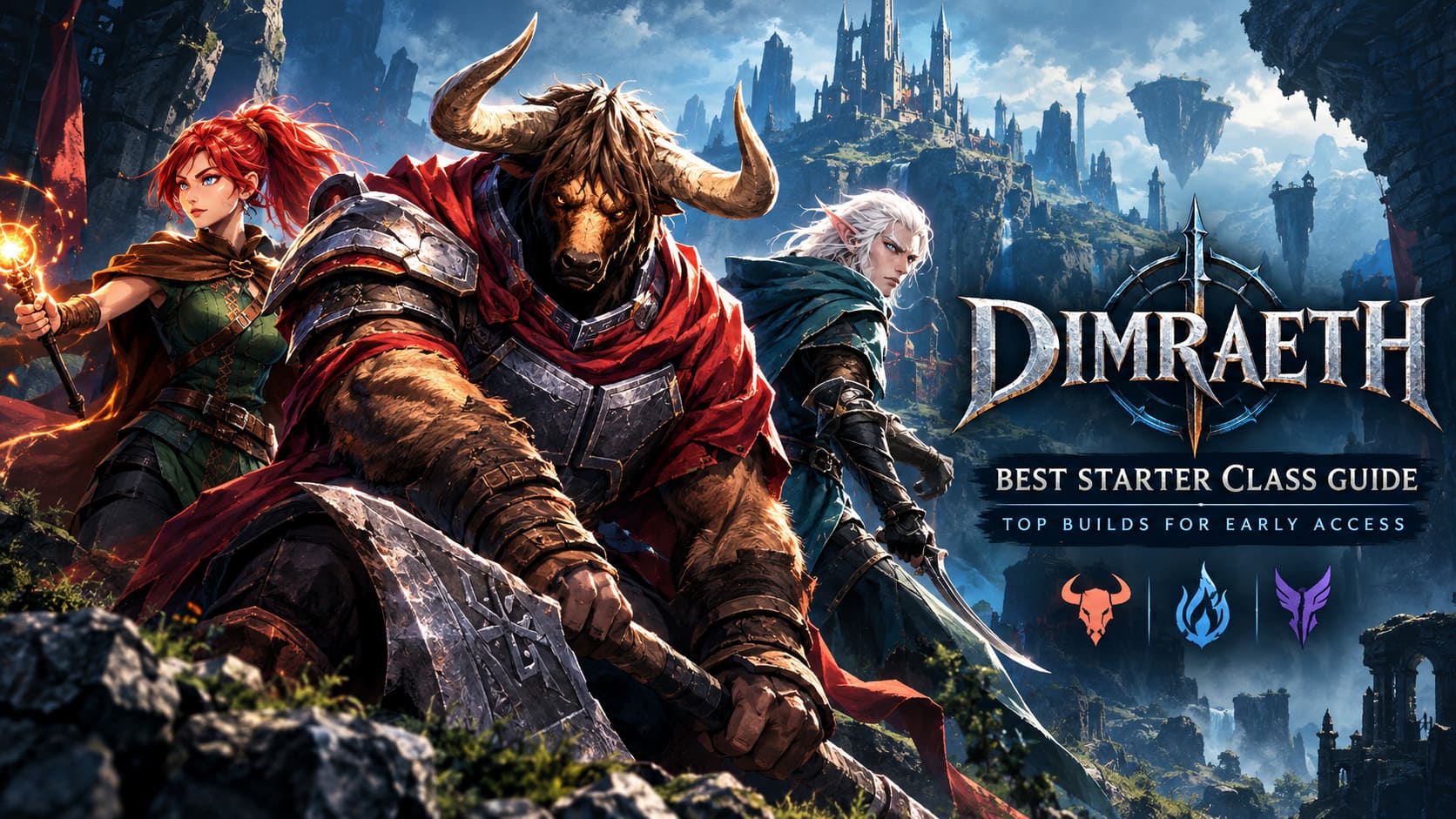
The current Early Access setup features three races and three classes:
| Race | Class | General Strength |
|---|---|---|
| Minotaur | Brawler | Durability, melee pressure, posture damage |
| Human | Magician | Versatility, weapon swapping, magic |
| Elf | Shadow | Mobility, critical damage, stealth |
Your character effectively develops through three skill trees.
The first comes from your race. The second comes from your class. The third is the special Archetype Tree created by combining the two.
That’s where things get particularly interesting.
A Minotaur Brawler, for example, doesn’t simply receive Minotaur bonuses and Brawler bonuses. The combination unlocks the Horned Vanguard archetype, giving the build its own progression path and combat identity.
That system is one of my favorite ideas in Dimraeth because it gives character creation some real weight. You’re not simply choosing a class and then replacing your gear every few hours. Your starting decisions establish the framework for your entire build.
And with the final game planned around eight races and six classes, there’s clearly a lot more room for combinations later.
The Three Early Access Classes
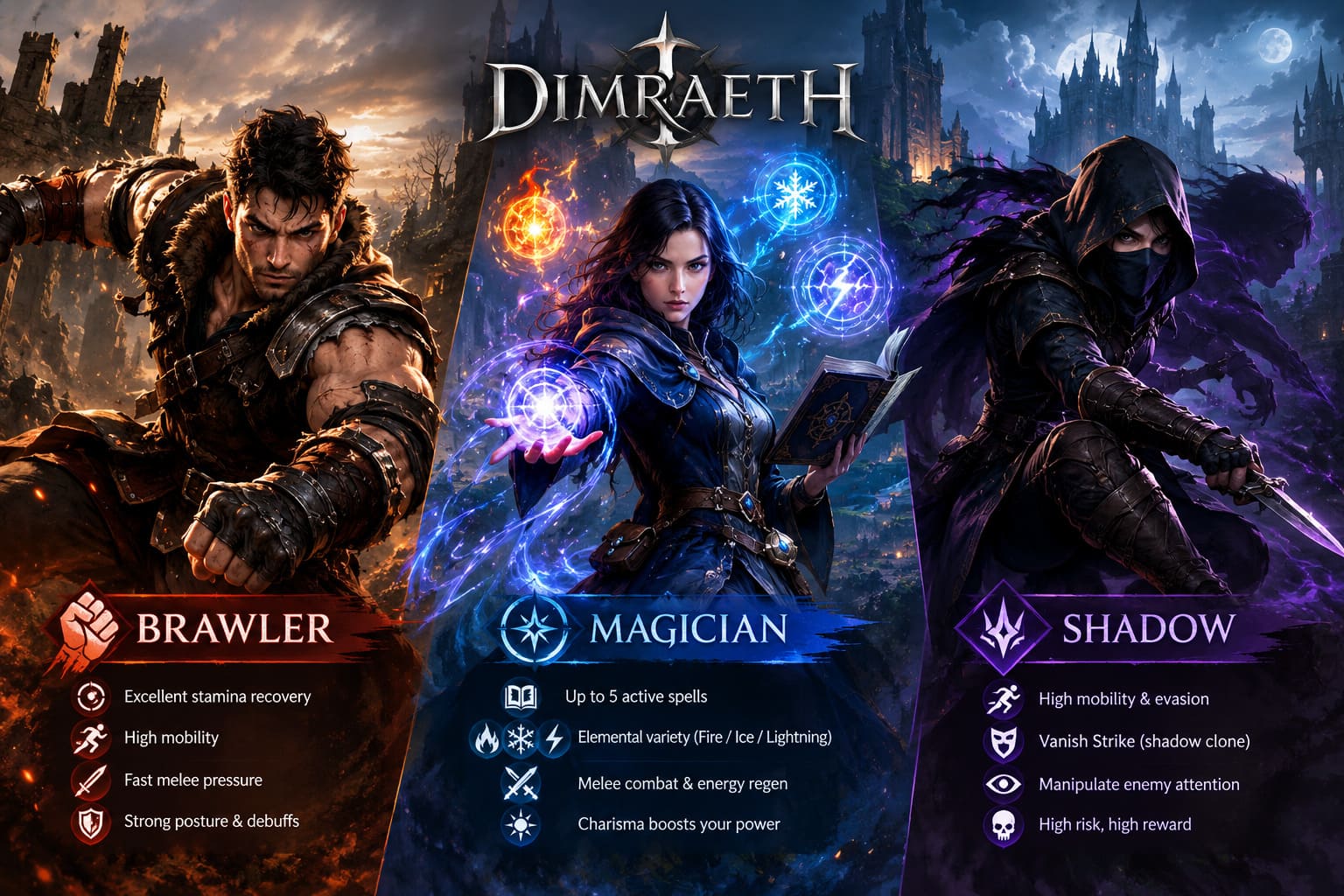
Brawler — The Aggressive Melee Choice
The Brawler is the class I’d recommend to anyone who enjoys being in an enemy’s face constantly.
This isn’t a slow tank that waits for the perfect opening. The Brawler is about maintaining pressure, recovering stamina efficiently, dodging through attacks, and punishing enemies before they have a chance to reset.
The important part is stamina.
Dimraeth’s combat rewards players who understand when they can attack, when they should dodge, and when they need to stop swinging altogether. The Brawler gives you more freedom to stay aggressive without exhausting yourself as quickly.
Its biggest strengths are:
- Excellent stamina recovery
- High mobility
- Fast melee pressure
- Strong posture and physical debuff potential
The downside is obvious: you still have to learn the combat.
A Brawler isn’t a magical solution for bad dodges. If you constantly attack without watching enemy patterns, the class won’t save you.
But once the rhythm clicks, it feels fantastic.
Magician — More Than a Traditional Mage
I was initially more interested in the Magician because of the elemental system.
You can equip up to five active spells, with Fire, Ice, and Lightning providing different options for dealing with enemies. What makes the class more interesting is that you’re not expected to stand twenty meters away and throw spells until everything dies.
The Magician can actively participate in melee combat and use physical attacks to regenerate arcane energy.
That creates a satisfying loop:
Fight → generate energy → cast → control the battlefield → return to combat.
Charisma becomes particularly important because it affects your magical capabilities and opens additional branches for offensive and defensive spells.
The Magician is therefore a great choice if you enjoy adapting to enemies rather than simply overpowering them.
Shadow — The High-Skill Option
The Shadow is probably the class I’d choose after already understanding Dimraeth’s combat.
It’s fast, evasive and built around positioning. Instead of absorbing punishment, you’re trying to make sure the enemy never gets a clean opportunity to hit you.
One of its more interesting early abilities is Vanish Strike, which leaves a shadow clone behind while you reposition.
That sounds like a small trick on paper, but abilities like this completely change how you approach groups of enemies. You can manipulate enemy attention, disappear from dangerous situations, and look for an opening behind an exposed target.
The problem?
You are much less forgiving when you make mistakes.
A missed dodge or badly timed attack can turn a great run into a corpse run very quickly.
The Three Early Access Races
Minotaur
If you want to hit hard and survive punishment, the Minotaur is the obvious choice.
The race naturally leans toward health, posture resistance and heavy physical combat. Axes and blunt weapons fit the fantasy perfectly, and the higher durability makes the Minotaur particularly attractive for new players.
The tradeoff is mobility.
You’re not going to feel as slippery as an Elf, and that’s exactly why pairing the Minotaur with the Brawler makes so much sense.
Human
Humans are the flexible option.
Their biggest advantage is the ability to move naturally between different weapon setups. A Human can weaken an enemy from range with a crossbow, switch into a sword-and-shield configuration and then use magic when the situation calls for it.
That’s incredibly useful while learning the game.
You don’t have to commit to one answer for every encounter.
Elf
The Elf is the race for players who want speed and magical potential.
Higher movement speed, faster casting and strong support for spear and elemental effects make the Elf an obvious partner for magic and mobility-focused builds.
It can be extremely powerful, but I wouldn’t automatically recommend it to a first-time action RPG player.
The Elf rewards confidence.
My Ranking: The Best Dimraeth Starter Builds
After putting all of those strengths together, these are the three combinations I’d prioritize during Early Access.
1. Minotaur + Brawler — Horned Vanguard
My pick for the best overall starter build.
The reason is simple: it covers the biggest weakness most new players have in a Souls-like combat system — making mistakes.
The Minotaur gives you the durability to survive attacks that would be much more punishing on a fragile character. The Brawler then compensates for some of the race’s slower, heavier feeling with mobility and stamina recovery.
The Horned Vanguard archetype pushes the combination even further toward posture damage and physical dominance.
That last part is particularly important.
Enemies in Dimraeth have visible posture mechanics, and breaking that posture creates opportunities for huge damage. A build that can repeatedly pressure that system has an enormous advantage during early progression.
If you’re starting Dimraeth without knowing exactly what you’re doing, this is where I’d start.
2. Human + Magician — The Spellsword
This is probably the most versatile beginner build.
You have ranged options, melee options, defensive tools and elemental magic. More importantly, you can experiment with all of those systems without completely rebuilding your character.
The Human’s weapon flexibility works beautifully with the Magician’s resource management.
You can pull an enemy from range, switch weapons when it closes the distance, generate arcane energy through combat and then drop an elemental spell when several enemies bunch together.
It’s not as durable as the Minotaur Brawler, but it gives you more answers.
I’d pick this one if you’re the type of player who gets bored doing the same thing for every encounter.
3. Elf + Shadow — Arcane Phantom
This is my “I already know what I’m doing” recommendation.
The combination of Elf movement speed and Shadow mobility creates an incredibly fast character. Add stealth, critical attacks and Vanish Strike, and you get a build designed around controlling the engagement rather than fighting enemies head-on.
The ceiling is extremely high.
The floor is not.
If you mistime a dodge or get surrounded, your advantages disappear very quickly. This is especially noticeable in dangerous areas where multiple enemies can attack simultaneously.
For experienced Souls-like or ARPG players, though, this could easily become one of the most entertaining builds in Early Access.
Quick Comparison
| Build | Difficulty | Survivability | Damage | Mobility | Best For |
|---|---|---|---|---|---|
| Minotaur Brawler | Easy | Excellent | High | Good | Beginners & Solo Players |
| Human Magician | Medium | Good | Very High | Good | Versatile Players |
| Elf Shadow | Hard | Low | Very High | Excellent | Experienced Players |
How to Fix Dimraeth Crashing on Launch, Black Screen, and Startup Freezes
Early Game Tips I’d Follow
There are a few things I’d prioritize regardless of which Dimraeth build you choose.
First, don’t neglect your stronghold.
Dimraeth isn’t only about dungeon crawling. Your base becomes an important part of progression, especially for crafting, cooking and upgrading equipment. Bringing resources home after exploring the world can make the next expedition considerably easier.
Second, learn the posture system early.
This is one mechanic I’d avoid treating as optional. Heavy attacks, parries and certain abilities can drain enemy posture, and a successful posture break gives you a valuable damage window.
If you’re struggling with an early boss, sometimes the answer isn’t more damage. It might simply be better posture management.
Finally, think about party composition in co-op.
Dimraeth supports groups of up to eight players, and larger groups change how combat encounters behave. A party full of melee characters can be fun, but having someone capable of controlling groups and exploiting elemental weaknesses gives the team much more flexibility.
An Elf Magician can be particularly useful here.
Dimraeth Online Co-Op Guide: Multiplayer Strategies, Class Synergies, and Stronghold Progression
So, Which Dimraeth Starter Class Should You Choose?
If you want my straightforward answer, I’d choose the Minotaur Brawler and build toward Horned Vanguard.
It’s forgiving without being boring. You still have to learn enemy patterns, manage stamina and understand posture, but the extra durability gives you breathing room while you’re figuring everything out.
If you want something more flexible, go Human Magician. It’s probably the best choice for players who want to experiment with several combat styles without feeling locked into one approach.
And if you’re already comfortable with Souls-like games and want something that rewards mechanical skill, Elf Shadow is the one I’d keep an eye on.
The exciting part is that this is only the Early Access starting lineup. With more races, classes and Archetype Trees planned, Dimraeth’s build system could become considerably deeper as development continues.
For now, though, I’d rather learn Mirkea with a build that lets me make a few mistakes than spend my first ten hours wondering why everything kills me.
Start with the Minotaur Brawler, learn the combat, master posture breaks, and then experiment. That’s probably the most enjoyable way to get your feet under you in Dimraeth.