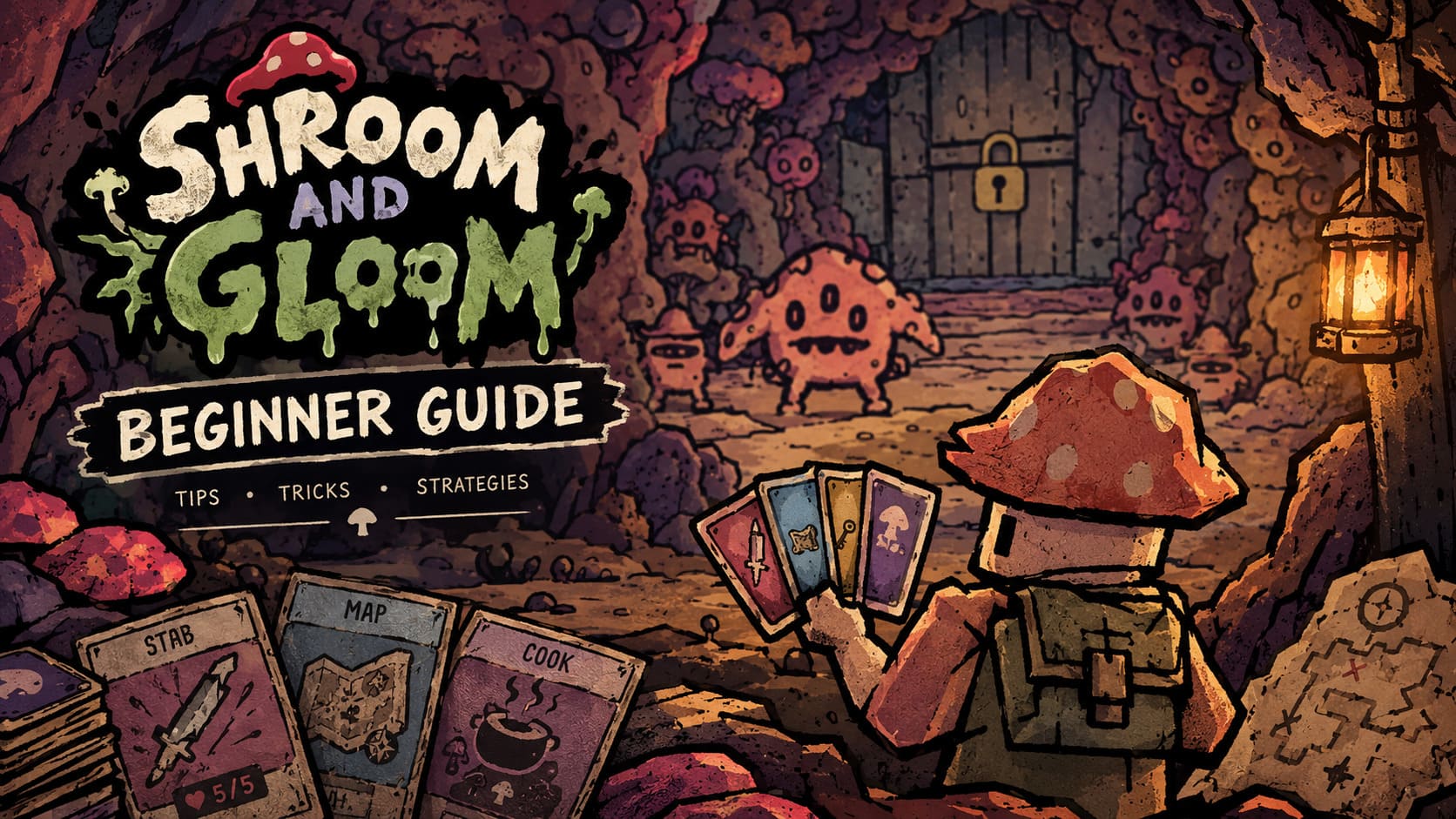
Shroom and Gloom Beginner Guide: Tips, Tricks, and Strategies
There are plenty of roguelike deckbuilders that make you think carefully about your next card. Shroom and Gloom goes a step further and makes you think about practically everything you do underground.
Doors are cards. Exploration tools are cards. Combat abilities are cards. Even the way you deal with enemies feels less like traditional turn-based combat and more like you’re running a very questionable underground kitchen.
That strange combination is exactly what makes Shroom and Gloom so interesting.
Developed by Team Lazerbeam and published by Devolver Digital, the 2026 first-person roguelike deckbuilder has a wonderfully weird paper-crafted presentation, unsettling fungal creatures, and a gameplay loop that can be surprisingly unforgiving when you’re just starting out.
I’ve seen plenty of players approach it like a normal deckbuilder and immediately run into trouble. I made the same mistake. The game looks familiar at first glance, but its systems reward a completely different mindset.
So, if you’re about to make your first trip into The Gloom, here are the things I think every beginner should understand before going too deep.
1. Forget Everything You Know About Traditional Deckbuilders
The first thing that caught me off guard was the double-deckbuilding system.
Instead of having one deck that handles practically everything, Shroom and Gloom separates your cards into two different pools.
| Deck | Main Purpose | What To Focus On |
|---|---|---|
| Combat Deck | Fighting enemies | Damage, status effects, combos |
| Explore Deck | Navigating the world | Keys, healing, tools, route planning |
The distinction sounds simple, but it changes the entire flow of a run.
Your Combat Deck is your weapon. It contains attacks and effects that help you deal with the fungal monsters waiting in the tunnels.
Your Explore Deck, meanwhile, is basically your survival toolkit. It can help you open doors, find hidden rewards, heal yourself, break obstacles, and understand where you’re going.
The mistake is treating your exploration cards like disposable junk.
They aren’t.
A card that looks boring in one room can suddenly become extremely important three rooms later. Resource management outside combat is just as important as building a strong combat deck.
That is probably the biggest lesson I’d give a new player.
2. Pick a Character That Matches Your Brain
The starting survivors aren’t just cosmetic choices. They encourage noticeably different approaches to the game.
The Paper Boy is probably the character I’d recommend to players who enjoy fast, flexible decks. His strengths revolve around mobility, card cycling, and setting up your hand quickly.
Then there’s the Lunch Lady, who feels like the character designed specifically for people who looked at Shroom and Gloom and thought, “Yes, I want to cook the monsters.”
Her playstyle revolves heavily around the game’s eating, cooking, seasoning, and enemy-combination mechanics.
The Concerned Parent is more methodical. This character leans toward defensive utility, resource management, and controlling the environment rather than simply trying to overwhelm everything immediately.
For a first run, I’d personally lean toward Paper Boy if you like experimenting with card combinations, or Lunch Lady if you want to understand one of the game’s strangest mechanics as quickly as possible.
Don’t worry too much about choosing the “perfect” survivor, though. Your first few runs should be about learning the systems.
3. Learn Your Exploration Cards Immediately
This might sound obvious, but knowing what your basic utility cards do saves an absurd amount of frustration.
The Map is one of your most important tools. Don’t treat it as something you only use when you’re lost. Use it to think ahead and understand the route you’re taking.
The Shovel is another card you’ll want to understand early. Suspicious patches of dirt can hide useful rewards, including additions to your combat options.
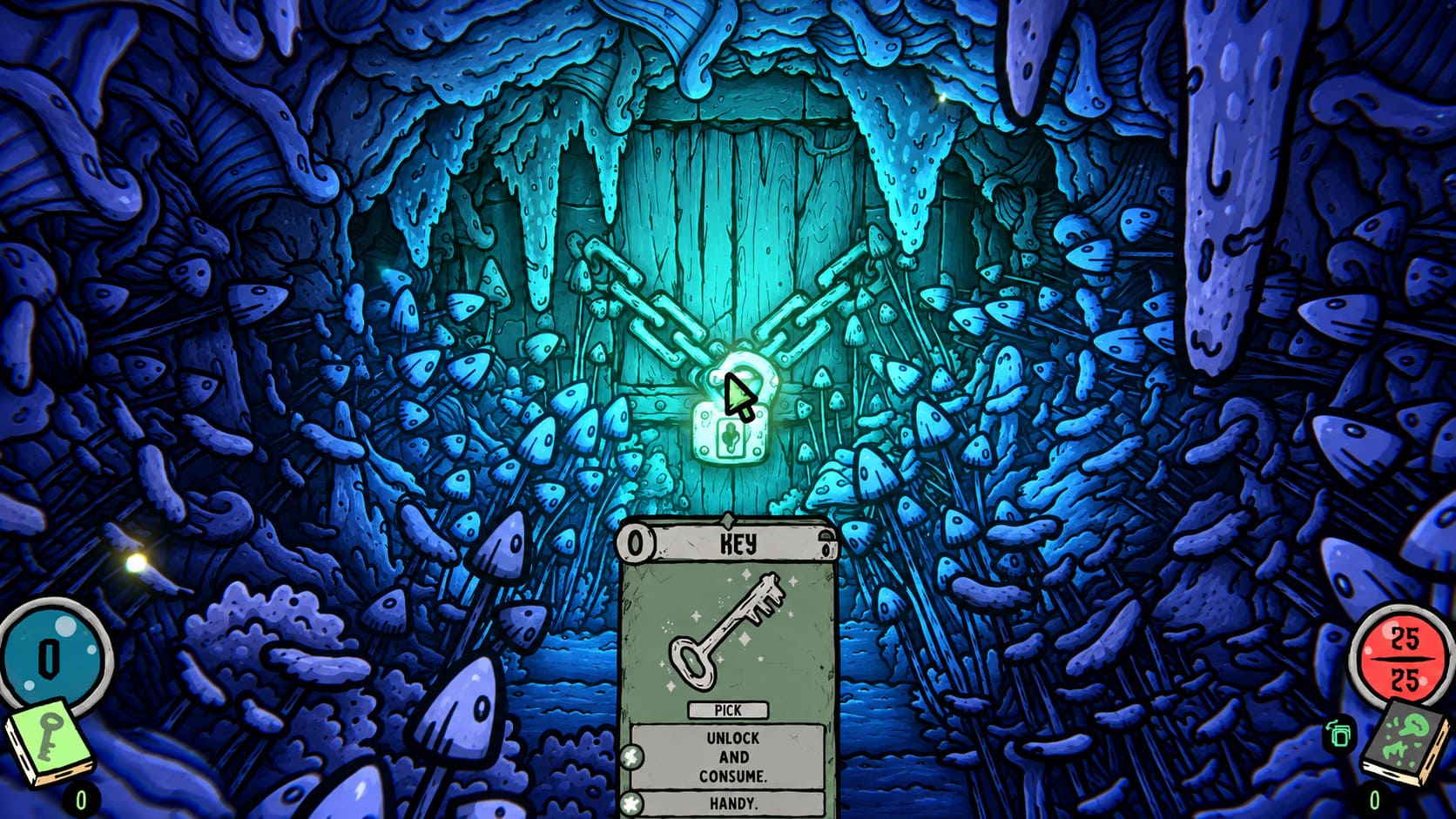
Then there’s the Key, which has the straightforward job of opening locked doors and chests.
And if you don’t have one?
That’s where Bash comes in.
Bash lets you force your way through a lock, but you pay for it with health. It deals 4 damage to you, which sounds painful when you’re already struggling, but sometimes the reward behind that door is absolutely worth the cost.
The important thing is to stop thinking about health as something that must always remain untouched.
In Shroom and Gloom, health is also a resource.
4. There Is No Traditional Blocking — Get Used to It
This is probably the biggest adjustment for players coming from games like Slay the Spire.
There are no conventional block cards here.
You can’t simply build a giant defensive wall and wait for enemies to wear themselves out.
Instead, combat encourages aggression.
The basic philosophy is simple:
Kill the enemy before the enemy kills you. Then eat it.
Cards such as Stab and Slash help bring enemies down, while Season can prepare targets for more powerful effects. Roast introduces elemental damage, and Eat turns a defeated enemy into a source of recovery.
At first, this feels reckless.
Eventually, it starts making sense.
You’re not supposed to turtle. You’re supposed to control the fight through damage, status effects, positioning, and efficient use of enemies as resources.
Once that clicks, combat becomes much more satisfying.
5. Don’t Rush to Kill Everything Immediately
Here’s a mistake I made early: assuming every enemy should be removed from the board as quickly as possible.
Sometimes that’s correct.
Sometimes it’s better to prepare your meal first.
Shroom and Gloom’s cooking mechanics give you interesting opportunities to manipulate enemies before finishing them off. Certain combat effects can weaken or alter targets, while other cards allow multiple enemies to be combined into a soup.
And yes, it is exactly as bizarre as it sounds.
The important part is that enemies aren’t simply health bars. They’re potential components in your next combo.
If you’ve got several enemies close to defeat, don’t automatically throw your strongest attack at the first one.
Look at your hand.
Ask yourself whether those enemies can be turned into something more valuable.
That’s where the game starts moving from “strange deckbuilder” to something genuinely unique.
6. Pay Attention to Spell Weakness
If there’s one status effect I’d recommend experimenting with early, it’s Spell Weakness.
The general idea is to set an enemy up with a vulnerability before hitting it with a stronger elemental or magical effect.
For example, you might use a card that applies the appropriate weakness and then follow it with a powerful Roast.
The result can be dramatically better than simply throwing attacks at the target one after another.
This is one of those systems that looks minor during your first few rooms but becomes increasingly important as enemies become tougher.
Think in sequences, not individual cards.
Your best card isn’t necessarily the card with the biggest number.
It’s the card that makes the next three cards better.
7. Watch Your Exploration Hand Before Starting Combat
This is an easy one to overlook.
You can spend several rooms using utility cards and then suddenly find yourself standing at the entrance to a combat encounter without the resources you actually need.
That’s a bad place to be.
Before triggering a fight, take a second to consider:
- Do I have enough useful cards available?
- Am I carrying enough healing?
- Did I spend an important utility card unnecessarily?
- Do I have a reasonable combat setup?
- Is this fight worth taking right now?
That last question matters more than you’d expect.
Not every encounter needs to be approached as though you’re proving something.
Sometimes the smartest move is simply preparing yourself before committing to the next battle.
8. Use Healing More Intelligently Than You Think
The Rest card is especially useful because its healing becomes stronger each time you use it.
It initially restores 9 Health, with its effectiveness increasing by 3 each time.
It also gives you the Well Rested buff for your next combat.
That makes Rest more than a panic button.
If you know a difficult encounter is coming, healing beforehand can be significantly more valuable than desperately trying to recover after the fight has already gone wrong.
Meanwhile, Rat Jerky provides a smaller but useful burst of recovery while also drawing a card.
I wouldn’t waste every healing option simply because you aren’t at full health.
Sometimes keeping those resources available is more important than squeezing out a few extra points of recovery.
9. Evolving Cards Are Worth Watching From Act 1
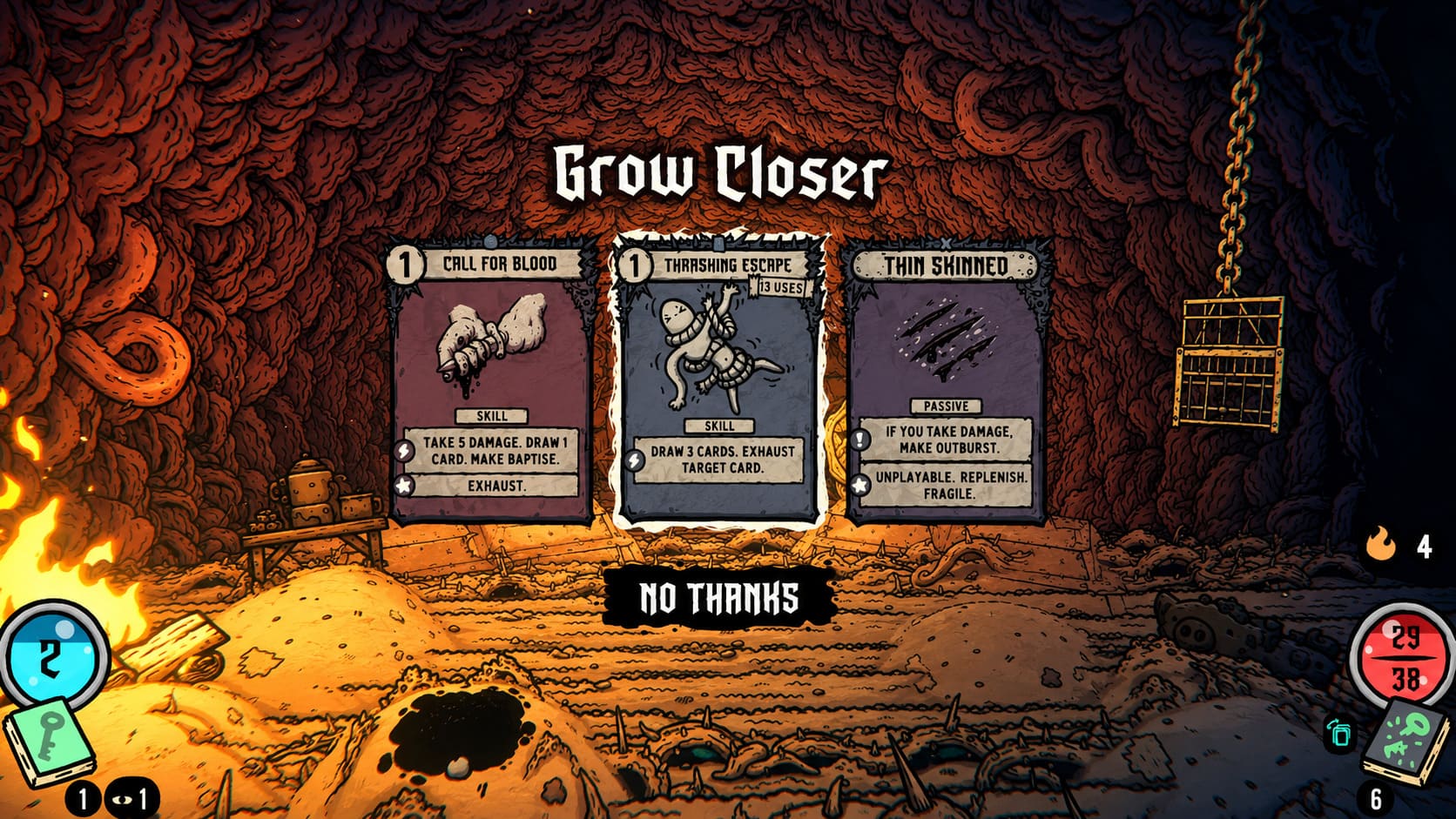
The card evolution system is one of the mechanics I think beginners should pay attention to immediately.
Certain cards can grow and mutate based on how you use them during a run.
That’s a very different approach from the traditional “visit merchant → pay currency → upgrade card” system.
If you find an evolutionary card early, don’t automatically ignore it because its current version looks mediocre.
A card such as Distant Shadow can become much more interesting when you fulfill its progression requirements.
The earlier you obtain an evolutionary card, the more opportunities you have to develop it.
My advice?
If you find one early and understand what it wants from you, build around it instead of waiting for a perfect card to appear later.
That’s where some of the most ridiculous runs can begin.
10. Don’t Ignore the Map When Planning Your Route
The tunnels aren’t just a backdrop.
The game’s hand-crafted environments are part of your strategy.
Using the Map proactively lets you think about where you’re heading and what kind of encounter might be waiting ahead.
This becomes particularly important when you’re approaching biome bosses.
If you know you’re moving toward a dangerous encounter, you have an opportunity to adjust your Combat Deck and resources beforehand rather than discovering your build is completely wrong when the boss fight starts.
The game reportedly features 26 handcrafted tunnels, leading toward distinct biome bosses, so learning to navigate efficiently is a big part of mastering the experience.
In other words, don’t just ask:
“Where can I go?”
Ask:
“Where should I go with the deck I currently have?”
That small change in thinking makes exploration much more strategic.
Is Shroom and Gloom Worth Buying? Price, Gameplay, and 2026 Review
My Biggest Beginner Tips After Understanding the Game
If I had to boil everything down into a short list, these are the lessons I’d keep in mind during the first few runs:
- Don’t waste Explore cards. They aren’t secondary to combat. They are half of your entire toolkit.
- Stop looking for traditional defense. The game wants you to be aggressive and convert enemies into healing and resources.
- Think about combos before damage numbers. A setup card can be more valuable than a stronger attack.
- Don’t panic when you lose health. Damage isn’t automatically a disaster if you have opportunities to recover.
- Experiment with cooking. The soup mechanics aren’t just a gimmick. They can become a serious part of your strategy.
- Invest in interesting cards early. Evolution-based cards become much more valuable when you give them time to develop.
- Use the Map before you’re lost. Planning ahead is much easier than trying to fix a bad route afterward.
Final Thoughts
What I like most about Shroom and Gloom is that it doesn’t feel like another roguelike deckbuilder simply wearing a different coat of paint.
The entire game is built around the idea that everything can become a card, and the developers actually seem committed to pushing that idea as far as possible.
Your combat deck matters.
Your exploration deck matters.
Your health matters.
The enemies matter.
Even a locked door can become a decision about whether you’re willing to spend health, use a Key, or take a different route.
That creates a surprisingly deep gameplay loop underneath the bizarre paper-craft visuals and fungal horror.
For beginners, the biggest challenge isn’t learning what every card does. It’s learning how the different systems interact.
Once you stop treating Shroom and Gloom like a traditional deckbuilder and start treating it as a constantly changing resource puzzle, the whole thing starts making much more sense.
And honestly, that’s when it gets fun.
So grab the shovel, keep some Rat Jerky handy, don’t be afraid of a little self-damage, and remember the golden rule of The Gloom:
If something is trying to eat you, figure out how to eat it first.