BeastLink SuperDestruction Guide: How the Kaiju Destruction Physics System Works
There’s a particular kind of moment that makes you stop playing a game and just stare at the screen.
You know the one. You’re in the middle of a firefight, some giant monster is charging down the street, and suddenly the building you were using for cover simply stops being a building. It cracks, buckles, collapses, and turns into a mountain of concrete between you and the enemy.
That is the idea behind BeastLink, and honestly, it’s the part of the game I find much more interesting than the usual “big monster fights big monster” pitch.
The game, developed and published by Grove Street Games, is built around a proprietary destruction technology called SuperDestruction. The concept sounds almost absurd on paper: a multiplayer battlefield where urban structures can be destroyed dynamically, with the resulting wreckage becoming part of the tactical environment.
As someone who has spent far too many hours playing shooters and destruction-heavy sandbox games, I’m immediately interested in that idea. We’ve had destructible environments before. We’ve had buildings come down spectacularly. But there’s a huge difference between blowing up a wall because the developers designed that exact interaction and being able to fundamentally change the shape of a battlefield because players decided to tear half of it apart.
That distinction could make BeastLink something special.
The Real Star of BeastLink Might Not Be the Kaiju
Let’s be honest: the Kaiju are obviously going to sell this game.
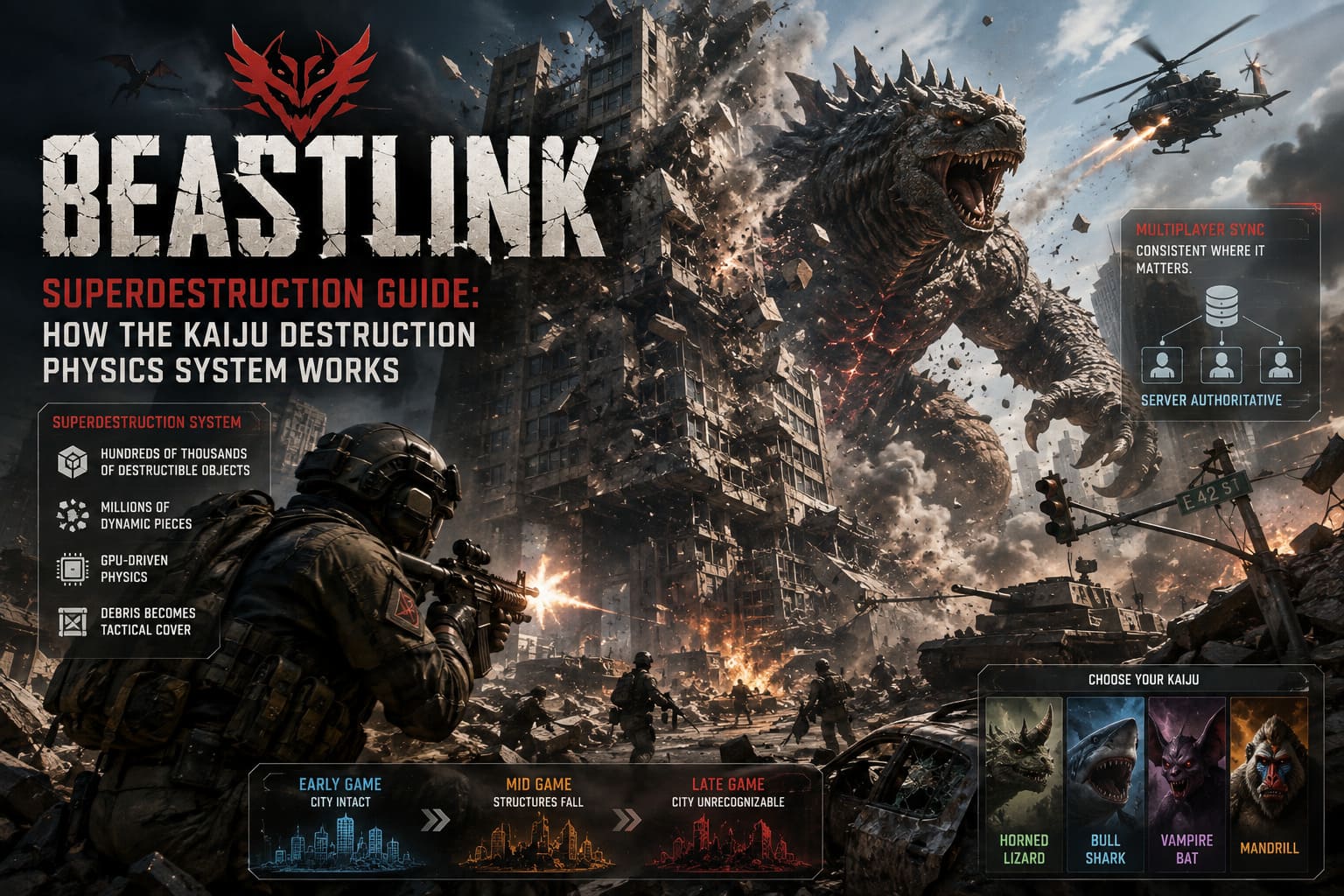
The pitch of switching between a human soldier and a gigantic monster is already enough to make people curious. One minute you’re running through a ruined city with a rifle, and the next you’re controlling something enormous enough to treat skyscrapers like cardboard.
But SuperDestruction is what could make that fantasy actually work as a game rather than just a flashy gimmick.
According to the technology description surrounding the game, urban maps are designed around an enormous number of destructible objects, potentially reaching hundreds of thousands of individual instances. Those objects can then break down into millions of smaller structural pieces.
That is a ridiculous amount of stuff to keep track of.
And this is where my skepticism kicks in.
I’ve played enough ambitious multiplayer games to know that “everything is destructible” is one of those promises that sounds amazing in a trailer and becomes much less impressive once you have 32 players, vehicles, explosions and multiple physics-heavy events happening simultaneously.
If BeastLink can actually deliver even a convincing version of this idea while keeping the battlefield readable and the performance stable, though, I think it could be genuinely impressive.
Why GPU-Driven Destruction Makes Sense
The basic philosophy behind SuperDestruction is easy enough to understand.
Traditional physics calculations can become extremely expensive when you’re asking a CPU to keep track of thousands upon thousands of moving objects. Now imagine adding collapsing buildings, vehicles, explosions, players and giant monsters into the same equation.
At some point, something has to give.
The solution described for BeastLink is to push a significant portion of the destruction workload toward GPU-based computation and custom compute shaders.
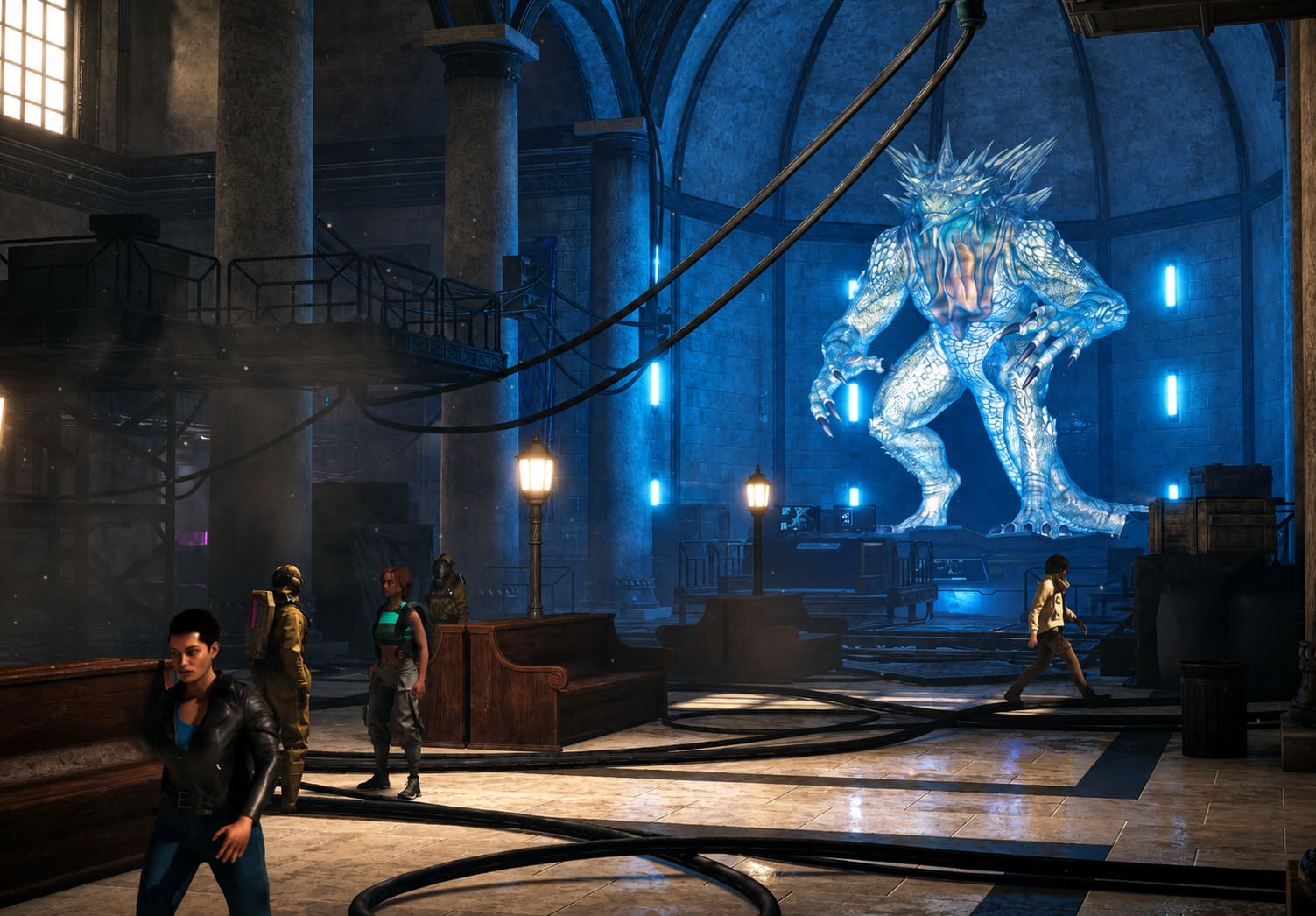
From a player’s perspective, the important thing isn’t really the technical terminology. What matters is what happens when you hit a building.
Instead of seeing a canned animation where a predetermined section of a wall disappears, the goal is for the structure to react to damage and produce a believable chain reaction.
A support section breaks.
The upper floors lose stability.
Concrete begins falling.
Dust fills the street.
The building’s debris becomes physical cover.
And suddenly the firefight has changed.
That last part is what matters most.
Destruction isn’t interesting just because it looks cool. It’s interesting when it changes what players can do.
Nanite Is Being Pushed Into Interesting Territory
Another piece of the puzzle is Unreal Engine 5’s Nanite technology.
Nanite has become one of the most recognizable features of UE5 because it allows developers to display extremely detailed geometry without relying on traditional rendering techniques for every individual polygon.
But dynamic destruction is a different beast.
Static geometry is easy compared with geometry that is constantly breaking apart, moving, colliding and disappearing.
The BeastLink approach reportedly involves extending the engine’s existing virtualized geometry workflow to deal with dynamic sub-instances and the enormous amount of debris produced during destruction.
If that works properly, this could be one of the coolest visual aspects of the game.
Imagine walking through a city after a Kaiju fight. Instead of simply seeing a prebuilt “destroyed city” texture, you’re looking at the actual consequences of what happened five minutes earlier.
A broken highway.
A collapsed apartment block.
Cars buried beneath concrete.
Open sightlines where a building used to stand.
That kind of environmental storytelling happens naturally, which is something I always appreciate in sandbox games.
The Multiplayer Problem Is the Big One
Here’s where I think BeastLink has its hardest technical challenge.
Making destruction look good on your own machine is one thing.
Making it look consistent for 32 players in the same multiplayer match is another problem entirely.
Imagine Player A shoots a building and watches it collapse toward the east. Player B, standing around the corner, sees the same building collapse toward the west.
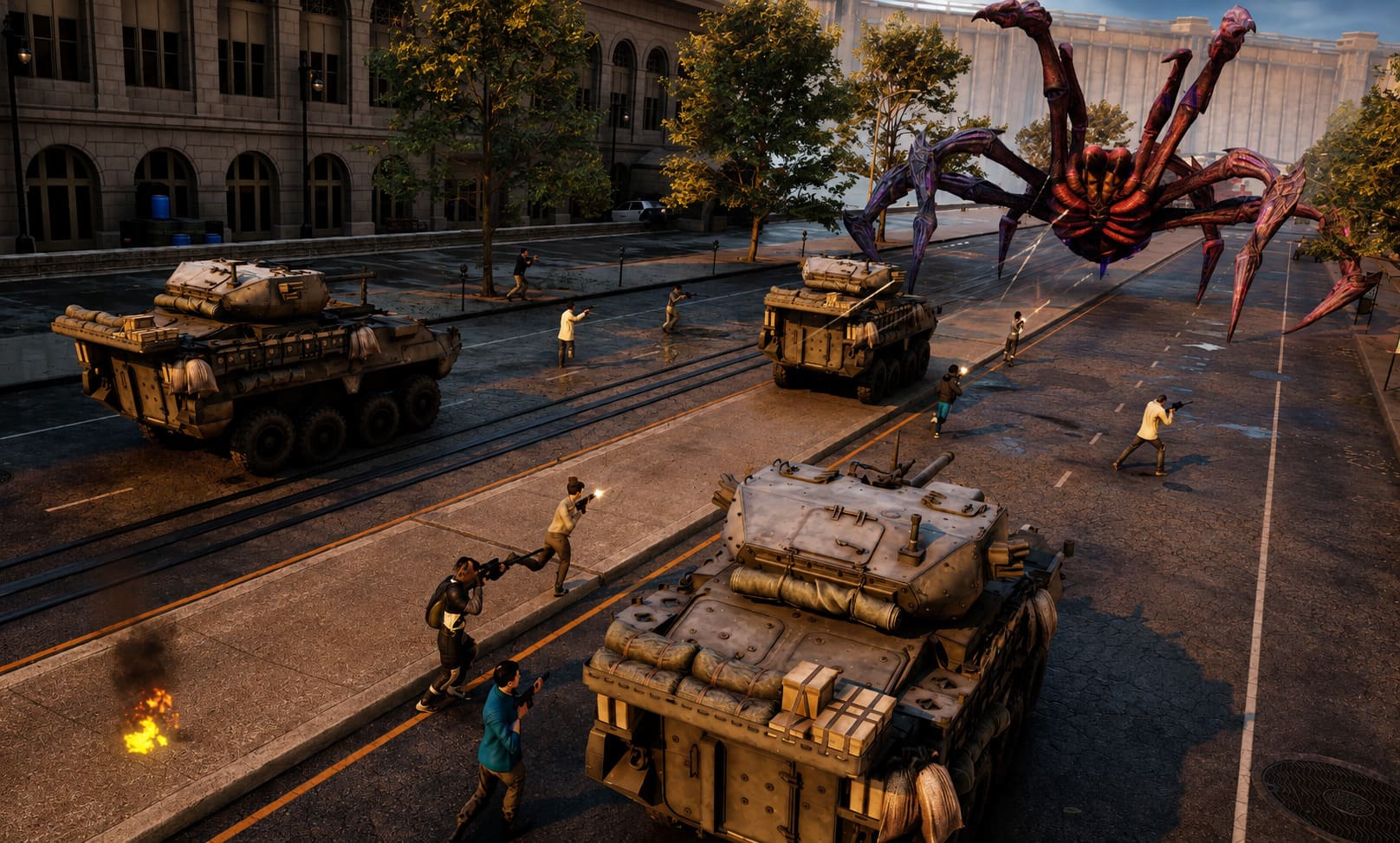
Suddenly the game has a serious problem.
The solution described for SuperDestruction relies on a server-authoritative approach. The server determines the important physical outcomes while individual clients don’t necessarily need to receive information about every tiny piece of debris.
And that is completely logical.
Nobody needs the server to tell your PC about every piece of broken glass flying through the air.
Instead, the important structural events need to remain consistent.
| Destruction Element | Multiplayer Importance | Likely Treatment |
|---|---|---|
| Major Building Sections | Very High | Server Synchronized |
| Falling Roofs | High | Server Synchronized |
| Large Concrete Pieces | High | Prioritized Physics |
| Broken Glass | Low | Local Simulation |
| Dust And Sparks | Low | Client-Side Effects |
| Tiny Debris | Low | Heuristic / Local Handling |
This is actually the part of the concept that interests me most from a gameplay perspective.
The destruction doesn’t necessarily have to be identical down to the last pebble. It has to be consistent where it matters.
That is the difference between visual chaos and competitive chaos.
The Human Side of the Game Could Be Surprisingly Fun
The Kaiju naturally get the spotlight, but I don’t think human players should be underestimated.
If you’re a soldier standing next to a 100-foot monster, your first instinct is probably going to be “run.”
Fair enough.
But if the environment is truly destructible, humans have something the monsters don’t always have: precision.
A squad could blast through a wall rather than use a main entrance. Players could destroy bridges, collapse structures, block roads and create defensive positions.
This turns the city into a giant tactical puzzle.
You aren’t just asking:
“Where is the enemy?”
You’re asking:
“What can I destroy to make the enemy’s next move worse?”
That is a much more interesting question.
Vehicles could also become part of this strategy. Tanks, helicopters and aircraft aren’t merely damage-dealing tools. In a highly destructible environment, heavy weapons can become tools for reshaping the battlefield.
A collapsing overpass could slow down a Kaiju.
A destroyed building could create a new firing position.
A crater could become temporary cover.
A blocked street could funnel a monster into an ambush.
That is the kind of emergent gameplay I want from a destruction sandbox.
Then You Become the Monster
And this is where the whole concept gets delightfully ridiculous.
After collecting enough serum and activating the BeastLink procedure, players can transition from human combat into Kaiju gameplay.
The early-access concept features four major creature archetypes: Horned Lizard, Bull Shark, Vampire Bat and Mandrill.
They aren’t simply different skins, either. Their descriptions suggest very different approaches to destroying the environment.
The Horned Lizard is the heavy bruiser. It sounds like the creature you choose when subtlety has officially left the building.
The Bull Shark is more specialized around coastal and aquatic environments.
The Vampire Bat brings vertical mobility and aerial attacks into the equation.
And the Mandrill appears to be the athletic option, with climbing abilities and an emphasis on throwing massive environmental objects.
Personally, the Mandrill is probably the one I’d want to try first.
There’s something inherently funny about turning a city bus into a projectile.
Destruction Could Create a Natural Match Progression
One of the smartest things about this concept is that the destruction itself can potentially create a match’s narrative.
At the beginning, the city is intact.
Humans have rooftops.
Helicopters have clear flight paths.
Vehicles can move quickly through streets.
Snipers can take advantage of tall buildings.
Then the monsters arrive.
And everything starts going wrong.
Early Game
The battlefield is relatively clean. Buildings provide verticality, streets are usable and human squads have plenty of defensive options.
Mid Game
Kaiju fights begin transforming the city. Major roads become blocked, structures collapse and traditional sniper positions disappear.
Late Game
The original city is almost unrecognizable.
And that’s where things get interesting.
The best hiding places may no longer be buildings. They could be craters, collapsed floors and enormous piles of rubble.
In other words, the destruction doesn’t just provide spectacle. It can naturally change the rules of the match as it progresses.
BeastLink Release Date, PS5 Launch Details, and PC System Requirements Revealed
But Here’s What I’m Worried About
As exciting as this sounds, I have one major concern: readability.
There is a point where realistic destruction stops helping gameplay.
If every building is constantly collapsing, every street is covered in debris and every Kaiju attack produces a giant cloud of dust, players could have difficulty understanding what’s actually happening.
Competitive multiplayer needs clarity.
You need to know where you are, where your enemies are, which surfaces are solid, which routes remain accessible and what objects can actually kill you.
The developers therefore have a difficult balancing act.
They need destruction to feel chaotic without making the game feel random.
They need the physics to look realistic without turning every encounter into a simulation of traffic accidents.
And, most importantly, they need the destruction to serve gameplay rather than become the gameplay.
If they manage that balance, SuperDestruction could be the game’s secret weapon.
My Take: This Is the Feature Worth Watching
I’m not going to pretend that BeastLink automatically becomes a masterpiece just because it has ambitious destruction physics.
We’ve all seen impressive technology demos.
Games are much harder.
A destruction system can be technically brilliant and still produce boring matches if the weapons, maps, progression and multiplayer design don’t support it.
But the underlying idea here absolutely has my attention.
The best destruction systems aren’t about watching buildings fall. They’re about giving players the ability to change the situation.
That’s why games with strong environmental interaction tend to create stories you remember.
You don’t remember “Match 14, Tuesday night.”
You remember the time your squad destroyed a bridge to stop an enemy advance.
You remember hiding beneath a collapsed building while a monster searched for you.
You remember a Kaiju ripping apart the structure you thought was safe.
You remember the moment when the familiar map suddenly became something completely different.
That’s the potential of BeastLink’s SuperDestruction system.
If Grove Street Games can turn its impressive technical ambitions into reliable, readable and genuinely useful gameplay, this could be one of the more interesting destruction sandboxes to watch.
And honestly, I hope it works.
Because after years of games giving us increasingly pretty explosions, I’d love to see one where the explosion actually changes the battlefield.
BeastLink has the ingredients for exactly that kind of game: human squads, giant monsters, vehicles, dynamic environments and a city that can theoretically be torn apart piece by piece.
The technology may be the headline, but the real test will happen when players get their hands on it and start finding ways to break the developers’ carefully designed battlefield.
That’s when SuperDestruction will either become a gimmick—or become the reason people keep coming back to BeastLink.