007 First Light PS5 Pro vs PS5 Comparison: Resolution, Quality Mode, and PSSR Upgrades Explained
There’s something strangely satisfying about watching a stealth mission fall apart in slow motion. One missed headshot, one guard spotting a body, and suddenly the entire mission turns into a cinematic disaster worthy of a Bond movie. That exact feeling is what makes 007 First Light so addictive — and also why the game’s performance matters so much.
IO Interactive clearly didn’t want to make “another action shooter.” Instead, they built a modern James Bond experience that mixes stealth, social infiltration, explosive action sequences, and dense sandbox environments in a way that honestly feels like a natural evolution of Hitman. The problem? This game absolutely punishes weaker hardware.
After spending time comparing the base PlayStation 5 version with the upgraded PS5 Pro release, one thing became painfully obvious: 007 First Light might be the strongest argument yet for Sony’s Pro console.
IO Interactive Pushed the Glacier Engine Harder Than Ever
You can immediately tell this isn’t just a lightly upgraded version of the old Hitman 3 engine. The lighting alone feels dramatically more advanced.
Entire casino interiors glow with layered reflections, dense jungles are filled with volumetric fog, and crowded city streets contain an absurd amount of dynamic lighting. According to technical discussions online, IO Interactive completely rebuilt parts of the Glacier engine with modern clustered lighting systems and upgraded rendering pipelines.
The result is stunning.
The downside? The game is incredibly demanding even before combat starts. Once explosions, smoke simulations, particle effects, and dozens of NPCs enter the scene, console hardware starts sweating.
And that’s where the split between the base PS5 and PS5 Pro becomes very noticeable.
Base PS5: Smooth Gameplay or Sharp Visuals — Pick One
The standard PlayStation 5 version gives players two graphical modes, and honestly, neither feels completely ideal.
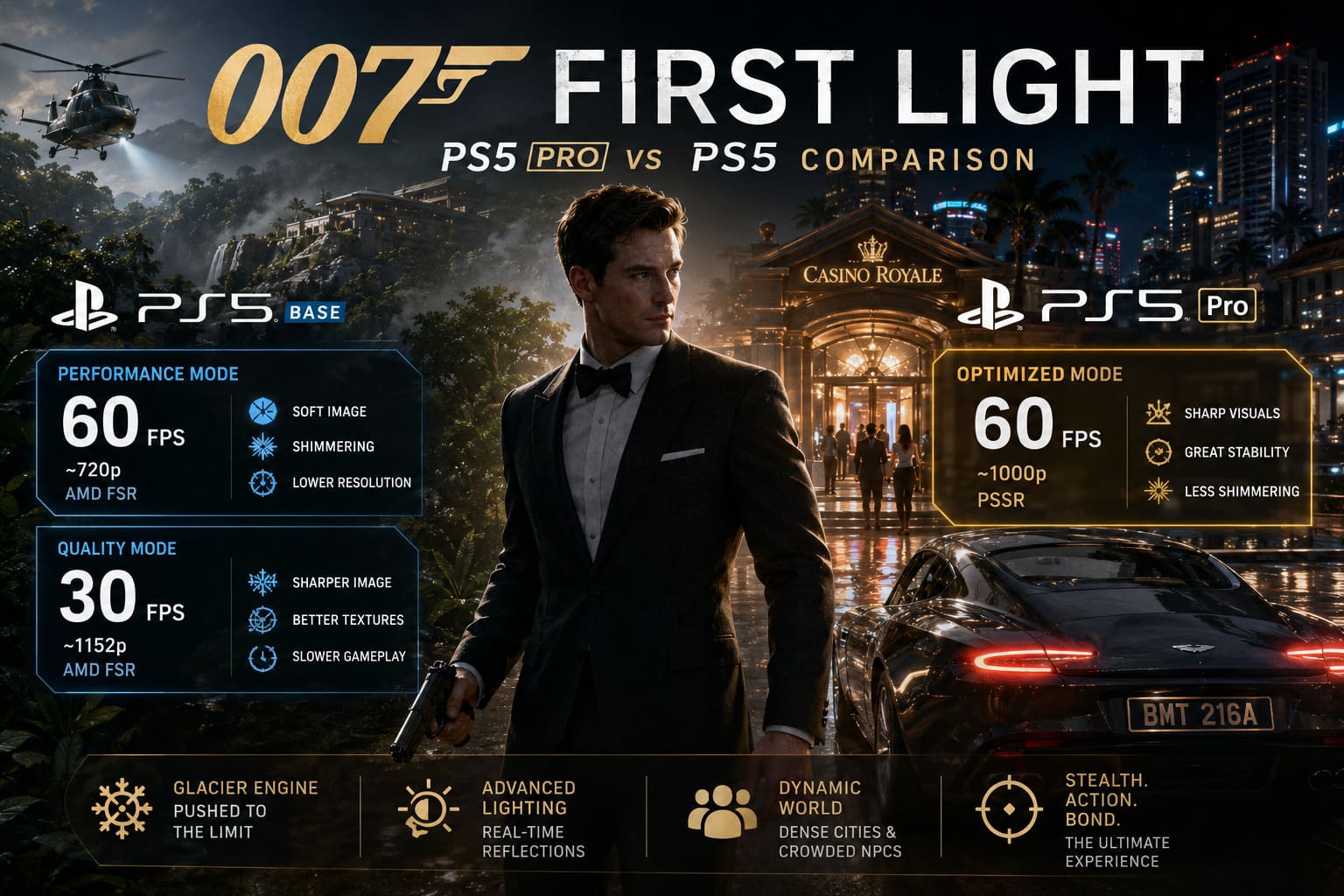
Performance Mode (60 FPS)
If you care about responsiveness, this is probably the mode you’ll end up using most of the time.
The good news:
- The game stays surprisingly stable at 60 FPS
- Gunplay feels responsive
- Stealth movement feels smoother
- Camera control during combat is far better
The bad news is impossible to ignore though.
Internally, the game appears to render at an extremely low resolution — hovering around 720p during heavier scenes before being reconstructed to 4K using AMD FSR technology.
On paper that may not sound catastrophic, but in motion it becomes obvious fast.
Problems I noticed in Performance Mode:
- Soft image quality
- Shimmering vegetation
- Pixel crawl during camera movement
- Fuzzy distant textures
- Occasional flickering on thin geometry
In darker levels the image can still look fantastic thanks to the game’s incredible lighting, but daylight environments expose the weaknesses immediately.
It’s one of those games where you constantly think:
“This feels amazing to play… but why does the image look so messy?”
Quality Mode (30 FPS)
Switching to Quality Mode immediately improves image clarity.
Textures appear cleaner, shadows become more stable, and distant scenery finally stops looking noisy. Character models especially benefit from the jump in internal resolution.
Bond himself looks significantly sharper:
- Hair detail improves
- Facial textures look cleaner
- Suit materials finally show proper fabric detail
- Lighting becomes more cinematic
The issue is simple: 30 FPS hurts this game more than expected.
Because 007 First Light mixes stealth with fast melee combat and reactive shooting, dropping from 60 FPS to 30 FPS changes the entire feel of movement. Aiming becomes less fluid, camera panning feels heavier, and action scenes lose some intensity.
Visually, Quality Mode absolutely looks better.
Gameplay-wise though? I kept returning to Performance Mode despite its blurry presentation.
PS5 Pro Changes Everything
This is where things get interesting.
The PS5 Pro version of 007 First Light honestly feels like the version IO Interactive originally wanted everyone to play.
Instead of forcing players to choose between image quality and frame rate, the Pro version delivers both simultaneously.
And after seeing them side-by-side, the difference is much larger than I expected.
Why the PS5 Pro Version Looks So Much Better
The biggest improvement comes from Sony’s PSSR (PlayStation Spectral Super Resolution) technology.
Unlike the softer FSR reconstruction on the base PS5, the Pro version produces:
- Cleaner edges
- Sharper textures
- Better motion stability
- Reduced shimmering
- Less visual noise during movement
The game reportedly renders internally around 1000p on PS5 Pro, but the reconstructed final image looks dramatically cleaner than the base console.
What surprised me most was temporal stability.
Even during fast camera movement:
- Jungle foliage remains detailed
- Thin objects stop flickering
- Distant geometry holds together
- Motion clarity improves massively
This is especially noticeable in large outdoor missions where the base PS5 struggles hardest.
The Real Difference Isn’t Resolution — It’s Stability
A lot of players focus purely on numbers:
- 720p
- 1000p
- 1152p
- 4K output
But honestly, the real difference here is image consistency.
The PS5 Pro version simply looks calmer.
There’s far less shimmering, fewer reconstruction artifacts, and significantly less breakup in detailed scenes. It finally feels like you’re seeing the artwork properly instead of watching an upscaler fight for survival every frame.
And importantly: It keeps all of this while running at 60 FPS.
That combination completely changes the experience.
Technical Comparison Table
| Mode | Target FPS | Internal Resolution | Upscaling Tech | Visual Quality |
|---|---|---|---|---|
| Base PS5 Performance | 60 FPS | ~720p | AMD FSR | Soft image, visible shimmering |
| Base PS5 Quality | 30 FPS | ~1152p | AMD FSR | Sharper image, slower gameplay feel |
| PS5 Pro Optimized Mode | 60 FPS | ~1000p | Sony PSSR | Sharp visuals with excellent stability |
Community Reactions Have Been Surprisingly Consistent
Looking through Reddit threads, YouTube performance breakdowns, and gaming forums, the overall opinion seems surprisingly unified.
Most players agree on three things:
- 007 First Light is one of the best Bond games in years
- The base PS5 version feels technically compromised
- The PS5 Pro version is genuinely impressive
A lot of players compared the experience to the jump between early cross-gen titles and fully optimized current-gen games.
The core gameplay itself is excellent:
- Creative stealth routes
- Strong pacing
- Gorgeous environments
- Memorable action sequences
- Surprisingly cinematic storytelling
But visually, the base console sometimes struggles to present that ambition cleanly.
How to Fix 007 First Light Black Screen on Launch and Startup Crashes on Steam
So Which Version Should You Play?

If you only own a standard PS5, I’d still recommend Performance Mode overall.
Yes, the image softness can occasionally become distracting, especially on large 4K televisions, but the smoother gameplay matters more in a game built around fast reactions and fluid movement.
I’d also strongly suggest disabling:
- Film grain
- Motion blur
- Excessive sharpening
Those settings help clean up the image slightly.
However, if you own a PS5 Pro, the decision is effortless.
The Pro version delivers the experience this game deserves:
- Sharp image quality
- Stable 60 FPS
- Better reconstruction
- Cleaner motion clarity
- Significantly improved presentation overall
It’s one of the clearest examples yet of how AI-assisted upscaling and stronger hardware can completely transform a modern AAA game.
007 First Light Safe Codes: How to Open All Locked Safes and Doors (Full Location Guide)
Final Thoughts
What impressed me most about 007 First Light isn’t just the visuals — it’s the ambition.
IO Interactive clearly wanted to build a Bond game that feels modern, cinematic, and mechanically deep instead of relying purely on nostalgia. In many ways, they succeeded. The missions are smartly designed, the stealth systems are addictive, and the action sequences genuinely feel like playable spy movie set pieces.
But this ambition comes at a heavy technical cost.
On base PS5, the game often feels like hardware and software fighting each other. On PS5 Pro, that struggle finally disappears.
And honestly? After seeing both versions in action, this may be the first console game where the PS5 Pro upgrade genuinely feels transformative rather than optional.