No Man’s Sky Cosmos Update 7.0: Xbox Series X Performance Breakdown & Full Patch Analysis
No Man’s Sky has always been a strange game to review because the version you played six months ago can feel completely different from the one you are playing today. Ten years after its original release, that statement has become almost ridiculous.
With Update 7.0, also known as Cosmos, Hello Games is pushing No Man’s Sky into another phase of its life. This isn’t simply another collection of missions, cosmetic rewards, and a few new things to scan. Cosmos puts much more emphasis on space itself, while also making some important changes to how the game handles rendering, streaming, and large-scale environments on Xbox Series X.
And honestly, that is the part that interests me most.
New gameplay systems are always welcome, but No Man’s Sky has reached the point where technical improvements can have just as much impact as new content. When you’re flying from a planet into orbit, approaching a crowded station, loading a huge player base, or jumping between star systems, the engine has a lot of work to do. Cosmos attempts to make that entire process feel less fragile.
The result is one of the most interesting updates No Man’s Sky has received in years.
What Is No Man’s Sky Cosmos 7.0?
Cosmos is the major 10th-anniversary update for No Man’s Sky, expanding the game’s focus beyond traditional planetary exploration.
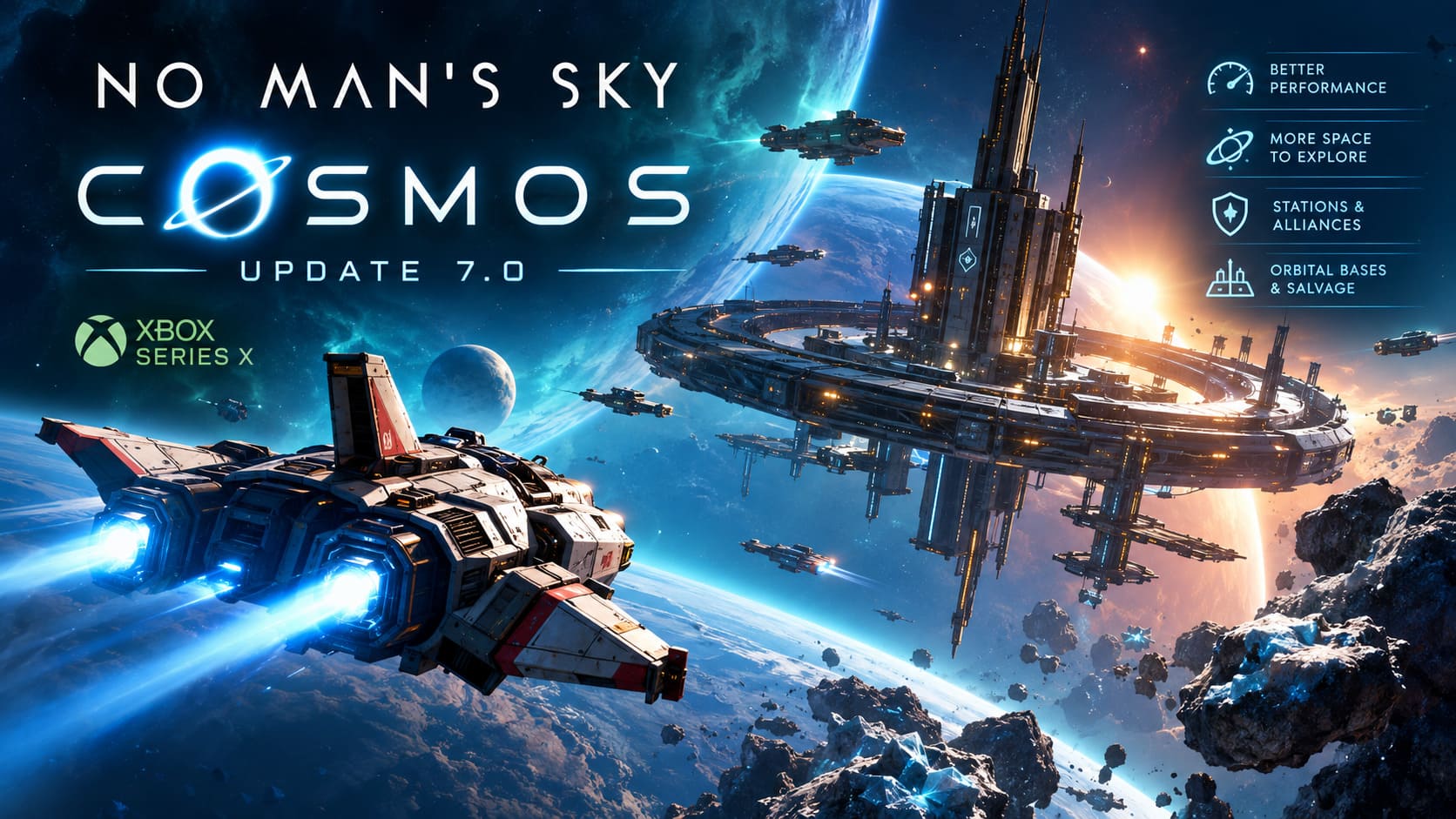
The headline additions include:
- Space station ownership and management
- Galactic alliances and territorial systems
- Deep-space outposts
- Orbital base construction
- Expanded salvage mechanics
- Spacewalking
- More detailed asteroid and ice environments
- Major Xbox Series X rendering and streaming optimizations
The important distinction is that Cosmos doesn’t simply make the galaxy bigger. It tries to make the space between existing destinations more meaningful.
For years, No Man’s Sky has had a strange relationship with space. It looks enormous, but much of your time is spent using it as a corridor between planets, stations, missions, and other destinations.
Cosmos finally starts treating that space as somewhere you can actually live, work, build, trade, and explore.
Xbox Series X Performance: The Technical Changes Matter
If you’re playing No Man’s Sky on Xbox Series X, Update 7.0 is arguably more interesting from a technical perspective than it initially appears.
Hello Games has introduced improvements to the way the engine handles graphics resources, file streaming, and procedural content. The biggest change is support for bindless textures, samplers, and buffers.
That sounds like developer jargon, but the practical idea is fairly simple.
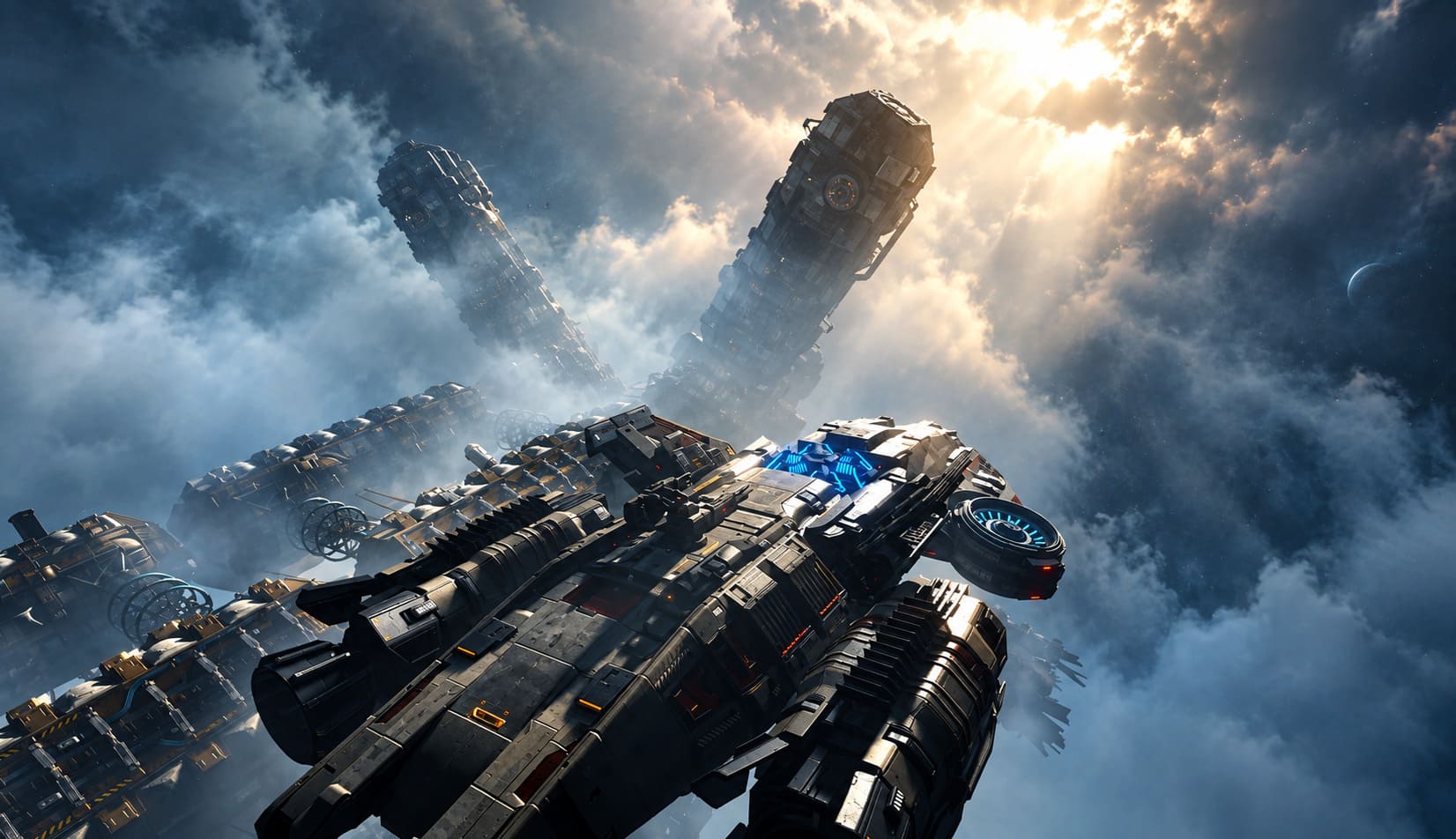
Instead of constantly asking the CPU to manage individual graphics resources before rendering them, the engine can give the GPU much more direct access to those resources. For a game like No Man’s Sky, which is constantly loading and unloading procedural assets, that can make a noticeable difference.
And this is exactly the kind of optimization I like seeing in long-running games.
A prettier texture is nice. A new spaceship is nice. But reducing the little performance hiccups that have followed a game for years is much more valuable in the long run.
Cosmos 7.0 Xbox Series X Technical Improvements
| Area | Cosmos 7.0 Improvement | Expected Benefit |
|---|---|---|
| Graphics Resources | Bindless textures, samplers and buffers | Lower CPU rendering overhead |
| File Handling | Improved console asset processing | Faster loading |
| Terrain Streaming | Optimized procedural generation | Less pop-in |
| Texture Loading | More efficient multithreading | Smoother traversal |
| Multiplayer | Improved synchronization | Reduced rubber-banding |
| Space Rendering | Better resource management | More stable large-scale scenes |
The Xbox Series X has plenty of raw hardware power. The bigger question has always been how efficiently No Man’s Sky can use it while simultaneously managing procedural terrain, physics, AI, multiplayer activity, and thousands of assets.
Cosmos attacks that problem at the engine level.
Does Cosmos Actually Make No Man’s Sky Run Better?
Based on the performance targets outlined for the update, Xbox Series X players get two distinct visual profiles, with both benefiting from the underlying optimizations.
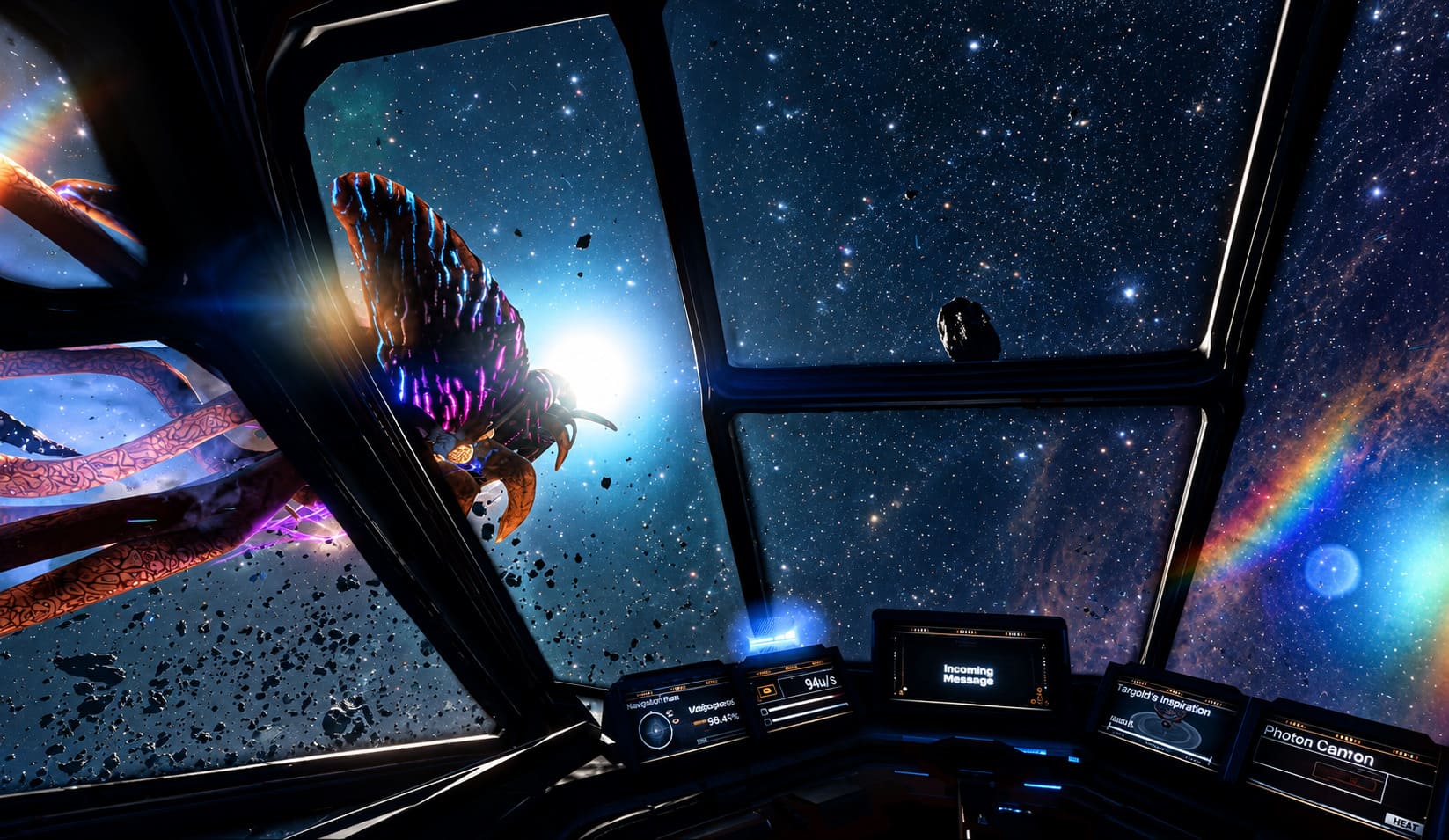
Quality Mode
Quality Mode targets native 4K at 60 FPS.
The major advantage here isn’t necessarily that No Man’s Sky suddenly becomes a completely different-looking game. It’s consistency.
Dense stations, busy fleet environments, complicated bases, and other CPU-heavy situations have traditionally been the places where performance can become unstable. Cosmos is designed to reduce those spikes and maintain more consistent frame pacing.
The target is around 60 FPS, with demanding situations potentially producing smaller drops.
For a game based around exploration, this matters more than people sometimes realize. Smooth frame pacing makes flying close to a planet, landing at a station, or navigating an asteroid field feel substantially better.
Performance Mode
Performance Mode is aimed at players with 120Hz displays and HDMI 2.1 hardware.
The resolution dynamically moves between roughly 1440p and 4K, depending on how demanding the scene is, while the frame-rate target reaches 120 FPS.
That is obviously the more interesting option for players who care about responsiveness rather than maximum image quality.
A 120 FPS No Man’s Sky might sound excessive at first. I actually think it makes a lot of sense.
Flying through space is one of the few activities in the game where higher frame rates can noticeably change the feel of movement. When you’re weaving between asteroids, approaching a massive station, or quickly descending toward a planetary surface, smoother motion makes the controls feel considerably more immediate.
Cosmos Makes Space More Than a Loading Corridor
For me, this is where Update 7.0 gets genuinely exciting.
No Man’s Sky has always sold the fantasy of being a space explorer. But after hundreds of hours, you eventually realize that many systems are built around a fairly predictable loop:
Planet → ship → station → planet → warp → repeat.
Cosmos starts breaking that routine.
Space Station Ownership
The biggest new gameplay system is arguably space station ownership.
Instead of simply visiting stations controlled by the game’s factions, players can eventually become station directors themselves.
This gives stations a much stronger role in the overall progression system.
Once you have control, you can customize parts of the station and manage its infrastructure. The station effectively becomes a permanent headquarters rather than another anonymous location on the map.
The economic side is particularly interesting.
You can focus on:
- Trading and commodity management
- Attracting alien merchants
- Expanding station facilities
- Customizing station interiors
- Developing your own economic hub
This is the kind of progression system that could keep veteran players busy long after they have collected most of the game’s traditional rewards.
And frankly, No Man’s Sky desperately benefits from systems like this.
Once you’ve accumulated a ridiculous fleet and upgraded your favorite multitool, you need something new to work toward. Owning and developing a station gives that progression a physical location.
Galactic Alliances Give the Endgame More Direction
Station ownership becomes even more interesting when combined with Galactic Alliances.
Players can work together to establish territories, coordinate exploration, and build defensive infrastructure.
I wouldn’t expect this to suddenly turn No Man’s Sky into a full-scale MMO strategy game, but the idea is promising.
The galaxy has always been huge. The problem was that its size didn’t always translate into meaningful player-controlled territory.
Alliances could change that by giving groups of players something to actually build and protect.
The biggest question is how deep this system becomes over time. If Hello Games continues expanding it, we could eventually see much more interesting player-driven economies and territorial competition.
That would be a natural next step for a game that has spent ten years gradually moving toward a shared-universe experience.
Deep-Space Outposts and Salvage Exploration
Another welcome addition is the expanded Star System Map, which can reveal points of interest outside the usual planetary destinations.
This includes Deep Space Outposts, where players can find new merchants, missions, and specialized services.
Then there are the drifting space hulks.
These abandoned structures turn salvage into something more physical. Instead of simply scanning a wreck and receiving a reward, players can dismantle damaged structures, recover components, and transport valuable materials back to civilization.
That change sounds small, but it fits No Man’s Sky extremely well.
The best moments in the game have always been those where you stumble across something that wasn’t part of your original plan. Deep-space salvage gives players another reason to wander away from the obvious destinations.
And that’s exactly what exploration games need.
Orbital Bases Could Change How Players Build
Cosmos also removes one of the old boundaries of construction by allowing free-floating orbital bases.
This is probably the feature builders are going to abuse in the best possible way.
You can create things such as:
- Deep-space research stations
- Orbital trading posts
- Player-operated restaurants
- Industrial platforms
- Remote hideouts
- Large-scale multiplayer bases
Some giant asteroids can also become construction locations, opening the door to some wonderfully ridiculous creations.
Personally, the asteroid bases are one of my favorite ideas from Cosmos.
There’s something much more satisfying about hiding a base inside a massive rock floating through space than building another attractive house on a planet.
It feels appropriately excessive for No Man’s Sky.
Spacewalking Finally Makes the Galaxy Feel Physical
Another major addition is spacewalking.
Players can leave their ships while near suitable space structures and move through zero gravity manually.
This is one of those features that probably looks like a gimmick on paper but could become surprisingly useful.
Being able to physically move around an orbital base or outpost makes those locations feel less like menus with 3D graphics attached.
The same philosophy applies to the ability to fly much closer to the central star of a system.
No Man’s Sky has always created the illusion of enormous interconnected star systems. Cosmos pushes that illusion further by allowing players to interact with more of that space directly.
Visual Improvements: Better Materials and More Interesting Asteroids
Cosmos isn’t just about systems and performance.
The rendering upgrades also target the game’s visual presentation.
One notable addition is improved support for anisotropic materials, which helps metallic surfaces react more naturally to directional lighting.
This is particularly noticeable on starships with exposed metal surfaces.
Instead of having every surface behave like a generic shiny material, metallic panels can produce more convincing highlights depending on the surrounding light.
The asteroid fields have also received significant attention.
The new environments are denser and more varied, with larger rock structures and ice formations creating more visually interesting areas to navigate.
This is important because asteroid fields are exactly the kind of location where increased visual density can easily become a performance problem.
If Cosmos can make these environments look substantially better without turning them into frame-rate disasters, that’s a worthwhile upgrade.
My Take on No Man’s Sky Cosmos 7.0
After ten years, I think No Man’s Sky has reached an unusual point in its life.
It no longer needs to prove that it can add more planets, creatures, ships, or procedural content.
We’ve seen that already.
What the game needs now is depth.
Cosmos appears to understand that.
Station ownership gives players a reason to establish themselves. Galactic Alliances create a reason to cooperate. Orbital bases give builders a new playground. Deep-space salvage makes the empty space between planets more useful. And the Xbox Series X optimizations address some of the less glamorous problems that become increasingly important as the game gets more complicated.
That combination is far more interesting to me than another isolated content drop.
What I Like Most
The station ownership system is probably the biggest win. It gives veteran players something substantial to build toward.
The Xbox Series X optimization is another major positive. Technical improvements aren’t as flashy as new content, but they affect every minute you spend playing.
Orbital construction could become a community obsession if the building tools are flexible enough.
Deep-space exploration also feels like the right direction for No Man’s Sky. The galaxy should encourage players to look beyond the obvious destinations.
There are still some questions, though.
The complexity of station management could become tedious if the economic systems turn into another collection of repetitive menus. Likewise, territorial systems need meaningful consequences if Galactic Alliances are going to remain interesting beyond the first few weeks.
And, as always with No Man’s Sky, the long-term value of Cosmos will depend heavily on what Hello Games does next.
No Man’s Sky Alliance Territory Conquest Guide: Dominate the Cosmos in 2026
Final Verdict
No Man’s Sky Cosmos 7.0 feels less like another expansion and more like the next chapter of the game’s evolution.
That’s why I’m more interested in this update than I expected to be.
The 10th anniversary gives Hello Games a perfect excuse to celebrate the game’s history, but Cosmos doesn’t spend all its time looking backward. Instead, it pushes toward a version of No Man’s Sky where space itself becomes the main playground.
For Xbox Series X players, the technical improvements are just as important as the new features. Better resource management, improved streaming, faster file handling, and more consistent performance should make the enormous procedural universe feel considerably more stable.
But the real achievement is the change in philosophy.
You’re no longer simply visiting the galaxy.
You’re starting to own a piece of it.
And after ten years, that is probably exactly what No Man’s Sky needed.