Blackwood 2026 Game: How AttritoM7’s Action Thriller Captures the Magic of Max Payne
There are certain types of games that seem to have disappeared from the industry. I’m talking about those grim, stylish third-person action games where the hero is usually exhausted, angry, slightly broken, and somehow still capable of walking into a room full of armed criminals and making an absolute mess of everyone inside. BLACKWOOD, the upcoming action thriller from Bangladesh-based developer AttritoM7 Productions, immediately gave me that feeling. The more I see of it, the more it looks like the kind of game made for players who still remember why the original Max Payne felt so special.
AttritoM7 is taking a surprisingly big step away from its previous work. The studio is best known for Zero Hour, a slow and tactical first-person shooter that puts considerably more emphasis on careful movement and realistic gunplay. BLACKWOOD goes in almost the opposite direction. It is faster, more cinematic, more aggressive, and much more interested in turning every firefight into a violent action sequence. Act 1 is scheduled to launch on September 16, 2026, with the game being published by IZilla Games.
What makes BLACKWOOD particularly interesting to me isn’t simply the obvious Max Payne comparison. Plenty of games have tried to recreate that atmosphere, and most of them only manage to copy one or two ingredients. BLACKWOOD appears to be chasing the entire experience: the bleak city, the damaged protagonist, stylish gunplay, psychological storytelling, and that wonderful feeling of being completely outnumbered but somehow still dangerous.
Fix BLACKWOOD Save File Corruption Glitch: AttritoM7 Data Recovery Guide
BLACKWOOD Has a Very Different Kind of Protagonist
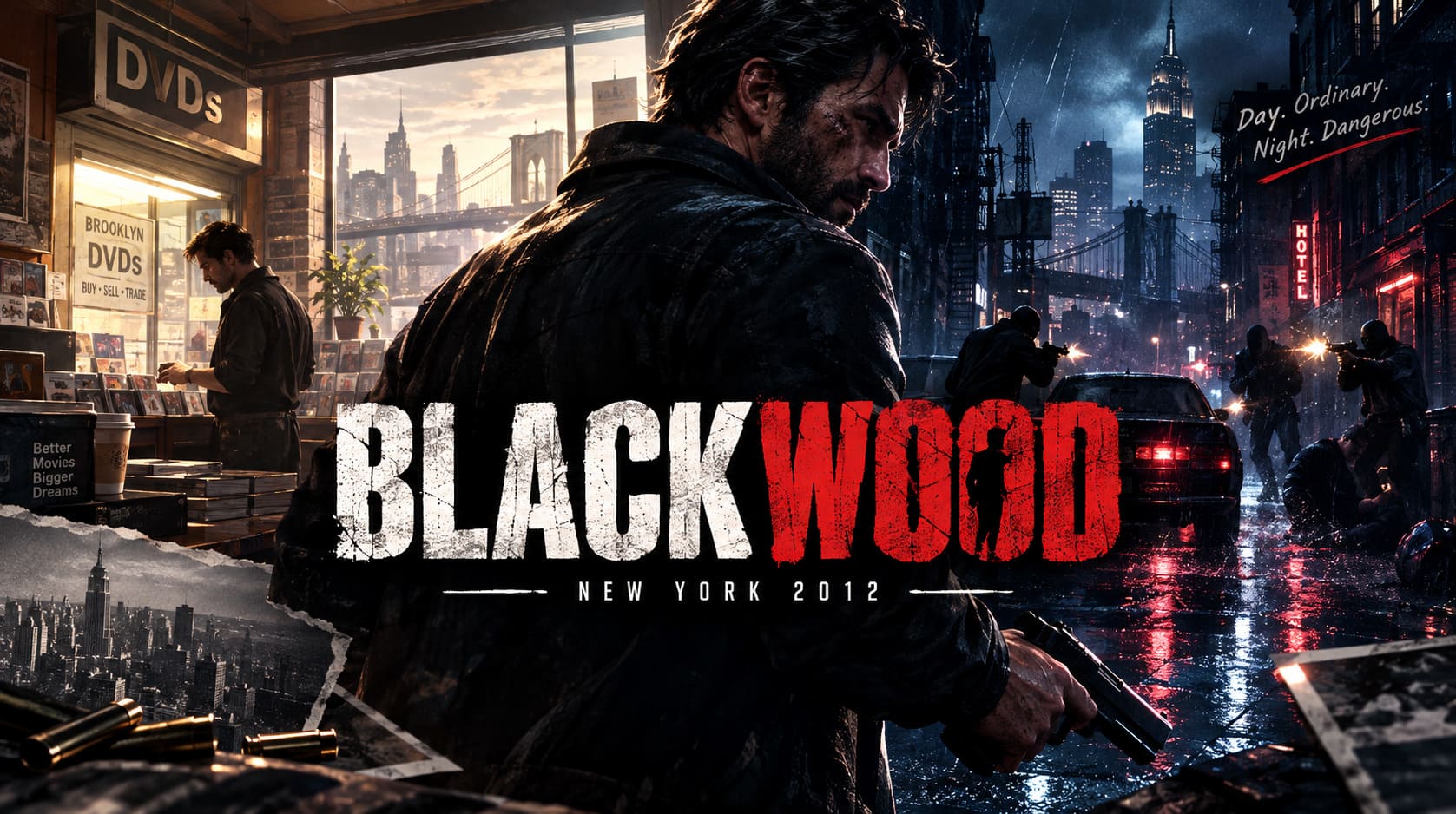
The story follows Anton Blackwood, a man living a strange double life in New York City in 2012. During the day, Anton runs a small DVD store in Brooklyn. It sounds almost deliberately boring, and that’s exactly why I like the idea.
Instead of beginning every mission with Anton already holding a loaded weapon, BLACKWOOD gives players a quieter side of his existence. You can interact with people around the neighborhood, operate the store, make money, and maintain the appearance of an ordinary life. On the surface, Anton is simply another guy trying to get through the day.
Then the sun goes down.
At night, Anton becomes a contract killer operating inside New York’s criminal underworld. That contrast is probably one of the game’s smartest ideas because it gives the violence more context. The player isn’t simply shooting enemies because the next level requires it. Anton is deliberately maintaining a normal life while simultaneously being pulled deeper into something much darker.
I’ve played plenty of games where the protagonist is described as having a “double life,” only for that idea to have almost no effect on gameplay. BLACKWOOD appears to actually build its structure around the concept. The daytime and nighttime portions aren’t just different environments; they represent two completely different versions of Anton.
A Modern Take on Max Payne-Style Gunplay
Let’s address the comparison everyone keeps making.
Yes, BLACKWOOD looks heavily inspired by Max Payne. Personally, I don’t think that’s a bad thing at all. After years of open-world games and cover shooters, I’ve been missing the pure satisfaction of a well-designed third-person action game that simply wants you to move fast, shoot accurately, and look cool doing it.
The gunplay seems built around momentum and aggressive positioning rather than sitting behind cover for half the encounter. Anton can move between weapons fluidly, sprint through spaces, transition from a shotgun to a pistol, and continue attacking without constantly interrupting the action.
That philosophy is important because cinematic gunplay only works when the controls feel responsive. You can have the best animations in the world, but if the character feels like he’s dragging a refrigerator behind him, the illusion falls apart.
From what has been shown so far, BLACKWOOD seems to understand that.
BLACKWOOD Combat and Gameplay Overview
| Feature | BLACKWOOD Approach |
|---|---|
| Gunplay | Fast, aggressive and cinematic |
| Movement | Momentum-focused third-person action |
| Weapon Switching | Designed for seamless transitions |
| Combat Style | Gunplay mixed with melee and environmental attacks |
| Atmosphere | Neo-noir, urban and psychologically dark |
| Progression | Weapon customization and tactical preparation |
The game also seems to modernize the classic bullet-time concept rather than simply copying it. Instead of making slow motion the entire identity of combat, BLACKWOOD appears to focus more heavily on positioning, timing, aggression, and controlling the battlefield.
That could make a huge difference. The best action games don’t make you feel powerful because enemies are stupid; they make you feel powerful because the mechanics let you outplay them.
The Melee Combat Could Be One of Its Biggest Strengths
Shooting is obviously the star attraction, but the close-quarters combat is actually what has me most curious.
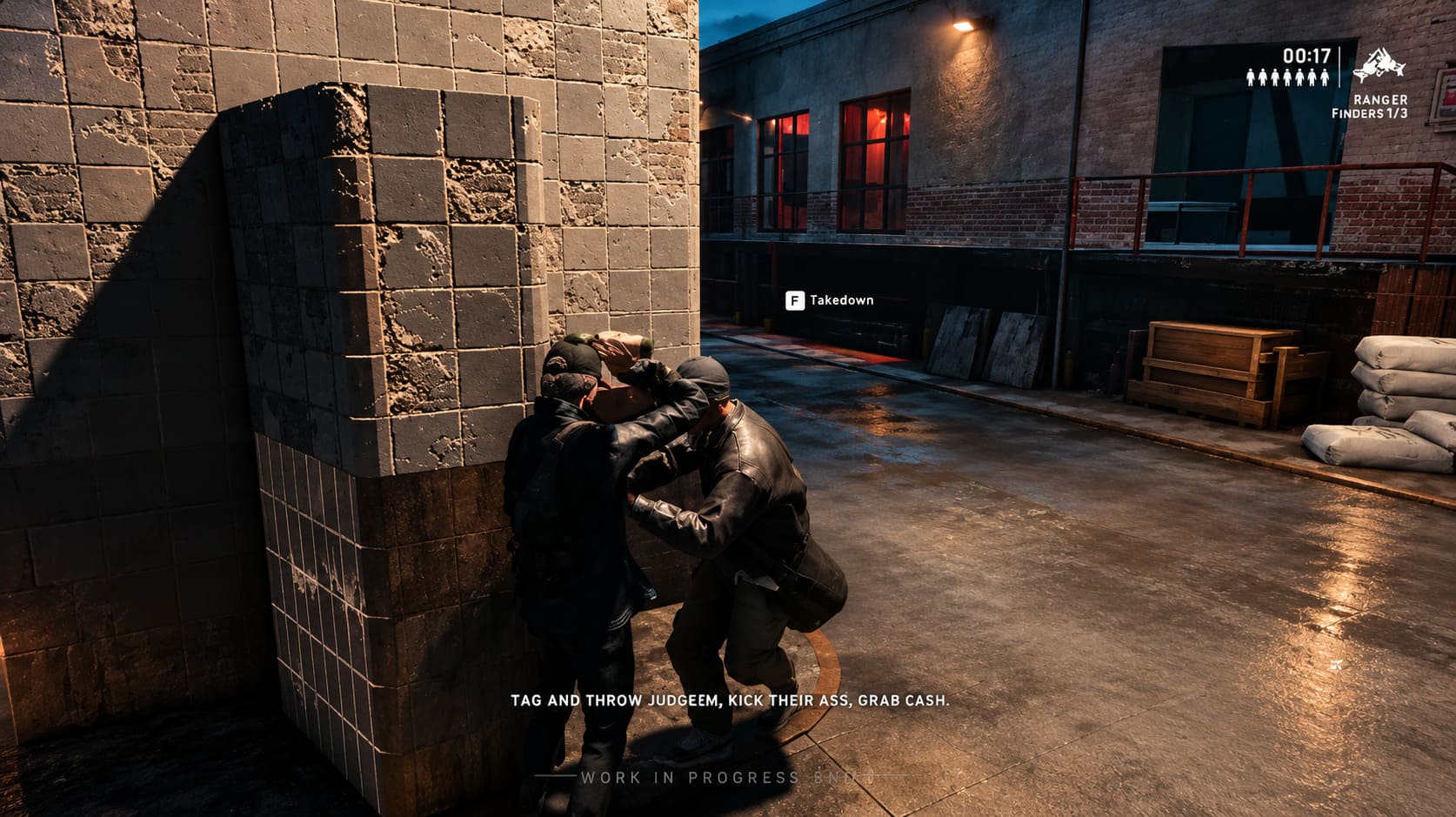
BLACKWOOD features environmental takedowns that allow Anton to use his surroundings during fights. Walls, doors, railings, floors, and other objects can become part of an encounter. Instead of simply triggering a generic melee animation every time you get close to an enemy, the game tries to make the environment part of the choreography.
That is exactly the sort of feature that can make repeated encounters feel different.
Imagine entering a small apartment, immediately running out of ammunition, and having to fight your way through the remaining enemies using whatever is around you. One enemy gets thrown into a wall, another is taken down near a staircase, and another gets disarmed before Anton finishes the fight at close range.
It gives combat a physical quality that reminds me more of modern action cinema than traditional shooters.
The influence of John Wick-style gun-fu is also obvious. But again, I think BLACKWOOD has the opportunity to do something more interesting than simply recreating movie choreography. If the developers manage to connect shooting, movement, melee, and environmental interactions naturally, combat could become the real reason people stick with the game.
2012 New York Looks Like the Perfect Setting
The decision to set BLACKWOOD in New York in 2012 is another detail that I find surprisingly appealing.
The city isn’t presented as some glossy futuristic metropolis. Instead, the developers are going for a darker, more grounded version of New York, filled with rain, dirty streets, cramped interiors, alleyways, apartments, stores, and criminal hideouts.
That setting fits the story perfectly.
There is something about a rainy New York night that automatically makes a crime thriller feel better. Add a morally questionable protagonist, neon reflections on wet pavement, cigarette smoke, old buildings, and a soundtrack full of melancholy, and you’ve already got half of the atmosphere.
The challenge, of course, will be making the city feel like more than a collection of levels. If BLACKWOOD can make its version of New York feel lived-in and reactive, the setting could become one of its strongest characters.
A Story About Morality, Manipulation and Survival
BLACKWOOD isn’t trying to make Anton into an unstoppable superhero.
The character is portrayed as flawed and psychologically complicated, with his decisions gradually pulling him deeper into a dangerous world. There is also a mysterious presence operating behind the scenes, suggesting that Anton may not have as much control over his life as he believes.
That opens the door for a more psychological story than the basic “hitman kills criminals” setup might initially suggest.
I’m especially interested in how the game handles Anton’s daytime identity. The DVD store isn’t just an unusual gameplay gimmick. It could become the part of the story that makes the nighttime violence actually matter.
When you spend time talking to ordinary people during the day and then go out at night to kill someone, the contrast becomes uncomfortable in a good way. It creates a question that many action games don’t bother asking: how long can someone pretend to be normal when their entire existence is built around violence?
Weapon Customization Gives BLACKWOOD a Tactical Edge
This is where AttritoM7’s experience with Zero Hour could become extremely valuable.
BLACKWOOD includes a substantial weapon customization system that lets players modify their firearms according to their preferred approach. Players can build quieter weapons for stealth-oriented encounters or configure more aggressive assault rifles for direct combat.
The customization takes place through Anton’s apartment, giving the player a dedicated space to prepare before heading back into the city.
I like this approach because it adds a little bit of planning to what could otherwise become a straightforward action game. You aren’t just collecting weapons; you’re preparing a personal arsenal.
It also means different players can potentially approach missions differently. One player might prefer stealth and precision, while another might decide that subtlety is overrated and simply kick the door down.
Honestly, I’m probably closer to the second player.
The Day-and-Night Structure Could Make the Game Special
For me, the most interesting feature of BLACKWOOD isn’t the gunplay itself. It’s the contrast between its two worlds.
During the day, the game slows down. You run the store, talk to people, manage resources, and experience Anton’s attempt at normality. At night, everything changes. The streets become dangerous, the weapons come out, and the pace accelerates.
That structure could give the game a rhythm that many action titles lack.
The soundtrack apparently follows the same philosophy, with more melancholic music accompanying the daytime sections before shifting toward heavier and more intense tracks during nighttime missions. If the music, lighting, gameplay, and storytelling all change together, the transition between day and night could become one of BLACKWOOD’s signature features.
BLACKWOOD’s Episodic Release Is Worth Watching
Another unusual aspect of the project is its multi-act release structure.
Act 1 is planned for September 16, 2026, followed by Act 2 in March 2027 and Act 3 in September 2027. Fortunately, this isn’t being positioned as a live-service game where players are expected to continually spend money on new content.
The developers have stated that purchasing BLACKWOOD provides access to the full story, with future acts arriving as free updates.
That’s a refreshing approach in an industry where “episodic” can sometimes mean “another opportunity to charge the player.” If AttritoM7 sticks to this model, it could earn considerable goodwill from players who are increasingly tired of battle passes, endless seasons, and fragmented content.
The biggest question is whether each act will feel substantial enough to justify the wait.
My Biggest Hope for BLACKWOOD
If I had to pick one thing I want from BLACKWOOD, it isn’t better graphics or more weapons.
I want weight.
I want the guns to sound powerful. I want enemies to react convincingly when they’re hit. I want melee attacks to feel painful rather than like animations playing on top of two characters. I want the city to feel cold, dirty, and miserable when Anton walks through it at night.
Most importantly, I want the game to understand that cinematic action isn’t about constantly throwing explosions at the screen. Sometimes a quiet hallway, a flickering light, and Anton walking toward a locked door can create more tension than an entire army of enemies.
Final Thoughts
BLACKWOOD is one of those upcoming 2026 games I’m genuinely curious about, largely because it isn’t afraid to embrace a style of game that the industry doesn’t produce nearly as often anymore. It has the hard-boiled protagonist, the rain-soaked city, the aggressive third-person shooting, brutal melee combat, psychological themes, and a soundtrack designed around its unusual day-and-night structure.
Of course, comparisons to Max Payne create enormous expectations. That’s a dangerous position for any developer because players remember the original for more than bullet time. They remember the atmosphere, writing, pacing, soundtrack, and personality.
BLACKWOOD doesn’t need to become another Max Payne. In fact, I hope it doesn’t.
It needs to become BLACKWOOD.
If AttritoM7 can combine its tactical experience from Zero Hour with the cinematic gunplay and noir storytelling they’re clearly aiming for, this could be one of the more interesting indie action thrillers of 2026. For players who miss old-school third-person shooters and want something darker than another colorful live-service shooter, Anton Blackwood’s descent into the criminal underworld is absolutely a game worth watching.
And if the developers manage to make those nighttime firefights feel as satisfying as they look in the previews, I suspect quite a few of us are going to be spending a lot of time in that rain-soaked version of New York.