Dual Visual Styles: A Take on the Dark Light: Survivor Aesthetic
When I first launched Dark Light Survivor, I didn’t expect to spend so much time switching between visual modes, but that’s exactly what happened.
The game essentially offers two different interpretations of the same experience, and both feel surprisingly complete rather than like a simple graphics toggle.
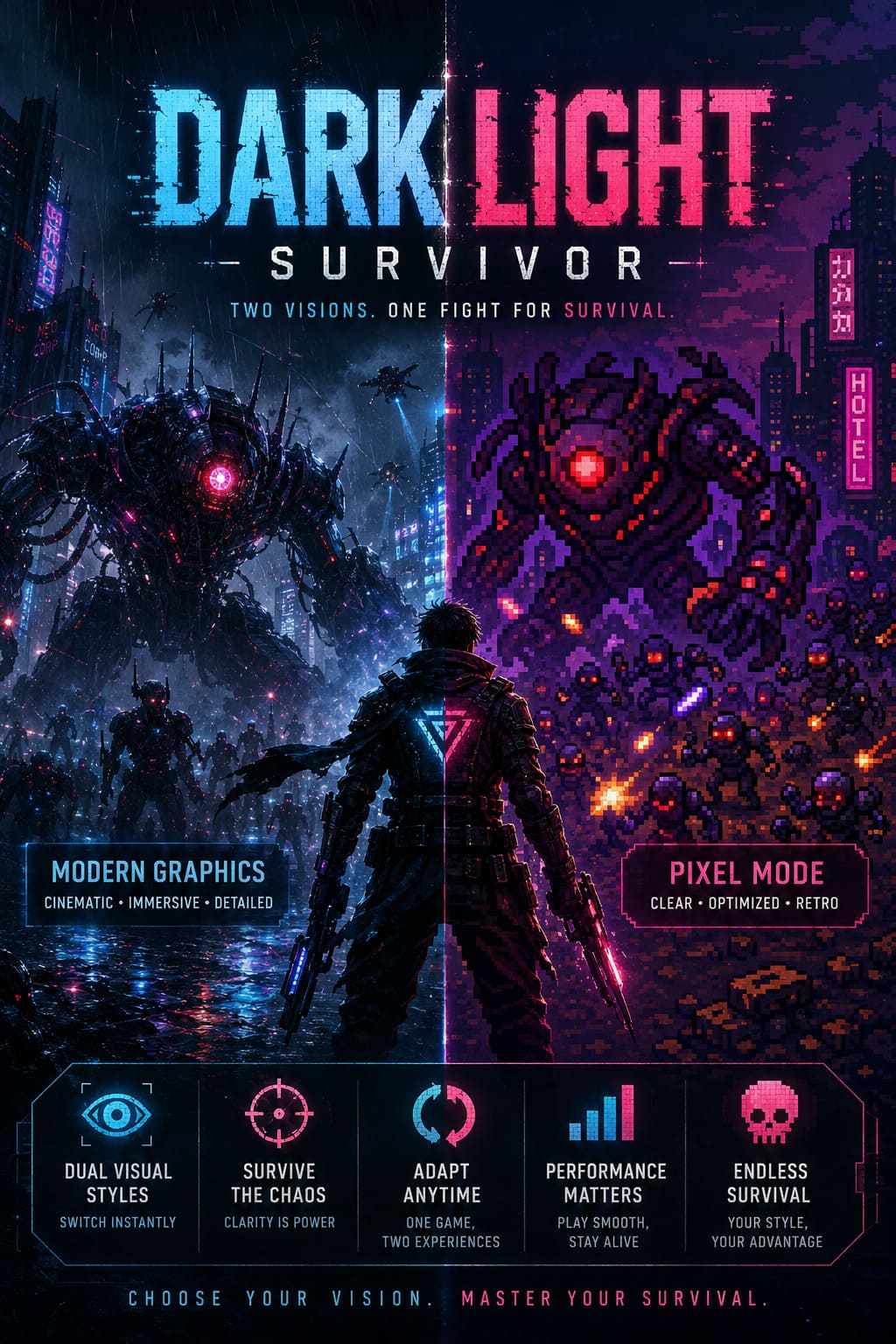
Modern graphics deliver a cinematic, high-detail cyberpunk world, while Pixel Mode strips everything down into a clean, retro-inspired version that feels like it belongs to a different era of gaming entirely.
What makes it interesting is that neither option feels like a compromise. Instead, they feel like two intentional design philosophies working side by side.
Mastering Perspective Switching in Dark Light: Survivor – A Personal Guide to Hybrid Combat Flow
Modern Graphics: The “Wow” Factor That Pulls You In
Modern Graphics in Dark Light Survivor are clearly designed to impress. This is the mode that showcases lighting effects, environmental depth, and detailed character models in full force. The cyberpunk world feels dense and atmospheric, almost overwhelming in its visual richness.
What stands out in Modern Mode
- Strong cinematic lighting with volumetric effects
- Highly detailed cyberpunk environments
- Enemy designs that feel more intimidating and complex
- Fluid camera transitions, especially in third-person perspective
There were moments where I stopped playing just to look at the environment. Neon reflections, fog layers, and massive enemies filling the screen create a strong sense of immersion. It feels closer to a high-budget action RPG than a typical roguelike survivor game.
However, this visual richness comes with a cost. When the screen fills with enemies, projectiles, and particle effects, readability can suffer. The chaos looks impressive, but it can become difficult to track what is actually happening.
The downside of Modern Graphics
The biggest issue is visual overload during intense moments. As the game progresses and enemy density increases, the screen can become difficult to read.
Performance demands are also higher, especially on mid-range systems or handheld devices, where frame drops can affect reaction timing.
Pixel Mode: Where Clarity Becomes Power
Pixel Mode initially looks like a stylistic alternative, but after spending time with it, it becomes clear that it serves a deeper gameplay purpose. Instead of focusing on visual complexity, it prioritizes readability and performance stability.
Nexus Hold in Dark Light: Survivor – A Player’s Complete Guide to NPCs, Upgrades
Core strengths of Pixel Mode
- Clean and readable enemy silhouettes
- Reduced visual clutter during large-scale fights
- Stable performance even in late-game chaos
- Retro-inspired aesthetic with intentional design
What surprised me most was how much easier it became to survive in high-intensity situations. In a genre where dozens or even hundreds of enemies can appear on screen at once, clarity is extremely important. Pixel Mode reduces unnecessary visual noise and allows you to focus purely on movement, positioning, and survival.
Instead of feeling like a downgrade, it actually feels like a tactical advantage.
Why Pixel Mode works so well
The simplified visuals improve reaction time and decision-making. You can instantly distinguish threats, projectiles, and safe spaces without being distracted by heavy effects or lighting. In long survival runs, this clarity becomes more valuable than graphical fidelity.
Gameplay Impact: More Than Just Graphics
The most interesting part of Dark Light Survivor is that visuals directly influence gameplay performance. This is not just a cosmetic choice—it changes how you play.
Comparison of both modes
| Aspect | Modern Graphics | Pixel Mode |
|---|---|---|
| Visual Clarity | Medium | High |
| Immersion | Very High | Medium |
| Performance | Demanding | Optimized |
| Late-Game Readability | Chaotic | Clean |
| Best Perspective Fit | Third-Person | Top-Down Focus |
In Modern Mode, I naturally played more cautiously because I relied heavily on atmosphere and visual feedback. In Pixel Mode, I became more aggressive because I could clearly see threats and react faster.
The Real Strength: Instant Switching
One of the smartest design decisions in Dark Light Survivor is the ability to switch visual modes instantly without restarting the game. This turns graphics into a dynamic tool rather than a fixed preference.
Over time, I developed a simple pattern that worked surprisingly well. I used Modern Mode during exploration and early waves to enjoy the atmosphere and world-building. Then I switched to Pixel Mode during late-game chaos when survival became the priority.
This flexibility encourages experimentation and prevents players from feeling locked into a single visual identity.
Who Each Mode Is For
Modern Graphics are ideal if you:
- Prefer cinematic presentation and immersion
- Enjoy detailed environments and lighting effects
- Play on a high-end PC or powerful setup
- Like third-person action perspectives
Pixel Mode is better if you:
- Value performance and smooth gameplay
- Struggle with visual clutter in chaotic games
- Play on handheld or mid-range systems
- Enjoy retro-inspired visual styles
Personal Experience: Why I Use Both
If I had to choose one mode permanently, I honestly couldn’t. Both offer something meaningful, and both change how the game feels in different ways.
Modern Graphics make the world feel alive, heavy, and cinematic. Pixel Mode turns that same world into a readable battlefield where survival depends on clarity and reaction speed. Instead of picking one, I ended up switching depending on the situation.
Modern Mode became my exploration and immersion tool, while Pixel Mode became my survival tool during intense runs. That balance feels intentional, almost like the developers expected players to adapt dynamically rather than commit to a single style.
Final Thoughts: A Rare Case of Meaningful Visual Choice
Most games treat graphics settings as simple technical adjustments, but Dark Light Survivor integrates them into the actual gameplay experience. Neither mode feels like a downgrade or an afterthought. Instead, they represent two valid ways to experience the same game.
Modern Graphics deliver spectacle and immersion, while Pixel Mode delivers clarity and performance. The fact that you can switch between them instantly makes the system even more powerful.
In a genre where visual overload is often part of the challenge, giving players control over clarity is a smart and refreshing design decision. Whether you prefer cinematic cyberpunk chaos or clean retro readability, Dark Light Survivor lets you choose your own experience without forcing you into a single vision.