Aion 2 Best Solo Classes Guide: Starter Class Tier List For Solo Players (2026 Launch)
If you’re planning to jump into Aion 2 at global launch and expect to spend most of your time playing alone, your first class choice matters more than you might think. Sure, you can technically level with almost anything, but there is a huge difference between a class that feels smooth and self-sufficient and one that makes every elite mob feel like a small boss fight.
That is especially important during the launch period. Everyone will be chasing quests, farming materials, exploring Atreia, and trying to get their first meaningful gear upgrades. You won’t always have a healer standing behind you or a tank ready to save you when a pull goes wrong. Sometimes it’s just you, a pile of mobs, and a cooldown that is unfortunately still 12 seconds away.
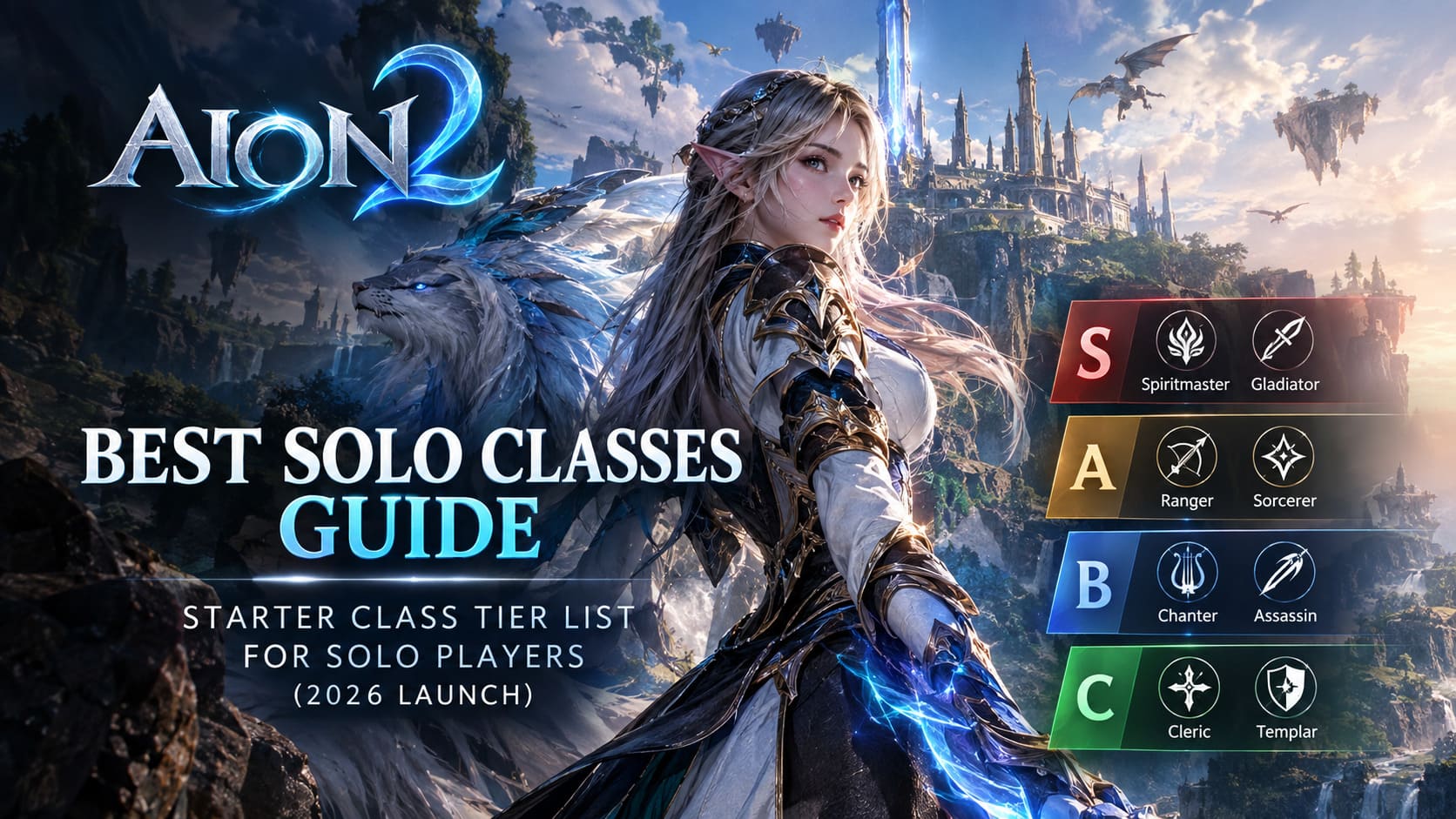
After looking at how the eight launch classes approach solo combat, there are two that immediately stand out for players who want a reliable solo experience: Spiritmaster and Gladiator. They achieve that goal in completely different ways, though, and that’s where things get interesting.
What Makes a Great Solo Class in Aion 2?
Before throwing every class into a tier list, it’s worth explaining what I actually care about when judging a solo class. Raw DPS is only one part of the equation. A class can have ridiculous damage numbers and still feel terrible when you’re alone if every mistake results in a death screen.
For solo progression, I would prioritize four things:
- Survivability: Can you recover from mistakes without constantly returning to town?
- Clear speed: How quickly can you deal with groups of ordinary enemies?
- Self-sustain: Do you have healing, mitigation, pets, shields, or other ways to stay in the fight?
- Ease of use: How demanding is the class when you’re learning Aion 2’s combat system?
There is also one factor that doesn’t show up neatly on a damage meter: how annoying the class feels to play solo. That’s surprisingly important. A class that kills everything slightly slower but never forces you to stop can feel dramatically better than a glass cannon that spends half its time recovering.
S-Tier: The Two Classes I Would Start With
| Tier | Class | Solo Strength | Best For |
|---|---|---|---|
| S | Spiritmaster | Pets, safety, ranged damage, utility | Safe solo PvE and beginners |
| S | Gladiator | AoE, durability, sustain | Fast melee leveling and grinding |
| A | Ranger | Mobility and ranged pressure | Kiting and experienced players |
| A | Sorcerer | Huge burst and AoE | High-damage players |
| B | Chanter | Healing and buffs | Safe but slower progression |
| B | Assassin | Burst, mobility, stealth | Solo PvPvE and skilled players |
| C | Cleric | Exceptional healing | Extremely safe progression |
| C | Templar | Defense and control | Players who enjoy tank gameplay |
1. Spiritmaster — My Pick for the Safest Solo Start
If I were starting Aion 2 completely fresh and wanted the least stressful solo experience possible, Spiritmaster would be near the top of my list. The class solves one of the biggest problems with solo MMORPG progression: you don’t have to personally stand in front of every monster you’re fighting.
The Spiritmaster revolves around elemental summons and ranged magical attacks. Instead of simply throwing spells until something dies, you’re effectively managing another layer of combat through your elemental companion.
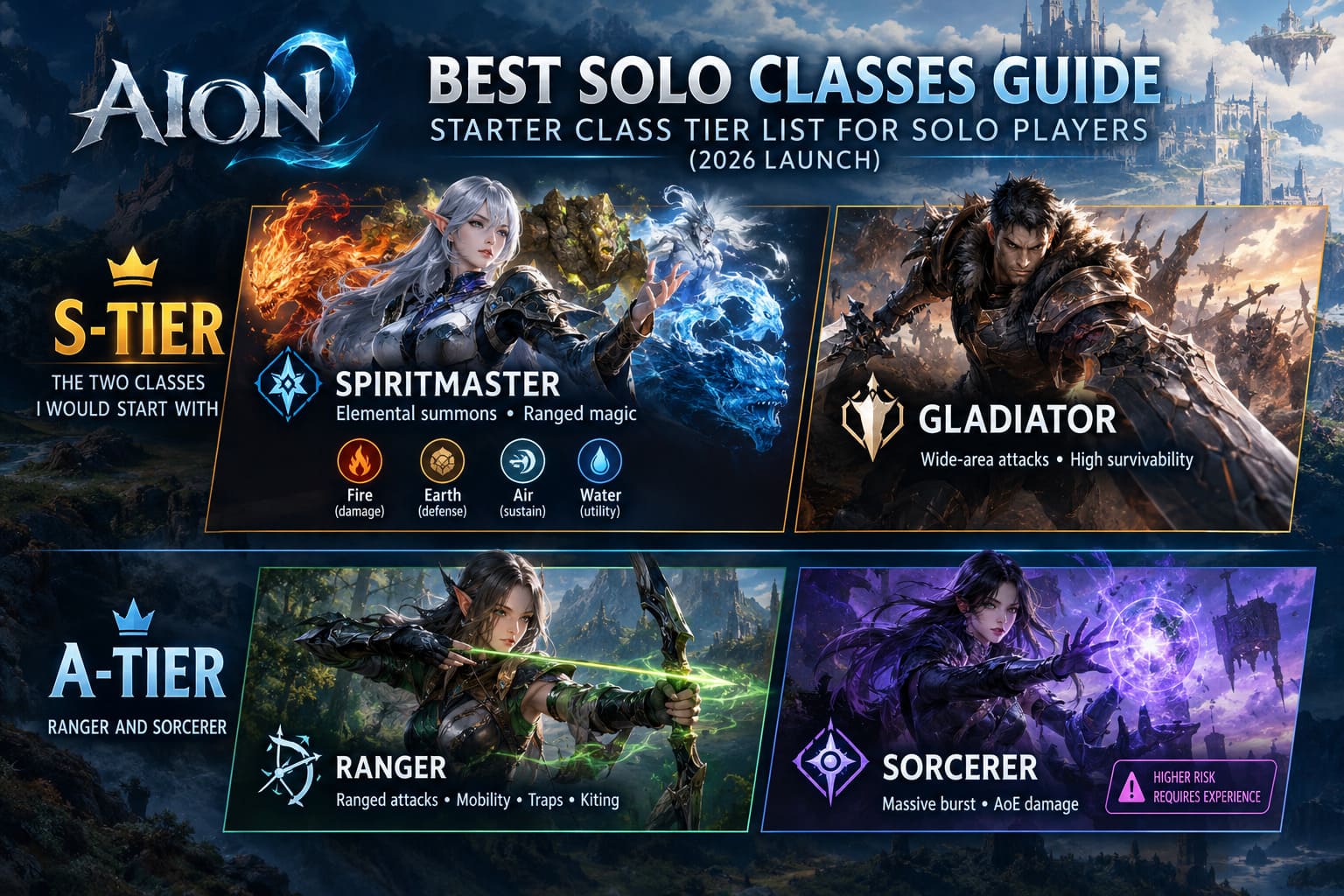
The four elemental options give the class a surprisingly flexible toolkit:
- Fire Elemental: Great for ordinary questing, farming, and general damage.
- Earth Elemental: The defensive option, particularly useful against tougher enemies and bosses.
- Air Elemental: Useful for sustained encounters where additional recovery and offensive pressure matter.
- Water Elemental: Focuses more heavily on utility, magic defense, and control.
That flexibility is what makes Spiritmaster so appealing. You aren’t locked into one combat pattern for every situation. Fighting trash mobs? Bring the aggressive option. Fighting something that hits like a truck? Switch toward defense. Dealing with a caster? Utility suddenly becomes much more valuable.
For a new player, this also creates a comfortable safety net. Your elemental can absorb pressure while you remain at range and focus on positioning and spell timing. You’re still playing the game rather than simply watching a pet fight, but you have considerably more room to make mistakes.
The class also becomes more interesting once you start combining elemental abilities into stronger burst attacks. That’s where Spiritmaster stops feeling like an easy beginner class and starts showing real depth.
The downside? If you prefer direct, aggressive combat, Spiritmaster might initially feel too detached. Some players simply don’t enjoy letting a summon take the first punch. I completely understand that.
2. Gladiator — The “Just Let Me Hit Everything” Option
Then there is the Gladiator, which is almost the complete opposite of Spiritmaster.
Instead of standing safely behind a summon, you’re running directly into the mob pack with a huge weapon and asking several enemies at once if they really want to have a bad day.
For solo leveling, this is a fantastic formula. Gladiator’s wide-area attacks allow you to gather multiple enemies and tear through them with sweeping attacks. This makes the class particularly comfortable for repetitive quest objectives and open-world grinding.
The other major advantage is survivability. Gladiator isn’t just about having a large health pool. Its offensive toolkit can also provide sustain, allowing you to recover health while continuing to attack.
That’s one of those things that doesn’t sound spectacular on paper but feels fantastic during actual leveling. You finish one group, move immediately to the next, and don’t have to constantly stop because your health bar is falling apart.
I’d recommend Gladiator particularly to players who don’t want complicated positioning or a massive rotation to memorize. The class still has depth, but its basic game plan is refreshingly obvious: get close, control the pack, hit hard, and stay alive.
A-Tier: Ranger and Sorcerer
Ranger
Ranger is probably the class I’d recommend to players who value movement above everything else. The combination of ranged attacks, mobility, traps, and kiting makes Ranger extremely comfortable when you have enough space to work with.
The catch is that mistakes are expensive. If you let an enemy close the distance or get caught by a disabling mechanic, that comfortable ranged advantage can disappear very quickly.
Ranger therefore feels less forgiving than Spiritmaster or Gladiator. A skilled player can get tremendous value from the class, but beginners will need to learn positioning properly.
Sorcerer
Sorcerer is the classic “delete the screen before it reaches you” option.
The class brings enormous magical burst and powerful AoE abilities, making it one of the most attractive choices for players who simply want to see enormous damage numbers. Against ordinary enemies, a well-played Sorcerer can make entire packs disappear surprisingly quickly.
But there is a problem: what happens when they don’t disappear?
Unlike Spiritmaster, Sorcerer doesn’t have a durable elemental standing in front of it. Unlike Gladiator, it can’t simply absorb punishment and heal through it. Defensive shields, crowd control, roots, sleeps, and good positioning become extremely important.
For that reason, I’d call Sorcerer an excellent solo class for experienced players rather than the safest starter choice.
B-Tier: Chanter and Assassin
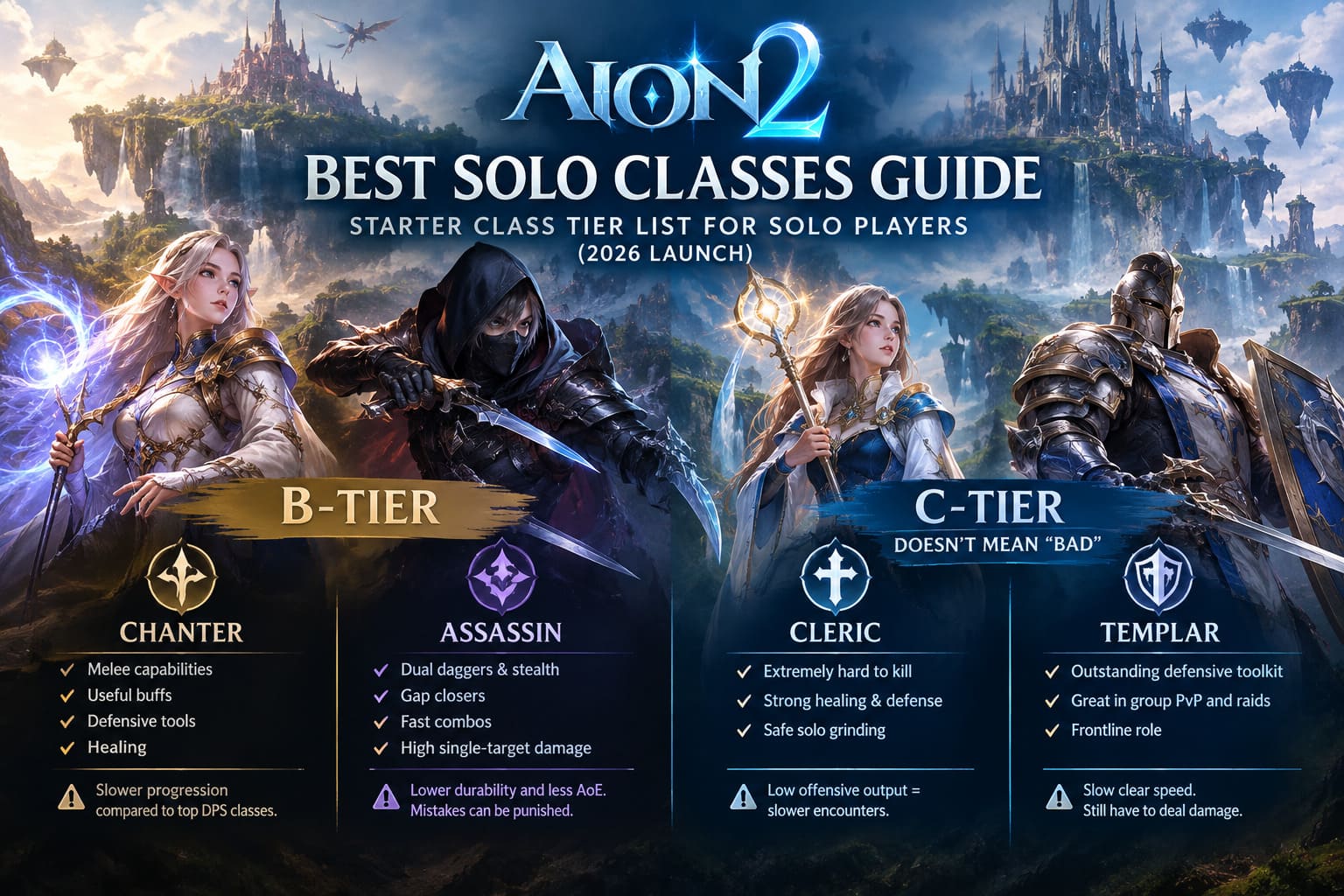
Chanter
Chanter is an interesting middle ground. It has melee capabilities, useful buffs, defensive tools, and healing, which makes it extremely difficult to completely cripple in solo play.
The problem is speed.
You can survive. You can heal. You can keep yourself buffed. But compared with a Gladiator or a high-damage Sorcerer, your progression can feel noticeably slower.
That doesn’t make Chanter bad. In fact, players who prefer consistency over explosive damage may genuinely enjoy it more. It’s simply not the class I’d choose if my primary goal were to race through the early solo progression.
Assassin
Assassin is where the tier list becomes much more dependent on player skill.
Dual daggers, stealth, gap closers, fast combos, and powerful single-target damage make Assassin incredibly exciting. In contested areas and solo PvPvE situations, the class has tools that can make other players extremely uncomfortable.
Pure PvE is a different story.
Assassin doesn’t have the same forgiving AoE coverage as Gladiator, and its lower durability means that mistakes can be punished brutally. If you already enjoy high-mobility melee classes, this may not bother you at all. For a first-ever Aion 2 character, however, there are easier ways to learn the game.
C-Tier Doesn’t Mean “Bad”
Cleric
Calling Cleric a C-Tier solo class can sound strange because the class is incredibly difficult to kill. The issue is not survival. The issue is time.
Cleric’s healing and defensive utility allow it to grind through content safely, but its offensive output means that ordinary encounters can take considerably longer than they would for dedicated DPS classes.
If your idea of a good MMO session is slowly and methodically grinding everything down while knowing that death is unlikely, Cleric could actually be a very comfortable choice.
Templar
Templar has a similar problem from a solo perspective. Its defensive toolkit is outstanding, and its role in group PvP and raids is much more naturally suited to frontline play.
Solo, however, that defensive specialization comes at the expense of clear speed. You can survive enormous punishment, but you still have to eventually reduce the enemy’s health bar to zero.
That can make Templar leveling feel slow compared with classes built around aggressive damage.
My Aion 2 Solo Class Tier List
If we’re talking specifically about solo PvE, leveling speed, survivability, and ease of use, my current breakdown looks like this:
- S-Tier: Spiritmaster, Gladiator
- A-Tier: Ranger, Sorcerer
- B-Tier: Chanter, Assassin
- C-Tier: Cleric, Templar
But I wouldn’t treat these tiers as permanent laws. MMO balance changes can completely reshuffle a class over time, and your own skill can matter more than a theoretical ranking.
Aion 2 Class Guide: All 8 Launch Classes Breakdown and Meta Tier List (2026 Global Release)
Solo Progression Tips for the Aion 2 Launch
Whichever class you pick, there are a few things I’d keep in mind when the global servers open.
First, don’t ignore account-wide progression. Systems that share progression between characters can make future rerolls much easier. If you eventually decide that your first main isn’t perfect, the work you did early on doesn’t necessarily disappear.
Second, make your daily and weekly content a habit. Solo instances and repeatable activities can become some of the most important sources of progression materials. Missing them repeatedly can create a noticeable gap later.
Finally, remember that the Abyss isn’t a normal PvE zone. You might be comfortably farming monsters one second and fighting another player the next. Spiritmaster can use its defensive tools and summon management to react to unexpected attacks, while Gladiator has the durability and mobility to disengage when a fight isn’t worth taking.
Final Thoughts
For me, the most interesting thing about the Aion 2 solo class meta is that Spiritmaster and Gladiator offer two completely different answers to the same question.
Spiritmaster is about control, distance, pets, and adapting your toolkit to the situation. It’s the class I’d look at if I wanted a relaxed solo journey with plenty of room for mistakes.
Gladiator is much more direct. You walk into the pack, start swinging, and rely on AoE damage and sustain to keep yourself moving. If you want your solo adventure to feel active and aggressive, it’s a natural fit.
Ranger and Sorcerer are excellent alternatives if you’re comfortable with positioning and managing your defenses, while Chanter and Assassin reward players who understand their specific strengths. Cleric and Templar sacrifice speed for durability and utility, which can still be appealing if you’re not interested in rushing through the game.
So if you’re staring at the character creation screen on launch day wondering where to begin, I’d narrow the decision down to one simple question: do you want your companion to take the hits, or do you want to be the one doing the hitting?
If the first answer sounds better, start with Spiritmaster. If the second one does, Gladiator is waiting.