Kingdom Rush 6 Genesis TD Ultimate Guide: Demo Towers, Tiers, and Synergy Mechanics
After spending an unhealthy amount of time with tower defense games, I’ve learned that the best ones aren’t necessarily the games with the biggest numbers or the longest upgrade trees. What matters is whether the game makes you stop, look at the battlefield, and think, “Okay, this wave is going to ruin my day unless I change something.” That is exactly the feeling I associate with the Kingdom Rush series, and Kingdom Rush 6: Genesis TD looks determined to bring that feeling back while pushing the formula in some interesting directions.
Developed and published by Ironhide Game Studio, Genesis is positioned as a prequel that takes players back to the early history of Linirea. The story centers on a young Veznan and the events that eventually shape the world fans already know. The planned release date is September 24, 2026, and the available demo information already gives us a pretty good idea of how the new game wants to approach tower defense.
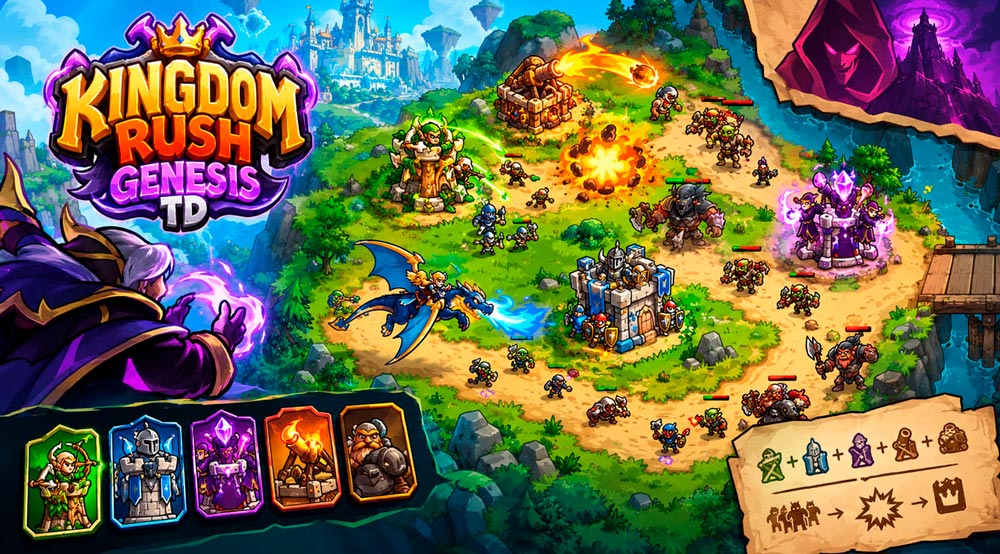
What immediately catches my attention is that Genesis isn’t simply trying to be another Kingdom Rush. The game puts considerably more emphasis on choosing a limited tower lineup and making those towers work together. With a full target roster of 15 towers but only five slots available before each stage, your pre-battle decisions could become almost as important as what happens once the first enemy walks onto the path.
Kingdom Rush 6 Genesis TD Hero Tier List Best Heroes Ranked
A Prequel That Actually Has Something to Say
The prequel setting is one of the more interesting parts of Kingdom Rush 6: Genesis TD. Instead of jumping forward to another crisis, the game travels back to the formative days of Linirea, giving players a chance to see familiar characters and locations from a different perspective.
The central conflict involves stopping Veznan before darkness completely consumes him. That gives the campaign a slightly different flavor from the usual “save the kingdom because monsters are attacking” setup. We already know that Veznan becomes one of the franchise’s most recognizable villains, so watching the events surrounding his younger self has the potential to add some useful context to the larger Kingdom Rush timeline.
The campaign is spread across three major environments:
- The Citadel — a classic defensive setting where players can get comfortable with the new systems.
- Stormcloud Depths — a more dangerous region built around new tactical problems and battlefield constraints.
- Arcania — a distant magical land that introduces a very different visual and strategic atmosphere.
I particularly like the idea of moving from familiar-looking kingdom territory into stranger magical environments. Tower defense can become visually repetitive when every map is essentially another road with trees around it, so distinct environments are important.
Five Towers, Not Fifteen: The Biggest Strategic Change
The tower system could be where Genesis really separates itself from earlier entries.
The game is expected to contain 15 unique towers, but players don’t simply take their entire collection into battle. Instead, you select five towers before entering a stage. That limitation sounds simple, but anyone who has played a lot of Kingdom Rush knows how much it can change the way you approach a map.
In older games, there is often a temptation to find a particularly powerful tower combination and lean on it whenever possible. Genesis appears to be encouraging something different: build a team that can answer several types of threats.
The four traditional tower families remain recognizable:
| Tower Family | Main Role | Best Use |
|---|---|---|
| Archers | Physical ranged damage | Fast enemies and consistent DPS |
| Mages | Magical damage | Armored targets |
| Barracks | Blocking and control | Holding enemies in place |
| Artillery | Area damage | Large groups and choke points |
The important part isn’t simply having one of everything. Synergy matters. A barracks tower can keep enemies grouped together, artillery can punish that group, while archers clean up anything that survives. Mages then give you an answer when heavily armored enemies start walking through conventional physical damage.
That’s the kind of interaction I want from a modern tower defense game. Individual towers should feel useful, but combinations should feel clever.
Demo Tower Tier List
The current demo information reveals six named towers, and they already cover a nice spread of battlefield roles.
S-Tier: Archer Garrison
The Archer Garrison looks like the dependable workhorse of the demo roster. It provides rapid single-target physical damage and seems designed to handle the ordinary enemies that make up the bulk of most waves.
That’s not necessarily glamorous, but reliable towers are incredibly valuable in tower defense. You don’t always need an elaborate ability that deletes half the screen. Sometimes you need a tower that keeps firing quickly and quietly removes one enemy after another.
Its fast attack speed should make it particularly useful against scouts and other lightly protected enemies.
S-Tier: Knights Order
If the Archer Garrison is the workhorse, the Knights Order is the wall.
Barracks have always been one of the most interesting tower types in Kingdom Rush because they don’t simply deal damage. They manipulate the path itself by deciding where enemies stop moving.
The Knights Order appears to continue that tradition with strong health and defensive capabilities. Put them at a critical choke point and suddenly your artillery has more time to fire, your archers have more opportunities to attack, and your mages can keep burning down armored targets.
For me, that’s exactly what a good barracks tower should do.
A-Tier: Elven Elite Ranger
The Elven Elite Ranger takes the archer concept in another direction. Instead of relying on rapid attacks, it focuses on precision and powerful single-target shots.
That makes it more attractive when the problem isn’t a huge crowd of weak enemies but one particularly nasty target that refuses to die.
It should work especially well as part of a mixed defense where another tower handles ordinary enemies while the Ranger focuses on priority targets.
A-Tier: Scholar Mages
The Scholar Mages provide the demo’s main magical damage option. Their role is straightforward but essential: dealing with enemies whose physical defenses make conventional archers less effective.
This is one of those situations where tower defense design rewards players for understanding enemy properties rather than simply looking at damage numbers. A tower that appears weaker on paper can become indispensable when the right enemy type arrives.
A-Tier: Royal Catapult
The Royal Catapult is the classic “please stand closer together” solution.
Its slow attack speed is offset by powerful splash damage, making it particularly effective against large groups of weaker enemies. The trick, naturally, is placement. A badly positioned artillery tower can spend its time firing impressive explosions into relatively empty areas.
Place it correctly behind a blocking unit, however, and suddenly every projectile becomes much more valuable.
A-Tier: Dwarven Culverin
The Dwarven Culverin takes the artillery role into a shorter-range, heavier-impact direction.
That makes it particularly interesting for tight choke points. Instead of relying on enormous range, it wants enemies to come close enough for its area damage to become devastating.
I tend to enjoy this kind of tower because it creates an actual positional decision. You aren’t just asking, “Where can I reach the most enemies?” You’re asking, “Where can I make this tower matter most?”
The Real Question: Which Five Towers Should You Bring?
The five-tower restriction could become one of the defining features of Genesis.
A balanced setup might look something like this:
Archer Garrison + Knights Order + Scholar Mages + Royal Catapult + Elven Elite Ranger
That combination gives you rapid physical damage, frontline control, magical damage, splash damage, and high-priority single-target damage.
But I wouldn’t automatically use that lineup on every map.
If a stage heavily favors tight enemy clusters, swapping in the Dwarven Culverin could make sense. If the enemy composition contains particularly dangerous armored units, keeping the Scholar Mages becomes much more important.
This is where the system could encourage experimentation rather than one universal meta.
Dual Heroes Return
The dual hero system is also returning, allowing players to control two heroes simultaneously.
For experienced Kingdom Rush players, this is potentially a huge advantage, but it also creates another layer of micromanagement. Two heroes can be positioned at opposite ends of a map, or you can concentrate both in one dangerous area when a boss arrives.
The announced roster contains 12 heroes, including returning favorites such as Gerald, Zefira, Bolin, Connor, Ignus, Malik, Oni, Drakkan, and Ashbite.
Three new heroes add some particularly interesting concepts.
Rhodes, the Earth Bastion
Rhodes is essentially a magical elemental tank. A Sun Gem embedded in his chest gives him his unusual abilities after an experiment involving the Stormcloud Sorcerers.
From a gameplay perspective, Rhodes sounds like the kind of hero you send directly into trouble. His defensive identity should make him a natural companion for damage-focused towers that need extra time to work.
Gemina, the Arcane Illusionist
Gemina sounds like the most mechanically unusual of the newcomers. Her ability to create convincing illusions of herself gives her the potential to confuse and occupy multiple enemies.
If implemented well, this could make her especially useful on maps where enemy movement is difficult to control.
Illiana, the Dragon Tamer
Illiana travels with her dragon companion Sparky, bringing an aerial element to the battlefield.
A dragon-riding hero is exactly the sort of ridiculous fantasy nonsense that fits Kingdom Rush perfectly. The series has never been afraid of mixing serious fantasy stakes with goofy characters, and I hope Genesis keeps that balance.
What We Still Don’t Know
One thing worth remembering is that some of the information surrounding Genesis is still based on developer reveals and demo material rather than a complete final build.
For example, the Ironbark Treant has been confirmed in the game’s lore but wasn’t part of the currently available demo roster. Other tower details, including specific skill-tree nodes, costs, ultimate abilities, and final numerical statistics, may still change.
That means any early tier list should be treated as a snapshot rather than gospel.
And honestly, that’s probably a good thing.
Tower defense games live and die by balance. A tower that looks mediocre during a demo can become incredible after a small damage or cooldown adjustment, while an apparently dominant strategy can disappear after one balancing patch.
Campaign, Enemies, and Bosses
Genesis is planned to feature 18 handcrafted campaign stages and more than 40 enemy types across five mythological races.
That’s a healthy amount of variety, particularly if the enemies are designed to force different tower combinations rather than simply having larger health bars.
The campaign will also feature six major bosses. These aren’t supposed to be passive giant enemies that simply walk down the road with a huge health pool. Boss encounters can alter the battlefield, destroy towers, or interfere with heroes.
Those mechanics are important because bosses are where tower defense games often reveal whether their systems actually work. A boss that simply requires more DPS isn’t especially interesting. A boss that forces you to reposition, change your hero placement, or rethink your tower economy is much more memorable.
Extra Modes and Replayability
For players who don’t stop after the campaign credits, Genesis offers additional challenges.
The Iron Challenge returns with restrictions that can remove heroes or limit tower availability while forcing you to survive an especially demanding wave.
Then there’s Rush mode, which changes the pacing of enemy waves and pushes the player toward faster decisions.
There are also more than 50 achievements across Steam and mobile versions, giving completionists another reason to keep playing after finishing the main campaign.
I’ve always thought Kingdom Rush works particularly well with challenge modes because the basic gameplay is already easy to understand. You know exactly what towers do; the fun comes from being told you can’t use the obvious solution.
PC and Mac Requirements
The technical requirements appear relatively modest, which is good news for players who don’t own gaming PCs.
The PC version requires a 64-bit version of Windows 10 or newer, 8 GB of RAM, and graphics hardware around the Intel UHD 600 level or better. Storage requirements are around 3 GB.
Mac players need macOS 10.13 or later, an Apple M1 or Intel Core M processor, 8 GB of RAM, and an OpenGL 3.0-compatible graphics solution with at least 1 GB of VRAM.
The game also supports offline play, which I consider a major positive for this genre. Tower defense is exactly the sort of game I want to be able to launch without worrying about whether a server is having a bad afternoon.
Final Thoughts
What interests me most about Kingdom Rush 6: Genesis TD isn’t simply the return of familiar heroes or the promise of another large tower roster. It’s the decision to make players choose five towers from a larger pool and build strategies around their interactions.
After playing a lot of tower defense games, I’ve come to appreciate systems that make preparation matter. If Genesis succeeds at making every map feel like a small tactical puzzle rather than a familiar recipe with different enemies, the five-tower system could become one of its strongest ideas.
The prequel story also gives the game a reason to exist beyond adding another chapter number to the franchise. Going back to early Linirea, exploring Veznan’s origins, and seeing familiar characters before their established adventures could give longtime fans plenty of fun discoveries.
There are still unanswered questions, particularly around the complete tower roster, final balancing, skill trees, and exact statistics. But based on the currently revealed material, Kingdom Rush 6: Genesis TD looks like a promising return to the series’ strategic roots, with enough new mechanics to keep veterans from simply playing the same game they’ve already mastered.
And if Ironhide gets the tower synergy right, I already know what is going to happen: I’ll tell myself I’m going to play one quick stage, accidentally spend two hours experimenting with tower combinations, and then wonder why it is suddenly 2 a.m.