Diablo 5 Confirmed Classes: Roster, Skills, and Lore Analysis So Far
Blizzard dropping Diablo 5 at BlizzCon 2026 was one of those announcements that instantly changes the conversation around an entire genre. After years of Diablo games following familiar patterns, the fifth mainline entry looks like it is willing to throw several of those assumptions out the window. The planned Spring 2029 release is still a long way off, but the premise alone is enough to make this one of the most interesting ARPG projects on the horizon: Diablo has won, Sanctuary is broken, and the player is entering the story after the apocalypse rather than trying to prevent it.
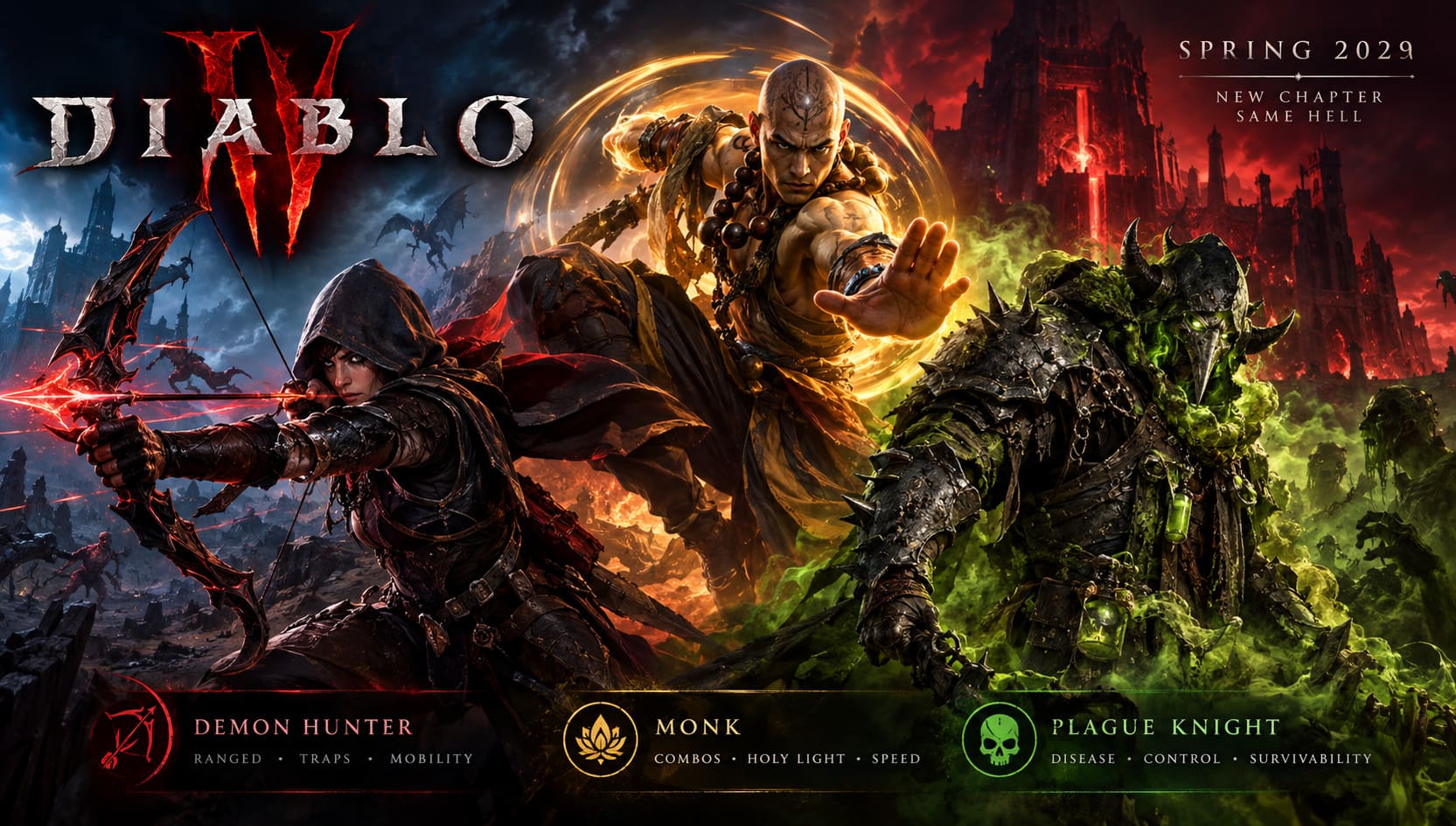
That setup also gives Blizzard a lot more freedom with its character roster. Instead of simply bringing back the safest combinations of classes from previous games, the developers have already confirmed three very different heroes for launch. The Demon Hunter, Monk, and completely new Plague Knight cover ranged combat, hyper-aggressive martial arts, and disease-based armored warfare. Having played more ARPGs than I can count, I think this is a much more promising starting point than another predictable lineup of sword-and-board, wizard, and generic ranged classes.
There is still plenty we don’t know. Blizzard has shown concepts and explained the broad identities of these classes, but the detailed skill trees, legendary interactions, endgame builds, and exact resource systems are still under wraps. That is probably a good thing at this stage. After all, one of the easiest ways to ruin an ARPG announcement is to reveal everything before players have had time to speculate.
Diablo 5 and Netflix Animated Series Connection: Everything Confirmed at BlizzCon 2026
Demon Hunter Returns as the Ranged Specialist
The Demon Hunter is probably the easiest class to understand for returning players. It comes back from Diablo III with its trademark combination of ranged weapons, traps, mobility, and aggressive positioning. For players who never quite connected with Diablo IV’s Rogue, this announcement feels particularly significant because the Demon Hunter has always had a very specific personality in combat.
The difference is not simply cosmetic. The Demon Hunter is built around maintaining distance while turning the entire battlefield into a firing range. Blizzard has described the class as a dedicated ranged powerhouse, with heavy projectile damage, tactical traps, and exceptional mobility forming the foundation of its gameplay.
That combination is exactly what I want from this class. I’ve always preferred ranged characters that require movement rather than simply standing at the edge of the screen and holding down one button. The best Demon Hunter builds in Diablo III had this wonderfully frantic rhythm where you were constantly repositioning, firing, managing resources, and looking for the next opening.
The old Multishot and Strafe-style fantasies are obviously going to be on everyone’s wishlist, but I hope Blizzard doesn’t simply recreate Diablo III builds with prettier graphics. Diablo 5 has an opportunity to make the Demon Hunter more tactical without making the class painfully slow.
What Makes the Demon Hunter Interesting?
- Long-range damage should remain the class’s primary strength.
- Traps and battlefield control could create more strategic encounters.
- High mobility should reward players who constantly reposition.
- Projectile-heavy builds could make crowd clearing extremely satisfying.
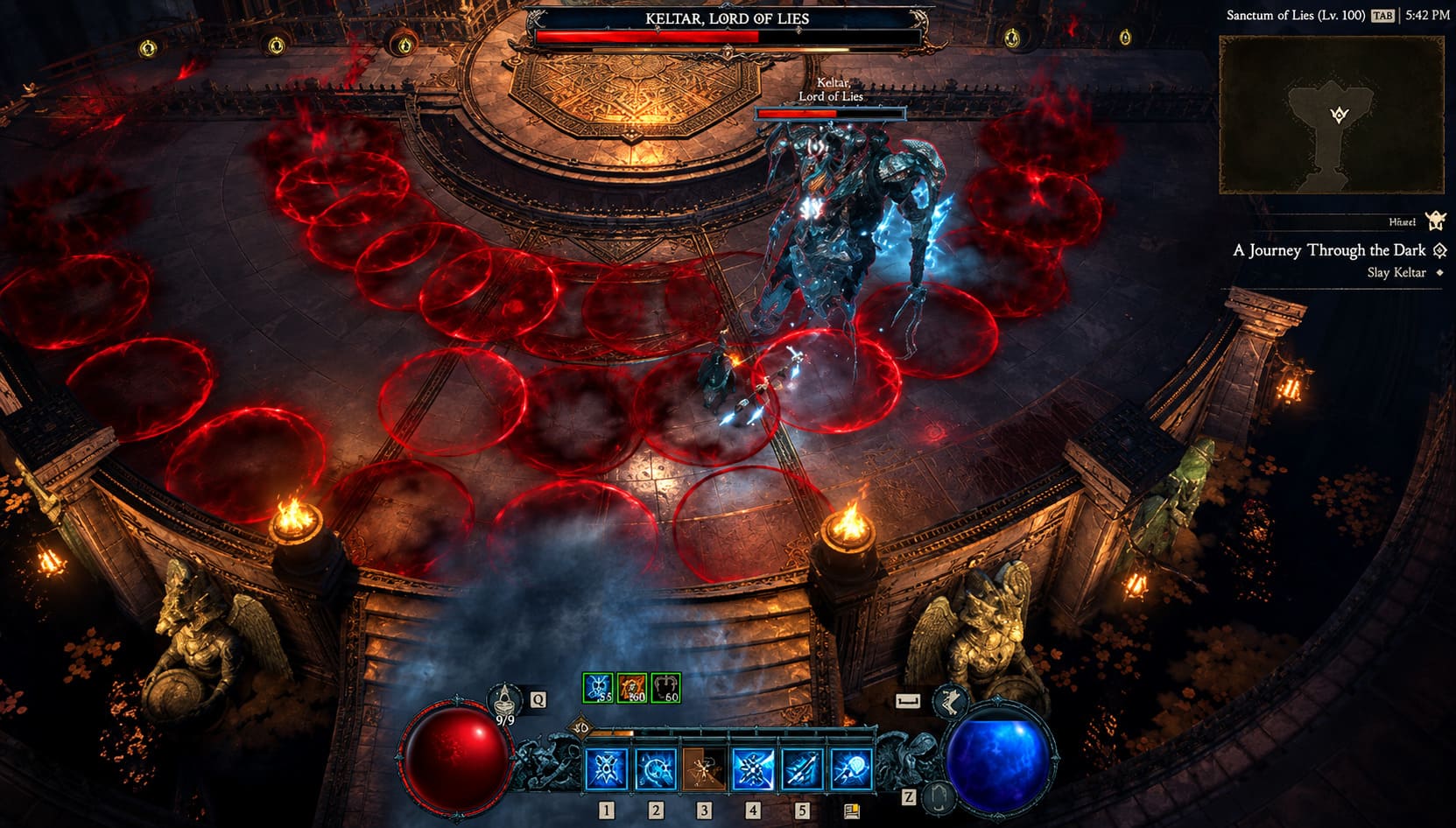
The big question is how Blizzard handles survivability. A glass-cannon ranged character is fun when movement matters, but frustrating when every mistake results in an instant death. If the Demon Hunter can combine mobility with clever defensive mechanics rather than simply stacking damage reduction, it could become one of Diablo 5’s most enjoyable classes.
The Monk Finally Gets Another Shot
The Monk is the class I’m personally most curious about. Diablo IV launched without a dedicated martial-arts character, and while several classes could produce fast melee builds, none really replicated the Monk’s distinctive combination of physical attacks, spiritual energy, mobility, and holy abilities.
Blizzard’s description is wonderfully simple: the Monk is back to punch demons and call down Holy Light. That’s pretty much the pitch you need.
The Monk occupies an unusual space because it isn’t just a traditional melee fighter. The class combines rapid punches, kicks, staves, and fist weapons with supernatural abilities that can damage enemies, protect allies, or create bursts of holy energy. That hybrid design is what made the Monk memorable in the first place.
I have always liked ARPG classes that force you to stay engaged with enemies instead of simply rotating abilities from a safe distance. A well-designed Monk can feel almost rhythmic, with attacks flowing into each other rather than behaving like disconnected cooldowns.
Why the Monk Could Be Diablo 5’s Fastest Class
The most exciting possibility is the return of the Monk’s combo-based combat philosophy. Instead of every skill being an isolated attack, the class could reward players for building sequences and timing abilities correctly.
That could also work extremely well with Diablo 5’s apparently deeper build system. Imagine having one Monk build focused almost entirely on explosive melee combos, another built around Holy Light and defensive barriers, and a third designed around mobility and enemy grouping.
If Blizzard gets the animation quality and hit feedback right, the Monk could become the class that makes every other Diablo 5 character feel slow.
Plague Knight Is the Real Surprise
The Demon Hunter and Monk are exciting returns, but the Plague Knight is easily the most interesting announcement from a design perspective. This isn’t a slightly altered version of an existing Diablo archetype. Blizzard is introducing a completely new class built around one of Sanctuary’s ugliest concepts: disease and decay.
The early concept immediately separates the Plague Knight from the traditional Paladin or Crusader. Instead of holy armor, celestial protection, and righteous attacks, this character embraces corruption and turns it against Diablo’s armies.
The visual design sounds appropriately disgusting in the best Diablo fashion. Heavy spiked armor, oversized pauldrons, and a closed horned helmet make the Plague Knight look less like a noble warrior and more like something that crawled out of a battlefield after everyone else had died.
But the gameplay mechanic is what really caught my attention.
The Plague Knight’s Spread-and-Consume System
The central idea appears to revolve around afflictions. The Plague Knight spreads diseases across groups of enemies, allowing those effects to build up before consuming them for another benefit.
- Infect enemies with diseases and toxic effects.
- Allow afflictions to spread through dense groups.
- Consume those diseases at the right moment.
- Convert them into buffs, resource regeneration, or massive area damage.
- Repeat the process while remaining in the middle of the fight.
This is much more interesting to me than simply giving a heavily armored character another shield bash. The Plague Knight could potentially be a class where enemy density actually makes you stronger.
That would create some great moments in Diablo 5’s endgame. Imagine entering a packed dungeon, deliberately spreading disease through hundreds of enemies, then consuming the entire infection network and turning the screen into a giant explosion of rot.
Of course, there is a balancing problem here. If the class becomes dramatically stronger whenever more enemies are present, Blizzard will have to make sure it doesn’t become useless against bosses or low-density encounters. The skill system will need to provide alternative ways of generating and consuming afflictions.
How the Three Confirmed Classes Compare
| Class | Primary Role | Combat Style | Main Strength | Biggest Question |
|---|---|---|---|---|
| Demon Hunter | Ranged DPS | Fast ranged attacks and traps | Mobility and sustained projectile damage | How defensive options will work |
| Monk | Melee Hybrid | Combos, martial arts, Holy Light | Speed and versatility | How deep the combo system becomes |
| Plague Knight | Melee Tank/Debuffer | Disease spreading and consumption | Crowd control and survivability | How it performs against bosses |
What I like about this lineup is that the three classes don’t feel interchangeable. The Demon Hunter wants distance, the Monk wants to stay active in melee range, and the Plague Knight seems designed to deliberately walk into the worst possible situation and somehow come out stronger.
That kind of contrast is exactly what an ARPG roster needs.
Diablo 5 Could Have the Biggest Class Roster Yet
The biggest piece of information might actually have nothing to do with the three classes we’ve seen.
Blizzard has stated that Diablo 5 is targeting a launch roster larger than any previous game in the franchise has ever had, including the number of classes available after previous games received expansions. That’s an ambitious promise, especially considering how many iconic classes already exist in Diablo’s history.
It immediately raises the obvious questions. Will the Necromancer return? What about the Sorcerer, Druid, Barbarian, Witch Doctor, Crusader, or other forgotten archetypes? And how many completely new classes might Blizzard introduce before launch?
Personally, I’d rather see Blizzard take some risks than simply assemble a greatest-hits collection. If the Plague Knight is an indication of the team’s approach, there could be several genuinely strange concepts waiting behind the curtain.
A huge roster is also only valuable if the classes actually feel different. Nobody wants ten classes that ultimately boil down to different animations for the same damage rotations. The interesting challenge will be giving every class its own mechanics, resource system, item interactions, and reasons to exist.
The Bigger Changes Could Matter More Than the Classes
The class announcements become even more interesting when placed alongside the other systems Blizzard has discussed for Diablo 5. The game is reportedly moving back toward procedurally generated overworld environments, while also bringing back several ideas that longtime Diablo II players will immediately recognize.
The classic grid-based inventory, dedicated belt equipment slots, and runes and runewords are all being brought back into the core design. For veteran ARPG players, those systems could have a bigger impact on character building than another dozen flashy skills.
I’m especially interested in what runewords could do to the new classes. A system like that can completely change how players approach gear if Blizzard gives it enough depth. A Demon Hunter could potentially use unusual equipment combinations to change how projectiles behave, while a Plague Knight might build around spreading afflictions faster or converting them into different resources.
That is where Diablo 5 could become genuinely addictive.
Why Diablo 5 Already Has My Attention
There is still a ridiculous amount of time between this announcement and the projected 2029 launch. That means everything we’ve seen should be treated as an early snapshot rather than a finished design. Skills will change, classes will be rebalanced, item systems will probably be rebuilt at least twice, and some announced features may never survive development.
Still, the direction is promising.
The Demon Hunter gives players a fast ranged specialist, the Monk brings back one of the franchise’s most mechanically satisfying melee archetypes, and the Plague Knight introduces something genuinely new instead of simply recycling an old class with a new coat of paint.
For me, the Plague Knight is the class to watch. The disease-spreading and consuming mechanic has the potential to become one of those systems that looks strange in a developer presentation but becomes incredibly satisfying once you start optimizing it. Meanwhile, the promised oversized roster suggests Blizzard is thinking much bigger about character variety than it did with previous installments.
The real test will come later, when we see the full skill trees, itemization, progression, and endgame. A huge class roster means very little if the builds aren’t deep and the combat doesn’t feel good. But if Blizzard can combine the old-school systems players have been asking for with genuinely new class mechanics, Diablo 5 could end up being much more than another sequel.
For now, I’m cautiously optimistic. After seeing the Demon Hunter, Monk, and Plague Knight together, I’m much more interested in discovering what Blizzard hasn’t shown us yet.
Diablo 5 has a long road ahead, but at least its first class reveal gives us something worth talking about.