Gunman Contracts Stand Alone PC Requirements & Download Size: Can Your Rig Run It?
There is something incredibly satisfying about a good tactical shooter that understands the difference between simply firing a gun and actually handling one. That was always the secret sauce behind Gunman Contracts, the cult-favorite Half-Life: Alyx mod that turned its creator’s obsession with cinematic gunplay into one of the most memorable VR shooting experiences around.
Now the idea has finally escaped the mod scene.
Gunman Contracts – Stand Alone arrives in September 2026 as a full Early Access release from 2080 Games, built to work both as a traditional PC shooter and a virtual reality game. And honestly, that is probably the most interesting part of the whole project. You don’t need a VR headset to play it anymore, but the game still carries the DNA of a VR-first shooter: physical weapons, environmental interaction, tactical encounters and a general feeling that every room is waiting for something to go horribly wrong.
The obvious question for PC players is simple: can your hardware actually run Gunman Contracts Stand Alone?
The answer looks surprisingly friendly on paper, although VR players should pay much closer attention to the requirements than someone playing on a normal monitor.
Gunman Contracts Stand Alone System Requirements
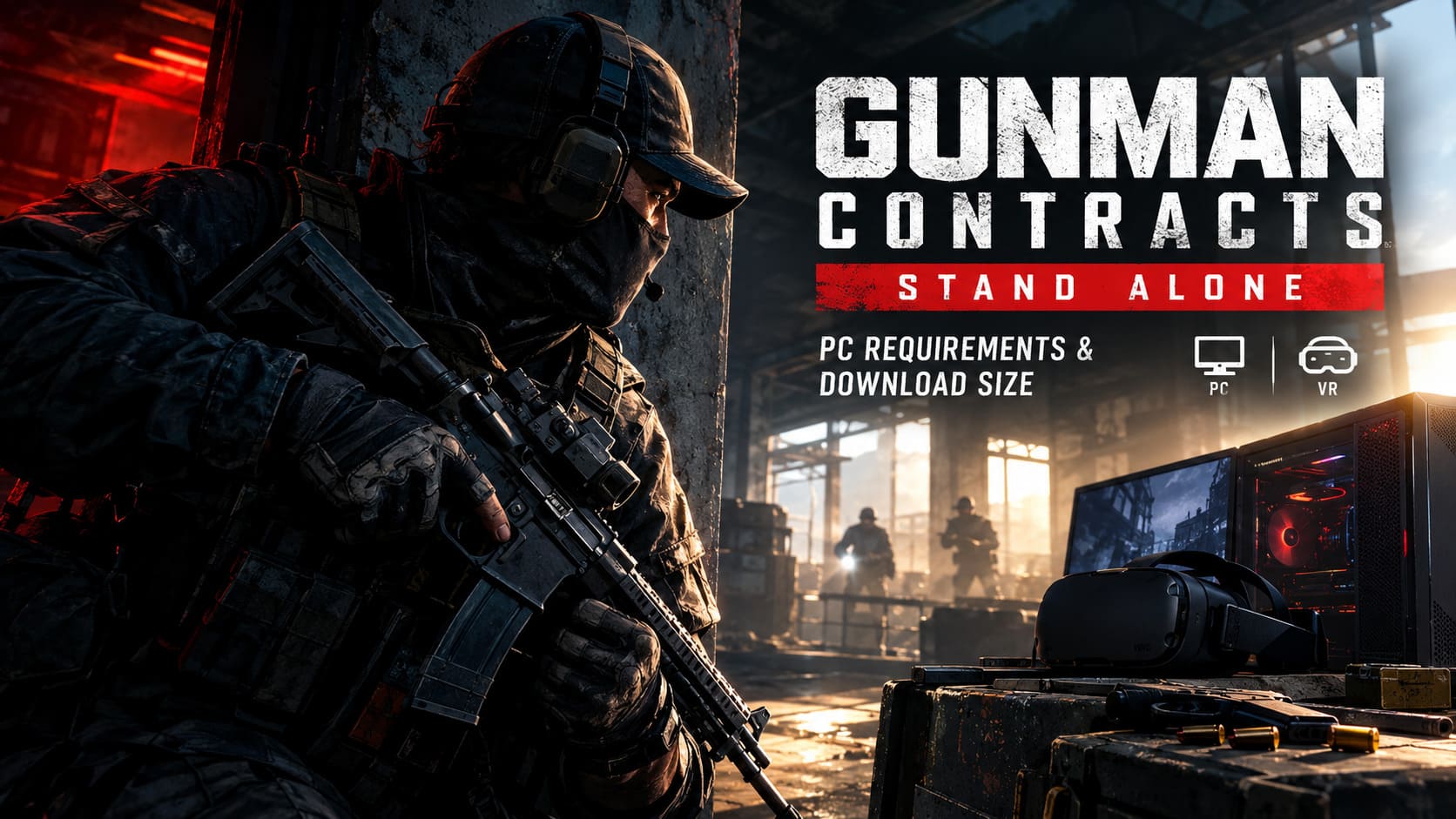
The official minimum configuration isn’t outrageous by 2026 standards. The game asks for 12 GB of RAM and a GTX 1070, which immediately tells me that this isn’t some ultra-demanding graphical showcase designed exclusively for RTX 5080 owners.
Here is the basic requirement breakdown:
| Component | Minimum Requirement |
|---|---|
| Operating System | Windows 10 64-bit |
| CPU | Intel Core i5-7500 / AMD Ryzen 5 3600 or better |
| RAM | 12 GB |
| GPU | NVIDIA GeForce GTX 1070 or better |
| Storage | 20 GB available space |
| VR | OpenXR-compatible headset |
| Architecture | 64-bit CPU and OS |
For flat-screen players, these specifications are fairly approachable. For VR, however, I would treat the GTX 1070 as the floor rather than the target.
That distinction matters.
A conventional PC game can get away with occasional frame-time spikes without ruining your evening. VR really can’t. A sudden hitch in a firefight is one thing on a monitor; having the world stutter while you’re physically moving your head is an entirely different experience.
The CPU Requirement Makes More Sense Than It First Appears
At first glance, the i5-7500 and Ryzen 5 3600 pairing looks strange. These processors belong to very different generations of CPU design, and the Ryzen 5 3600 has a much stronger multi-threaded configuration.
But the requirement starts making sense once you look at what Gunman Contracts Stand Alone is trying to simulate.

This isn’t supposed to be a shooter where enemies simply stand behind cover waiting for their turn to die. Weapons, objects, doors, impacts and environmental interactions are important parts of the gameplay. Add enemy AI and the additional processing associated with VR tracking, and suddenly CPU performance becomes much more relevant.
Personally, I would be happier running this game on a modern six-core processor than trying to squeeze everything out of an old quad-core chip.
The minimum specification should get you into the game, but minimum doesn’t necessarily mean smooth.
If you’re building a PC specifically for this game, I’d consider a modern 6-core CPU the sensible starting point, with an 8-core processor being an even safer bet for players who multitask, stream or run additional software in the background.
GTX 1070 Is the Real Starting Line
The NVIDIA GeForce GTX 1070 being listed as the minimum GPU is probably the most useful piece of information for players wondering whether their current PC is ready.
For standard 1080p gaming, the GTX 1070 is still a surprisingly capable card. It is old now, obviously, but the fact that it remains the official baseline suggests that Gunman Contracts Stand Alone isn’t demanding an enormous amount of raw rendering power for conventional monitor play.
I’d expect the situation to be considerably more complicated in VR.
VR effectively asks your GPU to maintain very high frame rates while rendering stereoscopic views and handling the additional workload associated with a headset. Depending on the headset, refresh rate and resolution, the difference between a comfortable experience and a miserable one can be substantial.
If I were buying hardware specifically for this game, I wouldn’t build around the GTX 1070 today. Something in the neighborhood of an RTX 3060, RTX 4060 or a comparable modern AMD card would give you considerably more breathing room.
And that’s especially important if you want to use higher headset resolutions or supersampling.
My Practical GPU Targets
- GTX 1070: Playable baseline for standard PC gaming.
- RTX 3060 / similar: Much more comfortable territory, particularly for VR.
- RTX 4060 / newer equivalent: Better long-term choice for VR and higher settings.
- High-end modern GPU: Ideal if you’re chasing high headset refresh rates and aggressive supersampling.
The important thing here is not simply average FPS. Stable frame times are king in VR.
How Much Space Does Gunman Contracts Stand Alone Need?
The official storage requirement is 20 GB.
And compared with the current generation of 100 GB-plus releases, that feels almost refreshing.
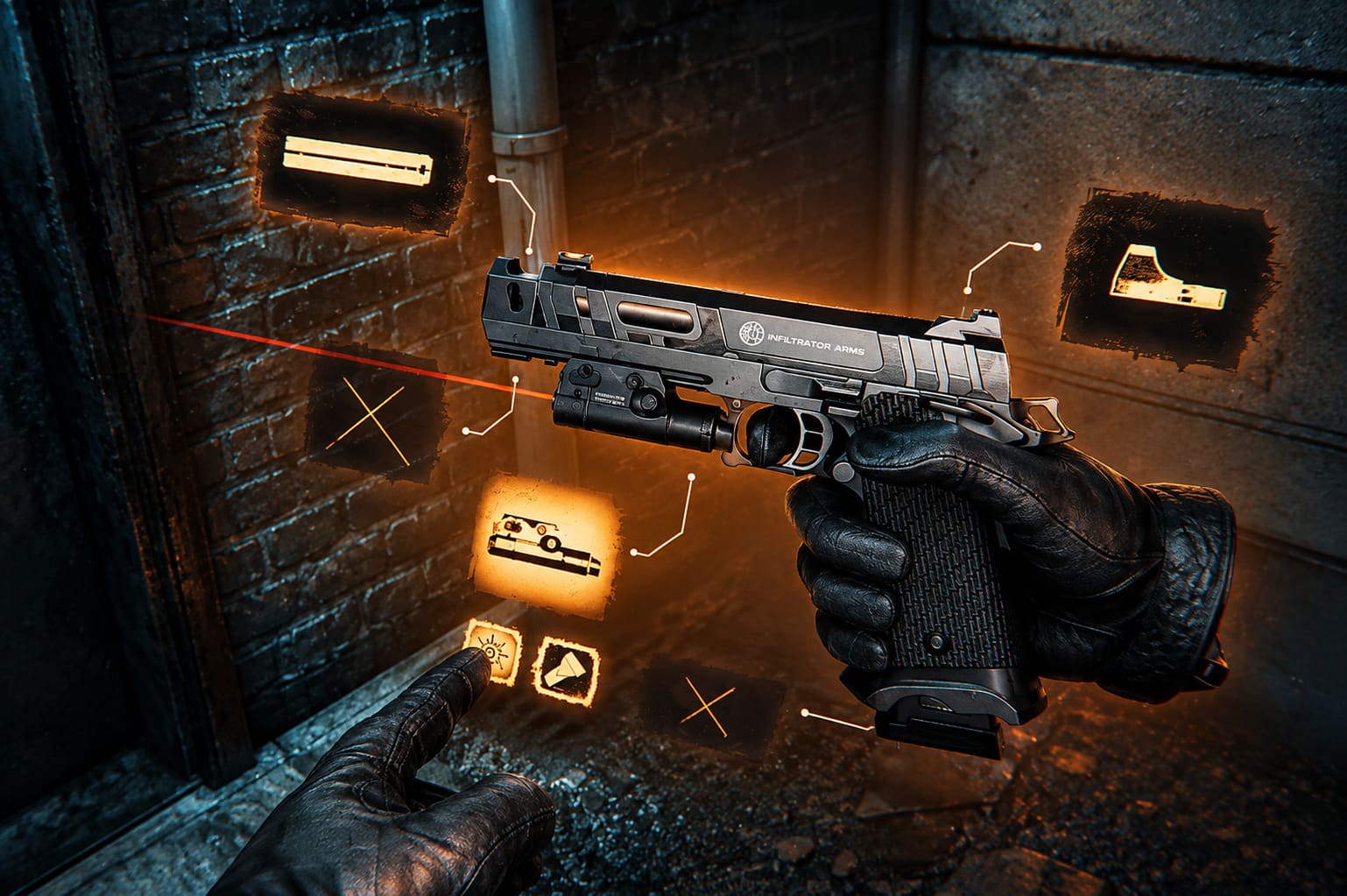
You won’t need to sacrifice half of a 1 TB SSD just to install this one.
One thing I would keep in mind, though, is that the number shown on a Steam store page isn’t necessarily identical to the amount of data transferred during the download. Game files are commonly compressed before installation, after which Steam expands them onto your drive.
So don’t be surprised if the download process and the final installed footprint aren’t exactly the same.
I would simply make sure you have at least 20 GB of free space, preferably with additional room available for updates, temporary installation files and future Early Access content.
That’s particularly important here because the game is planned to grow.
SSD or HDD? This One Is Easy
If you still have a mechanical HDD installed in your gaming PC, this is one of those games where I’d strongly recommend moving it to an SSD.
It’s not because the game officially demands an SSD. It doesn’t.
It’s because VR and slow storage are a particularly unpleasant combination.
Gunman Contracts relies heavily on weapons, environments, audio and interactive objects. During gameplay, the system may need to pull different assets from storage while you’re moving through a level.
A SATA SSD is already a massive improvement over a traditional HDD. An NVMe SSD is even better, although I wouldn’t go out and buy an expensive Gen5 drive specifically for this game.
You don’t need ridiculous storage technology here.
You just need a reasonably modern SSD.
12 GB RAM Works, But I’d Rather Have 16 GB
The official minimum is 12 GB of system RAM, which is perfectly reasonable.
Still, if your computer currently has 8 GB, this might be a good excuse to upgrade.
VR setups can have several layers running simultaneously. Depending on your configuration, you’ve got the game itself, the VR runtime, headset software and potentially Steam, Discord, browser tabs and other background applications consuming memory.
That is why I consider 16 GB RAM the practical sweet spot, even though 12 GB is officially enough.
If you’re building a new machine in 2026, 32 GB is also a perfectly sensible choice, especially if gaming isn’t the only thing you use the PC for.
The Biggest Advantage: You Don’t Need VR Anymore
This is where Gunman Contracts Stand Alone becomes particularly interesting.
The original Gunman Contracts experience was strongly associated with Half-Life: Alyx and VR. That was part of its charm, but it also limited its audience.
The standalone release changes that.
You can play it on a normal monitor with a mouse and keyboard.
That means the game’s audience suddenly includes traditional FPS players who may have never owned a VR headset.
And I think this is a smart move.
VR remains incredible for this kind of gunplay, but the cost and setup requirements can be a barrier. A flat-screen mode gives people a way into the game without asking them to buy additional hardware first.
At the same time, players with OpenXR-compatible headsets can still experience the physical interaction that made the original mods so popular.
It’s basically two different ways of enjoying the same fantasy.
What You Actually Get in Early Access
The Early Access launch isn’t just a technical demo.
The initial package includes three connected story missions, beginning with an infiltration involving a heavily guarded human trafficking operation. There are also additional modes for players who want something more replayable after completing the main contracts.
The launch content includes:
- Three connected story missions
- Takedown Mode with customizable enemy encounters
- Last Stand, featuring waves of enemies and bomb-defusal mechanics
- Interactive safehouse
- Gun range and target-training activities
- Weapon customization and progression
- Firearms, tactical knives and a combat bow
This is one of the reasons I’m interested in the project beyond its technical specifications.
A shooter like this lives or dies by its sandbox. If weapons feel great, enemies react convincingly and environments encourage experimentation, you can get a ridiculous amount of entertainment from relatively small levels.
That’s exactly what made the original Gunman Contracts mods work.
Early Access Also Means More Content Is Coming
The current version is only the beginning.
The development roadmap calls for additional story contracts, new locations and expanded weapon content before the game reaches its full 1.0 release.
That’s the part potential buyers should keep in mind when looking at the current price and content.
You’re buying into an Early Access game, not a finished blockbuster.
Personally, I don’t think that’s necessarily a negative here. Gunman Contracts is exactly the kind of project that could benefit from community feedback. Weapon handling, enemy behavior, difficulty and mission design are all areas where player feedback can genuinely influence the final product.
The fact that the original concept already has a passionate community gives the developers something that many Early Access games desperately lack: a group of players who actually understand what made the original experience special.
Is Your PC Ready for Gunman Contracts Stand Alone?
If your gaming PC is somewhere around the GTX 1070 / Ryzen 5 3600 class, yes, you are at least within the official target range.
But I’d separate the question of “Can it run?” from “Can it run the way I want?”
For standard 1080p gaming, the minimum hardware should be considerably less intimidating. VR is where I’d recommend having more headroom.
My ideal setup would look something like this:
| Hardware | My Recommendation |
|---|---|
| CPU | Modern 6-core or better |
| GPU | RTX 3060 / RTX 4060 class or better |
| RAM | 16 GB minimum for a new build |
| Storage | SSD |
| Free Space | 20 GB minimum, more for updates |
| VR | OpenXR-compatible headset |
If you’re still sitting on an HDD and 8 GB of RAM, those would be my first upgrades before worrying about anything exotic.
Gunman Contracts Stand Alone Review: Release Date, Gameplay, and Is It Worth Buying?
Final Verdict
Gunman Contracts – Stand Alone has one of those origin stories that makes me want to see it succeed.
It started as a fan-driven VR project inspired by the fantasy of being the world’s most dangerous professional gunman. Now it is becoming a standalone tactical shooter with traditional PC support, VR compatibility and a much larger future ahead of it.
The hardware requirements are actually one of the more encouraging parts of the release. A GTX 1070, 12 GB of RAM and 20 GB of storage aren’t frightening requirements in 2026. They suggest that the developers have aimed for accessibility rather than turning the game into another benchmark for expensive GPUs.
My only real warning is for VR players: don’t confuse the minimum specification with the ideal specification. VR performance is all about consistency, and having extra GPU and CPU headroom can make the difference between an immersive contract and a headache-inducing one.
For everyone else, the barrier to entry is refreshingly low.
And honestly, that’s exactly what I want from Gunman Contracts. Give me tight gunplay, interesting environments, satisfying weapons and missions that make me feel like I’m starring in my own low-budget John Wick movie. I don’t need 150 GB of textures to sell me on that fantasy.
If the developers can preserve the personality of the original mods while expanding the standalone version into a deeper campaign and replayable tactical sandbox, this could become one of those Early Access shooters that people keep recommending years later.
Check the requirements, install it on an SSD, bring at least 16 GB of RAM if you can, and let the contract begin.