Is Big Walk Coming to PS5? Release Date, PS Plus, and Crossplay Details Explained
If there’s one thing I’ve learned after spending years playing co-op games, it’s that most of them promise teamwork but eventually turn into everyone running in different directions while one person carries the entire group. Big Walk looks like it’s trying to solve that problem in a completely different way, and honestly, that’s why it has my attention.
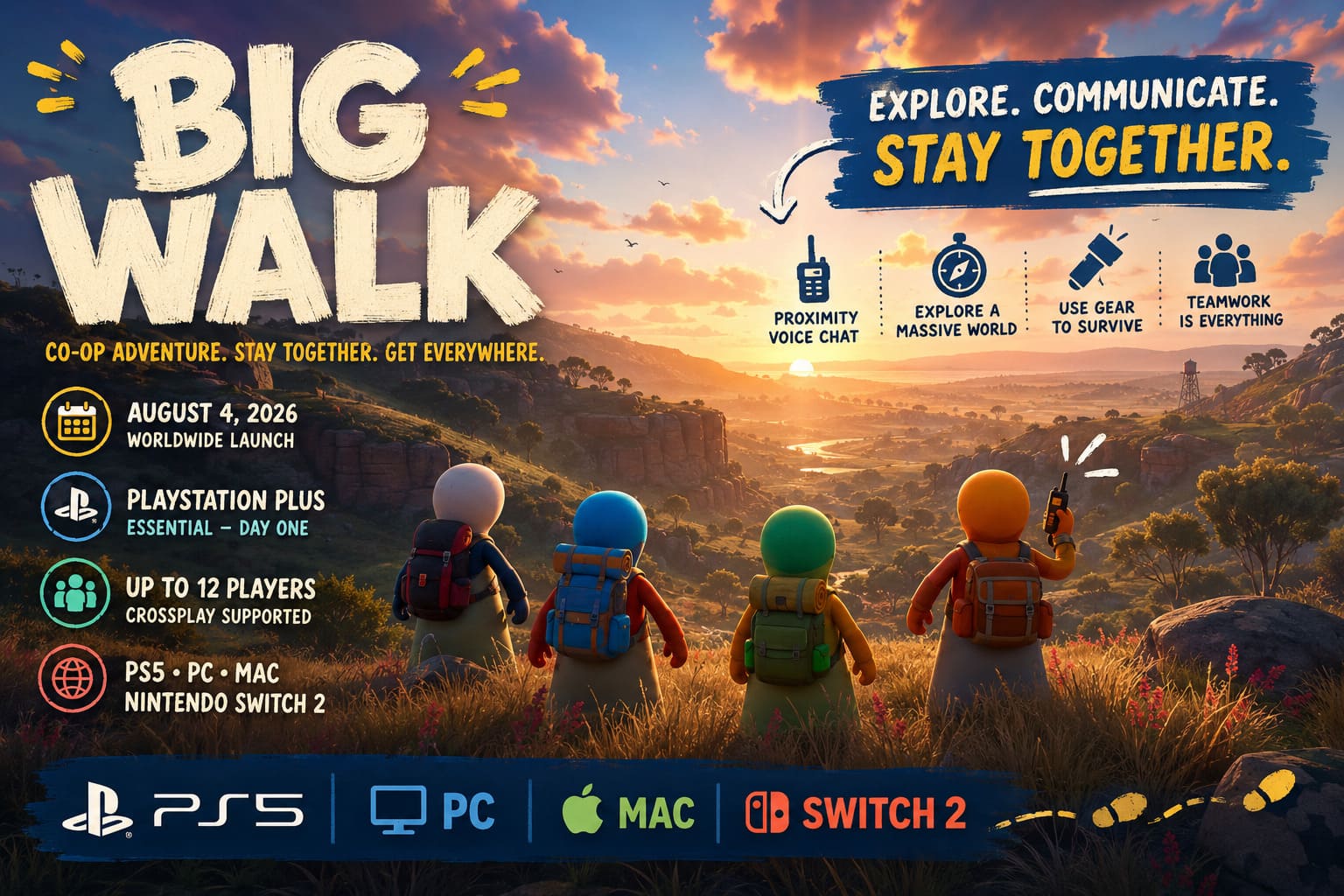
Developed by House House, the team that surprised everyone with Untitled Goose Game, Big Walk launches on August 4, 2026, arriving simultaneously on PlayStation 5, PC, Mac, and Nintendo Switch 2. Even better for PlayStation owners, the game joins PlayStation Plus Essential on day one, making it incredibly easy to convince friends to jump in without asking them to spend another $20.
After watching gameplay, reading developer interviews, and comparing community reactions with my own experience in dozens of multiplayer games—from Deep Rock Galactic and Lethal Company to Helldivers 2 and Sea of Thieves—I genuinely think Big Walk could become one of those rare co-op games that people keep coming back to simply because every session creates a new story.
Big Walk Game 2026 House House’s Next Big Hit and the Panic Publisher Collection Bundle Revealed
Big Walk Release Date on PS5
The launch schedule is refreshingly simple. Every confirmed platform receives the game on the same day, giving players across different systems the same starting point. For a cooperative adventure built around bringing friends together, this is exactly the kind of approach that makes sense.
| Feature | Details |
|---|---|
| Release Date | August 4, 2026 |
| Platforms | PS5, PC, Mac, Nintendo Switch 2 |
| Standard Price | $19.99 USD |
| PS Plus | Included Day One with PlayStation Plus Essential |
| Maximum Players | 12 Online |
| Crossplay | Yes |
For PlayStation players, this is probably the biggest win. Since the game is included with PS Plus Essential throughout August, there’s almost no barrier to trying it with your friends. That’s exactly the kind of release strategy I wish more indie developers could benefit from.
Instead of convincing eleven friends to buy another multiplayer game they’ll abandon after a weekend, you simply tell them to claim it while it’s available. That alone could help Big Walk build a much healthier online community during launch week.
The First Thing That Makes Big Walk Feel Different
After years of shooters and survival games dominating co-op, Big Walk almost feels rebellious. It isn’t trying to compete through bigger weapons, endless progression systems, or constant rewards. The entire experience is built around something much simpler but surprisingly difficult in multiplayer games: communication.
Rather than asking who has the strongest character or the best equipment, Big Walk constantly asks a different question: Can your group actually work together? That sounds simple, but in practice it completely changes how players approach every situation.
There are no enemies waiting around every corner and no competitive leaderboard forcing players to rush. The biggest challenge comes from navigating the world together, understanding puzzles, and keeping everyone connected.
A World Designed Around Teamwork
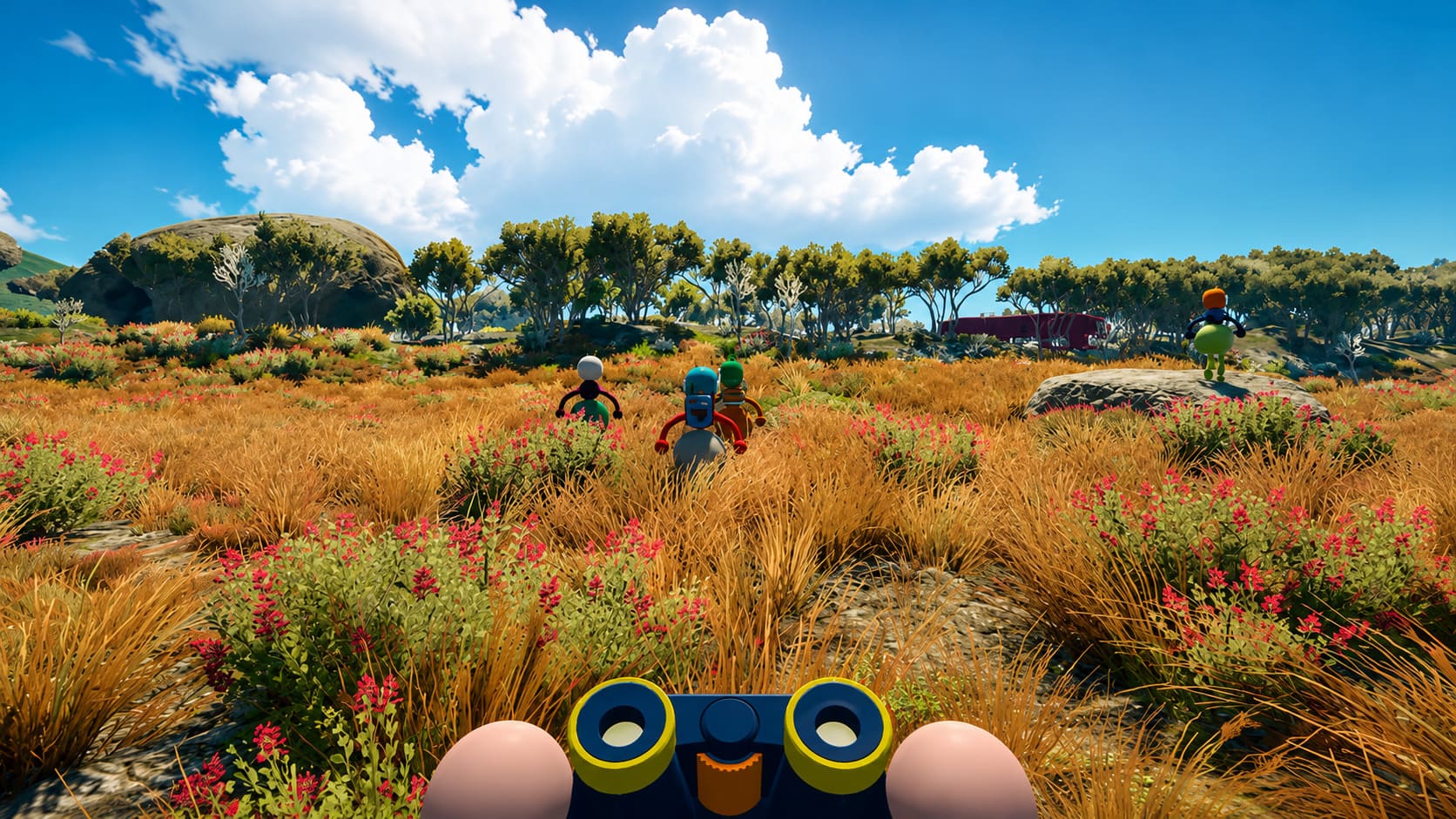
The massive Australian-inspired environment isn’t just a pretty backdrop. Every hill, cave, cliff, and abandoned structure exists to separate players in interesting ways. Instead of following a simple objective marker, players have to explore, communicate, and make decisions together.
What I especially like is that the developers aren’t treating exploration as filler content. Finding your friends becomes part of the gameplay itself, creating moments that traditional multiplayer games rarely achieve.
Players will rely on:
- Walkie-talkies to communicate over longer distances.
- Compasses to navigate the huge open areas.
- Signal flares to guide separated teammates.
- Environmental clues to solve exploration challenges.
- Physical cooperation to overcome obstacles.
These mechanics create situations that simply don’t happen in standard co-op titles. One player might get trapped underground while another searches from a mountain peak. Someone else could accidentally wander in the wrong direction, forcing the whole group to coordinate a rescue mission.
Those unscripted moments are usually what players remember years later. Big Walk appears to understand that the best multiplayer memories often come from unexpected chaos.
The Voice Chat System Is the Real Star
This might actually become Big Walk’s defining feature. Instead of traditional party chat where everyone sounds equally loud regardless of location, the game uses proximity voice communication that reacts to the environment.
Walk away from someone, and their voice slowly disappears. Enter a cave, and sounds naturally echo around you. Get separated across a massive valley, and suddenly communication becomes a real gameplay challenge.
As someone who has played countless multiplayer games, I love systems like this because they create comedy naturally. Developers don’t need to write jokes when players themselves create hilarious situations.
You don’t need scripted moments when the players are already creating stories. That is usually the sign of a strong multiplayer foundation.
Crossplay Is Exactly What Every Co-op Game Needs
One of the smartest decisions House House made was adding full cross-platform multiplayer from launch. Whether your friends are playing on PlayStation 5, PC, Mac, or Nintendo Switch 2, everyone can join the same adventure.
I’ve lost count of how many multiplayer games split friend groups because someone owned a different platform. For modern cooperative games, crossplay is no longer just a bonus feature—it is almost essential.
Big Walk understands that its biggest strength comes from bringing people together, not dividing communities by hardware.
No Split-Screen… But I Actually Understand Why
Some players were disappointed after learning there won’t be local couch co-op. Normally, I would completely understand that criticism because local multiplayer remains one of gaming’s greatest traditions.
However, Big Walk’s design explains the decision. The game depends heavily on players having different perspectives, discovering information separately, and communicating through realistic voice systems.
If everyone could simply look at the same television screen, many puzzles and exploration challenges would lose their purpose. While split-screen would be fun, it would probably damage the core experience.
Why Xbox Players Are Still Waiting
One question keeps appearing across gaming communities: Is Big Walk coming to Xbox? Currently, the confirmed platforms are limited to PlayStation 5, PC, Mac, and Nintendo Switch 2.
Considering House House is still an independent studio, focusing development resources makes sense. Building a large online world with advanced networking, voice systems, and crossplay support requires a lot of testing.
Could Xbox happen later? Absolutely. Many successful indie games expand to additional platforms after launch when demand increases. For now, Xbox players will simply have to wait for official announcements.
Is Big Walk Just Another Internet Party Game?
This is probably the biggest misunderstanding surrounding Big Walk. Yes, there will be chaos. Yes, players will make ridiculous decisions. Yes, someone will probably get lost while everyone else tries to explain where they are.
But that doesn’t mean the game is just another random physics sandbox. Everything shown so far suggests Big Walk features a handcrafted cooperative adventure lasting around 12–20 hours, filled with environmental puzzles and meaningful exploration.
That separates it from many viral multiplayer games that depend only on random moments. Big Walk seems designed to create funny situations while still giving players a proper journey to complete.
My Biggest Hope for Big Walk
After playing multiplayer games for years, I’ve become careful whenever developers promise ‘the next great social experience.’ Many games launch with huge excitement but disappear quickly because their mechanics cannot support long-term interest.
Big Walk feels different because its foundation isn’t based on grinding better gear or chasing endless rewards. The main progression comes from the friendships and stories created during each adventure.
Some groups will carefully solve every puzzle. Others will spend hours making terrible decisions and laughing at the results. Both experiences sound equally valuable, and that is usually a sign of great multiplayer design.
Final Thoughts
I don’t think Big Walk is trying to replace competitive shooters, massive RPGs, or traditional adventure games. Instead, it focuses on something many modern games forget: simply having a memorable experience with friends.
Sometimes the best gaming memories don’t come from winning ranked matches or unlocking rare items. They come from getting lost together, making mistakes, solving impossible problems, and laughing about what happened afterward.
The day-one PlayStation Plus release removes most of the risk for PS5 players, crossplay keeps friends connected across platforms, and the communication-focused gameplay gives Big Walk a unique identity in a crowded multiplayer market.
If House House delivers on everything shown so far, Big Walk could easily become one of the standout cooperative games of 2026. It isn’t trying to be the loudest game of the year. It simply wants to give players a memorable adventure with friends, and sometimes that is exactly what makes a game special.