33 Days till Extraction Guide: Mechanics, Release Date, and Three Whales Studio’s New Sci-Fi Roguelite
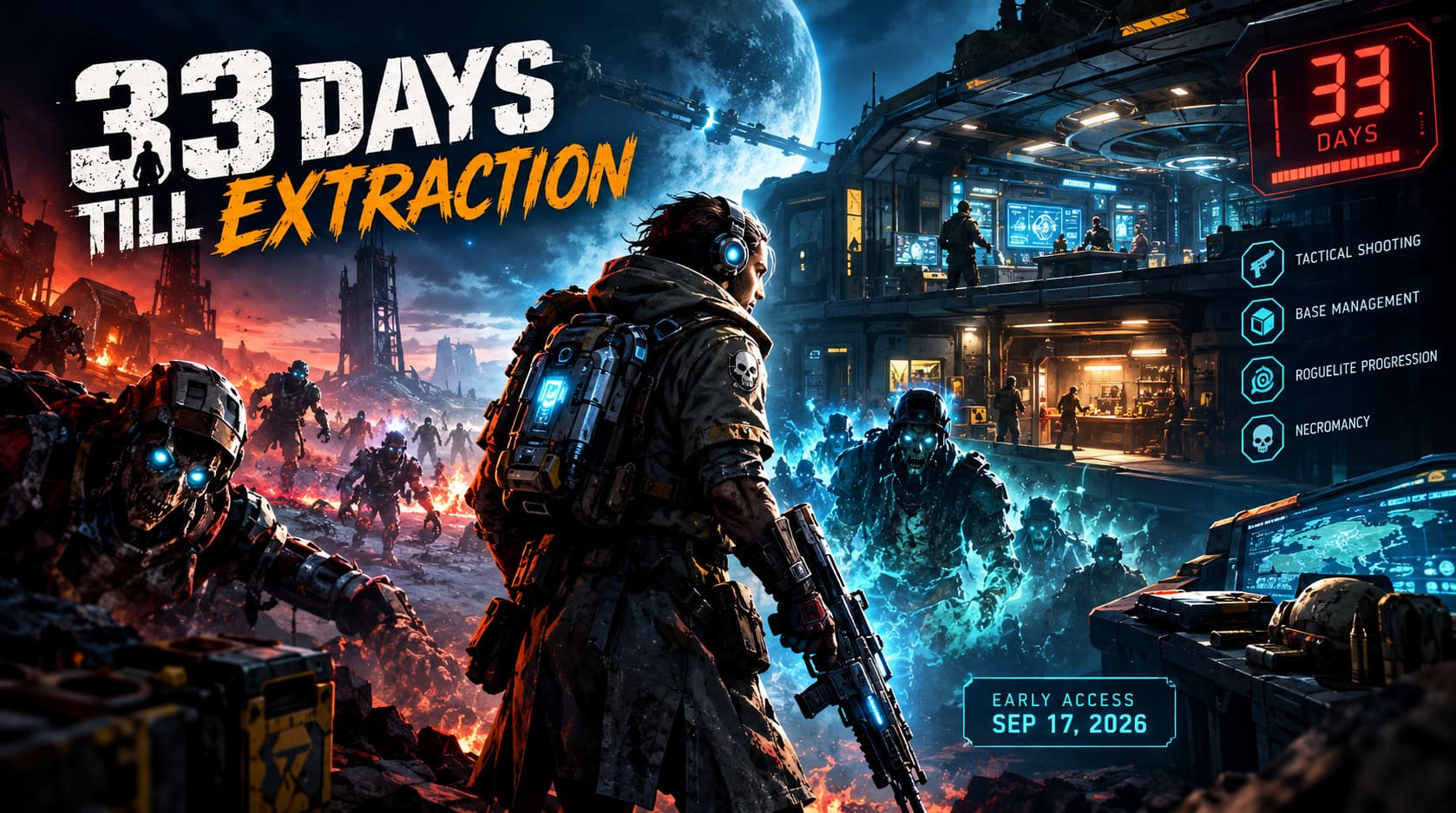
There are plenty of extraction games around in 2026, and honestly, I was starting to wonder how many different ways developers could remix the same survival formula. Then I started looking at 33 Days till Extraction, and it immediately felt like the kind of weird genre mash-up I actually want to play. Three Whales Studio, the team behind Age of Water, has traded its post-apocalyptic seas for a ruined alien world where tactical shooting, roguelite progression, base management, and necromancy all collide. The result is a top-down sci-fi action RPG with a very simple premise: survive for 33 days and make it to extraction.
That sounds straightforward until you realize the entire game is built around a brutal clock. You are not simply clearing maps, collecting better weapons, and becoming unstoppable. Time is a resource, and wasting it can be just as dangerous as taking a bullet. With the Steam Early Access release scheduled for September 17, 2026, this is one of those games I would keep an eye on if you enjoy titles that punish sloppy decisions rather than simply testing your aim.
33 Days till Extraction on Nintendo Switch: Will the Survival Shooter Ever Get a Port?
A 33-Day Countdown That Actually Matters
The story drops you onto a planet that has been practically erased by orbital bombardment. Civilization is gone, military structures are wrecked, hostile factions are fighting over whatever remains, and you are stuck in the middle of it all. Depending on how you approach the setting, your character feels somewhere between a hardened Space Marine death-chaplain and a commander who has been abandoned behind enemy lines. Either way, the objective is brutally clear: stay alive until the evacuation bots arrive after 33 days.
The countdown is more than a story gimmick. It gives the whole experience a sense of urgency that many survival games struggle to create naturally. You cannot spend hours casually wandering around looking for every piece of loot because every wasted night can leave you weaker later. Food, fuel, ammunition, equipment and squad members all become part of the same equation, and that makes even relatively small decisions feel meaningful.
I particularly like this approach because it avoids the usual survival-game problem where the player eventually becomes so comfortable that the supposed apocalypse starts feeling like a holiday. 33 Days till Extraction wants you to feel under pressure throughout the run. You are not building a permanent kingdom; you are trying to construct just enough of a functioning operation to survive long enough to escape.
The Day-and-Night Gameplay Loop Is the Real Hook
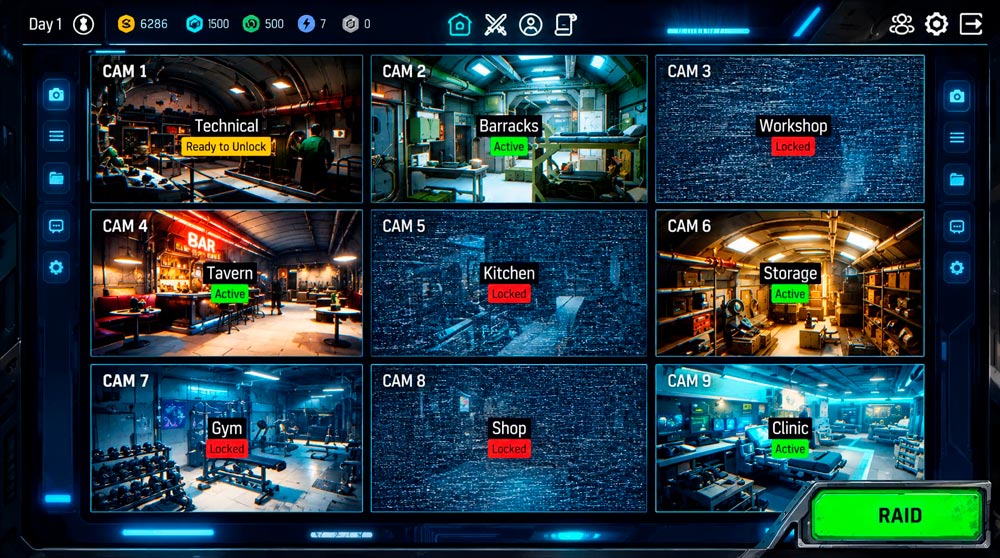
The most interesting mechanical idea is the split between daytime and nighttime. During the day, the surface becomes almost impossible to operate in safely because heavily armed military patrols and armored units dominate the area. Instead of pretending you can fight everything head-on, the game pushes you underground and turns the bunker into your main workspace. This is where you plan raids, craft equipment, manage resources and decide which problems need attention before night arrives.
Then darkness falls and the entire rhythm changes. The dangerous patrols pull back, opening the door for you to leave your shelter and raid procedurally generated locations. This is where the game becomes a frantic top-down shooter, with bullets flying everywhere and enemies coming from multiple directions. You can search ruined facilities, military sites and other dangerous areas for food, fuel, weapon components and technology, but staying longer always increases the chance that something goes horribly wrong.
That risk-versus-reward structure is exactly what I want from an extraction game. You find something valuable and immediately start thinking, ‘Do I really need to go deeper?’ Maybe you have enough supplies to survive another day, but there is a locked room nearby that could contain a major upgrade. Maybe your squad is already damaged and should head home. Those decisions are far more interesting than simply following a quest marker from one fight to the next.
What You Do During Each Phase
| Phase | Main Activities | Primary Risk |
|---|---|---|
| Day | Base management, crafting, planning, recruitment | Running out of resources or preparing poorly |
| Night | Raids, combat, scavenging, extraction | Enemy ambushes, depleted supplies, losing squadmates |
| Long-Term | Upgrades, skills, equipment and squad development | Making choices that hurt later runs |
The beauty of the system is that these phases are connected. A successful night gives you the materials required to make your bunker stronger, while a poorly planned day can turn the next raid into a disaster. It creates a feedback loop where combat and management constantly affect each other instead of feeling like two unrelated game modes.
Tech Necromancy Is Where Things Get Weird
If the basic extraction concept sounds familiar, the Tech Necromancy system is what makes 33 Days till Extraction stand out. This is not a clean military sci-fi game where every solution involves another rifle or bigger explosion. The developers have mixed futuristic technology with supernatural battlefield rituals, giving the player access to abilities that would look completely out of place in a conventional tactical shooter.
As a death-chaplain, you can manipulate the dead and turn fallen enemies, scavengers and even dead squadmates into useful combat assets. That sounds ridiculous on paper, but it creates some genuinely interesting tactical possibilities. Instead of simply killing an enemy and moving on, you can potentially turn that corpse into part of your next strategy, using reanimated fighters as distractions, temporary allies or additional firepower.
This also means the character build system has considerably more potential than a basic collection of weapon upgrades. You can combine conventional firearms with supernatural abilities, creating loadouts that feel very different from one another. Plasma weapons, lasers and ballistic guns can exist alongside abilities involving vampirism, energy manipulation and necromantic curses. Using an enemy’s own forces against them is exactly the sort of mechanic that can make repeated runs feel different.
Your Bunker Is More Than a Menu Screen
Base management is another major part of the experience, and I am glad it is not being treated as a decorative side feature. Your underground shelter is effectively your lifeline. Generators require fuel, your crew needs food, weapons need upgrading, and crafting stations allow you to turn scavenged materials into equipment that can keep you alive during future raids.
The interesting part is that the bunker also connects to your squad. According to the game’s recent development updates, recruited companions are not just interchangeable NPCs with different portraits. They have individual traits, perks and backgrounds, which makes losing one potentially more painful than simply losing a few points of progression.
There is even a grim solution if a valuable squadmate dies. You can potentially bring their body back and use necromantic abilities to return them to the battlefield. I like this idea because it fits the game’s identity perfectly: death is a setback, but it does not always have to mean the end of a character. Of course, turning your former teammate into an undead combatant sounds like exactly the sort of decision that could have unexpected consequences later.
Procedural Maps Should Keep the Runs Interesting
Every nighttime expedition uses procedurally generated environments, which is essential for a game built around repeated raids. Ruined cities, military compounds and corporate laboratories can change between runs, preventing the experience from becoming a memorization exercise. You might know the general objective, but you cannot rely on the exact same route every time.
The environmental events are arguably just as important. Electronic storms can interfere with your radar, automated security systems can suddenly activate, and bounty hunters can turn what looked like a routine scavenging mission into a desperate fight. These surprises are useful because they make the extraction decision feel organic rather than scripted.
From my experience with roguelites, procedural generation works best when it creates situations rather than simply rearranging rooms. 33 Days till Extraction has the right ingredients for that. If the hazards, enemies and loot combinations interact properly, you could end up remembering individual disasters rather than remembering identical map layouts.
Co-Op Could Be Completely Chaotic
The game can also be played cooperatively, and this seems like a particularly good fit for its systems. A coordinated squad can divide responsibilities, with one player focusing on heavy weapons while another specializes in scouting or tech-necromancy. That should make difficult raids more manageable, but it also introduces the usual problem with multiplayer survival games: your friends can be just as dangerous as the enemies.
Shared resources, friendly fire and increasingly chaotic bullet-hell encounters are a recipe for arguments when a run goes wrong. Personally, I think that is part of the appeal. Some of the best co-op gaming stories come from situations where a perfect plan collapses because somebody opened the wrong door, stayed for one more piece of loot, or accidentally brought an entire enemy patrol down on everyone.
The important thing will be whether the multiplayer difficulty scales properly. If the game simply throws more enemies at a larger squad, co-op could become exhausting. If it instead creates new tactical problems that encourage teamwork, it could become one of the strongest reasons to keep playing after the novelty of the first few runs disappears.
Early Access, Difficulty and What Players Should Expect
33 Days till Extraction enters Steam Early Access on September 17, 2026, following a playable demo that has already given players a taste of its opening systems. Early community reactions have highlighted the atmosphere, gunplay and unusual combination of mechanics, although difficulty has also been a recurring discussion point. That does not surprise me at all. A game with limited resources, permadeath-style consequences, procedural raids and a countdown can become brutally unforgiving very quickly.
Some Steam Deck players and other community members have also discussed controller layouts and interface improvements, while the developers have been making balance changes ahead of launch. The planned Early Access period is expected to last around six months, with additional weapons, locations, enemies and abilities being developed during that time.
That makes September’s release feel more like the beginning of the game’s next stage rather than a final destination. If Three Whales Studio listens carefully to players without sanding away the game’s deliberately harsh personality, the full version could end up significantly stronger than the initial Early Access build.
33 Days till Extraction PC System Requirements
The hardware requirements are surprisingly reasonable considering how busy the game can become during large combat encounters. Players do not need a monster PC just to get started, although the recommended specifications provide considerably more breathing room for chaotic battles and larger effects.
| Specification | Minimum | Recommended |
|---|---|---|
| OS | Windows 10 64-bit | Windows 10/11 64-bit |
| CPU | Intel Core i3-560 / AMD Phenom II X4 945 | Intel Core i5-2500K / AMD FX-8120 |
| RAM | 8 GB | 16 GB |
| GPU | GTX 960 2GB / Radeon R7 370 2GB | RTX 2060 / Radeon RX 6600 XT or better |
| DirectX | Version 12 | Version 12 |
| Storage | 10 GB | 10 GB |
Those requirements make the game relatively accessible, which is good news for players who enjoy tactical indie releases but are not interested in upgrading their entire PC for every new game. The more interesting question will be how well performance holds up during the nastiest situations, when multiple enemies, effects and projectiles fill the screen. That is where an extraction roguelite can go from smooth to messy very quickly.
My Take: This Is One to Watch
I have played enough extraction shooters and roguelites to know that combining several genres does not automatically make a game interesting. Sometimes you just get a pile of mechanics competing for attention. 33 Days till Extraction, however, has one thing going for it that many of those experiments lack: its systems appear to support the same central idea. The countdown, bunker management, scavenging, procedural raids and necromancy all revolve around the question of how far you are willing to push your luck before getting out.
The concept is also strange enough to be memorable. A ruined sci-fi planet, a ticking 33-day deadline, top-down bullet-hell combat and undead soldiers are not exactly the ingredients of another generic extraction shooter. I especially like the idea of bringing a dead squadmate back because it captures the game’s grim sense of humor while also making death mechanically relevant.
There are still reasons to be cautious. Early Access means balance problems are almost inevitable, and the steep difficulty could become frustrating if the game relies too heavily on punishment rather than meaningful tactical choices. Procedural generation can also lose its magic if the underlying mission structure becomes repetitive. But if Three Whales Studio keeps improving the systems instead of simply adding more content, I can see 33 Days till Extraction becoming a very addictive little sci-fi roguelite.
The September 17 launch should tell us a lot. For players who want something beyond another conventional extraction shooter, this is a particularly interesting one to watch. Personally, I would rather take a weird game with a strong identity over another polished title that feels like five other releases I have already played. 33 days is the deadline, the planet is already dead, and apparently even your squadmates are just temporary. That is a pretty good setup for a game.