Reincarnation Insurance Program Console Port: Release Date, Rumors, and Everything We Know
R.I.P. – Reincarnation Insurance Program is one of those games that sounds completely ridiculous when you explain it in a sentence, yet somehow makes perfect sense after you play it. You take the role of an expendable corporate agent, enter a zombie-infested wasteland, mow down absurd numbers of enemies, collect increasingly ridiculous equipment, die, and then return to work as if death were just another item on your company’s HR checklist. After spending time with plenty of survivor-likes, roguelites, looter shooters, and ARPGs, I can say that R.I.P. stands out because it combines several familiar ideas without feeling like a simple copy of any one of them.
The full 1.0 release arrived on September 15, 2026, following its Early Access launch earlier in the year. That gives players a substantially more complete version of the experience, including additional progression systems, new challenges, more equipment options, and endgame content. Naturally, the PC launch has also created a new question among players who prefer playing from the couch: is R.I.P. – Reincarnation Insurance Program coming to consoles?
At the moment, the most important thing to understand is that a specific PlayStation 5, Xbox Series X|S, or Nintendo Switch release date should not be treated as confirmed unless WarmCore Studio or 2P Games officially announces one. There is plenty of discussion around a possible console version, and the game’s controller-friendly design certainly makes the idea plausible, but speculation and confirmation are two very different things. Here is what makes the potential port interesting and what console players should realistically expect.
R.I.P. Reincarnation Insurance Program PS5 Release Date & Update
Why R.I.P. – Reincarnation Insurance Program Has People Talking
If you’ve played games such as Vampire Survivors, Brotato, Halls of Torment, or various ARPGs, the basic loop will feel immediately familiar. You enter a dangerous area, survive increasingly aggressive waves, gather resources, improve your character, and try to turn a barely functional build into something completely broken. The difference is that R.I.P. puts considerably more emphasis on loot, equipment customization, and shooter-style combat.
That combination is a big part of the game’s appeal. Traditional bullet-heaven games often give you a collection of weapons and passive upgrades and let the numbers do most of the work. R.I.P. goes further by giving the player a proper inventory and equipment-focused progression system. Weapons can be modified with different effects, while elemental and technological combinations can dramatically change how a build performs once the screen becomes packed with enemies.
Personally, this is where I think the game has more staying power than many games in the same genre. I’ve played plenty of survivor-likes that are fantastic for a few hours but eventually become a predictable routine of choosing the same upgrades every run. R.I.P. encourages experimentation, and that makes the loot grind considerably more interesting. Finding a weapon that completely changes the way you approach the next run is much more satisfying than simply watching your damage number increase.
The Reincarnation System Makes Death Part of the Progression
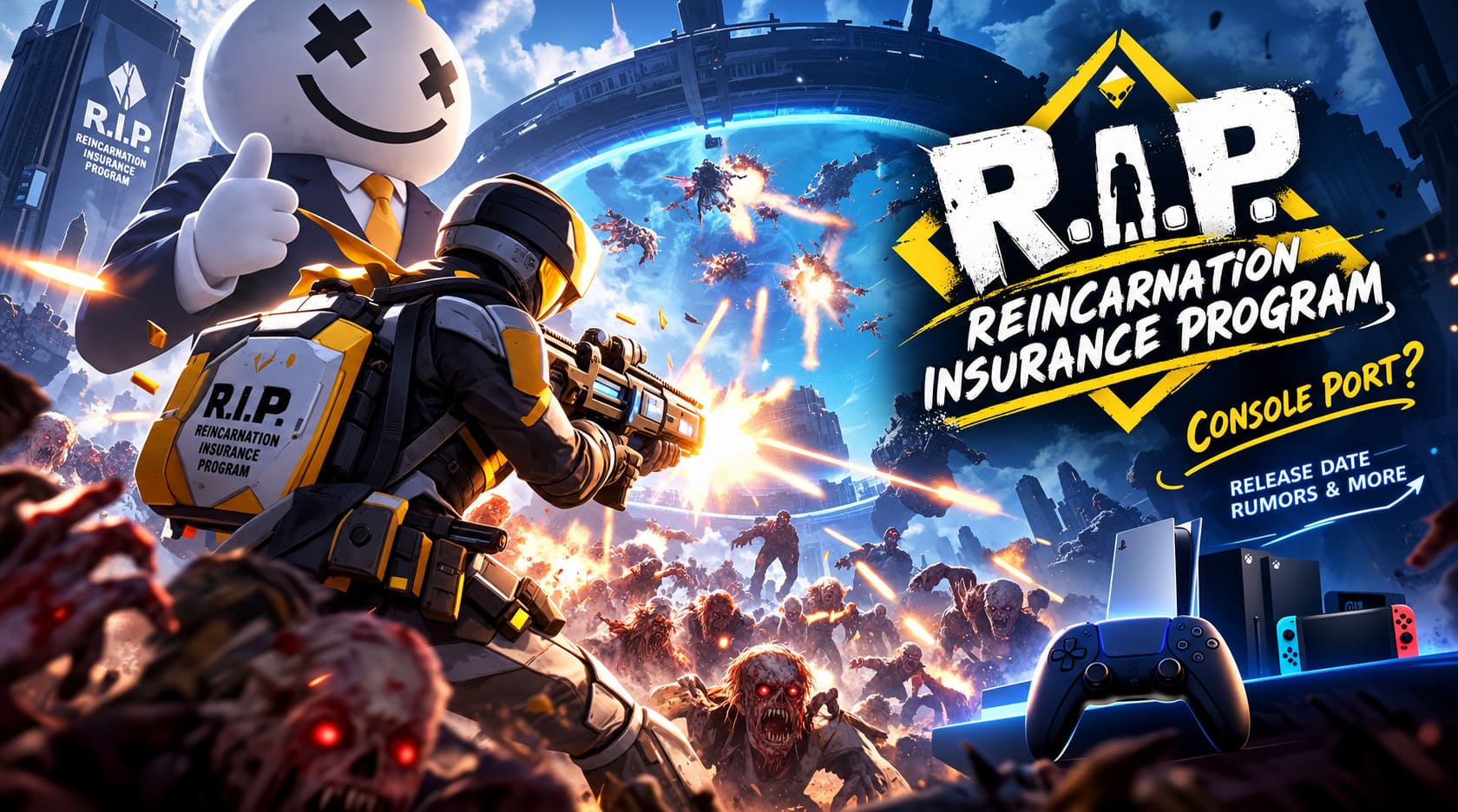
The game’s central concept is also one of its cleverest ideas. Your character works for the mysterious Reincarnation Insurance Company, meaning death isn’t necessarily the end of your progress. Instead, dying becomes another step in the progression loop. You lose the run, but the experience feeds into the larger metagame, allowing you to improve your character, adjust your equipment, and try again.
This structure makes R.I.P. particularly accessible to players who enjoy roguelites but don’t necessarily enjoy starting completely from zero. There is still plenty of tension during a run because surviving longer generally means obtaining better rewards, but a failed attempt doesn’t feel completely wasted. That balance is important in a genre where repeated deaths can otherwise become frustrating.
The corporate theme also gives the whole thing a darkly funny personality. Your character isn’t some legendary hero destined to save the world. You’re essentially another employee being sent into an impossible situation because somebody in management decided the numbers looked acceptable. After a while, the idea of resurrection becoming an insurance benefit starts to feel perfectly normal.
What Makes the Combat Different?
One of the biggest strengths of R.I.P. is that it doesn’t force players into a single control philosophy. You can use an automated shooting approach that feels closer to a traditional bullet-heaven game, or take more direct control and manually aim your weapons using a twin-stick-style setup. That second option makes the game feel much more like a conventional top-down shooter, particularly when you’re trying to position yourself carefully during chaotic encounters.
The distinction becomes even more interesting when you start experimenting with different equipment. Some weapons are better suited to dealing with dense crowds, while others can be more useful against tougher targets. Elemental effects and technological abilities add another layer to the decision-making process, especially when the screen starts filling with enemies and every second of positioning matters.
Then there are characters such as Ling, whose melee-focused playstyle changes the formula completely. Instead of simply standing back and watching bullets erase enemies, Ling uses a high-mobility katana-based combat style capable of cutting through large groups. It is exactly the kind of character that can make an otherwise familiar genre feel fresh again.
Void Spire and the Endgame Grind
The arrival of the 1.0 version is particularly important because R.I.P. isn’t just about completing individual survival runs anymore. The game has an endgame structure designed to give experienced players a reason to keep optimizing their builds. One of the most notable additions is Void Spire, where players can take highly developed builds into increasingly difficult encounters.
This is the kind of mode that immediately appeals to players who enjoy theory-crafting. Once you have already figured out the basic mechanics, the question changes from ‘Can I survive?’ to ‘How far can I push this build?’ That’s a much more interesting long-term challenge for players who enjoy experimenting with stats, equipment combinations, damage types, and character abilities.
It also explains why the possibility of a console version is attracting attention. A game built around short runs and repeatable endgame challenges can work extremely well on a console, particularly for players who like sitting down for 20 or 30 minutes without committing to a massive RPG session.
Is R.I.P. – Reincarnation Insurance Program Coming to PS5 and Xbox?
This is the question most console players actually want answered. The short version is that there is currently no reason to treat a specific PS5 or Xbox Series X|S release date as confirmed simply because the game has attracted strong interest on PC. A successful Steam launch can certainly make console development more attractive to a publisher, but it doesn’t automatically mean that a port is finished or scheduled.
That said, there are several reasons why R.I.P. looks like a natural candidate for consoles. Controller support is already an important part of the PC experience, and the game has been designed around both automated and direct aiming options. Its interface also needs to accommodate a relatively complex equipment system, which means controller navigation is already an important consideration rather than something that would necessarily have to be invented from scratch for a console release.
| Platform | Current Situation | What Players Should Expect |
|---|---|---|
| PC | Released | Full 1.0 version available |
| Steam Deck | Verified | Designed for handheld controller play |
| PlayStation 5 | Not officially dated | Possible future platform, pending confirmation |
| Xbox Series X|S | Not officially dated | Possible future platform, pending confirmation |
| Nintendo Switch | Unconfirmed | Technical feasibility would depend on optimization |
Why Steam Deck Compatibility Matters for a Console Port
The Steam Deck situation is worth watching because handheld PC optimization can expose many of the same design problems that developers face when adapting a PC game to a controller-focused platform. Menus have to be readable, buttons need sensible assignments, and the interface cannot assume that the player has a mouse hovering over every inventory slot.
For R.I.P., this is particularly relevant because the game isn’t just about moving around and shooting. Inventory management, equipment upgrades, character development, and build customization are all important parts of the experience. If those systems work comfortably on a handheld controller, that gives the developers a useful foundation should they decide to bring the game to PlayStation or Xbox.
However, Steam Deck compatibility shouldn’t be interpreted as proof of a console port. The hardware, certification requirements, operating environment, performance targets, and platform-specific features are different. It is an encouraging technical sign, but it is not an announcement.
The Biggest Challenge: Keeping the Chaos Running Smoothly
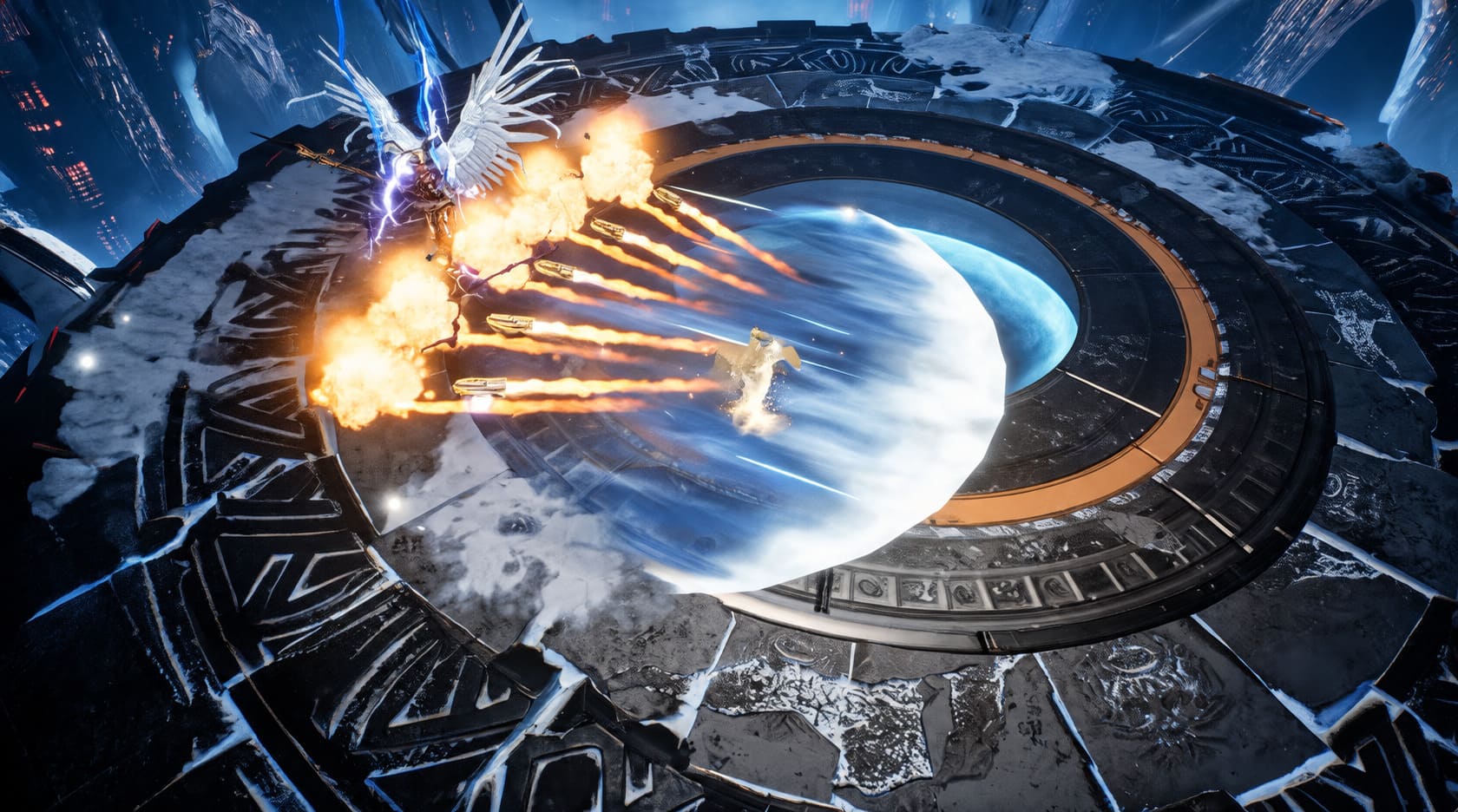
The real technical challenge isn’t getting R.I.P. to boot on a console. It is keeping the game running smoothly when the screen becomes completely ridiculous. Bullet-heaven games are deceptively demanding because the player may be dealing with hundreds or even thousands of enemies, projectiles, damage calculations, status effects, physics interactions, and visual effects simultaneously.
On a reasonably powerful gaming PC, the developer has more flexibility because hardware configurations vary and players can often adjust graphical settings. Consoles are different. Developers have to work within fixed hardware specifications, which means optimization becomes much more important. A build that looks fantastic during the first few minutes of a run isn’t particularly useful if a late-game encounter causes severe frame-time spikes.
That becomes especially important for an endgame mode like Void Spire. If players are expected to push increasingly difficult floors while creating enormous combinations of effects, the engine needs to remain stable under the worst possible circumstances. Performance during peak enemy density is arguably more important than maximum graphical fidelity.
What About Nintendo Switch?
The Nintendo Switch is a more complicated question. On paper, R.I.P. seems almost perfectly suited to portable gaming because individual runs can be relatively short and the gameplay loop is easy to pick up whenever you have some free time. I’ve always thought games like this work surprisingly well on handheld hardware because the player doesn’t need to remember a huge quest chain every time they launch the game.
The problem is performance. A screen filled with enemies, projectiles, explosions, damage numbers, and particle effects can become extremely demanding on lower-powered hardware. A Switch version could therefore require reduced enemy density, simplified effects, lower visual settings, or other compromises. Whether those changes would be necessary depends entirely on how efficiently WarmCore Studio can scale the game’s technology.
The situation could be different for newer Nintendo hardware, but until the developer officially discusses its platform plans, any specific release window should be considered speculation rather than established information.
Could a Console Version Arrive in 2026 or 2027?
Players naturally want to know whether they should expect the game this year or wait until 2027. Since the PC 1.0 release happened in September 2026, a hypothetical console adaptation would need to account for porting, optimization, certification, localization, platform testing, and potentially additional development work. For an indie team, that can take considerably longer than simply compiling the game for another platform.
For that reason, late 2026 or sometime in 2027 can be discussed as a plausible timeframe rather than a confirmed release window. The exact timing would depend on whether console development is already underway, how much of the existing controller framework can be reused, and whether the studio chooses to prioritize one platform before another.
I’d also be cautious about websites or social media posts claiming to know an exact release date before an official announcement. Games like R.I.P. can change significantly during the transition from PC to console, and an early target date isn’t the same thing as a guaranteed launch.
What Console Players Can Do Right Now
If you only play on PlayStation, Xbox, or Nintendo hardware, the frustrating part is simply waiting for official news. There isn’t much value in trying to predict an exact date from rumors alone. The most useful thing is to follow announcements from WarmCore Studio and 2P Games and watch for actual platform listings, release windows, or developer statements.
If you have access to a gaming PC or Steam Deck, however, R.I.P. is already playable in its full 1.0 form. This is also a good way to see whether the game’s unusual mixture of bullet-heaven combat and ARPG-style loot is actually your thing before investing time into waiting for a console version.
- Watch official developer announcements for confirmed platform information.
- Keep an eye on PlayStation and Xbox storefront listings for legitimate platform pages.
- Follow post-launch updates, since console plans can become clearer after the PC 1.0 launch.
- Try the PC or Steam Deck version if you already have compatible hardware.
Final Thoughts: R.I.P. Could Be a Great Console Fit
After playing a lot of roguelites and survivor-style games, I think R.I.P. – Reincarnation Insurance Program has a particularly strong formula for console gaming. The short runs, controller-friendly combat, ridiculous enemy swarms, persistent progression, and endless hunt for better equipment all fit naturally into a living-room setup. It has enough depth to reward players who want to optimize builds, but the basic idea is simple enough that you can jump into a run without studying a wiki for an hour.
The important caveat is that a good console fit isn’t the same thing as a confirmed console release. As of the game’s September 2026 1.0 launch, players should separate official information from community speculation when discussing a PS5, Xbox Series X|S, or Nintendo version. Until WarmCore Studio or 2P Games provides concrete platform details, there is no confirmed console release date to put on your calendar.
Still, the ingredients are there. R.I.P. already embraces controllers, works on handheld PC hardware, and is built around a gameplay loop that feels almost tailor-made for quick console sessions. If the developers decide to make the jump, the biggest question won’t be whether the game works with a controller—it will be whether they can preserve that wonderfully chaotic late-game experience without sacrificing performance.
And honestly, that’s the part I’d be most interested in seeing. A fully optimized console version where you can sit on the couch, pick a ridiculous build, walk into a zombie apocalypse, and turn the entire screen into an explosion of bullets, swords, numbers, and questionable corporate decisions sounds like exactly the kind of chaos R.I.P. was made for.